Wednesday, November 14, 2018

Destiny of the Republic: A Tale of Madness, Medicine, and the Murder of a President

This is the 2nd book by Candice Millard; my book group also read her River of Doubt, which I found equally engrossing. She is able to tell a good tale about actual historical events, chock full of detail about people as well as places and happenings. The title says it all. I knew nothing about James Garfield but according to Millard's website, "James Abram Garfield was one of the most extraordinary men ever elected president. Born into abject poverty, he rose to become a wunderkind scholar, a Civil War hero, and a renowned and admired reformist congressman. Nominated for president against his will, he engaged in a fierce battle with the corrupt political establishment. But four months after his inauguration, a deranged office seeker tracked Garfield down and shot him in the back." Not only do we follow the assassin's (Charles Guiteau) paranoid descent into a conviction that God wants him to kill Garfield, but we learn almost more than we want to know about the state of medicine in the United States (the NYT called Millard's description "fascinating, if appalling") that very probably was the actual cause of Garfield's death. Of course she tells us about the political machinations that got Garfield nominated and elected along with his wildly unpopular vice president, Chester A. Arthur. And we learn about the role of Alexander Graham Bell in trying to save the president with one of his inventions after Garfield was shot. It is truly a fascinating account and if you are a fan of Erik Larson, you will be happy to read this also.
Appropriately laudatory reviews from The New York Times, Kirkus, The Washington Post,  and Publishers Weekly.

The Music Shop

This novel by Rachel Joyce has one unique aspect: there is a play list (multiple ones actually) on YouTube for all the music mentioned in the book. And the range is wide--from punk to jazz to R & B to classical. The main character (not sure he could really be called a protagonist) is a lonely, affable teddy bear of a man who owns a run-down record shop in an even more run-down side street in London, neighboring a tattoo parlor, a funeral home, a Christian gift shop, a baker, the local tavern and a handful of residences. There are a couple of major environmental factors working against the success of the shop. First vinyl records are going the way of the dodo--it's the 80's--to be replaced by CD's, at least according to the recording company reps. Frank refuses to carry CD's and at some point the reps refuse to sell vinyl records to him UNLESS he buys CD's. The 2nd big challenge is a major development company that is trying to buy out all the residents of Unity Street and is probably instigating vandalism of the stores as a way to intimidate owners to sell. And it's working as one by one the shops start to close and neighbors sell out. The major problem is Frank himself, however, who comes from a pretty stunted childhood in some ways; although it was rich in music, it was very short of maternal care taking. His mother even drove away the one woman Frank loved, the one he believed could give him a normal life,  the one he thought was carrying his child. Now he keeps himself apart although he can, apparently and unfailingly, choose just the right music to solve the emotional problems of others. While I am a huge believer in the emotive resonance of music and, therefore, its power to move us--that is I love and endorse the premise of the book--I just did not like any of the characters. So I dutifully read the book for my book group but can't really recommend it. It reminds one strongly of The Little Paris Bookshop, which pursued the same plot line, only with much more engaging and empathetic characters. Most of the book group liked it, so I'm somewhat of an anomaly. I have liked her other books, The Unlikely Pilgrimage of Harold Fry and The Love Song of Miss Queenie Hennessy, both of which I've posted on this blog.
Here is an effusively glowing review from The Washington Post, another from The Guardian, and from Publishers Weekly. Even Kirkus loved it and thought it food for a film rendition--oh well, what do I know?!

Wednesday, October 17, 2018

Sandman


Lars Kepler, the pseudonym for husband-and-wife team of Alexandra and Alexander Ahndoril, has written 7 novels in the "DS Joona Linna" series of Scandinavian noir, but this 4th installment is the first one I've read. I will refer you to the Washington Post's review for a succinct plot summary. Let it suffice to say that it is indeed very dark, and often grisly. It has to do with a serial killer, Jurek Walter, who, even though he is now in prison, is able to exert his evil influence on people outside, making them disappear or die terrible deaths. The action is precipitated when one of his victims, Mikael Kohler-Frost, makes an appearance after having been given up for dead 13 years ago. However, Mikael's sister, Felicia, is still missing and Joona is convinced that Walter knows where she is. Joona's colleague, Saga Bauer,  is sent onto the maximum security psych ward where Walter is being held to try and ascertain Felicia's whereabouts. Saga's experience on the ward create a sense of dread. There are all kinds of evil.
I think I got hooked on Scandinavian noir with Smilla's Sense of Snow (remember Gabriel Byrne in the film version?!) and I still regularly pick it up (see posts for Holt, Jansson, Jungstedt, and of course, Larsson), although, sometimes after reading one, I feel like I need to read something REALLY light and fluffy. Anyway, if you are a fan of the genre, you won't be disappointed here. Additional reviews from Kirkus, the New York Journal of Books, the Washington TimesThe New York Times and Publishers Weekly.

Tuesday, October 16, 2018

Child 44

My friend Anne Zald turned me on to Tom Rob Smith, and suggested I read this book first. It was so hard to read in places because I just knew things were going to go badly downhill for the characters, that I did what I seldom do...I read the last chapter to see how it turned out and then went back and finished the book. Some reviewers say the ending is too pat, but it allowed me to finish the book. It is set in post WWII Moscow for the most part; it's 1953 and Stalin has created a terrorist dictatorship masquerading as the Communist idealistic society. Everyone knows things are broken but no dares even think it, much less say it, lest the secret police take you away in the middle of the night and present you with the "evidence" that you are a traitor.   Our protagonist, "Leo Stepanovich Demidov, an M.G.B. officer with relentless ambition and an unquestioning nature" (NYT review) is called away from a major investigation to deal with the death of a fellow policeman's young son, Arkady. He resents not only being pulled into this thankless task, leaving the field of play in the big investigation to his competitor and enemy, but he must betray his colleague, who believes his son was murdered, in order to be loyal to the state. "It is not morally possible for Leo to contemplate such a question [murder]. As a loyal Soviet ideologue, he must believe that violent crime is a function of capitalist decadence. In a worker’s paradise only political-thought crimes matter. So unguarded children have nothing to fear. And Arkady’s story must be forgotten" (NYT review). As if this is not enough to threaten his status as a war hero and his career, he is then asked to investigate his own wife, Raisa. The dynamics between the two of the are truly complex, mainly because nobody is really honest about anything in Soviet Russia. Does he sacrifice her or protect her? You will find out the significance of the title eventually, but you will be filled with dread throughout the book. The Kafkaesque existence of the characters is reminiscent of those portrayed in novels dealing with North Korea (e.g., Inspector O series by James Church or Star of the North by David John). Additional reviews from The Guardian, Kirkus, The Telegraph. It was also made into a movie.

This is How It Always Is

This book by Laurie Frankel has a rather unexciting premise as its foundation, but I read it because my friend Joan Ward recommended it to me. It is the story of how one family copes when their youngest child decides at age 3 years that he would rather be a she. But that fails to convey what a beautifully written, loving, and compelling story this is.  You struggle along with the parents and the siblings as well as Claude/Poppy in trying to find the best path forward in a society that sees only "either/ or" rather than "and."
Rosie and Penn have a magical love for one another that seems to have begun before they even met. When first they get together, Penn is a struggling writer and Rosie is an ER resident. Penn sits in the ER waiting room every time Rosie has a shift--for hours at a time--just so he can talk with her on her breaks. He's working on a novel. When they marry, he becomes the stay-at-home parent. They have one boy, then two, and then four when twins are born, and in one final attempt for a daughter, they get Claude. But Claude really loves girl things--clothes, cooking, girlfriends--and Rosie and Penn are determined that they will support their wonderful child no matter what, so eventually he goes to pre-school in a skirt, wearing a pair of wings, and after some push back from his teacher, settles into being a girl with a penis. The other kids just don't care much at this stage. But of course that can't last. When a transgender college student is brought into the ER beaten and stabbed and dies, Rosie panics and decides Madison is not safe and they move to Seattle. Poppy becomes best friends with Aggie next door, and although Aggie's parents know about Claude/Poppy, they ask Rosie and Penn not to say anything to Aggie. And so the entire family guards this secret until it is no longer a secret. The next step Rosie takes to help her youngest is more dramatic. She volunteers to work at a clinic in rural Thailand and takes Claude/Poppy with her. Penn is the steady anchor at home, telling all his children a never ending Sheherazade-like fairy tale full of lessons for life. Their conversations and struggles as they try to figure out how best to help Claude/Poppy are achingly realistic. You will absolutely love every member of this family. Don't miss this thought provoking story. Reviews from The New York Times, Kirkus, Publishers Weekly, and the Star-Telegram. Received numerous best book of the year awards. Here is an interview with Laurie Frankel on NPR about being the parent of a transgender child.

Tuesday, October 9, 2018

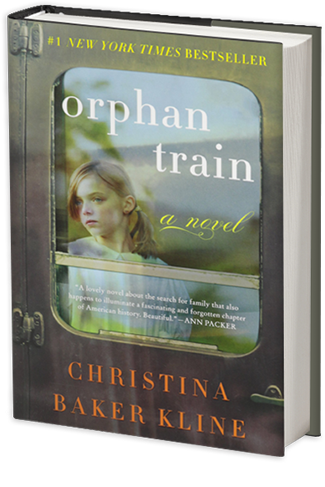
Orphan Train

This historical novel by Christina Baker Kline is based on a "little known but historically significant moment in our country's past. Between 1854 and 1929 [i.e., 75 years!], so-called orphan trains transported more than two hundred thousand orphaned, abandoned, and homeless childrenn--many of whom, like the character in this book, were first generation Irish Catholic immigrants--from the coastal cities of the easter United States to the Midwest for 'adoption,' which often turned out to be indentured servitude." (from the Author's notes).
That is the backbone of the story which switches back and forth between a story taking place in 2011, Spruce Harbor, Maine and that taking place in Depression-era Minnesota. A young woman in foster care arranges to help an elderly widow sort through and clean out her attic as part of a community service agreement after she steals a library book. Native American seventeen-year-old Molly Ayer has been shuffled from one miserable situation to another ever since her father was killed in a car accident; her mother is a drug addict incapable of caring for herself, much less a daughter. Vivian Daly is an apparently wealthy white woman who appears to have a priveleged life. But as the two sort through the boxes and trunks of memories and memorabilia, Molly discovers that they have a lot in common. For Vivian, born Niamh, was orphaned by a tenement fire shortly after immigrating from Ireland. She was told her entire family perished in the fire, and she became a ward of the Children's Aid Society and was shipped off to take her chances in finding a new on in the Midwest. Both of these women will give something very valuable to the other. The metaphor of "portage"--carrying your belongings as you move through life--is a both a reality and a thought exercise that the two will share in their time together.
Highlights from her interview with NPR are here. Lots of good reviews, for example Kirkus, Publishers' Weekly, and Huffington Post.

Friday, August 24, 2018

Natural Causes: an epidemic of wellness, the certainty of dying, and killing ourselves to live longer

Prolific political activist and investigative journalist Barbara Ehrenreich has here taken on the--in her view misguided--culture of obsessive "fitness" and keeping people alive at all costs. She challenges some of the evidence (or lack thereof) and precepts of preventive medicine, mindfulness, and the belief we have control over our bodies. But she also ponders some interesting developments in understanding cell biology--especially those we consider dysfunctional, like cancer--such as the scientific quandary of why our immune systems sometimes turn against us. The review from the New York Times sums it up well:
"Nothing in modern life prepares us for the leaving of it. We treat aging as an outrage or, worse, as a sin. In our addiction to betterment, we’ve replaced “health” — an absence of sickness — with the amorphous “wellness” and a flurry of overtesting, fad diets and pointless “alternative” treatments."
At age 76, Ehrenreich has decided that she is "old enough to die." That means no longer subjecting herself to unnecessary exams, tests, and treatments.  “Not only do I reject the torment of a medicalized death, but I refuse to accept a medicalized life.”
With a PhD in cellular immunology, she is certainly qualified to offer an informed opinion on these matters.
Additional reviews from The Guardian, the Washington Post, The Atlantic and Kirkus.

Coffin Road

This is the 2nd book I've read by prolific Scottish author Peter May (see also my post for Black House). He has written several series, but this is among his body of stand-alone novels. The plot for this book, set in the outer Hebrides, is a timely one--the precipitous decline in bee populations around the world. However, we don't know that until we are thoroughly wrapped up in the mysterious protagonist, whose name we aren't sure of, because he has been in a boating accident and lost his memory. People know him as Neal Maclean, a writer delving into the unsolved disappearance of 3 lighthouse keepers from a nearby island over a century ago. He can't remember anything about his life or the people around him, not even the woman in the neighboring cottage with whom he has apparently been having an affair. His dog knows him, but there seem to be no clues to his identity in the cottage he's been renting for the last year and a half. No ID. No e-mails. No pictures. He's told everyone he's writing a book but there's no evidence of this in his computer. All he finds is map of the island highlighting the Coffin Road--an ancient path followed by pall bearers. When someone breaks into his cottage and tries to kill him, the need to recover his identity becomes a mater of life and death.
There are two additional parallel storylines. Teenager Karen Fleming is still trying to come to terms with the apparent suicide of her father 2 years earlier. As she struggles to deal with her mother's plans to move on and remarry, Karen wants to talk to anyone who knew her father. But after she contacts a work colleague of her father's, he dies in an automobile accident--maybe. Karen becomes increasingly convinced that her father's death was not a suicide, and maybe he isn't even dead. Meanwhile DS George Gunn is sent to investigate the murder of a man at the same lighthouse where the keepers disappeared. The stories are connected of course, but you will be led on a totally believable but devious chase to find out how. Part scientific thriller, totally engrossing mystery--well worth the read. Reviews from The Guardian, Kirkus, Publishers Weekly

Tuesday, August 14, 2018

Star of the North

This timely and compelling thriller by D.B. John (see my post on another book of his that I read, Flight from Berlin) is set largely in North Korea during the rule of Kim Jong Il. The book opens with the kidnapping of a college-age couple by North Korean operatives from a beach in South Korea. Because they were taken aboard a submarine, no information turns up from the usual search and surveillance methods, and the two are eventually presumed drowned. The young woman's twin sister, Jenna--both of them are half Korean-American and half African-American--has never fully accepted her sister's death. Jenna's grief over her missing twin is compounded by her father drinking himself to death after the disappearance, and she has languished in her pursuit of an academic career. Nearly 12 years later, Jenna is tapped by the CIA to participate in talks with the North Koreans and suddenly she has hope that she might be able to find out more about the disappearance of her sister. Her story is interwoven with narratives from the perspective of two North Koreans. One is a poor village woman who finds a propaganda balloon in the forest (which she must by law turn over to the authorities) filled with food and other contraband. She takes a risk and opens a stall in the black market area of the train station with what she's found. The other voice is a high ranking Korean official whose English language skills tap him to be one of the diplomatic party being sent to Washington, D.C. for talks. The characterizations of daily life for ordinary citizens, the inner circle of the regime, and prisoners in the labor camps are all based upon accounts from those who have escaped or defected. Like the descriptions in The Orphan Master's Son, these are often painful to read. The government's deceit and manipulation of its own citizens as well as the rest of the world is a sobering reminder of what we're dealing with in our current negotiations with North Korea. Reviews from Publishers Weekly, the Washington Post, and Kirkus.

Monday, August 13, 2018

Amsterdam: A history of the world's most liberal city

This book by Russell Shorto (am American who now makes his home in Amsterdam) is more than a history. It is also an examination of culture and philosophy and politics and how these evolved in a unique way, derived from Amsterdam's unique geography. It also tells how this relatively small city and country came to have an outsize impact on the developing world from the 16th to the 20th century. Amsterdam residents wrested their land from the sea, which required unrelenting cooperative activity. But they also allowed independent ownership of that land, encouraging entrepreneurship and diversity of thought and action. Early on, Amsterdam became a haven for those with different views, especially around religion, and they often had to fight off much larger and more powerful countries to maintain or regain their sovereignty. Not only was Amsterdam the home of great art (e.g., Rembrandt, van Gogh) and philosophy (e.g., Spinoza) but also of tremendous financial and trade power with the Dutch East India Company. They created the first publicly traded companies and stock market. Only once did they truly fail, when they let the Nazis take over, betraying their significant Jewish population.
Takes a while to get started, but this is a fascinating book. Laudatory and more detailed reviews from
Publishers' Weekly, The New York Times, Kirkus, and The Guardian.