Showing posts with label speculative fiction. Show all posts

Monday, February 10, 2025

Cold Storage


This work of speculative fictionby Michael C. Grumley is set 2046 after the United States as we know it has suffered The Collapse. In the Prologue, a man is taken into the Himalayas by a couple of guides who discovered a large metal structure in the ice. Upon verifying their story, the client murders both guides. The main story has to do with a mortal game of cat and mouse as one side is trying to revive and protect a man who has been cryogenically frozen, while the other side wants him back to learn things about how the process affected him. But as the book expands, we are introduced to the group of nine people who are planning to freeze themselves and be revived when medicine has advanced sufficiently to keep them alive much longer than normal. Obscene amounts of wealth and the technology and security resources that that wealth can buy definitely give them the upper hand. 

Publishers Weekly offers this review: Grumley's riveting sequel to Deep Freeze successfully steers the series into full-tilt sci-fi madness. After dying in a freak bus accident, U.S. Army veteran John Reiff was revived as part of a covert research program ...Twenty-three years later, Reiff has been frozen again and stored in a cabin in Utah. His body is removed from storage by a group of his apparent allies...They've retrieved Reiff because he's become a subject of interest for a shadowy group of power brokers called "The Nine," whose members want to know if Reiff's freezing had any adverse effects. If not, they plan to freeze themselves to survive a mysterious event. Once Reiff's rescuers bring him back to life, they learn he may be connected to a bizarre discovery involving space travel, which carries massive implications for the future of the planet. Grumley tosses a lot of balls in the air, but he juggles them all nimbly, keeping the plot's many surprises well concealed without sacrificing pace. Blake Crouch fans will love this."

Wednesday, September 11, 2024

Hum


 Helen Phillips "is the author of six books, including the novel The Need , a National Book Award nominee and a New York Times Notable Book. She is the recipient of a Guggenheim Fellowship and a Rona Jaffe Foundation Writers' Award. Her collection Some Possible Solutions received the John Gardner Fiction Book Award. Her novel The Beautiful Bureaucrat was a finalist for the New York Public Library's Young Lions Fiction Award and the Los Angeles Times Book Prize. A professor at Brooklyn College, she lives in Brooklyn with artist/cartoonist Adam Douglas Thompson and their children" (book jacket). This is her most recent speculative fiction novel. Although this book has received numerous laudatory reviews, I didn't much care for it... maybe because I never had kids. I found the children's behavior obnoxious on many occasions and their mother's mostly passive acceptance of same distressing as well. In other words, I didn't like any of the human characters and couldn't identify with much of the stress in the storyline. Which isn't to say that the story lacks relevance. As the New York Times notes in their review, "Along the way, the story raises many unsettling questions. What is the right role for A.I. in our lives? In a world of so much artifice, what counts as authentic experience? How do we usher our children into a future that we find frightening to imagine?"They provide this opener of the general plotline: "In Helen Phillips’s near-future novel, “Hum,” a family’s dream vacation away from technology devolves into a misadventure with major consequences." The review goes on to provide a much more detailed explanation of the settings, actions, and characters' interactions--with other members of the family as well as with one significant "Hum." They conclude by praising the author, "This sleek ride of a novel further cements Phillips’s position as one of our most profound writers of speculative fiction."

The Los Angeles Times gushes, "“Phillips has given us a lot to chew on, but there is also something comforting embedded in this cautionary tale: an homage to our adaptability, our capacity to love and our willingness, however reluctantly, to embrace the new … Here she urges us not to surrender our power to choose and to resist, but to be thoughtful warriors, deciding for ourselves how we will dwell on our imperiled planet.” 

Here is Kirkus' review and summary: "What happens when the forests are gone, surveillance cameras are ubiquitous, and AI-programmed robots do the work? Set in a future altered by climate change and technology that may feel uncomfortably close at hand, Phillips’ new novel again shows her talent for finding warmth, humanity, and connection within an all-too-conceivable dystopian landscape. The action begins with May Webb, an unemployed mother of two elementary school students, undergoing a procedure designed to alter her features just enough to confound facial-recognition software. (The procedure is performed, as are many tasks in the world of the novel, by a robot with a soothing demeanor called a hum.) For surrendering her face to this experiment, May—whose AI-communication job has recently rendered itself obsolete and whose husband, Jem, has been laboring to keep the family financially afloat working gig-app-facilitated odd jobs—is paid the equivalent of 10 months of her previous salary. She immediately splurges on a three-night stay for the family in the idyllic Botanical Gardens, an accessible-only-to-the-rich paradise of greenery, frolicking animals, and fresh air walled off to shut out the city’s grit, graffiti, litter, and soot. But the family’s perfect vacation takes an unfortunate turn when the children wander off and get lost, setting in motion a string of events that endangers the family’s power to stay together. Writing with precision, insight, sensitivity, and compassion, Phillips renders the way love and family bonds—between partners, parents and children, and siblings—can act as a balm and an anchor amid the buffeting winds of a fast-changing, out-of-control world. A perceptive page-turner with a generous perspective on motherhood, identity, and the pitfalls of 'progress.'”

Sunday, May 19, 2024

The Mars House


I thoroughly enjoyed this speculative/ science fiction set on the planet Mars in the 6th-generation colony of Tharsis.  Author Natasha Pulley does an outstanding job of creating a new world, a new world order, and new human beings. After decades of living on a planet with gravity only a third of planet earth's, the population has grown significantly taller. When most of the original colonies from various countries on earth are wiped out in an early catastrophe, the emerging survivors were the Chinese, and so Mandarin is the official language of the colony, although many do speak English. Power has become concentrated in the hands of the "great houses," in particular, the house of Gale and the house of Song. The Consul who runs the colony is from the latter and one of our main characters is Senator Gale. Climate refugees from all parts of earth are fleeing to Tharsis and this, not surprisingly, creates a distinct us vs. them mentality among the Tharsians. These incomers are called Earthstrong and are forced to wear a metal cage that limits their movements as, due to their greater strength from living in earth's gravity, they can easily break bones or kill the long-term colonists by accident. The refugees live in poor housing and have no rights as citizens and are eligible only for the hardest and most dangerous work. Should they decide to "naturalize," they gain all the rights of citizenship--if they survive. At the very least, the process is disabling, leaving many in wheelchairs or with brain damage. Senator Gale is campaigning for the Consul position on a "forced naturalization" platform, which would require all immigrants to undergo the process. 

Our protagonist, "January [Stirling], once a principal dancer for the London Royal Ballet, is now a factory worker and refugee in Tharsis...When a live interview between Gale and January proves disastrous for both, Gale presents January with a solution: accept an in-name-only marriage with them to bolster their election, and January can live his life as a full citizen without naturalization. January accepts and finds that the person he married is not the xenophobic horror he thought" (Library Journal). Their review goes on to conclude that the book is "Exquisitely layered and entertaining..."

Publishers Weekly says, "...Pulley introduces some truly complex ethical and political questions. Even better, she refuses to offer black-and-white answers, and never loses sight of her characters' empathy and humanity. The worldbuilding is carefully considered, linguistically nuanced, and technologically fascinating. The unlikely love story between January and Gale, who, like all Natural Martians, is genderless, is the cherry on top. Their romance is touching in its simplicity--stripped of all the politics and advanced technologies involved, they are two people who find themselves drawn closer together as they realize that, though their opinions may differ, their core belief in human decency is the same. With dark humor and a gift for making the complex accessible, Pulley gives readers much food for thought" 

Kirkus adds that author Pulley "... explore[s] topics of political interest today: climate change, immigration, gender, political corruption." and concludes that the book is "Full of charming details and gender-bending gallantry, this imaginative thriller is a pleasure to read."

Thursday, March 21, 2024

Among the Living


This is the newest release (Feb. 2024) of horror and fantasy author Tim Lebbon, an author new to me; I am a fan of some fantasy but not so much horror.  I would also characterize this book as speculative fiction, i.e., near possible future scenarios. Set in our world, now in advancing climate change, we encounter two teams with opposite goals. One is a team of 4 rare mineral prospectors, exploring areas that were previous inaccessible before the planet warmed up, and the other team of 3 are eco-activists, trying to prevent further destruction of a dramatically changing world. On team 1 is Dean, whose growing unease about what they are doing causes him to send an email to former friend Bethan, a member of team 2;  team 2 is not on the same island by chance, but due to Dean's warning. It reminds me of "The Body Snatchers," except, instead of aliens from another world, the threat comes from within our own. I'll let Publishers Weekly offer a further summary in their review.

"Combining a plausible existential threat with vivid depictions of a forbidding landscape, Lebbon (The Last Storm) crafts an expert work of ecological horror. In the near future, catastrophic climate change has so devastated the planet that America’s drought-afflicted farming belt is now known as the Desert. The demand for new sources of rare-earth minerals leads four experts to the Arctic’s Hawkshead Island, where they’ve identified a cave system that could yield riches. But when they enter, the researchers encounter an unusual group of mummified human remains, apparently tens of thousands of years old. Despite every indication that the bodies are long dead, one of them, whose head is in “an impossible position,” appears to move, sending the expedition members fleeing for their lives. When three of the four emerge from the caves, they meet another team, this one comprising activists and ecoterrorists, who are concerned that the intrusion may have unleashed a contagious intelligent disease that could kill every human on Earth. Lebbon skillfully exploits the very real concern that melting permafrost could release deadly viruses to create a nail-biting scientific thriller worthy of Michael Crichton. Readers will be wowed."

The New York Times brief review recommends it. "This novel is wildly entertaining. The ragtag band of survivors must traverse dangerous, unpredictable terrain full of snow bears and sinkholes, all while fighting creatures that emerge from the ground. The tension and violence are as aggressive as a revving engine here, but Lebbon’s timely message — that hurting our planet is hurting ourselves — is just as loud."


Wednesday, June 21, 2023

Camp Zero


This is another science fiction book by an author I have not previously encountered, Michelle Min Sterling. Kirkus offers this summary:

"It’s 2049, and 25-year-old Rose accepts a dangerous assignment from Damien, her master-of-the-universe boss, who promises that she and her mother will be set with income and housing for life in a precarious, ever warming world if she succeeds. On her mission, she’ll continue as a sex worker alongside five other women while keeping an eye on Damien’s interests in a new, secretive project. Meanwhile, Grant Grimley just wants to escape the reach of his family’s vast wealth, a legacy created from centuries of extraction. He accepts a teaching job that guarantees to get him off the grid. Rose and Grant, both Americans, arrive at a camp in the Canadian wilderness, a frigid frontier of sorts, where a renowned architect seeks to build a refuge from climate catastrophe. Not too far off, a group of women—American soldiers and scientists—is creating a sanctuary of their own to survive an imperiled planet. It's a smart setup. The author has imagined an array of futuristic ideas stemming from our present, including a next-generation smartphone that’s implanted as a chip behind people's ears at birth and a Floating City off Boston’s shores where the elite live in bliss while the rest of the population deals with worsening hurricanes and wildfires." They are not ringingly positive about the book but do conclude by saying, "the book has a soul that generates momentum. It’s committed to the bonds of family, the ones we are born into and the ones we choose, as a way forward in an increasingly chaotic world. A love letter to what communities of women can accomplish when they work in concert."

There are several plot lines and hidden motives of the characters that are revealed as the narrative moves forward. The Toronto Star concludes their review by praising the author's "powerful storytelling, the vividness of her vision, and her creation of a world which will likely haunt your dreams."

Saturday, May 20, 2023

Ascension


Edinburgh-based Nicholas Binge is "an author of speculative thrillers, literary science-fiction, and horror." The premise is that a towering snow-covered mountain that "dwarfs the Himalayas" (Publishers Weekly) has suddenly appeared in the middle of the Pacific Ocean, defying all logical explanation. Harold Tunmore, former surgeon, former physicist and currently investigator of "mysterious phenomena" is recruited by a nameless organization to join a team of other eminent scientists to scale the mountain and provide answers. 

It's 2019 and Harold has been missing for 30 years. When brother Ben hears from a friend that Harold has been seen living in a psychiatric hospital, Ben immediately goes to verify. Ben finds Harold alive and well physically but making no sense in his conversation. Harold commits suicide days later and Ben takes possession of his only personal belongings, a briefcase filled with papers. Most of them are unsent letters addressed to Ben's teenage daughter Hattie and it is through these letters that we learn of the attempt to make sense of the strange existence and effects of the mountain. 

Booklist makes favorable comparisons to other eminent authors' works: "Ascension is a pastiche of august influences. The epistolary structure is borrowed from Dracula. The doomed expedition that drives Harold mad is akin to H. P. Lovecraft's At the Mountains of Madness. Even the frame of Ben publishing his brother's wild tale is reminiscent of the children's classic Bunnicula. Binge earns his place among these literary lights with an expert story of creeping dread and cosmological horror."

Publishers Weekly calls the book a "superlative science fiction thriller," and goes on to praise the author: "Binge's superlative imagining of how the mind-blowing scientific discoveries, which have global implications, would affect his characters elevates this above similar genre fiction." Even Wall Street Journal concludes favorably, "“Ascension is thoroughly recommended—a macabre, escapist pleasure for the thoughtful set."

Library Journal is also laudatory, saying "This thrilling science fiction novel from Binge ... is full of exploration and intriguing thoughts about the true nature of life on Earth...The story of that improbable and amazing ascent brings mystery and thrills as nothing is as it seems, and the implications for God and humanity are staggering...An exciting story where the undiscovered wonders of Earth prove as exciting as those out in the galaxy."

My verdict: although very readable, this novel is grim, sad, and hard to unwind at times.


Monday, September 27, 2021

Scorpion


I have never read the previous novels by Christian Cantrell--a software engineer in addition to being an author-- but I thoroughly enjoyed this one. This book is variously referred to as speculative fiction or a science fiction thriller. It is set in the near future with lots of cool technologies that could soon be with us. The premise is that a divorced and still grieving (over the accidental death of her daughter) CIA analyst, who usually has a 9-5 desk job, is tasked to track down the "Elite Assassin." The killer has struck several times with no consistency in mode of murder, no apparent connection between the victims, and the only clues left are 4 digit numbers that are stamped, tattooed, cut, or pressed into the victim's flesh. The only thing revealed by her intensive searches through unimaginable amounts of data is that the age of the victims is decreasing; it is finally the murder of a 9 month old infant that galvanizes Quinn to undertake this assignment. Quinn Mitchell is not a field agent, and yet she finds herself flying all over the world in order to view murder scenes first-hand in her pursuit of the killer. In one humiliating interview, a hotel manager, who could identify the killer, suggests that Quinn quit following the bodies and start following the money if she wants to get ahead of her target. What I liked most about this book, aside from the cool tech, the twisty plotting, and the intriguing characters was the author's droll sense of humor, revealed in clever comparisons and turns of perspective. I highly recommend this book as do Publishers Weekly, which calls the book "as entertaining as it is intellectually and ethically challenging," and Kirkus, which concludes "...the technology sings, the physics is plausibly presented, and the suggestion of time travel fascinates. A fast, fun, and intelligent SF thriller."

Wednesday, October 28, 2020

Survivor Song


This only slightly speculative thriller by Paul Tremblay takes place in contemporary Massachusetts, which is under quarantine due to the outbreak of a particularly virulent varient of rabies. Rather than dying in days or weeks, symptoms--loss of mental capacities, aggressive biting behavior, and death--occur within hours. When the husband of 8-months-pregnant Natalie returns from a fraught trip for groceries, an infected neighbor attacks them; Paul is killed and Natalie is bitten before she fatally stabs the crazed man. Natalie turns for help to her oldest and closest friend, pediatrician Ramola Sherman. Fighting panicking people who jam the road to the hospital, Ramola gets Natalie to a hospital for a vaccination, but it's not clear whether they made it before the virus has reached Natalie's brain. When an attempt to evacuate Natalie to a maternity hospital for delivery is thwarted by more infected victims storming the hospital, Ramola begins a desperate attempt to get Natalie to safety. The tension comes from the numerous obstacles they face--infected animals and people attacking them, roving armed bands of militia--as well as the uncertainty about Natalie's and her unborn child's future. Obviously a somewhat hyperbolic scenario of what we are currently facing with the COVID pandemic is depicted in the hysteria and violent reactions of the population. A fast read with well developed characters. All but the last chapter of the book takes place in the mere span of a few hours, and you know how it will end because the author warns you ahead of time. But it's a compelling ride.

NPR concludes their review by saying, "Survivor Song is a small horror story. A personal one. A fast and terrible one that is committed beautifully to the page. It goes on, piling banal complication on top of the awful terror of time running out, and crushes you in the most surprising of ways — with a look, a line, a touch, a memory, an inevitability that you saw coming from page 1. It exists in a pandemic world where all choices are bad ones. Where things unravel faster than you can possibly believe. Where happy endings are transactional: they come with a cost. Because Survivor Song isn't a fairy tale. It's a horror story."

The NYT notes the prescience of the author  writing something that sounds remarkably like our current situation: “In the coming days,” the narrator tells us, “conditions will continue to deteriorate. Emergency services and other public safety nets will be stretched to their breaking points, exacerbated by the wily antagonists of fear, panic, misinformation; a myopic, sluggish federal bureaucracy further hamstrung by a president unwilling and woefully unequipped to make the rational, science-based decisions necessary; and exacerbated, of course, by plain old individual everyday evil.”


Friday, September 25, 2020

Migrations


“The animals are dying. Soon we will be alone here.” So opens Charlotte McConaghy's debut adult novel, set in the near distant future. Our protagonist and narrator is a woman trying to make sense of a world gone mad and of her own self-destructive compulsion to wander. Abandoned early on by her father,  Franny Stone in turn abandons her mother when she wanders off at the age of 12. When she returns home, her mother is gone. Franny loves the wild spaces and the creatures that inhabit them, especially the birds and creatures of the sea. Over the years, as multiple species are driven to extinction by human greed, she undertakes one last migration of her own, to follow the only remaining flock of Arctic terns on their monumental annual journey from Greenland to Antarctica. She tags three birds during nesting season and then has to convince one of the disappearing number of fishing boats to take her south. She badgers Ennis Malone, captain of the Saghani, to take her onboard, against his better judgement and the opinion of his eccentric crew.  Franny promises that following the terns will lead them to the "Golden Catch" that has eluded them these last few years.

Franny's tortured history is revealed in flashback chapters and in her unsent letters to her ecology activist husband, Niall. But her obsession, now shared by Ennis, may be the undoing of them all. 

The book is rich in metaphor. For example, as The Guardian notes with regard to the terns' migration, "This journey is the longest migration undertaken by any animal – a complete crossing of the globe – and a feat that terns complete twice-yearly. The book uses this act of endurance, this instinctual movement, metaphorically: Franny too is driven to constant movement by forces she cannot control or understand, and is determined and driven even in the face of great adversity." They also comment on the thing I found most distracting,  the "book’s constant shuttling about in time, as well as the unreliability of Franny’s narration, the half-truths and silences with which she surrounds herself and everything she holds back from the other characters and the reader alike." If I were to re-read the book, I would keep a timeline of Franny's life on paper.

The New York Times chides that the novel veers into melodrama in the last half, but also concurs with my sense of how beautifully this book is written when they say, "this novel’s prose soars with its transporting descriptions of the planet’s landscapes and their dwindling inhabitants, and contains many wonderful meditations on our responsibilities to our earthly housemates."

 The Washington Post concludes, "In many ways, this is a story about grieving, an intimate tale of anguish set against the incalculable bereavements of climate change. There are many losses, but lives are also saved. Franny charts our course through a novel that is efficient and exciting, indicting but forgiving, and hard but ultimately hopeful."


Thursday, June 11, 2020

The End of October

Pulitzer Prize-winning non-fiction author Lawrence Wright has dived into speculative but well-researched fiction with what many reviewers (The New York Times,  The Guardian, Vox, Slate, The Atlantic) call an "eerily prescient" account of a global pandemic. CDC expert Henry Parsons is asked by the WHO to investigate a cluster of deaths in an Indonesian detention camp for gay men. Before Henry can even report back on the horrendous and highly contagious disease he encounters there, an infected man is on his way to pilgrimage at Mecca--the annual gathering of over 3 million faithful Muslims. Even the harshest measures are insufficient to keep people from returning to their homes after the outbreak, spreading the disease far and wide.
Henry is one of the people who needs to be working on understanding the virus in order to treat or prevent it, but is instead caught up in a worldwide travel ban, unable to return to his family in Atlanta or get access to the research and lab facilities he needs. Focusing mainly on the Middle East and the United States, Wright talks about the breakdown first of civility--neighbors don't help neighbors in a pandemic; they are afraid of them--and then of society, he paints a picture that seems all too familiar from today's headlines.
The New York Times says that what distinguishes Wright's book from a large body of pandemic based fiction is "deep, thorough research... In writing the novel, he interviewed scientists, epidemiologists, government officials and military officers. His understanding of world affairs, Middle East gossip, politics and governmental ineptitude is exceptional." And he weaves his story together with illustrative non-fiction; for example, he details "accounts of historical epidemics, descriptions of Russian cyber- and biowarfare capabilities, the story of the 1803 attempt to save the New World from smallpox..." (NYT)
NPR says of Wright's digressions into discussing pandemics throughout history that "we readers are currently in the market for exactly that: Every single fact a great reporter like Wright has learned about pandemics."
The Washington Post picks out a quote from the book that sounds like it could have come from Dr. Fauci's daily briefings: "Typically, with a pandemic, you have two or three big waves of contagion before it settles down and becomes the normal flu you get every year. That lasts till the next pandemic comes along. So if this one is like the 1918 flu, the really big wave will hit in October. But of course, we don’t know what this one will do.” Whether or not you think it is a good thing to imagine the outcome of a global pandemic while living in the middle of one is a personal decision. Even the author has mixed feelings. In an interview with The New Yorker, he says, “In some ways, I have to admit, I’m kind of proud that I imagined things that, in real life, seem to be coming into existence...On the other hand, I feel embarrassed to have written this and have it come out.”
I was engrossed and carried along by the story as well as the history and science. 

Sunday, March 29, 2020

The Grace Year

It's been decades since I read Lord of the Flies, but at times this felt like a female version of that story. It is also reminiscent of The Power (which I started recently but never finished). Author Kim Liggett actually opens the book with quotes from Lord of the Flies and Handmaid's Tale. Booklist also ties the story line to The Hunger Games...so lots of young adult angsty stuff going on in this speculative fiction about a world where women are both deprived on any real power, but seen as so terrifying in their potential power that they are sent away for a year to rid themselves of their destructive magic and purify themselves. Many don't return, captured by poachers who sell their body parts to unscrupulous buyers seeking miracle cures. The ones who do seem permanently altered--and not in a good way. Sixteen-year-old Tiernay has never aspired to the role of wife/mother that is designated for the lucky women who are picked by a man prior to the Grace Year. She would prefer  to live out the life of those who are not selected, working in the fields or workhouses. But her childhood friend picks her at the selection ceremony and she feels betrayed. When the women are marched off into the woods and left at a crude compound, Tierney, with skills learned from a tomboyish childhood, tries to organize cleaning the filthy quarters and building rain barrels for fresh water instead of the murky green stuff that comes out of the camp's well. But she has a powerful enemy in the person of a young woman, Kiersten, who wanted to marry Tierney's betrothed. And that woman eventually turns the rest of the women against Tierney. How Tierney will survive on her own is the meat of the story.
Reviews from Kirkus and Publishers Weekly. 

Wednesday, January 1, 2020

Recursion

Blake Crouch is the prodigious author of speculative fiction books and this is the 2nd book of his I have read (see my post on Dark Matter). He offers up another example of a mind bending proposition, in this case, what if memory creates reality. And what if you could change people's memories or let them go back into a remembered event and start life over from that point. There would be a new timeline to accompany that life. Only it turns out that the previous timeline/ set of memories, would also still be present. It might be enough to make people crazy. And that is what happens. As more and more people are affected by "False Memory Syndrome" mass insanity follows.
It started out with the best of intentions by scientist Helena Smith--what's that saying about paving the road to hell--as she tries to find a way to map and recreate memories  to alleviate the losses associated with Alzheimer's Disease. But this research, prompted by her mother's own descent into disconnection through forgetting, gets hijacked by a lab tech, Marcus Slade, who first uses the technology to make a personal fortune, and then to sell the technology to those who regret the roads not taken. Unfortunately, the ultimate outcome is that the plans for building the "memory chair"--which basically allows the altering of reality--is hacked from Slade's lab and people begin to use it for bad purposes and nuclear war on a massive scale ensues. So the creative genius behind the chair, Helena, goes back and lives life over, time and time and time again, trying to make things turn out differently.
It was compelling but also somewhat mentally exhausting to read this and to stretch my mind around how this can happen. Recommended for hard core sci-fi readers only.
Laudatory reviews on NPR, from the New York Times, the Washington Independent Review of Books, and from Kirkus which accurately calls this book "An exciting, thought-provoking mind-bender."

Thursday, November 15, 2018

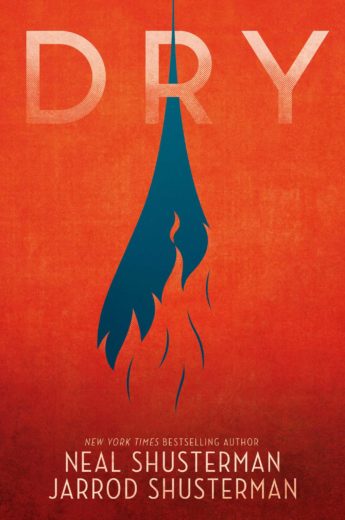
Dry

This collaboration between YA author Neal Shusterman and (son) Jarrod Shusterman has been getting rave reviews (Kirkus, Publishers Weekly). The characters are all indeed young adults, but the theme is very current and of concern to all ages. Especially with California once again consumed by deadly fires, this tale of how quickly humanity descends into dysfunctionality when Arizona and Nevada stop the flow of the Colorado River into southern California was scary reading on a very visceral level. I started the book yesterday and finished early this morning if that gives you any idea of how engrossed I was. It reminded me strongly of The Water Knife (about which I wrote some time back) but told from the perspectives of several different teenagers. Alyssa, 16, is your typical high school student who plays soccer and has an annoying 10-year old brother, Garrett. Kelton's family are survivalists living next door in this suburban neighborhood; Kelton has had a crush on Alyssa forever, but she thinks he's creepy because of his family. Jacqui, 19, has been surviving on her wits for 2 years and only hooks up with the other 3 when they go looking for Alyssa and Garrett's now missing parents who went out to look for water. Henry is an adopted 13 year old left at home by his adoptive parents in a gated community while they are on a cruise. He is a schemer and opportunist and meets the other 4 when they come looking for Alyssa and Garrett's uncle. They all quickly find out that no amount of preparation is foolproof when things start to go sideways. The government is slow to respond; FEMA is focused on a hurricane and doesn't see the emergency from a water shortage. Except that it's not a shortage--that's been going on in California for a while; it's the Great Tap-Out and people die pretty quickly from lack of water. But before they do, they turn on one another, lose hope and give up, or become heroes. The questions about under what circumstances we lose our humanity are compelling.