Showing posts with label France. Show all posts

Thursday, December 11, 2025

A Chateau Under Siege


This book is the16th installment in Martin Walker's "Bruno, Chief of Police" series. Bruno is now a more senior officer in charge of his region and so when someone is apparently fatally stabbed in a nearby town's battle re-enactment, he is called in to investigate. Here is Publishers Weekly's review. I totally agree with their conclusion. 

"Benoît "Bruno" Courrèges returns in Walker's sturdy 16th cozy featuring the soldier turned small-town cop (following 2022's To Kill a Troubadour). When the French town of Sarlat hosts a reenactment of the Hundred Years War, its main actor, intelligence agent Brice Kerquelin, is stabbed during the performance and ends up in critical condition. Various government agencies scramble to solve the apparent assassination attempt, while Bruno is charged with protecting Kerquelin's adult daughters, Claire and Nadia. Before long, however, Bruno learns that the performance had not been going as planned, with Kerquelin pulling a series of unrehearsed moves just before the supposed assassination. The detective smells a rat, especially after he establishes a link between Kerquelin, a missing tech mogul, and a Taiwanese group monitoring France's interest in manufacturing new computer processing chips. As he digs deeper, Bruno uncovers a network of international espionage far more sinister than he first imagined. Fans will be happy to find all the hallmarks of the series: the pacing is brisk; Bruno's former flame, Isabelle, provides romantic tension; and his dog, Balzac, keeps the detective company while he cooks several decadent and vividly described meals. This is reliable, frothy fun." 

Thursday, November 21, 2024

Death at the Château Bremont


This is the first of the "Provençal Mystery Series" by author M.L. Longworth. Any of you who watched the all-too-short TV series, "Murder in Provence"--starring Roger Allam-- will recognize the main characters, chief magistrate of Aix-en-Provence Antoine Verlaque and law professor Marine Bonnet. There are 9 books in the series and I am ready to dig into these. When documentary film director Étienne de Bremont dies after falling from a window in the attic of the family Château, the police are quick to call it an accident or perhaps even suicide. But investigating magistrate Verlaque is not so sure. Étienne was universally admired and liked and he'd grown up in the Château, often playing for hours in the attic. When it turns out that Marine had been childhood friends with the de Bremont brothers, Verlaque brings her into the investigation while, at the same time, trying in his dogged way to rekindle the romantic relationship he had previously with Bonnet. The the other brother, ne'er-do-well François, is found dead at the Château, only this time it's clearly murder. The resolution of these two deaths causes everyone to re-evaluate their beliefs about the de Bremont brothers. 

Booklist's starred review says, "This first novel in a projected series has charm, wit, and Aix-en-Provence all going for it. Longworth's voice is like a rich concoction of sparkling Dorothy Sayers and grounded Donna Leon. Its blending of aristocratic mystery and guide to Provencal wines, foods, habits, and Aix itself is delightful, and the old-fashioned plotline, with enticing clues nicely planted for the reader, returns refreshingly to the values of the genre's golden age." Library Journal concludes their review, " A beloved home turns sinister in this evocative romantic suspense debut from veteran travel and food writer Longworth. Via great sights and a strong sense of place, readers can leisurely follow Verlaque and Bonnet as they uncover a complicated backstory." Publishers Weekly was less favorable, calling this a "disappointing debut...Despite the appeal of the intelligent Marine and her refreshingly opinionated friend, Sylvie..." Nevertheless, Kirkus calls this "A promising debut for Longworth, who shows there’s more to France than Paris and more to mystery than Maigret."

Sunday, November 29, 2020

The Invisible Life of Addie LaRue


I  read one previous book by Victoria Schwab, A Darker Shade of Magic, the first of the "Shades of Magic" series. This book has a totally different premise. Adeline LaRue grows up in a small rural village in early 18th century France. Against her will, she has been promised as a bride to a village widower with 3 children. Adeline doesn't want to live a small life determined by others and, on the eve of her wedding, she falls to the ground pleading with whatever gods can hear to set her free. The Darkness responds but in a particular way designed to make young Addie want to give up her life--and therefore her soul--sooner rather than later. Her freedom comes at the cost of no one ever remembering her. She can carry on a conversation, eat a meal, or sleep in the same bed with someone and, the moment she is out of sight, they have forgotten her existence. She is now immortal in body but no one will remember her. However, over the centuries she does, in fact, serve as a muse for artists who capture essential bits of Addie in their music, writing, paintings--even though the artists can't identify the source of their inspiration. Her benefactor, Luc--the devil we are to believe--wants Addie for himself and shows up periodically over the next 300 years trying to convince her to join him. Although life is often a struggle, even terrifying at times, Addie refuses. Then, one day in 2014 New York City, the rules change. Addie tries to return a book she has stolen--a tactic that has worked countless times in the past--but this time the bookstore clerk remembers her. Addie eventually discovers that Henry has also made a desperate pact with devil. They fall in love, but of course there is a catch.  

Glowing reviews from NPR,  The Washington Post (which calls this novel "propulsive, compulsive and captivating"), Kirkus ("rich and satisfying and strange and impeccably crafted"), and Slate among others. Apparently the film rights for a big screen adaptation have already been sold.


Friday, February 14, 2020

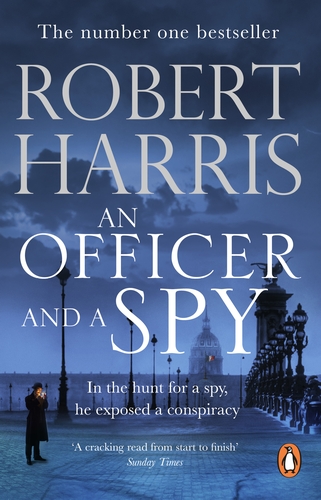
An Officer and a Spy

I have previously read Munich by Robert Harris and thought it very well done. He has written several books that range from alternative history to historical fiction to thrillers. This one focuses on the "Dreyfus Affair" that occurred in France in the 1890's...the "Belle Epoque" between the end of the Franco-Prussian war (when France lost Alsace & Lorraine) and the run-up to WWI.  Dreyfus, a Jewish officer in the French military was wrongly accused of being a spy, was summarily tried, publicly disgraced, and sent to Devil's Island as a solitary prisoner for several years.
The narrator of this work is George Picquart who was put in charge of the secret intelligence unit of the military shortly after Dreyfus' conviction. As he was familiarizing himself with the workings of a department and a job he never wanted to be a part of, he began to realize that the "evidence" against Dreyfus had been manufactured and that senior officers in the military were behind the conspiracy and subsequent coverup. At the same time, it became increasingly clear to Picquart that there was still someone spying for the Germans within the military. He risked his career and was even imprisoned for trying to exonerate Dreyfus and bring the real spy to justice. All the characters are historically accurate as is the timetable (over several years) of the affair.
The book is well-researched and, although a little slow at the beginning, will eventually engender the same outrage over the military's illegal and immoral behavior that the protagonist feels. The trial of Dreyfus inflamed an already pervasive anti-Semitic sentiment in the country. An insightful review from The New York Times provides the larger socio-political context that allowed this travesty of justice to occur. A glowing and detailed review from NPR, another from The Guardian. The Washington Post calls the book "mesmerizing."

Thursday, December 27, 2018

Black Diamond

See the previous post, which is about Bruno, Chief of Police, the first in Martin Walker's Bruno series. This is the 3rd book in the series and some day, I will have to go back and read the 2nd, The Dark Vineyard. Bruno, who is honorifically titled Chief of Police for the French village of St. Denis, even though he is the only policeman in the village, is doing his shopping in the weekly farmers' market when several hoodlums race through on motorcycles and destroy the stall of a local Vietnamese family. Within days, an Asian restaurant in a nearby town is fire bombed. Then Bruno begins to get hints that the local truffle trade--the "black diamonds" that provide a multi-million dollar source of income for the region--is being threatened by substitutions from smuggled and inferior Chinese truffles. When his dear friend and truffle expert is brutally murdered, Bruno up to his ears in mysteries. But, as Bruno learns, his friend was also a former intelligence agent whose work may have made him a target, and there may be more important things being smuggled in from Asia than mushrooms. Once again, painful episodes from France's past, this time its colonial relationship with Vietnam, will surface and spoil the sense of a peaceful pastoral paradise. Bruno would really rather just focus on cooking, drinking wine, hunting truffles with his dog Gigi, playing and coaching rugby, and sorting out his "romances past (Isabelle of the Police Nationale), present (exotically English Pamela), and possibly future (needy single mother and research chemist Florence)."[from Publishers Weekly review]
As always, you'll want to add the Perigord region to your travel itinerary or at least go find the closest French bakery.  Additional reviews from Kirkus, The Independent, and the Washington Independent Review of Books.

Bruno, Chief of Police

I actually read this book by Martin Walker, the first of the Bruno series, some time back, but, having recently read another book in the series, I thought I should go back and fill in. Bruno Courrèges is the Chief of Police in the small town of St. Denis, in the Perigord region of France, known for foie gras and truffles. Bruno loves to cook and feed his friends. He raises animals on his little acreage and grows his own vegetables. He also plays on the local sports teams and coaches the youth soccer team. Most of the time, life is quiet in St. Denis and that's how he likes it, but he can call on a network of contacts when real trouble arises. An elderly ex-soldier who lived in the village has been found brutally tortured and murdered with a swastika carved into his chest. Because this is deemed a hate crime, competing police forces intercede and want to shut Bruno out of the investigation. Bruno however is good at skirting the national authorities and begins to think this crime has its roots in WWII and especially in a group called the Milice. According to Wikipedia, the Milice:
"was a political paramilitary organization created on 30 January 1943 by the Vichy regime (with German aid) to help fight against the French Resistance during World War II. The Milice's formal head was Prime Minister Pierre Laval, although its Chief of operations and de facto leader was Secretary General Joseph Darnand. It participated in summary executions and assassinations, helping to round up Jews and résistants in France for deportation....The Milice was the Vichy regime's most extreme manifestation of fascism....The Milice frequently used torture to extract information or confessions from those whom they interrogated. The French Resistance considered the Milice more dangerous than the Gestapo and SS because they were native Frenchmen who understood local dialects fluently, had extensive knowledge of the towns and countryside, and knew local people and informants."
Bruno also uses his local knowledge to flush out possible motives for murder. As The New York Times says in its review of Walker's 2nd installment in the series, The Dark Vineyard, Bruno works with "great discretion, circulating so quietly and tactfully among his neighbors that his interviews are more like friendly visits. It’s a wonderful detection method and an even cannier literary strategy, allowing Walker to pursue the plot of his mystery while beguiling the reader with extended scenes of village market days, old-fashioned wine harvests and some exceptionally congenial dinner parties." Of course, uncovering this information exposes some dark aspect of France's history, a marked contrast to the seemingly idyllic presentation of St. Denis. Nevertheless, you'll find yourself wanting to go there or at least enjoy some French cuisine.  Read this article in the NYT for some insights on the village and cuisine which so richly embellish these books.

Wednesday, November 14, 2018

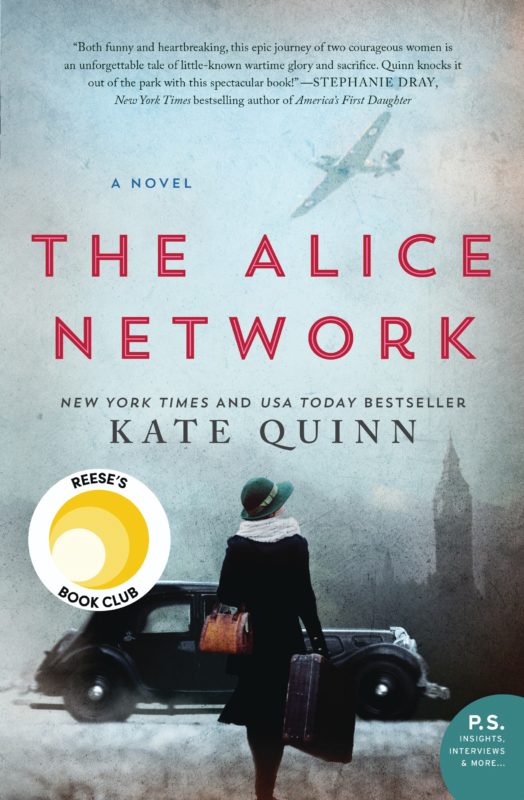
The Alice Network

This historical novel from Kate Quinn, based on actual people and events, is told from two alternating perspectives. WWII has taken a terrible toll on Charlie St. Clair's family. Her brother James came home from the war "shell shocked" and eventually killed himself. Her cousin and dearest friend, Rose, was still in France when the Germans invaded and has not been heard from. Nineteen year old Charlie feels she failed them both and thus fell into her own depression, resulting in desperate and careless sexual encounters and an unwanted pregnancy. Her father is not speaking to her and her mother has brought her to Europe for the Swiss "cure" to her "Little Problem." But Charlie has decided to take this opportunity to slip away from her domineering French mother and find her missing cousin Rose. She has only one lead, the name on a missing persons report. When she shows up on the doorstep of one Eve Gardiner, instead of useful information she gets a gun pointed in her face and a belligerent and drunken threat to go away or get shot. But timid Charlie stays, in part because the hired help, another war shocked ex-soldier and Eve's driver, shows up to feed Eve breakfast. Not surprisingly, Finn becomes the love interest for Charlie. Eve is reluctantly convinced by a tidbit of information Charlie offers about the name of a restaurant where Rose had worked, and especially by the name of the owner, René.
The alternating story is told by Eve, a stuttering file clerk who is recruited to become a spy in WWI France because she speaks both French and German perfectly. She is minimally trained in England and then sent to the village of Lille, which is occupied by the Germans. She is greeted and managed by Lili--her pseudonym in the network--who was renowned in real life for timely and critical intelligence gathering. Eve is placed undercover as a somewhat dim-witted (the assumption people make as a result of her stutter) but competent waitress in a restaurant run by a collaborator, René Bordelon. If he is alive, Eve will hunt him to the ends of the earth for what he did to her. It is a taut tale from both perspectives and the unlikely alliance between the two brings closure--albeit tragic--to both. Great writing and compelling characters and settings.
Descriptive review from NPR. 

Thursday, December 7, 2017

The Little French Bistro

What a disappointment. I so enjoyed The Little Paris Bookstore, by Nina George, that I pleasantly anticipated reading this selection for our upcoming book group. The parallels to the first book are significant, a protagonist who has existed for decades without love suddenly realizes there is more to life during a journey of self-discovery. I almost never disagree with Kirkus reviews, who found this book to be "a satisfying virtual visit to the French Riviera," but I found the plot to be utterly predictable and the prose to be overblown. I would put that down to translation except that the first translated book was done by the same guy, Simon Pare.
Marianne is sick of her life and especially her unfathful and condescending husband. While with him on a tour in France, she sneaks away from dinner and attempts to drown herself in the Seine, only to be rescued by a homeless man and taken to a hospital, where her husband catches up with her and tells the doctor she is mentally ill.
Once again, Marianne makes her escape with suicide in mind and this time, inspired by a colorful ceramic tile she saw in the nurses' station, she heads for the coast to a tiny fishing village called Kerdruc, where she plans to walk into the sea. She is immediately adopted by an entangled group of locals (for more detail, see the NYTimes review) and made the chef's assistant at a local bistro. And of course she meets someone and falls in love. She has already fallen in love with the sea, the food, the countryside....and has begun playing the accordion again. Someone just happened to have a spare one lying around. She does not know what to do about her marital situation and chooses not to discuss it with anyone, until her husband makes a public appeal on TV and everyone recognizes her. She tries to run away again, this time from the people in Kerdruc, and go back to her husband. Realizing she has changed too much to make this possible, she returns to Kerdruc, her lover, and everyone else's romantic problems in the village are solved in the last chapter. Oh please spare me.
The reviewers all liked the book, however: Publishers Weekly, Washington Post, New York Times.

Thursday, November 10, 2016

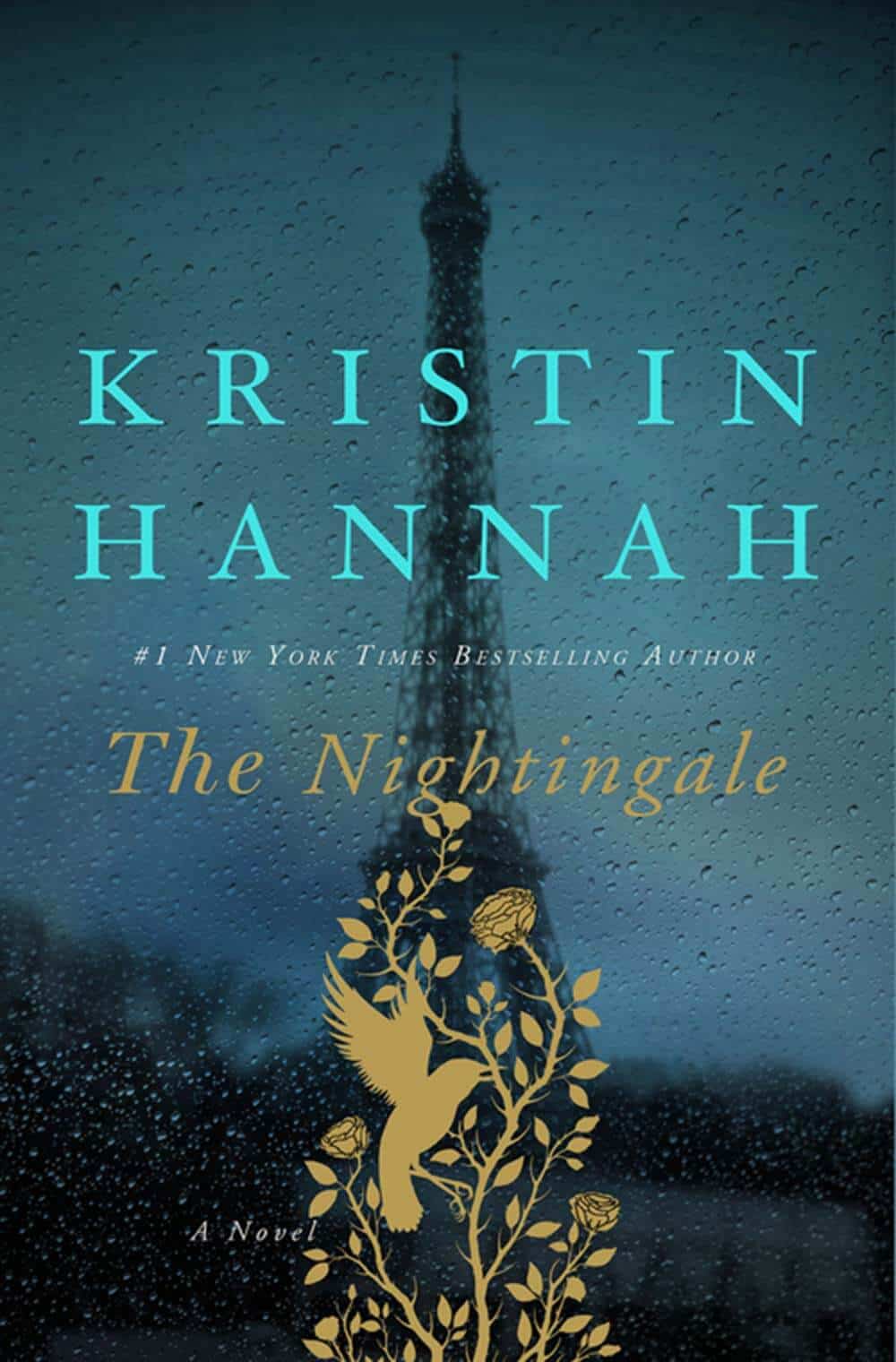
The Nightingale

This highly acclaimed book by Kristin Hannah was personally recommended to me by friend Betsy Friedman. It is beautifully written and compelling story with well developed characters, and yet it was sometimes uncomfortable to read due to the subject matter. Set during WWII when the Nazis have occupied France, two sisters who are as unlike as can be imagined end up taking very similar paths, each to resist the obscenities of the war in her own way.
Viann and Isabelle's mother dies when they are quite young and their father retreats into alcohol and absence. Viann gets pregnant by a childhood sweetheart at 16 and moves to the country to live happily with husband and child. Younger sister, Isabelle, is an emotionally wounded isolate, getting kicked out of one boarding school after another. But she is also adventurous and when she returns to Paris, having decided to live with her father, she gets involved in the French Resistance, eventually coming to be a primary resource for getting downed American and British pilots out of the country. She leads them over the harrowing Pyrenees mountains on dozens of occasions, gaining notoriety as The Nightingale. Viann's husband is sent off to fight the invading Germans but is captured. The village where Viann lives with her daughter is occupied and a series of German officers is billeted at her house, one kind, one cruel. When her neighbor and best friend is sent to a concentration camp, Viann bravely declares the child is her own and hides his Jewish identity. Eventually she is responsible for hiding away 19 Jewish children in a convent in the nearby countryside. The arbitrary terror and cruelty of the Nazis is painfully described, but so is the incredible bravery and love of the two women. A very informative tale about the little known women who resisted war in France. About writing this book, Hannah said,
"For me, The Nightingale started like any other novel. With research. I came across the historical stories of the women of the French Resistance and there was no going back. Their stories were mesmerizing, heartbreaking, intimate and universal. I was appalled that their stories were not better known.
All of my research led me to a central question: When would I, as a wife and mother, risk my life and my son’s life to save a stranger? Once that was in my head, I knew I had a story worth telling." Agreed!

Sunday, April 17, 2016

The Little Paris Bookshop

This novel by Nina George (who has written dozens of books and stories, but only this one has been translated from German by Simon Pare) is a luscious little cruise through the Rhone River valley of France aboard a book barge called the Literary Apothecary. It even comes with a swell map opposite the title page, something for which I am always grateful. There are delicious descriptions of food, countryside, people, cats, and feelings. Jean Perdu considers himself a literary therapist and prescribes books to help people sort out their emotions, and he is remarkably astute in figuring out just what people are feeling and needing at a given point in their lives. Except for himself, of course. For the last 20 years he has lived a frozen statue of a man, even since the love of his life, Manon, left him. He knew she was married to a farmer in the south of France, but was happy to have her in his life for the few weeks a year she spent in Paris. He never read the letter she left him, until a new tenant, Catherine, moved into his building and needed a table; he was happy to be rid of it, having rid himself of almost everything else in his life. But in the drawer of this table, he had stuffed the letter. And now he learns that Manon left him in order to go home and die from a cancer she had not disclosed to him. She asks him to come and see her before she dies. Of course it is 20 years too late for that.
Still, Jean, must seek forgiveness and so he unties the barge and heads south. He's not alone. There are the two resident cats, and at the last minute, his neighbor, the reclusive author, Max Jordan, jumps aboard, losing most of his belongings to the river in the process. It is a journey of discovery in many ways. Jean finally begins to deal with his grief and to realize how he has cut himself off from life. He starts paying attention again to the smells, tastes, sights, and sensations of life. When he reaches the town where Manon lived, he finds her husband has remarried, has a daughter, runs a vineyard and makes a wine named Manon. Jean still isn't ready so he leaves the barge in the hands of other fellow travelers, and drives even further south to put himself back together. Eventually he comes to allow Catherine in as a new love in his life, goes to visit Manon's grave--where she is clearly NOT there in any way, shape or form--and connects, not only with Manon's family, but reconnects with his own parents as well. Pleasant read. Good reviews available from Kirkus, the NYT Sunday Book Review, the Toronto Star, The Guardian, etc. It spent 13 weeks on the NPR bestseller list for hardcover fiction and was also on the NYT Bestseller list.

Wednesday, February 11, 2015

The Kill Artist

This is the first book in the Gabriel Allon series by Daniel Silva; having recently read one of the more recent installments, The English Girl, I wanted to backtrack and find out where Allon came from. This is very solid writing with well detailed settings, complex characters, and tight, fast-paced plots. I don't feel compelled to read all the Allon books (14 so far) but would never mind spending a few hours with another installment.
As the book opens, Allon is working as a highly in-demand art restorer, a profession in which he was originally trained through the auspices of the Israeli Secret Service to give him a valid cover for his less public activities. He is hiding from his former life, which he knows was responsible for the death of his small son and the permanent invalidism of his wife, who has been in a nursing home these last nine years. Still his former boss, Ari Shamron, once again the head of Mossad, has tracked him down and persuades Allon to assassinate the terrorist Tariq, the man who killed Allon's son. Shamron says there is proof that Tariq was behind the recent murders of the Israeli ambassador to France and his wife. He wants it done off the books and offers Allon a blank check to make it happen.
Allon recruits a part-time former agent and fading high fashion model, Jacqueline Delacroix, who also hides from her past as Sarah Halévy, daughter of Jews killed in WWII. Allon and Delacroix think they have infiltrated Tariq's organization, when in fact, they have been lured in by Tariq himself. The race is on to find and kill Tariq before he derails the Israeli-Palentinian peace process by murdering the key players, and to get Jacqueline out before her usefulness to Tariq is expended. It is only at the very end of the book that we find out how ruthlessly Shamron has manipulated Allon and Delacroix to get what he wants. Detailed plot summary available here.

Saturday, January 3, 2015

The Book of Life

This conclusion to Deborah Harkness' "All Souls Trilogy" is totally satisfying, although the complex cast of characters and plot machinations did make me want to go back and re-read the first two books, A Discovery of Witches and Shadow of Night. Now fully empowered, witch and weaver Diana Bishop and her vampire scientist husband, Matthew Clairmont, are back in the present and seeking to dodge the wrath of the Covenant for having married across species and, worse yet, conceiving twins. Vampires are not supposed to be able to conceive and Matthew's "son," Benjamin, crazy with the Blood Rage that Matthew keeps under tight control, is determined to find out why this has happened. He has been capturing, impregnating, and torturing witches in his single-minded quest, and Diana is next on his list. Add to that, the scion of the Clairmont clan, Baldwin, seems determined to put a stop to his "sire's" acknowledgement of Diana as a Clairmont. Facing opposition and outright danger on multiple fronts, Diana and Matthew head back to America, where an unlikely alliance with Diana's geneticist colleague may provide the answers they are so desperately seeking regarding the genetic inheritance of witches, vampires and daemons. Diana continues to seek the missing pages of The Book of Life, racing against those who would use it for ill, and when she finally finds it, the outcome is totally unexpected. If you love the paranormal, a bit of science, a great mystery, and historical fiction, this is the series for you.

Monday, November 3, 2014

Sepulchre

I know I read an earlier work by Kate Mosse, Labyrinth, some time ago but I don't seem to have posted a review. There is also a sequel in this "Languedoc Trilogy," Citadel, which I have not yet read. If you like the supernatural, this will certainly appeal as it has elements of Tarot card reading, evil spirits, and languishing ghosts. The time frame moves back and forth between the autumns of  1891 and 2007. Each heroine, Leonie in 1891 and Meredith in 2007, start out in Paris and end up in Rennes-les-Bains, or more specifically, Domain de la Cade, in the mountainous region bordering the Pyrenees. Leonie's story focuses on the vendetta of an evil man, Constant, growing ever more diabolical as he is consumed by syphilis. He feels jilted by Isolde, who is Leonie's widowed aunt-by-marriage to her mother's older half-brother. Leonie's brother, Anatole, has rescued Isolde from the disastrous affair with Constant, only to be hounded by him and slandered through a rumor campaign in the Paris press. Finally, Anatole and Isolde--who have become lovers--concoct a plan to fake her death and funeral, but Constant eventually sees through the ruse and takes up the pursuit once again, eventually resulting in both their deaths. Leonie has her revenge on Constant in the end, summoning dangerous spirits to kill him.
Present tense, Meredith is writing a biography of Debussy and also looking for the ancestors of her mother. Meredith was adopted by an aunt because her mother was mentally unbalanced and eventually took her own life. She has only a photograph of a young solder, taken--she thinks--in southern France, and a piece of music titled "Sepulchre" as legacies from her mother. She starts in Paris and then heads to Rennes-les-Bains, ostensibly to look for archival traces of Debussy's wife, Lily, but also because she believes she will find her own family's history there. The Domaine de la Cade has been turned into a high end hotel and Meredith finds more evidence of her ties to the ancestral owners.
If I have done the complex plot a disservice, I apologize. There is rich description and decent character development. I was actually a bit put off by the supernatural elements, which is not usually true for me. I love historical mysteries generally, but found myself a bit impatient with this one. I also just don't like books--or real life for that matter--where it appears that one really bad person can wreak so much havoc and get away with it. Constant essentially destroys the Vernier family, although Anatole and Isolde's son does survive and turns out to be Meredith's ancestor. Constant murders Leonie and Anatole's mother, drives Isolde slowly insane, and spreads rumors about evil spirits being housed at Domaine de la Cade, causing a mob to burn the place down. Yes the devil gets him in the end, but there is just too much death and destruction before that happens--for my taste.  For a more informed review, here is one from The Guardian.

Friday, July 11, 2014

All the Light We Cannot See

This brand new novel by Anthony Doerr is set in the run-up to and through WWII, and told through the viewpoints of two main characters. Marie Laure went fully blind at age 6 and lives with her father, who is the key master at the Museum of Natural History in Paris. As the Germans approach Paris, Marie-Laure's father is entrusted by the museum with a rare diamond to keep it hidden; Marie-Laure and her father head east and eventually arrive to stay with her great uncle, Etienne, on the isle of Saint-Malo. Her father is not only a skilled locksmith, but also a maker of exquisite small models. He built one for Marie-Laure of their entire Paris neighborhood so she could learn her way around. He is building her one for the town of Saint-Malo when he is betrayed by a collaborator for "taking measurements" of buildings.  Interned in a German prison camp, he is never seen again. Etienne has suffered what was then called "shell shock" from his experience in the Great War, and has not left his house (and often his room) for several decades. He is cared for by a housekeeper, who gets fed up and joins the resistance. She persuades Etienne to use a hidden radio transmitter in the attic of their house to transmit logistical coordinates. When the old woman dies of pneumonia, Marie-Laure and Etienne take over the task of picking up the information in a loaf of bread and transmitting the valuable data.
Our other main story teller is Werner Pfennig, who, with his younger sister Jutta, is raised by an French nun in an orphanage in a mining town in Germany. Their father was killed in the mines and Werner expects the same fate to befall him unless he can escape. He finds old radio parts in the trash and is able to receive transmissions of science talks for kids before they are cut off by the war. It turns out that the broadcasts were recordings made by Etienne's brother. Werner becomes the local radio repair wizard and at age 12 is sent to a school for German boys to be trained as an electronics engineer. He eventually helps develop equipment that can be used to locate the transmissions of resistance groups and is sent out with a small group of German soldiers to locate these radios and kill the people operating them. Near the end of the war, he gets sent to Saint-Malo and his path crosses that of Marie-Laure, but he cannot bring himself to betray her.
This is a story rich in character, setting, and emotion. It is often bleak, although not hopeless. Excellent historical fiction and a thoroughly engrossing read. Rave reviews and more detailed summaries from the NYT, The Guardian, and The Washington Post.

Tuesday, March 11, 2014

Code Name Verity

       Elizabeth Wein is the author of this "companion novel" to Rose Under Fire, but I urge reading this one first to enhance understanding. These two books were both driven by the author's fascination with the Air Transport Authority--British women pilots in WWII.  The story is divided into two parts, the first told by captured British spy, Julia Beaufort-Stuart, who is being held and tortured in the Gestapo headquarters of a French town. Per her account, which is conveyed via the notes she is supplying to the Germans in exchange for her life--temporarily--she is a traitor of the worst sort, supplying radio codes, names of airfields and types of aircraft. It is a somewhat rambling account that documents the development of her friendship with ATA pilot, Maddie Brodatt. Maddie, we learn from Julia, has been mechanically inclined all her life, able to take apart and repair all kinds of engines, and she is also passionate about flying. Julia is shown photos of the plane in which Maddie flew her to France that crash landed after Julia parachuted. The photos supposedly document the complete incineration of the plane, with Maddie onboard. The accounts of torture, for both Julia and the resistance fighters also being held in the same prison, are horrific, if somewhat obliquely described.
This award winning book by
     The second part of the book is Maddie's tale, told through notes she kept while hiding with the Resistance fighters in France. We learn that, due to an emergency, she decides to fly Julia to France, even though technically she is not authorized to fly into a war zone. ATA pilots were only supposed to ferry planes within Britain. They come under fire, damaging the tail of the plane and forcing Maddie to crash land after dropping off Julia. The plane was supposed to return British pilots, being helped and hidden by the Resistance, back to England. Now she becomes one of those in hiding and puts her skills to use learning to make explosives. Indirectly, through her section leader, she learns that Julia has been captured and is very likely being held and tortured in the nearby town. One night, her group of saboteurs get information about a prisoner transport and determines to blow up a bridge and free the prisoners. Things go terribly wrong and Maddie kills Julia--at Julia's request--to avoid her being taken to the concentration camps for medical experiments. A woman who had been present at Julia's interrogations secretly brings Julia's notes to Maddie and she learns that, in spite of Julia's reputation within the prison as a collaborator, she has revealed not a single piece of useful information to the Germans.
There is a several page "Author's Debriefing," after the story itself, that describes some of the source material for the novel and it is well worth reading. Although ostensibly written for young adults, these are really remarkable stories, with compelling characters, clever plotting, and a sometimes painfully clear description of what happened to people in WWII. Highly recommended for adults and recommended with caution for YA's. This review in the NYT also gives a wonderful flavor for the book.

Thursday, January 2, 2014

Scarlet

This is Book 2 in Marissa Meyer's "Lunar Chronicles" series, preceded by Cinder. I am officially hooked. I really like the cyborg heroine of the first book and, although she plays a secondary role here, she is, in fact, the driver for the whole series. Cinder, an outcast because she is cyborg in a world of humans, finds out at the end of the first book that she is also the missing Lunar princess, Selene. People have been trying to find her for years, and if Queen Levana does find her, she will finish what she started when she tried to kill her as a toddler. Selene is the rightful heir to the Lunar empire.  Levana has made the moon her launching place for a planned takeover of earth and only Cinder/Selene has ANY hope of stopping her. Scarlet, the title character, gets involved because the kidnapping of her grandmother 3 weeks ago, is tied up with Levana finding Cinder. Her grandmother helped rescue the infant princess and now Levana's minions will torture her and anyone dear to her in order to find out what she knows about Princess Selene's location. There has been a little breakdown in communication, though, because Cinder inadvertently revealed herself to Levana at Emperor Kai's coronation ball. Captured, imprisoned and slated for execution, Cinder is an internationally wanted fugitive. She escaped from prison by using her newly available lunar powers of manipulating bioelectricity--she can manage people's perceptions and feelings. If you have seen any of the Star Wars movies, you are familiar with the tactic exercised by Obi-Wan Kanobi. Along the way, she hooks up with another fugitive who just happens to "own" (OK maybe he borrowed it from the U.S. military) a large star ship. Throw in some lunar super soldiers who have been hiding in plain sight--a bit like werewolves-- and you have a rousing good adventure tale. Will Emperor Kai cave in and marry Levana to stop the bloodshed, even though he knows she plans to kill him? I can hardly wait for the next in the series, Cress, due to come out this year.

Wednesday, December 4, 2013

The Paris Architect

Author Charles Belfoure is a real live architect so his perspective on German-occupied Paris during the early 1940's reflects his passion for the buildings and the structure of the city itself. Lucien, a struggling architect who sat out France's defense at the Maginot Line, which the Germans adroitly circumvented, does not consider himself to be a brave man or a fool. And only one or the other would choose to have anything to do with Jews at this point in time when the Gestapo are relentlessly hunting them down and shooting anyone who even lives in the same building as a Jew. When Manet, an aristocrat turned industrialist, comes to Lucien asking him to devise a hiding place that can't be found by the Gestapo, Lucien turns him down flat.  Manet, however, promises not only a sizable sum of money, but the opportunity to build his next big factory, which at this time in the war, would be providing armaments for the Germans. Lucien is a modernist, a fan of Gropius and the Bauhaus movement, hence much reviled in a city that reveres classic architecture. He agrees more out of a desire to get his big break and do something that will demonstrate his talent, although the money does allow him to buy scarce food on the black market. Swearing each time that it will be his last, Lucien continues to build cleverly disguised hiding places, outwitting the Gestapo, and so becoming their target. With his marriage already on the rocks, Lucien's wife leaves him, accusing him of being a collaborator--an architect who has sold his soul to the devil. His denial and revelation that he has been helping hide Jews only adds to her scorn. Even Lucien's beautiful mistress, Adele, has abandoned him in favor of a powerful member of the Gestapo who can get scarce fabrics to supply her fashion design business. Because of Lucien's activities, a Catholic priest who has been aiding Jewish children, brings a boy to him, ostensibly for a short time, but the priest is captured and disappears forever into Gestapo headquarters.  Lucien finds he likes being a surrogate father for Pierre. Bette, Adele's second in command, it turns out, is also hiding Jewish children, and when Lucien designs a hiding place in her apartment that saves their lives, she falls fully in love with him. As the noose draws tighter, Lucien's unlikely friendship with a German engineer buys him the resources to escape across the Swiss border with Bette and the 3 children. I thought the writing at times was a bit clunky, and the ending way too tidy, although goodness knows there was plenty of torture and violence prior to this. The book is most interesting for its portrayal of neighbor turning against neighbor when fear is expertly manipulated. There is a map in the front material so you can follow the action through the streets of Paris.

Monday, May 6, 2013

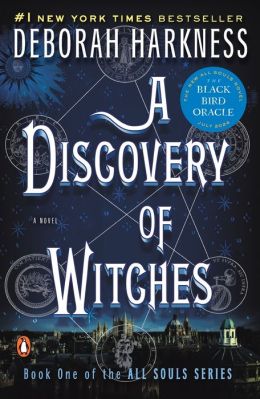
A Discovery of Witches

I have my friend Betsy Friedman to thank for beating me about the head -- uh I mean persuading me to read this book. It's the first book I've read in a long time where I had to force myself to put it down at night and turn out the lights to go to sleep. Rich, interesting settings and characters, including a house that communicates its wishes with groans and slamming doors, hides secrets until they need to be revealed, and spontaneously adds rooms when it's expecting guests. Obviously it is about witches, but also about vampires and daemons and how they have and have not gotten along--for centuries.  Author Deborah Harkness is a history professor at USC and has created two characters also steeped in history. The main witch character, Diana Bishop, is a historian of science, specifically interested in those who pursued alchemy. She has fought her witchy heritage all her life, believing both that it played a significant role in the brutal murder of her parents when she was aged seven, and that she needed to prove to herself that she could achieve academic credibility without using magic. And she largely succeeded at not using magic, until one day she calls up an old alchemical manuscript  from the stacks in Oxford's Bodleian Library and unwittingly unleashes pent-up floods of political maneuvering among the three groups of non-human creatures. An unlikely protector appears in the form of Matthew Clairmont--physician, professor, and ancient vampire, who has lived hundreds of years of history.  Their relationship may be the catalyst for an all-out creature war, or even an evolutionary tipping point. It becomes apparent to one and all that history and magical forces have been leading to this union for a very long time and yet there are those who will stop at nothing to make sure they do not survive together. I can hardly wait to read the sequel, Shadow of Night.

Monday, October 11, 2010

A diversion--Tell No One

Not sure who turned me on to this movie, and I don't usually talk about movies here, but this one was so good that I can't resist. I recognized Kristin Scott Thomas as a co-star, but given that it's a French film (with sub-titles) it's no surprise that my pedestrian experience does not include having seen the lead (Francois Cluzet) or knowing the director (Guillame Canet). It was suspenseful, action filled and tightly plotted. The cinematography was great. A physician whose wife was murdered 8 years ago has come under renewed suspicion from the police when two dead bodies are discovered on land near the old crime scene. Even though it seemed he couldn't and wouldn't have killed his wife, certain facts of the crime just don't add up. And now too many facts are starting to point to him as the killer of not only his wife, but the two dead bodies and a new murder where the evidence is found in his apartment. Altogether too tidy for at least one policeman's taste. The parallel story is that the doctor has received a video via e-mail showing his wife alive and well and 8 years olders accompanied by the admonistion, "tell no one, they are watching." Riveting and absolutely recommended.

Friday, September 7, 2007

Dingley Falls Fails, and Other Books I Did Like


Ah well, just goes to show that no two readers read the same book...where did I just read something about 'the reader writing the book'--oh well, another senior moment. Anyway, I was trying to work my way through Nancy Perl's recent recommended reading (see previous post on The Grand Complication) by tackling Dingley Falls, which, from NP's account sounded irresistible. While she was charmed by the extensive cast of characters, I was overwhelmed, and after reading over 120 pages, still didn't care very much about any of them. One of Nancy Perl's rules is the 'Rule of 50', i.e., there are too many books and not enough time, so 50 pages (minus 1 page for every year your chronological age exceeds 50) is sufficient to make a decision about a book. Obviously I still haven't embraced this wholeheartedly, but I'm working on it. I will agree with her that the novel reads like an elaborate soap opera, but I was never a big fan of soaps, so maybe that's the problem.
But other books have come to mind because of recent conversations with my book buddy Sara--books I really did like. Once when our talk turned to France I was reminded of a really wonderful little memoir by another Sarah (with an 'h") called Almost French: Love and a New Life in Paris. Australian journalist Sarah Turnbull moves to France to live with her true love and for all her infatuation with Paris and the French, she is never really accepted by them but always considered an outsider. On the other hand there are some things she's willing to change-- and some she is not--in order to fit in. It's not just that she's Australian, it's that they are so French. Well, anyway, it's a somewhat humorous and not unkind inside look at culture shock and one woman's eventual success at coping.
Then Sara sent me this very evocative little poem ("Books" by Dorianne Laux) about someone graduating from high school and standing on the brink of whatever is to come after that and, incidentally, the person has stolen a book from the school library. Which reminded me of a really wonderful book, ostensibly written for young adults (but I can't imagine a not-young adult NOT liking it for that reason) called The Book Thief by Markus Zusak. In contrast with Dingley Falls, this was a book where I came to care deeply about all the characters. The young protagonist, Liesl, is farmed out to a foster family near Munich as the Nazis are on the rise and the Hitler Youth are snapping up any youngster of school age. Her mother has fled after burying her son, Liesl's younger brother, and Liesl steals her first book, a gravedigger's handbook. It is this book that her foster father uses to help her learn to read. Along the way, an old debt is repaid by taking in and hiding a Jew in the basement of her foster parents' home and he and Liesl become fast friends. What makes this book really interesting is that a fairly benevolent Death is the narrator. He is kept awfully busy by the events of the war, but not too busy to check up on Liesl from time to time. What also makes it poignant is the significant and layered role that books play in her life. For example, she steals her 2nd book from a pile set on fire during a Nazi inspired book burning, and Liesl reads from her small hoard of stolen books to the gathered neighbors in the air raid shelter to take their mind off what is happening above. I really liked this book.