Showing posts with label cults. Show all posts

Saturday, March 2, 2024

The Mysterious Case of the Alperton Angels


This very twisty tale by Janice Hallett could be called an epistolary novel, or as the book jacket describes it, ""A novel about a journalist in pursuit of a story about a child who survived a cult mass suicide, which may not be all that it appeared to be, told in Janice Hallett's signature original and innovative style of emails, messages, news clips, and screenplay excerpts."

Publishers Weekly summarizes in their review, "...true crime author Amanda Bailey investigates the Alperton Angels, a cult that carried out a mass suicide after one of its members—a teenager whom the cult was convinced had given birth to the anti-Christ—alerted the police to its criminal activities. Eighteen years have passed since the Angels’ death ritual, and no one has been able to track down the mother or her child since. Planning to write a book about the incident, Bailey searches for the missing Alperton baby, now presumably a young adult. There’s only one problem: rival author Oliver Menzies, with whom Bailey shares a checkered history, is on the same trail... Hallett isn’t afraid to make demands of her readers: she pieces most of the novel together via a series of WhatsApp messages and discarded drafts of Bailey and Menzies’ work. The twists never let up as Hallett barrels toward the finish, frequently undermining reader expectations along the way while staying firmly in the realm of fair play. Hallett’s fans and newcomers alike will relish this brilliantly constructed and eminently satisfying mystery."

The New York Times says of its characters. "The book works as a juicy mystery — what really happened all those years ago? — but is equally satisfying as a story about the combative relationship between Amanda and Oliver, observed and commented on by Ellie Cooper, Amanda’s wry, kibitzing transcriber. It’s also an unlikely ode to the joys and frustrations of shoe-leather research, especially when the case is as crazy and convoluted as this one. Amanda is a nimble, occasionally ruthless investigator who flatters and sometimes lies to potential interview subjects. Some of her sources flake out, a few mislead her and others are too frightened to reveal much. Worryingly, fatal accidents befall a number of people right before they disclose any information."  They also sum up my feelings about the book's challenges and rewards. "...At times it can feel as if Hallett is juggling too many balls — interpersonal dynamics, characters’ back stories, a dizzying cat’s cradle of conspiracies and interlocking crimes, not to mention a very complex denouement. It might help to jot down a few notes as you go along, just to keep things straight.But it’s worth the trouble to pay close attention to this highly entertaining tale as you parse the evidence, invited to be an armchair sleuth alongside the characters."

Monday, February 21, 2022

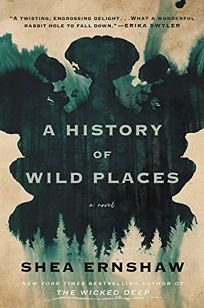
A History of Wild Places


This is the first adult book by Shea Ernshaw, an Oregon YA author,  was a puzzler for a long time--it's almost 500 pages long--and I didn't know until near the very end if it was supposed to be about the supernatural or just humans behaving badly.  It opens as Travis Wren, a man riddled with guilt because he failed to find his younger before she committed suicide, has been asked to find a missing children's book author, Maggie St. James. She's been gone for 5 years, but Travis has a special ability to see people and events associated with objects. A silver book charm that was found near Maggie's abandoned car in northern California provides him with a trail to follow deep into the woods. When his truck gets stuck in the winter snow miles from the main road, he, too, disappears. The story then shifts to several years later and Theo and Calla are a married couple living in a run down farmhouse with Calla's younger sister, Bee, who is blind. They are part of an off-the-grid, self-sustaining community called Pastoral. The leader of the community is charismatic Levi, Bee's lover and, it turns out, the father of her as yet unborn baby. The community believes that their is a deadly disease that infects the woods that surrounds them and that, if they venture beyond the boundaries of Pastoral, they will also become infected and die. People who are caught going outside the boundaries of Pastoral are subjected to purification, being buried up to their necks, to determine if they have become infected. Bee's blindness has given her a hypersensitivity to sounds and she often attends the community's midwife at birthings because she can hear the baby's heartbeat. A baby born prematurely, who will die without medical intervention, precipitates a crisis in the community. Levi declares that one life must be sacrificed to protect the community, but the baby's father takes steps on his own to leave. Theo's job in the community is to watch the gate and make sure no one comes in and no one leaves, but he has an insatiable desire to go beyond the boundary himself. When he tells his wife that he has been going down the road beyond the gate during his night shifts, she is terrified he will die, but protects his secret. More and more secrets emerge until Calla and Theo come to realize that things in the community are not as they seem. Publishers Weekly says the plot "strains credulity, and the prose is often simplistic, but the twisty plot brims with tension." Booklist enthuses, "A richly embroidered tapestry deepens in hues as the story turns darker. Readers will sink into this one, and although they might question details of the resolution, they will be moved by the novel's power."


Friday, January 7, 2022

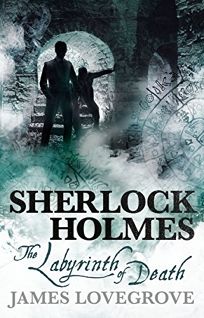
The Labyrinth of Death


I took this book from the holiday gift exchange my mystery book group had and really enjoyed it. I had never heard of author James Lovegrove, but he has written several other books (this is the 5th) featuring the Sherlock Holmes and Dr. Watson pair of protagonists. Set in 1895 (Victorian) London and in the English countryside, the characters seem believable and fairly consistent with past representations. The case here is initiated by a high court judge who comes to Sherlock, upon the recommendation of advocates and police officers he has encountered in court, to find his missing 29-year-old daughter. She is apparently quite a "free spirit," very intelligent and quite outspoken. The judge's wife died recently and he has been less than attentive to his daughter, taking solace in alcohol. It's not long before Sherlock and Watson track down the judge's daughter, but Hannah Woolfson has inserted herself into a unique organization under an assumed name in order to find a missing friend and Sherlock wants to leave her in place since they cannot get closer to the group's setting or founder as both are guarded by armed ex-soldiers referred to as the Hoplites. The term is taken from ancient Greece as is the name of the group--the Elysians. The mastermind of this community is a lauded and titled architect, Sir Philip Buchanan, who is convinced of the superiority of ancient Greek society and plans to train promising individuals and insert them back into British society at large to better it. He doesn't seem to care what the cost might be to the members of his group. When Sherlock reports back to judge Woolfson, he is of course furious, but Sherlock promises her safety. Hannah and the Holmes/Watson pair communicate via letters as to the progress of Hannah's investigations. Watson, who is widowed, is quite taken with Hannah and not at all happy with the arrangement and the potential danger to which Hannah might be exposed. After one particularly disturbing letter, Watson overrides Sherlock's admonitions to stay distant and falls into a trap set at the Elysian community by a man who Hannah had thought to be an ally. Sherlock and Watson must outwit a series of puzzles in an elaborate labyrinth in order to survive.

A middling review from Publishers Weekly.

Tuesday, February 16, 2021

Black Widows


This murder mystery by Cate Quinn is based on the story of a polygamous man who has been brutally and ritually murdered. The book jacket sums it up this way: "Against the wishes of his family and the laws of the elders of the Mormon church, Blake Nelson has adopted the old polygamous ways and lives alone with his three wives, miles from anywhere, in rural Utah. Blake and his wives kept to themselves-and kept most folks out. That is, until his dead body is discovered. Black Widows is told in the three voices of Blake's very different wives, who hate each other, and who sometimes hated their husband. Blake's dead. Did his wife kill him? And if so, which one?" The three narrators, "First Wife" Rachel, sister-wife Emily, and sister-wife Tina, could not be more different from one another. Rachel is a dyed-in-the-wool Mormon, who met Blake in college and who wants nothing more than to forget her horrifying past, where she was raised in and rescued from a brutal polygamous cult. Emily is just a lost soul, constantly rejected by a hyper-critical Catholic mother; she is a chronic dreamer, snoop, and liar. And Tina is an ex-hooker and recovering drug addict rescued during a stint of rehab by volunteer Blake. The police suspect Rachel, but Emily is the one who confesses. I was surprised to learn who the culprit was. The danger of becoming the next victim of the killer is real for all of them. What is really cleverly done is making Blake a central character in his own right even though he's dead from the outset. With Blake gone, of course the sister-wives all suspect each other, but they have also never really seen or known one another. Moreover, at least two of them haven't really known themselves or what they can become once freed from Blake's control. All that emerges as their pasts, their secrets and their dreams are gradually revealed. The setting is also vividly drawn and its influence on relationship dynamics is significant.

It was a good mystery, well told, with insights into some aspects of the regular Church of Latter Day Saints, but also some disturbing descriptions of sexual abuse of underage girls by cults, so consider before reading. Publishers Weekly provides a brief and positive review. The New York Journal of Books calls this a "rock solid suspense novel." The New York Times laments that the police investigators are unidimensional characters but then gushes "oh, my, can this author draw women!"