Showing posts with label California. Show all posts

Monday, February 17, 2025

Mother-Daughter Murder Night


The title of this book by Nina Simon refers to a tradition, held by single mom Beth and teen daughter Jack, to sit down and watch a mystery show on TV every Thursday night. They live on Elkhorn Slough just off the coast of central California. Beth's mother, Lana, a formidable and well-respected commercial real estate broker in Los Angeles, was so appalled when Beth got pregnant at age 17 that they parted ways and now only see each other on Jewish high holidays. Beth has managed to support herself and Jack, becoming a geriatric nurse, while Jack is a child of the water, who paddles out into the slough every morning before going to school. She is so skilled and knowledgeable that she has become the youngest certified kayaking guide at the Kayak Shack nearby, taking groups of tourists and nature lovers on tours of the slough on weekends.

When Lana is unexpectedly diagnosed with metastasizing cancer, she requires extended treatment and care. And so, the two strong and wildly different women are forced to share Beth's tiny 2-bedroom house for months while Jack is turfed to sleeping on the sofa bed in the living room.  On one of Jack's morning tours, a father and son drift away from the group and discover a dead body floating in the mud flats. Of course Jack is traumatized by this and things go from bad to worse when a belligerent and bullying detective initially targets Jack as the likeliest suspect in what turns out to be a murder. Lana decides--to keep from dying of boredom and to protect her granddaughter--that she will figure out who the real killer is.

I wholeheartedly agree with Library Journal's glowing review: Simon's dazzling debut delivers everything a mystery fan could crave, including a realistically nuanced cast of characters, a vividly evoked coastal California setting, writing imbued with a deliciously desiccated sense of wit, and a perfectly plotted murder with enough red herrings deftly dropped in to confound the most experienced mystery reader. ...Insightful and frequently funny analysis of family dynamics wrapped up in a cleverly crafted cozy crime novel." Booklist concludes, " On the cozy side, this debut mystery is woven around family rifts and redemption, and will leave readers with warm fuzzies." Publishers Weekly concurs: "Simon stocks her layered plot with plausibly motivated suspects and convincing red herrings, but it’s her indomitable female characters and their nuanced relationships that give this mystery its spark. Readers will be delighted." Likewise, Kirkus praises, "Simon knows how to build an intriguing plot with lots of suspects, plenty of red herrings, and a handful of jaw-clenching attacks on the Rubicons designed to stop their investigation. Nancy Drew meets Columbo in this feisty-female–driven whodunit."

Wednesday, November 16, 2022

Golden State


I just loved the premise of this book by Ben Winter,  i.e., "In a strange alternate society that values law and truth above all else, Laszlo Ratesic is a nineteen-year veteran of the Speculative Service. He lives in the Golden State, a nation standing where California once did, a place where like-minded Americans retreated after the erosion of truth and the spread of lies made public life and governance impossible." But I felt that it sort of fizzled out after a very confusing reveal. According to his website, Winter is a "data scientist working in the mobile technology industry..." who writes futuristic dystopias. 

Publishers Weekly offers a brief storyline which goes " in the near future, California is a sovereign state governed by absolute truth, and telling a lie can result in jail time or worse. Laszlo Ratesic, a veteran police officer whose innate ability to know when someone is lying helps him piece together unsolved crimes, investigates the death of a construction worker who fell off of a roof during a job. The seemingly accidental fatality is filled with anomalies, which leads Ratesic and the young female officer he’s mentoring to uncover a grand-scale conspiracy with staggering implications." One of those anomalies is a novel hidden inside the cover of a dictionary that Lazlo and partner find in the victim's apartment. Of course novels (being fiction) are strictly forbidden reading. Lazlo believes in the premise of the Golden State until he finds himself unexplainably drawn into reading the novel. I can't say much more about the plot without spoiling some of the surprising twists and turns. In the end, Publishers Weekly was disappointed, concluding that "Winters’s exploration into the nature of truth will grip many readers, but this ambitious novel misses the mark." Kirkus, on the other hand, offers a more favorable recommendation, "it’s still a skillful and swift-moving concoction. For those who like their dystopias with a dash of humor. No lie." I would agree with Kirkus' comparison to author Philip K. Dick's novels (e.g. he wrote the novels on which the movies Blade Runner and Minority Report were based.) Whereas the Library Journal compares his work to other famous dystopian authors, saying "VERDICT Highly recommended for fans of dystopian fiction, especially those who enjoy classics of the genre, such as George Orwell's 1984 and Aldous Huxley's Brave New World."

Monday, April 25, 2022

The Darkest Game


Detective Tully Jarsdel is known around the homicide division of the LAPD as the "professor policeman" since he abandoned his PhD studies in ancient history to become the oldest recruit. Then he was plucked from among his more senior colleagues for a special detail after excelling at a battery of tests designed to assess flexibility of thinking, an analytical mind...to solve cold and other "unsolvable" cases. He is partnered with a detective--Morales--who finds Jarsdel's expansive knowledge of the esoteric and his pedantic "lessons" to be constant provocation to eye-rolling dismissal.

Author Joseph Schneider himself comes from an unconventional background. His former careers include acting, magic, and teaching dance. This is the 3rd installment in the "Tully Jarsdel" mystery series and is kicked off by the point blank shooting of Dean Burken, senior curator at the Huntington Library and Museum. There are lovely descriptions of both that setting and some of the inner workings of the Huntington. The investigation of the murder soon leads to the community of Avalon on Catalina island following the murder of a member of the Huntington's board of directors.  Throughout, we are offered glimpses of Tully's family life--again, very unconventional--which consists of two fathers, one of whom, Baba, is an Iranian emigre and the other, Dad, who is dying of cancer. We also get tidbits about the persecution of those who would challenge the Ayatolloah, after the Revolution in Iran, that drove Baba to leave.

Kirkus especially likes the "elaborate banter between the two detectives. The rogues’ gallery of suspects is as quirky and colorful as anything in Hammett or Chandler, and Schneider’s plot, while linear, is full of surprises...Morales’ brusque, slangy dialogue plays nicely against Tully’s stylish, erudite speech." And they conclude that this book offers "Juicy prose redolent of classic noir, with contemporary twists." Publishers Weekly is more equivocal in its review, complaining about the "lengthy if astute asides on such topics as the museum business, the city's Persian population (Jarsdel's father emigrated from Iran), L.A. history (including, notably, the genocide of the region's indigenous people), and the moral challenge of police work in general..." but concludes that "This flawed but deeply intelligent novel will reward thoughtful readers."

Monday, February 21, 2022

A History of Wild Places


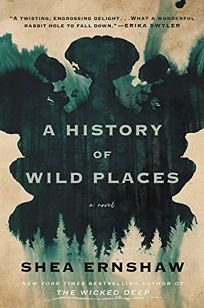
This is the first adult book by Shea Ernshaw, an Oregon YA author,  was a puzzler for a long time--it's almost 500 pages long--and I didn't know until near the very end if it was supposed to be about the supernatural or just humans behaving badly.  It opens as Travis Wren, a man riddled with guilt because he failed to find his younger before she committed suicide, has been asked to find a missing children's book author, Maggie St. James. She's been gone for 5 years, but Travis has a special ability to see people and events associated with objects. A silver book charm that was found near Maggie's abandoned car in northern California provides him with a trail to follow deep into the woods. When his truck gets stuck in the winter snow miles from the main road, he, too, disappears. The story then shifts to several years later and Theo and Calla are a married couple living in a run down farmhouse with Calla's younger sister, Bee, who is blind. They are part of an off-the-grid, self-sustaining community called Pastoral. The leader of the community is charismatic Levi, Bee's lover and, it turns out, the father of her as yet unborn baby. The community believes that their is a deadly disease that infects the woods that surrounds them and that, if they venture beyond the boundaries of Pastoral, they will also become infected and die. People who are caught going outside the boundaries of Pastoral are subjected to purification, being buried up to their necks, to determine if they have become infected. Bee's blindness has given her a hypersensitivity to sounds and she often attends the community's midwife at birthings because she can hear the baby's heartbeat. A baby born prematurely, who will die without medical intervention, precipitates a crisis in the community. Levi declares that one life must be sacrificed to protect the community, but the baby's father takes steps on his own to leave. Theo's job in the community is to watch the gate and make sure no one comes in and no one leaves, but he has an insatiable desire to go beyond the boundary himself. When he tells his wife that he has been going down the road beyond the gate during his night shifts, she is terrified he will die, but protects his secret. More and more secrets emerge until Calla and Theo come to realize that things in the community are not as they seem. Publishers Weekly says the plot "strains credulity, and the prose is often simplistic, but the twisty plot brims with tension." Booklist enthuses, "A richly embroidered tapestry deepens in hues as the story turns darker. Readers will sink into this one, and although they might question details of the resolution, they will be moved by the novel's power."


Thursday, November 15, 2018

Dry

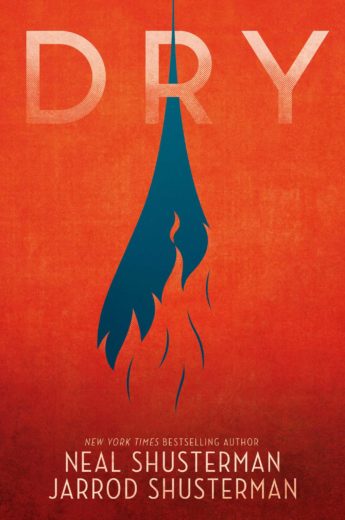
This collaboration between YA author Neal Shusterman and (son) Jarrod Shusterman has been getting rave reviews (Kirkus, Publishers Weekly). The characters are all indeed young adults, but the theme is very current and of concern to all ages. Especially with California once again consumed by deadly fires, this tale of how quickly humanity descends into dysfunctionality when Arizona and Nevada stop the flow of the Colorado River into southern California was scary reading on a very visceral level. I started the book yesterday and finished early this morning if that gives you any idea of how engrossed I was. It reminded me strongly of The Water Knife (about which I wrote some time back) but told from the perspectives of several different teenagers. Alyssa, 16, is your typical high school student who plays soccer and has an annoying 10-year old brother, Garrett. Kelton's family are survivalists living next door in this suburban neighborhood; Kelton has had a crush on Alyssa forever, but she thinks he's creepy because of his family. Jacqui, 19, has been surviving on her wits for 2 years and only hooks up with the other 3 when they go looking for Alyssa and Garrett's now missing parents who went out to look for water. Henry is an adopted 13 year old left at home by his adoptive parents in a gated community while they are on a cruise. He is a schemer and opportunist and meets the other 4 when they come looking for Alyssa and Garrett's uncle. They all quickly find out that no amount of preparation is foolproof when things start to go sideways. The government is slow to respond; FEMA is focused on a hurricane and doesn't see the emergency from a water shortage. Except that it's not a shortage--that's been going on in California for a while; it's the Great Tap-Out and people die pretty quickly from lack of water. But before they do, they turn on one another, lose hope and give up, or become heroes. The questions about under what circumstances we lose our humanity are compelling.

Saturday, September 2, 2017

Y is for Yesterday

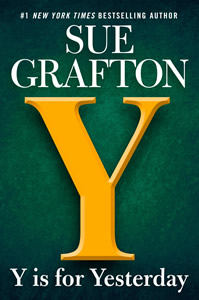
Sue Grafton has taken the somewhat unusual road of setting all of her Kinsey Milhone novels in a short time period in the 1980's, and aging her protagonist only a few years, from 32 in A is for Alibi to 39 in this latest installment (what will happen when she reaches "Z" all her fans are wondering?!--maybe I will go back and start reading from the beginning ;-). The present stories start in the fall of 1989 but one of the threads is tied to events from the spring and summer of 1979, when a teenager, Sloan Stevens, was murdered by a classmate from a fancy private academy. Fritz McCabe, the one who actually pulled the trigger, has now been released from prison since he was convicted as a minor and has to be released on his 25th birthday. His parents have received a $25,000 blackmail demand in relation to a video tape Fritz and his buddies made in high school showing the sexual assault of a very drunk 14 year old classmate by Fritz and another boy, Troy. If the tape were sent to the DA, Fritz would go back to prison for statutory rape, for which there is no statute of limitations. The parents don't want to pay, and are advised not to pay by their attorney, who refers them to Kinsey. Kinsey delves into the past events surrounding the making of the tape, and the cheating scandal at Climping Academy that started the ball rolling and eventually resulted in Sloan's death. Fritz was just a pawn, and the emotional bully who ran the show back then, Austin Brown, disappeared before Fritz confessed and hasn't been seen in 10 years.
Meanwhile, the man who tried to kill Kinsey in the previous book, X, has returned; he is looking for the "souvenirs" he took from the series of young girls he murdered. He thinks either Kinsey or one of his ex-wives might have them, and he will do anything to get them back, including taking a second run at killing Kinsey--for good this time. Meanwhile, the usual cast of characters, Henry, Rosie, Cheney, and Anna are all around and dealing with their own personal dramas. As always, Kinsey's character is feisty and engaging, and the thinly veiled town of Santa Theresa (Montecito) is always fun to visit. The ending was a surprise to me, but then I am obligingly misled.

Saturday, December 19, 2015

X

The latest in the Sue Grafton alphabet series. I have read and enjoyed (and own) "A" through "W" so was happy to dive into this. The brevity of the title gives an inkling of the serious nature of the story...usually the titles have a sub-title, e.g., W is for Wasted. Not only is there a worse than usual bad guy, but Kinsey must come to terms with her own prejudices and misjudgements of former acquaintance and work colleague Pete Wolinsky, who was recently murdered. Then there is the elderly couple who have moved in next door and seem to be taking advantage of Henry's good nature--they turn out to be practiced con artists. Kinsey sets out to catch them cheating in a way that will get them into jail. She takes on one of Pete's old cases to make amends to his memory and to his widow, and in the process crosses swords with a violent stalker of women. She also gets dragged into an enraged divorcee's efforts to get even with her philandering husband by stealing some art.
This felt like a rich and satisfying read. Grafton always has a bit more to offer than, for example, Janet Evanovich, in terms of moral quandries and complex characters. I would put her on the spectrum somewhere between Evanovich and Sara Paretsky--some quirky fun, but also serious issues.

Thursday, February 13, 2014

Califia's Daughters

Boy I do not know how I missed this for so many years, but am grateful once again to the book blog from Powell's Bookstore in Portland for bringing it to my attention! This is Laurie R. King, writing as Leigh Richards, and she is simply a wonderful story teller, whether it is the slightly fanciful Mary Russell/ Sherlock Holmes mysteries, or her darker contemporary novels. The title is taken from the name of the Amazon queen, Califia, in Garci  Rodríguez de Montalvo's multi-volume tale, translated as The Labors of a Very Brave Knight  Esplandián.
In the latter part of the 21st century, the population has been decimated by the inadvertent release of bio-agents when terrorist groups opposed to technology started burning libraries and bombing labs. Another unexpected consequence is that one of the viral pathogens attaches itself to men only and is passed along generation to generation. As the book opens, 90% of the population is women. Men are protected and hidden like precious commodities. Outside of a few recreated cities, people live largely as they did in the 1900's with very basic machines (wind mills, etc.) and rely on farming and trading to survive. It is a largely lawless country and you travel at your peril and are always wary of strangers. So when a couple of covered wagons, accompanied by a guard of a dozen women, and carrying the "gift" of a man and boy come to the secluded Valley in south central California, they are initially greeted by just a few of the 100+ people living there. The travelers are asking permission to move their community south from Oregon because the radiation is poisoning the rivers, and an aggressive woman named Queen Bess is moving relentlessly south from Portland to take over every community that cannot fend off her army.
Dian, head of security for the Valley, begins to fall in love with their newest arrival, Isaac, and so it is harder than expected when she leaves to covertly investigate the group from Oregon before the Valley community offers final acceptance. The journey north is full of surprises starting with an abandoned female infant found at a crossroads. She is ambushed, badly wounded, loses her beloved wolfhound Culum, but is rescued by a man, Robin, living alone in the woods, disguised as a woman. When he is kidnapped by Destroyers, she is forced to go to Ashtown to find him and repay the debt of life she owes. This tale is realistically wrought, fast-moving and so well-developed that you will be looking for these characters after you close the book.

Friday, February 7, 2014

W is for Wasted

It has been ages since I read one of Sue Grafton's "Alphabet" series, although I have them all and have read them all. Kinsey Millhone has aged slightly but it is still the late 1980's when we encounter her in this book. Her PI business has been going well enough that she is not worried about the fact that nothing new is coming in the door right now and she can kick back a little. Then she is contacted by the Coroner's office who inform her that a recently deceased homeless man has her name and phone number on a card in his pocket. Kinsey can't identify him, but as she seeks to identify him, she is shocked to find he is related to her on her father's side and that he has left her his entire estate--almost half a million dollars--and disinherited his three children. Since she has been named executor of his will, it is up to her to deliver the bad news to the children who do not take it at all well.
A seemingly unrelated death of a somewhat sleazy PI Kinsey had known is tied into the whole complicated mess when former lover Dietz shows up at her door claiming he is out $3 K after working for the dead PI and that it was Kinsey who sent the job his way. The deaths of both the homeless man, now known as R. Terrence Dace, and the dead PI, Pete Wolinsky, are eventually tied back to a drug study at the university that the lead researcher, Dr. Linton Reed, will do anything to protect.  The usual cast of characters, Henry, William, and Rosie are all here as is a new addition, Ed the cat. Grafton never fails to entertain, and, in this case, provoke.

Wild

Cheryl Strayed is coming to Bend as part of the "Author, Author!" series put on by Deschutes County Public Library. So I vowed to read the book before she came. This is one of those amazing memoirs that will leave you bowled over by her incredible determination, but also slightly uncomfortable for all the personal revelations. It's a little like seeing someone without their clothes on to have their emotions and most intimate behaviors laid out before you. In this combination of feelings, I am reminded of the memoir by Storm Large, Crazy Enough. Cheryl loses her mother from cancer when the woman is in her early forties and it just tears her and her family apart. Her father was long gone, but her step-father immediately got involved with another woman, and her brother and sister just withdrew. She had no real home, no real family and she subsequently embarked on a course of self-destruction that shattered her marriage as well.
She decides to hike the Pacific Crest Trail (PCT) — by herself — to "find herself" or who she wants to be. She is ill-prepared physically, having never backpacked in her life, and starts off with a pack that she cannot physically lift off the floor, eventually nicknamed the Monster. Even though other hikers eventually help her lighten the load by shedding non-essentials, it remains bigger than packs carried by others because she is alone and must carry everything, instead of sharing--her own tent, her own stove, etc. She starts out with hiking boots a size too small, and though they are replaced with larger ones halfway through the 1,200 mile trip, her feet never recover the entire time, and she loses 6 of her toenails and walks with constant blisters and open sores on her feet. She has almost no money, encounters rattlesnake, bears, mountain lion tracks, unpassable stretches of snow and ice, and at least one pair of hunters with bad intentions. Nevertheless she also finds  good camaraderie among the other PCT hikers she encounters and eventually reaches her goal. It is a moving account and you have to admire — and occasionally shake your head at — her sheer stubbornness. It is well written, and her connection to nature shines through.

Sunday, October 7, 2012

Summer of the Big Bachi

This is the first in a series of books by Naomi Hirahara that feature protagonist Mas Arai. I would almost say, the anti-hero, Mas Arai, because at least in this first book, I did not find much to like about him. He was 15 years old and living in Hiroshima the day the bomb was dropped. He survived physically but many around him did not and he lives with the images of the dead and dying and with the things the survivors did that are hard to reconcile. Some people did overtly bad things, others--like Mas--just failed to do things that in retrospect they wish they had. Bachi is a little like karma and Mas' has come back to bite him one fateful summer in his 69th year. He lives in Altadena and has made his living as a gardener, marrying Chizuko, and then sending their only daughter, Mari, to Columbia. But he is neither a very good husband or father, since he keeps secrets, hides his earnings and spends them on the races, and is generally emotionally unavailable to either spouse or child. His wife has since died of stomach cancer and he hasn't heard from his daughter in a long time. In fact, it is only through a friend, who has a daughter the same age, that he learns his daughter is married and pregnant. The big secret that Mas has kept all these years is that his pal Riki Kimura left their friend, Joji Haneda, to die and stole his papers so he could escape to the U.S. at the end of the war, and has been living under that name ever since. Now someone is looking for Joji Haneda and bad things are starting to happen. When a young Japanese man, claiming to be the grandson of Riki Kimura and Haneda's sister, Akemi, also comes to town and starts snooping around, Mas is reluctantly dragged into sorting things out to prevent an even greater miscarriage of justice. This is an intriguing glimpse into the 1st, 2nd, and 3rd generation Japanese American culture in southern California.