Showing posts with label prejudice. Show all posts

Sunday, September 21, 2025

James


This widely praised retelling of the Huckleberry Finn story by Percival Everett has won both the Pulitzer for fiction (2025) and the National Book Award for fiction (2024) and was shortlisted for the Booker Prize. We are reading this for our book group in October; I have been wanting to read it for several months and feel richly rewarded for doing so. The basic premise is to retell Twain's novel from the perspective of Jim the slave, or as Everett put it, it's a conversation with Twain about a book he could not have written at the time.

Several of the "set pieces" from Huckleberry Finn are maintained while others are added to help create the character of James, a secret reader and philosopher. Library Journal succinctly notes that "The rules of engagement for Black people encountering white people are brutally clear in 1830s Missouri, a state with enslavement. Don't ever make a white person think you know something he doesn't, or you'll pay. " James teaches the local children how to code-switch --using slave speak--within hearing range of whites even though his vocabulary and grammar are far superior to those of his enslavers. They go on in their review, praising the "fast and furious" action, the attention grabbing characters, and an unexpected reveal that "changes the nature of Huck and Jim's relationship dramatically." They conclude by saying that "Everett ...has written an even richer and penetrating Adventures than Twain's already rich masterpiece."

James decides to run when he learns that he is to be sold down river and separated from his family. Huck decides to fake his death to avoid the severe beatings of his father and stumbles into Jim on a small island in the Mississippi River. Booklist summarizes the story's trajectory: "When he is accused of robbery and murder, James flees with an initially gleeful Huck, who only gradually understands the terrifying reality of being a Black man with a price on his head. As Huck comes to acknowledge the depth of his relationship with James, and the "slave's" profound gifts, the boy is forced to recognize the illogic of white supremacy and privilege. Meanwhile James, determined to return and rescue his wife and daughter, takes the story in a completely different direction than the original, exemplifying the relentless courage and moral clarity of an honorable man with nothing to lose."  

Publishers Weekly calls this an "ingenuous retelling" of the classic tale noting that "Everett also pares down the prose and adds humor in place of sentimentality. " They conclude that "Everett has outdone himself." Kirkus praises "One of the noblest characters in American literature gets a novel worthy of him." The New York Times calls this "...Everett’s most thrilling novel, but also his most soulful."

Friday, June 2, 2023

The Measure


This book by Nikki Erlick was another recommendation from the B & N sales person. It's an indictment of human behavior and very relevant to the present time even though it is based on a fantastical event. One morning in March, "every adult on earth suddenly seemed to be sharing the same surreal experience, the ubiquity of the boxes both a terror and a relief." They woke to find a small box with their name on it and the inscription "The measure of your life lies within." Eventually, it is verified that the piece of string in each box indicates when a person will die and, as data accumulates, the scientists are able to determine exactly which month and in which year the person will die. Some people choose never open their box. Many are traumatized to find their piece of string is much shorter than they would wish. But most fascinating and provocative are the reactions of society to people who have the short strings. Would you open the box? When interviewed on the Today show, Erlick said the book "was inspired by the Greek myth about three old women spinning threads of human destiny." Holding a masters degree in global thought from Columbia University, and after visiting a dozen countries in 3 years, Erlick said in another interview "The emphasis on the interconnectedness of the world is something I took with me and put into this book...I had all these different characters and I knew I wanted to create a sense that even in our loneliest, most isolated moments — like when I was writing in quarantine — we’re still connected as humans. Our lives touch other lives even if we don’t actively see it happening.”

There are eight characters, each of whom have their own chapters interspersed throughout. This is a bit hard to track at first, but, as we get to know them and watch how Erlick begins to weave their lives together, we can walk in their shoes for a bit. Several reviewers call the book "life-affirming" and "utterly original." Jenna Bush, the host of the Today Show's book club says about her July pick, "I know it sounds like a book about death but really it’s a book about how we choose to live.”

Spoiler alert: the origin of the boxes is never explained.

Tuesday, February 14, 2023

Demon Copperhead


Inspired by Dickens' David Copperfield and having lived as a child in Appalachia, Barbara Kingsolver sadly has more than enough contemporary parallels to draw upon: poverty, addiction, child labor, loneliness, social class antipathy and humankind's continuing need to find someone "other" to blame for their misfortunes. The narrator is Damon Fields, named after a father who died before Damon was born. He lives with his mother, a frequent drug user, in a tired old single wide trailer in the hollers of Lee County, Virginia. When his mother's boyfriend moves in with them, Damon's troubles are multiplied by his step-father's cruelty and abuse and his mother's subservience in the face of his behavior. When Damon's mother overdoses, the 11-year old is thrown into an uncaring and often brutal foster care system where kids are often seen as free labor and a source of money from the state. Damon is frequently hungry, cold/ hot, and exhausted. School is an irrelevance since he often can't attend. The only family that's ever been kind to him are his former neighbors, the Peggotts, and their adopted grandson, Matthew, used to be Damon's best friend. Damon calls him Maggot and is in turn called Demon. Torn away from even that minimal support system by the state, Demon runs away in desperation, seeking his paternal grandmother, who he has never met. She won't let him live with her but offers to help by finding him a good placement. And he goes to live with the coach of the local high school football team and his non-conformist daughter Angus. Life starts to turn around for him as he becomes an excellent football player, bringing him fame and popularity beyond his wildest dreams. And then his knee is injured and his life begins to spiral downward once more.

Booklist offers a glowing review, concluding that Kingsolver "revels in creating wicked and sensitive character variations, dramatic trials-by-fire, and resounding social critiques, all told from Damon's frank and piercing point of view in vibrantly inventive language. Every detail stings or sings as he reflects on nature, Appalachia, family, responsibility, love, and endemic social injustice. Kingsolver's tour de force is a serpentine, hard-striking tale of profound dimension and resonance.Kingsolver's account of the opioid epidemic and its impact on the social fabric of Appalachia [which] is drawn to heartbreaking effect. This is a powerful story, both brilliant in its many social messages regarding foster care, child hunger, and rural struggles, and breathless in its delivery."

Saturday, November 26, 2022

The Book of Lost Friends


This book by Lisa Wingate tells two intertwined stories, one set largely in the Reconstruction era South and one that is set in a small and still largely segregated town, Augustine, Louisiana in the 1980's. Hannie Gossett is a freed slave now working a sharecropping farm with an aunt and 2 brothers at the destitute Goswood Grove, the plantation where she and her family were enslaved. When she sees a girl sneaking into the plantation house after dark, she confronts her and finds out she is the illegitimate Creole daughter of Hannie's former master. She claims to be the rightful heir to Goswood Grove, but her half sister, Lavinia, denies it. Neither has the paperwork to prove their case and they decide to look for their father, who was headed to Texas two years ago and never returned. Hannie throws her lot in with them, disguised as a boy who can drive their wagon. It is a harrowing journey filled with predators of the human variety and a few surprisingly good people who want to help them.  Novice English teacher Bennedetta ("Benny") Silva has taken a job in the high school of the town that grew up around Goswood Grove. In a desperate attempt to engage her apathetic students, she borrows records from both the Goswood Grove library and the town library and asks the students to pick a real person and find out as much about them as they can. Links from the past to present day families slowly emerge. There is a minor romantic storyline that is entirely predictable and uninspiring. 

Reviews were mixed. Booklist asserts that "Wingate...makes history come alive with the dual tale of formerly enslaved Hannie Gossett in 1875 and Benedetta "Benny" Silva in 1987. Punctuating their struggles are real "Lost Friends," advertisements from a southern Methodist newspaper that featured messages from those searching for loved ones lost and separated by slavery." And they conclude, "Historical fiction fans will appreciate the authentic articles and the connection between modern times and the past, while adventure lovers will enjoy a voyage reminiscent of Huckleberry Finn." Library Journal tells us that "After the Civil War, the Southern Christian Advocate, a newspaper for the African American community distributed throughout the South, included a column called "Lost Friends" that allowed individuals to advertise for information about missing loved ones, generally sold off or stolen before or during the war. That column is the inspiration for this enthralling and ultimately heartening new novel from Wingate...Emphasizing throughout that stories matter and should never go untold, Wingate has written an absorbing historical for many readers." Publishers Weekly, however, says the book is a "disappointing outing" that is "marred by a lack of depth." Their conclusion is even more derogatory, "This underwhelming tale is sunk by its surfeit of deficiencies"

Sunday, October 9, 2022

Cackle


I was in the mood for something a bit more frivolous and this book by Rachel Harrison certainly filled the bill. But there is also a strong flavor of feminism here. This is the review from Booklist:

"Annie's boyfriend was her world; then he dumped her. She can't afford to live in New York City without him paying half of the rent so she moves to a small town to teach. Right away, nothing is quite right. The town is magazine-perfect, but there are persistent spiders everywhere. Before she meets and befriends Sophie, Annie has no one, but then she quickly realizes there is something off about Sophie. The townspeople are terrified of Sophie, who talks as if she has lived quite some time. After she curses a boy in Annie's class, it is clear that Sophie is a witch. Still, Annie is not comfortable in her own company; if she's alone, she seeks solace in alcohol, texting her ex, and later on, a friendly spider. Annie is, at times, annoying, whiny, frustrating, endearing, and interesting. But she doesn't stay that way, with Sophie's help. Sophie's attention toward Annie is a psychological cat-and-mouse game as Sophie wants a witch friend. Annie's evolution from lonely teacher to witch will hypnotize readers." For an additional review, check out Publishers Weekly

Wednesday, July 7, 2021

Where the Crawdads Sing


I have now read this best selller by Delia Owens twice, most recently for my book group, and am astounded at my failure to have posted about it. This is Owens first novel (written at age 70) although she has co-authored--with her former husband-- several non-fiction accounts of her work as a wildlife scientist in Africa. The biography on her website describes her childhood as follows: "Her mother, also an outside-girl, encouraged Delia to explore far into the oak forests, saying 'Go way out yonder where the crawdads sing.' Her mother taught her how to hike without stepping on rattle snakes, and most important not to be afraid of critters of any kind. Delia went on to spend most of her life in or near true wilderness, and since childhood has thought of Nature as a true companion. One of her best friends." Hence we have the basis for the main character Kya and for the title of the book. 

When she is five years old, Kya watches her mother walk away from their rough shack in the North Carolina marshes and Kya doesn't stop looking for her until well into adulthood. Within the next few months, the older siblings all drift away, leaving the now 6-year old to fend for herself with periodic appearances by a drunken and abusive father. Over the next few years, Kya throws herself into learning to survive and even tames her father for a few months by cleaning and cooking to the best of her ability. In that short time span, he teaches her how to fish but then eventually leaves her as well. At one point, the truant officer comes out to take her to school but one day of bullying is all Kya can handle, and afterwards she successfully eludes any attempts to find her in the marshes. She becomes known in town as the "Marsh Girl" and local boys make a sport of coming to her shack to taunt her. And then one day, Tate, a former friend of her youngest brother, comes into her life and he befriends her and eventually teaches her how to read and count. Her curiosity about the natural world around her is limitless and she gradually develops the artistic skills inherited from her mother to start drawing and even painting the creatures and environment she so closely observes. Her only friends are the Black man who runs a small gas dock, Jumpin, and his wife Mabel. Of course, the inhabitants of Colored Town are also outcasts and so are more sympathetic and supportive of Kya, collecting clothes for her and buying the mussels she collects,  thus giving her some small amount of money to buy staples.

When Tate leaves for college, Kya once again experiences her desolate loneliness and is vulnerable to the charms of the town's former high school football star, Chase. He courts Kya until she gives in to his sexual advances, which he brags about in town and then goes off to marry someone else. Chase is eventually found dead out near an abandoned fire tower and Kya is blamed and put on trial. This is a coming of age narrative, a love story, a mystery, and a paean to nature--all rolled up in lyrical language that reflects Owens' passion for nature and her appreciation of humans' (and animals') basest and best instincts. Although set in the 50's and 60's the issues of prejudice, poverty, and longing for belonging still resonate today. The book holds several surprises at the end, but every reader will agree with the NYT's assessment that whatever rewards come to Kya, she has earned the hard way. Read about the book's remarkable trajectory to sell more print copies than any other adult title in 2019.

Tuesday, June 15, 2021

Final Argument


This is the 2nd book I have read recently about getting a convicted black man off death row in Florida; the other was The Guardians by John Grisham. Grisham's book was about a small organization that specialized in getting innocent people out of jail. This book by Clifford Irving is about a former public prosecutor, Ted Jaffe, who has gone corporate and inadvertently finds out that a witness in a case he prosecuted 12 years ago lied about the convicted man's confession of murder. As he digs in, Jaffe becomes convinced that the police detective in charge of the case perjured himself as well. And just to complicate matters, the murdered man was the husband of a woman Jaffe was having an affair with. But Jaffe becomes obsessed with getting a new hearing with this evidence, even though he is not supported by his current law partners, is facing a crisis with a drug addicted son at home, and the man sentenced to die hates him and doesn't want him as his lawyer. I found this a slow read for the first two thirds of the book and truly had to push myself to finish it. As it turns out, winning is going to cost him a lot. Kirkus offers a generally positive review. I would recommend Grisham's book over this one if you want to dip into the whole thorny area of black men being convicted of crimes they don't commit and the prejudices against them in the legal system.

Saturday, May 15, 2021

Hour of the Witch


This is the 2nd novel I have read by Chris Bohjalian; see also my post for The Red Lotus for a little more info on the author. This was a very well-researched historical novel, set in 1662 Boston. This was apparently a town largely comprised of immigrants from England (Puritans) who felt the English church had become too corrupt and were, therefore, seeking a more unadulterated form of worship. Quakers were routinely flogged in the public square as were drunks, adulterers, and anyone who got above themselves. Protagonist Mary Deerfield is a married 24-year old woman who came to the colonies with her parents when she was 16. Her father is a wealthy merchant trader and her older husband, Thomas Deerfield, is a successful miller. He is also physically and emotionally abusive. They have never been able to have children and, since Thomas had 3 children from his previous marriage, they both assume that it is Mary who is barren. Although Mary is a faithful church goer, she is more open minded than many of her neighbors and her actions seem to arouse a fair amount of resentment and suspicion. For example, she consulted a woman herbalist about her inability to conceive. She stopped children from throwing rocks at an elderly Quaker man who had been whipped. She offered herbs to the indentured servant of a neighbor to relieve his suffering from a fatal disease. Mary has never revealed to anyone the abuse and cruelty she endures, and the town considers Thomas an upstanding citizen and godly man. Thomas' abuse seems to be escalating and, when he stabs her hand with a fork, breaking the bones, she begins to fear for her life decides to file for divorce. Such physical abuse is illegal in Massachussetts but it's her word against his that he attacked her, and their servant Catherine swears she has never heard a cross word or seen any abuse from Thomas towards Mary. But being forced to live with Thomas may be the least of her problems as someone seems to be trying to conjure evil forces against her. It is a stark picture of sanctioned misogyny in this period of our history. I have to admit that the book was slow to start, and I was so convinced from the outset that things would turn out badly for Mary that I read the last chapter before deciding to continue. It is well written with well-developed characters and lots of historical detail. 

There are plenty of glowing reviews. The Washington Post calls it "a thriller in structure, and a real page-turner, the ending both unexpected and satisfying." While Kirkus notes the book "Illustrates how rough justice can get when religion and institutional sexism are in the mix."

Monday, May 10, 2021

A Small Death in the Great Glen


A. D. Scott is a new author to me but she has written six or seven books in the "Highland Gazette" series which features Joanne Ross as the protagonist. This is the first book in the series. Scott was born and raised in the Highlands of Scotland so her descriptions of towns, geography, weather, and the people are rich and evocative. The setting is a smallish town in 1956 which is still overshadowed, to an extent, by the losses of WWII. This means that outsiders, whether they are the Italian family that now runs the chip shop or refugees fleeing the strictures of Communism in Poland, are "outsiders." So when a young boy is found in the canal, and it is determined that he was dead before being found in the water, suspicion is easily directed towards those outsiders by a bigoted DI Tompson. Joanne's two daughters were the last to see the boy alive but they are reluctant to talk given that the older daughter had coerced the boy into a forbidden prank of ringing doorbells and running away. All they will say is that he was taken away by a "hoodie crow"-- large black birds signifying evil in children's tales--and their story gains no traction. But when the youngest sees the local Catholic priest, Father Morrison-Bain, at a town festival and shrieks in terror "hoodie crow," at least some people being to suspect his involvement. Joanne is "just a typist" at the Highland Gazette, the local paper, and it is against the express wishes of her verbally and physically abusive husband.  She would like to be a real reporter, though, and have a life of her own, so she is constantly trying to keep her husband (and his parents) appeased by playing the good wife and mother while still doing a little investigating on her own. She enlists the help of other newspaper staff and her friends in town and, collectively, they begin to accumulate a less than savory history on the good priest, even though the thought of his involvement is anathema to the townspeople, especially once it's revealed that the child was "interfered with." Still it isn't as straightforward as it would be in today's environment of huge scandals around sex abuse in the Church.

In spite of the dark subject matter, Kirkus concludes by saying  the book is "A rollicking, cozy escapade, too lighthearted to call Tartan noir." The Historical Novel Society lauds her character development, authentic voice and her ability to "tie up the many ends of her introductory tale with aplomb." Booklist calls it "captivating on every level." I'm looking forward to reading more.

Tuesday, April 6, 2021

Wolf Winter


This was Cecilia Ekbäck's debut novel which I was keen to read after having read her The Historians.  This book is set in Lappland--the northern part of the Scandinavian countries--in the early 1700's. A small family, parents Paavo and Maija, and two daughters, Frederika and Dorotea, aged 14 and 6, respectively. They have apparently traded their fishing boat in a coastal Finland village for an uncle's homestead in Sweden. Paavo, once a successful fisherman, has developed a morbid fear of the water. The rundown homestead is near BlackÃ¥sen mountain, which locals consider to be a place infused with evil; supposedly the devil got trapped in a mountain crevice and hasn't been able to get back home to hell. 

One day, while daughters Frederika and Dorotea are herding the goats in a mountain meadow, they come across the mutilated body of a neighboring man. The few settlers who live in the area quickly explain the death away as a wolf attack. But Maija, who has some training in the healing arts, recognizes the clean slash from belly to chin as what it is--murder by a human, probably one of their neighbors. Maija's determination to get to the truth of the matter is energized when the dead man's widow kills herself and her four children. Everyone Maija tries to talk to seems to be hiding something and respond with reticence or outright anger at Maija for her persistence. If something is amiss, the settlers want to blame the nomadic Lapp herders who come down to the valley every winter. But the Lapps have been the victims of loss, too, and Maija is adamant that she will not let fear, rumors, and prejudice ruin their lives again. There are hints of a backstory in their former home and Maija's grandmother's ghost is a constant mental companion to her. However, when Frederika seeks help from her mother because the dead man's spirit has become a constant and threatening presence, Maija sternly warns Frederika to stay away from such indulgent and dangerous fantasies. There is a significant element of the supernatural--"a dose of…Scandinavian magical realism" (Historial Novels Society)--woven throughout this absorbing entry into the Scandinavian noir genre of thrillers. And Ekbäck's evocation of the beautiful but often unforgiving landscape and life-threatening weather are absolutely compelling. 

The Guardian offers a more detailed plot summary, and, in spite of some reservations about the book, concludes with effusive praise "for the beauty of its prose, its strange, compelling atmosphere and its tremendous evocation of the stark, dangerous, threatening place, which exits in the far north and in the hearts of all of us." Kirkus calls the tale "irresistible."


Tuesday, January 8, 2019

White Teeth

This debut novel by Zadie Smith was also one of those chosen for PBS's Great American Read, and was my 2nd choice for this month's (January 2019) book group. Once again, I failed to complete the book I chose (see A Confederacy of Dunces) and seemed not to grasp what the critics found so gratifying in this novel; after 300 pages, I still did not care about any of the characters. Briefly stated, Kirkus says it's "An impressively witty satirical first novel, London-set, chronicling the experiences of two eccentric multiracial families during the last half of the 20th century." Publishers Weekly calls the book "A remarkable examination of the immigrant's experience in a postcolonial world, Smith's novel recalls the hyper-contemporary yet history-infused work of Rushdie, sharp-edged, fluorescent and many-faceted." While the New York Times asserts that "Zadie Smith's debut novel is, like the London it portrays, a restless hybrid of voices, tones and textures. Hopscotching through several continents and 150 years of history, White Teeth encompasses a teeming family saga, a sly inquiry into race and identity and a tender-hearted satire on religious antagonism and cultural bemusement."
A summary of numerous reviews is offered in The Guardian. 

Tuesday, October 16, 2018

This is How It Always Is

This book by Laurie Frankel has a rather unexciting premise as its foundation, but I read it because my friend Joan Ward recommended it to me. It is the story of how one family copes when their youngest child decides at age 3 years that he would rather be a she. But that fails to convey what a beautifully written, loving, and compelling story this is.  You struggle along with the parents and the siblings as well as Claude/Poppy in trying to find the best path forward in a society that sees only "either/ or" rather than "and."
Rosie and Penn have a magical love for one another that seems to have begun before they even met. When first they get together, Penn is a struggling writer and Rosie is an ER resident. Penn sits in the ER waiting room every time Rosie has a shift--for hours at a time--just so he can talk with her on her breaks. He's working on a novel. When they marry, he becomes the stay-at-home parent. They have one boy, then two, and then four when twins are born, and in one final attempt for a daughter, they get Claude. But Claude really loves girl things--clothes, cooking, girlfriends--and Rosie and Penn are determined that they will support their wonderful child no matter what, so eventually he goes to pre-school in a skirt, wearing a pair of wings, and after some push back from his teacher, settles into being a girl with a penis. The other kids just don't care much at this stage. But of course that can't last. When a transgender college student is brought into the ER beaten and stabbed and dies, Rosie panics and decides Madison is not safe and they move to Seattle. Poppy becomes best friends with Aggie next door, and although Aggie's parents know about Claude/Poppy, they ask Rosie and Penn not to say anything to Aggie. And so the entire family guards this secret until it is no longer a secret. The next step Rosie takes to help her youngest is more dramatic. She volunteers to work at a clinic in rural Thailand and takes Claude/Poppy with her. Penn is the steady anchor at home, telling all his children a never ending Sheherazade-like fairy tale full of lessons for life. Their conversations and struggles as they try to figure out how best to help Claude/Poppy are achingly realistic. You will absolutely love every member of this family. Don't miss this thought provoking story. Reviews from The New York Times, Kirkus, Publishers Weekly, and the Star-Telegram. Received numerous best book of the year awards. Here is an interview with Laurie Frankel on NPR about being the parent of a transgender child.

Wednesday, January 4, 2017

The Color of Water

I read this some time ago and did not realize I had not written a blog post about it. This was also a book group selection; it is a memoir and commemoration of James McBride's Polish, Jewish mother, Ruth. McBride's father was black and he had 11 brothers and sisters. After leaving the south, where she was raised by an abusive Rabbi father and a sickly and non-English speaking mother, Ruth made her way to Harlem. She married and was widowed from two black men. Nevertheless, she managed to send all of her children to college. It is a truly remarkable story of a woman who was disowned by her Jewish family when she married and never looked back. She adopted the black community and seemed fearless in being a part of it, even when her children feared for her. When one of her children asked her what color God was, she replied "the color of water."
McBride has worked as a professional journalist (Boston Globe, Washington Post) and musician (jazz and blues saxophone), and then he decided to write this book. He began interviewing his mother, who he admired and loved but felt he did not really know much about, and the entire process took 14 years. This book was on the New York Times best seller list for two years and there are numerous laudatory reviews: The New York Times, Kirkus, Publishers' Weekly
Highly recommended.

Sunday, December 11, 2016

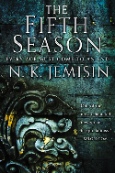
The Fifth Season

Another new author to me, N. K. Jemison is referred to as a "speculative fiction" writer of short stories and novels, many of which have received literary nominations and awards. The Fifth Season, the first part of her "Broken Earth" series,  won The 2016 Hugo Award. One of the common themes of her writing is oppression and this book is no exception. People oppressing others because they are different and mostly because they are afraid, should certainly resonate in our current political climate. This description of The Fifth Season's precipitating events, from Jemison's own website, sums it up more succinctly than I could.
"Three terrible things happen in a single day. Essun, a woman living an ordinary life in a small town, comes home to find that her husband has brutally murdered their son and kidnapped their daughter. Meanwhile, mighty Sanze — the world-spanning empire whose innovations have been civilization’s bedrock for a thousand years — collapses as most of its citizens are murdered to serve a madman’s vengeance. And worst of all, across the heart of the vast continent known as the Stillness, a great red rift has been torn into the heart of the earth, spewing ash enough to darken the sky for years. Or centuries."
Essun goes in search of her missing daughter, trying to navigate a broken world, and a rapidly deteriorating social order where her kind--the Orogenes--are trained and used, or killed, but above all, feared.
There's a great review by Naomi Novik (see my post on her novel, Uprooted) in the New York Times. Also good reviews from Publishers Weekly, Kirkus, and NPR.

Sunday, January 17, 2016

The Hangman's Daughter

Oliver Pötzsch is a script writer for Bavarian TV and has now also written 5 books in this series which begins with The Hangman's Daughter. The protagonist is the hangman himself, Jakob Kuisl, who in 17th century Bavaria, also served as chief torturer and, unofficially, as a local healer in the town of Schongau. At that time, doctors believed the body was ruled by "humors" and so relied on bleeding, cupping, smelling the patient's urine and other similarly useless tasks; whereas midwives and other local healers relied on herb lore. We are left in no doubt as to which approach was more effective. However, people were alternately very superstitious about those who used such remedies and when problems arose, those same native healers were often labeled as witches or devils and persecuted to the grave. Hangmen, too, were shunned by the townsfolk as a necessary evil and so they and their families lived in the less desirable parts of town and could not interact with the wealthy burgers.
The story opens when Jakob is a boy, trying to wake his father from a drunken stupor in order that he can go hang someone. This is not a profession that brings great happiness, apparently, and this was common behavior for Jakob's father.
Thirty five years later, Jakob is now the town's executioner and has a family of his own--his wife, a nearly grown daughter, Magdalena, and two younger twins. Magdalena has her eyes on Simon Fronwieser, son of the town's physician; Simon is disgusted by how his father practices medicine and seeks to learn all he can about healing. Surprisingly, Jakob has a relatively extensive library of more progressive medical texts and so Simon is a frequent visitor at the house, and is equally besotted with Magdalena. This horrifies Simon's father who believes, like the other wealthy men in town, that one should not fraternize with the hangman's family.
Now a young orphan turns up in the river, fatally beaten and wounded with a crudely made symbol on his shoulder that the townspeople immediately conclude is evidence of witchcraft. They target the local midwife, Martha Stechlin, and it is up to Jakob, Simon and Magdalena to find the real killers before Jakob is forced to execute Martha as a witch. It is a sufficiently intricate plot to keep one guessing as to who is behind this and the additional murders of children that occur in the next few days. Time is running out for Martha, when Magdalena is kidnapped by a man with a hand of bone; those who've seen him believe is a devil summoned by the witch. Lots of good historical detail and description. The author is directly descended from the Kuisl dynasty of executioners and so had a great starting place to learn about what their lives were like. This will be a good recommendation for those who love historical fiction, a good mystery or a bit of the paranormal. Very readably translated from the German by Lee Chadeayne

Saturday, December 19, 2015

Major Pettigrew's Last Stand

This debut novel by Helen Simonson is next up for my book group and, although I did not feel totally engrossed in the book, I did come to feel a certain fondness for Major Ernest Pettigrew (retired), a widower living in the village of Edgecome St. Mary in Sussex. The major has been living alone for several years now; his ambitious and mostly unlikable adult son, Christopher, is in "The City" as an investment banker and seems to think his father is not worth his time. Nevertheless, he and his new American girlfriend, are renting a cottage near the Major to keep an eye on him.
Major Pettigrew's younger brother, Bertie, dies unexpectedly, and he is dealing not only with this new grief, but distress that the mate to a valuable Churchill shotgun may not be returned to him by the widow. The matched set were divided between the two sons when the father died; at the time the father stipulated, verbally, that the guns should be reunited when one or the other of the brothers died. Major Pettigrew wants the gun because it confers prestige, and because he always felt, deep down, that as the oldest son it was rightfully his. On the other hand, Christopher and Bertie's family want to sell the guns to get the money.
Major Pettigrew is comforted in his grief by an unlikely outsider, the widow of a Pakistani shop owner in the village, Mrs. Jasmina Ali. She is smart, beautiful, a good business person, and loves literature. They become friends and would like to become something more. But the village and Ernest's family and friends look down on her because of her color, her religion and her social class. She is sucked back into her brother's family, and even though her husband left the shop to her, it appears it will go to his nephew instead, if the family has its way.
Major Pettigrew has a sharp wit but is on the verge of giving up when sensible Grace--the suitable choice of partner for him--encourages him NOT to settle but to pursue his passion. He drives north, helps Jasmina escape, and in the end, even rescues the seemingly cold-hearted nephew. All ends happily after all.

Friday, May 9, 2014

Boy, Snow, Bird

Hard to know where to start in describing my reaction to this novel by Helen Oyeyemi. I was drawn to it and puzzled by it and occasionally repelled by it. Boy Novak is the "name" given to the narrator for parts 1 and 3 of the book. Snow is her step-daughter, and Bird is her daughter (also the narrator for part 2 of the book. Boy is raised by an unimaginably cruel father, Frank; the mother's identity and whereabouts are unknown--until the very end of the book. As soon as she possibly can, Boy runs away from Manhattan and travels as far as the bus will take her with the $20 odd she stole from her father, which, as it turns out, is Flax Hills, Massachussetts. She is blond and attractive and eventually marries dark haired, good looking professor turned jewelry artist, Arturo Whitman. Arturo is widowed and has a young daughter, Snow, who is as pale as her name. Arturo's mother and sister live next door. Boy is initially infatuated with Snow, but when Bird is born, Boy takes a dislike to Snow and sends her to live with an aunt and uncle--a sister of Arturo's she did not know about until she married Arturo and received flowers from her. Bird's birth raises rather a host of problems as it is obvious that she has Negro blood, which eventually reveals the fact that Arturo, his sister Vivian, and his parents have been "passing"--it is the middle of the 20th century and racism is still blatant and burdensome. The other sister was sent away by her mother because she was too dark to "pass." Boy loves Bird, but is somewhat cool and distant and will never explain why she sent Snow away. But in part 2, Bird discovers a letter from her step-sister, addressed to Bird but hidden by Boy. Bird is now 13 and dealing with racism in her small town, as is her best friend, Louis Chen. When Snow finally comes to visit the following Thanksgiving, the sisters reconnect and Boy and Snow reconcile to a degree. Boy's best friend Mia, an investigative journalist, uncovers a devastating secret about Boy's own life that totally knocked me over. I'm honestly not sure why Oyeyemi chose to include this plot twist. There is always a sense of both the magical and the sinister woven throughout what is a very compelling narrative in this novel. The whole notion of mirrors, symbolizing outward appearance, also plays a key role for Boy, Snow and Bird who often see something--or nothing--in mirrors that differs from what others see. You'll have to decide for yourself if you like this book. Reviews were favorable: here is the one from the NYT; and from The Guardian.

Thursday, May 30, 2013

City of Shadows

I picked up this book by Ariana Franklin, because I had been so taken with her medieval mysteries (see Mistress of the Art of Death and The Serpent's Tale) and was surprised to find this set in 1920's and early 30's Berlin. The "White Russians" have fled the Bolshevik revolution, the Communists and the National Socialists are in a no-holds-barred fight for the hearts and minds of the German populace that is being slammed by exponential inflation as the Weimar Republic staggers to its knees, and Jews are--as always--being blamed for everything. The criminals and thugs are prospering either through illegal activity or through gang violence, and yet people still long to believe in fairy tales, like the one about one of the Romanov children having escaped the slaughter of the czar's family. So when Esther Solomonova's boss, "Prince Nick," a corrupt nightclub owner, decides to rescue a woman from an asylum and pass her off as Anastasia, Esther is roped into the helping the young woman. Her objections to the fraud become secondary, however, when people around the fake czarina begin to die. Once again, we see how fear and complacency allow evil to blossom as Germany heads for the horrors of WWII and the purge of anyone non-Aryan, and non-conforming. Still, in spite of the grim historic situation, there is a bit of romance and a fairy tale ending to this one, so dive in and enjoy Franklin's rich attention to historic detail and character development. You'll need to suspend your disbelief a bit, but then we all do that every day, don't we?

Saturday, April 27, 2013

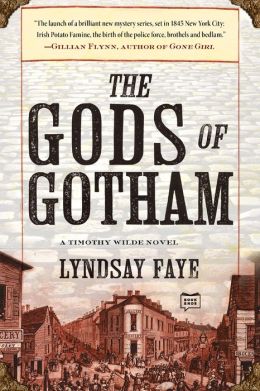
The Gods of Gotham

When a young boy's body is found in a waste bin with the front of his body crudely cut in a cross and several organs missing, the nascent NYPD, called "The Copper Stars" in 1845, are all hands on deck trying to find out why. This is a period of time when daily shiploads of starving Irish immigrants pour into a city that already has insufficient work and housing for them and the anti-Catholic sentiment is at burning point. Tim Wilde, younger brother of political wheeler dealer and now police captain Val Wilde, has reluctantly become one of the first crop of Copper Stars after an explosive fire burned his home, his decade-long savings, and part of his face. And it turns out he has a special talent--for observing things others miss--and that may make him especially useful at solving crimes rather than just preventing them, or so his new boss believes. On his way home from a particularly bad day, a small blood-soaked girl literally runs into Tim and instead of turning her in, he shelters her and finds that none of the blood is her own. Eventually he learns that she comes from a house that sells the services of children as well as women, and that several children have disappeared from there whenever a man in a black hooded cloak visits. With the help of unlikely allies, a mass grave of 19 children, probably all Irish, is found and it appears a serial killer is at work. A letter claiming responsibility for the murders is sent to the paper and threatens to stir the anti-immigration sentiment into a fiery riot, but the truth is much more complicated, as is the human heart. Great historical detail, vividly described and compelling characters all serve to make this an engrossing read. Several aspects of the ending definitely caught me by surprise.

Saturday, April 13, 2013

Voodoo River

With a title like Voodoo River, it's little wonder that this "Elvis Cole" installment by Robert Crais is set in the bayous of Louisiana. Normally I like to read a series in order, but I picked up a few paper backs to take to New Zealand and got hooked again on Robert Crais, so am kind of reading whatever I have on hand (see earlier reviews of Free Fall and The Last Detective). This one goes back to the time when Elvis met Lucy, then an attorney in Baton Rouge. Elvis is supposed to be tracking down the birth parents of a TV star, who it turns out, is being blackmailed about her parentage. Said star doesn't tell Elvis that and he finds out the hard way by running head on into the blackmailer and some even worse bad guys who eventually kill the blackmailer; they are also running illegal immigrants into the country. There are some pretty colorful characters here, including a centenarian snapping turtle named Luther who can bite a 2 X 4 (that's a board) into splinters and you just know he's going to be bad news. Pike comes out from LA to make sure Elvis comes out the other end of a high risk double cross designed to round up the  coyotes at the top of the food chain and get the blackmail victims off the hook. Lucy crowns Elvis with the moniker "Studly DoRight" in this book, and we meet her son Ben, so a lot of the material for subsequent books gets its genesis here...good one to read if you want to dive into these--and they are well worth reading. As I said in earlier reviews, there is a lot of actual detecting that goes on in this series.