Showing posts with label Depression (economic). Show all posts

Tuesday, October 28, 2025

This Tender Land


This Depression-era novel by William Kent Krueger is one of his stand-alone books about 3 youths who escape one of the notorious "Indian Training Schools" and a young orphan girl in the care of horrible superintendents of the school. They go in search of different things--sense of self, family, home. They are tied together by friendship, by kinship and by terrible events that preceded their leaving and which now mean they are hunted by the law. They are thrown out into a United States that is starkly divided between the haves and the have-nots, the latter being where they typically find support and generosity. Starting out in a canoe on the Gilead River, they eventually make it to the Missouri and then the Mississippi in St. Paul, Minnesota. Their travels are beset by difficult times and dangerous people as well as empathetic helpers--all of which stress their relationships to one another. 

Library Journal says, " It's a remarkable story of a search for home that also reveals the abusive treatment of Native American children in schools and the wanderings of people during the Depression." Booklist agrees that this "... is more than a simple journey; it is a deeply satisfying odyssey, a quest in search of self and home. Richly imagined and exceptionally well plotted and written, the novel is, most of all, a compelling, often haunting story that will captivate both adult and young adult readers. Publishers Weekly calls it a "heartland epic" in which "the constant threat of danger propels the story at a steady clip." One reviewer (Parade) aptly compares it to Where the Crawdads Sing. The Historical Novel Society praises inn concluding their review, "Crafted in exquisitely beautiful prose, this is a story to be treasured – outstanding and unforgettable."

Tuesday, April 29, 2025

Crossing to Safety


Having already won a Pulitzer for Angle of Repose and a National Book Award for The Spectator Bird, Wallace Stegner crafted this loving reflection on friendship and the vicissitudes of life. I read this book decades ago, have recommended it to many and, in the process, lost my own copy. So I re-purchased the book and re-read it for one of my book groups. The lyrical language and the portrayal of the main characters grabbed me as firmly as they did the first time around. The first sentence is illustrative of his magic with words: "Floating upward through a confusion of dreams and memory, curving like a trout through the rings of previous risings, I surface. My eye open. I am awake."

Two couples meet in Madison Wisconsin through their husbands who are novice faculty/ instructors in the university's English department. Sid and Charity Lang come from east coast social class and money. Larry and Sally Morgan are poor westerners, yet somehow they bond, largely through the effusive and generous efforts of Charity. Both Charity and Sally are pregnant, due to deliver at the same time and so the baby delivery derby is on. Sid and Larry share long walks to talk over the multiple obstacles they face to find permanent employment in the middle of the Depression (1937). Both feel the university offers promise. Sid wants to write poetry but his wife drives him to write academia; whereas Sally supports Larry fiction writing passion. They both have to teach to earn their chops. During the good times they share, the two couples feel they are the "four in Eden.'' But, in Eden, there was also a serpent in the grass and in this case it is Charity's drive to make her husband into something he is not. "...headstrong, insufferably well-organized Charity tries to bully the passive Sid into a more aggressive mold. Charity is one of the most vivid characters in fiction; if she is arrogant, she is also kindhearted, enthusiastic, stalwart and brave--an ardent liver of life. Her incandescent personality is both the dominant force and the source of strain in the enduring friendship Stegner conveys with brilliant artistry (Publishers Weekly).

Publishers Weekly calls the book "a meditation on the idealism and spirit of youth, when the world is full of promise, and on the blows and compromises life inevitably inflicts..." and goes on to assert that Stegner "has created a believable human drama the dimensions of which reach out beyond the story's end and resonate in the reader's heart." Library Journal closes their review by saying, "This is a wonderfully rich, warm, and affecting book. Highly recommended." To be fair, I include the comments from Kirkus' less than laudatory review which opens and closes with the following: "Stegner takes a long look back—at four decades of a foursome's life—in a novel that at moments is beguiling, though at others it labors for its theme... Stegner clings to his theme of undying friendship beyond the point where his material keeps it alive, leading him to an often visibly artificial and conventionalized effort to push things along to their end. In all, less moving as a whole piece than highly remarkable for the fine penetration and achievement of some of its moments." I still thought the journey was worth it, precisely because of those moments.

Friday, May 24, 2024

Edge of the Grave


Robbie Morrison, Scottish born and bred, wrote what was intended to be a series featuring protagonist Jimmy Dreghorn, a detective in a special squad of the Glasgow police department. To my knowledge, there is only one sequel, Cast a Cold Eye, nor could I find an author website. You can find information about him on Amazon and Wikipedia. I think the "Tartan noir" (Scottish authors) could give the "Scandi-noir" a run for its money in creating crime fiction; although, this book does, at least, offer glimpses of humor.  Set primarily in 1930's Glasgow, there are chapters that fill in Jimmy's background, both when he was a teen and when he was in WWI. His partner Archie McDaid,  is brawny and Dreghorn frequently refers to him as "Big Man," whereas Archie refers to his partner as "wee man." Jimmy is also the only police officer of Catholic upbringing in a force that is almost exclusively Protestant. It is a time when that still mattered and even the numerous and vicious gangs that rule the streets are either Catholic or Protestant. DI Dreghorn and Sgt. McDaid are part of a team specially picked by the new Chief Constable to address the rampant gang violence. When the book opens, they have been called to the scene of domestic abuse, with the wife beaten senseless and the small child murdered. The husband is loosely affiliated with one of the gangs and so Dreghorn and McDaid put pressure on the gang's leader, "King Billy," to help then find him. He agrees on the condition that Jimmy will look for Billy's sister who disappeared 20 years ago.

The pair are also the first on the scene when a body is pulled from the Clyde River near one of the shipyards that have been the foundation of Glasgow's economy; since the end of the Great War, many of the yards have been idled and many men are now out of work. The victim turns out to be the son-in-law of the owner of the largest shipyard in Glasgow and the wealthiest man in the City, Sir Iain Lockhart. Lockhart detested the man his daughter had married. "The deceased's widow, Isla, was Jimmy's doomed first love, and the investigation draws him back into his past, when he was a young boxer training under her father. Jimmy's instincts are dangerously muddied by complicated loyalties as the investigation reveals a criminal tangle of serial murder, blackmail, and child trafficking that bridges the gap between the gangland underworld and high society" (Booklist).

There is a very interesting Q & A with Robbie Morrison where he discusses the influences on his writing, and Morrison also provides a great "Author's Note" at the end of the book that indicates what is fact and what is fiction in this story.

Sunday, August 20, 2023

The Four Winds


Kristin Hannah's relatively new book (2021) centers on one family experiencing the Dust Bowl in Texas. The years of relentless drought and wind destroy not only the land, but also the lives attached to it. "In 1921, Elsa Wolcott is a tall, bookish woman of 25 whose soul is stifled by her superficial parents. By 1934, after marrying Rafe Martinelli, a young Italian Catholic who was the first man to show her affection, Elsa is a mother of two who has found a home on her beloved in-laws' farm (Booklist)." "...the Martinelli farm is no longer thriving, but Elsa is attached to the land and her in-laws, and she works tirelessly and cares for her children, 12-year-old Loreda and seven-year-old Anthony. Her husband, Rafe, has become distant and something of a hard drinker, and ...he abandons them (Publishers Weekly). When Anthony develeops silicosis (dust pneumonia), Elsa is forced to leave her beloved inlaws and save her children by migrating to California. What awaits them is almost worse. Migrants have flooded west and resentful residents call them Okies, no matter where they came from. Employers are quick to cheat and exploit them. They are treated with condescension and scorn, forced to live in squalor, and paid pennies an hour for back-breaking work. Harper "convincingly portrays Elsa's coming of age from sheltered recluse to workers' rights champion (Library Journal). So many of the issues still resonate today. Hannah is an accomplished writer who lets you feel all the pain and sadness. I loved her first book, The Nightingale, and this book also features an incredibly strong, resilient woman; Kirkus says of her, "Elsa displays an iron core of character and courage..." But they also accurately note that this is "a saga of almost unrelieved woe."

Sunday, August 4, 2019

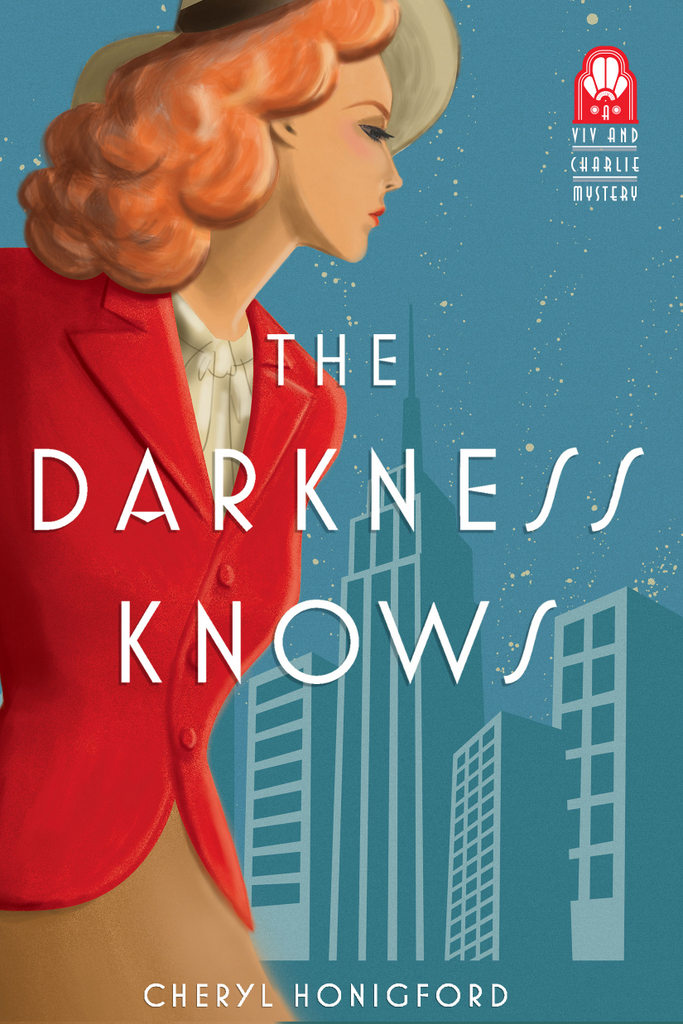
The Darkness Knows

This debut novel by Cheryl Honigford received good reviews as a cozy type mystery. It's set in 1938 Chicago, a time when still too many people suffer the after effects of the Depression and everyone is worrying about events in Europe that threaten war. Protagonist Vivian Witchell was in the right place at the right time to pick up a good role in a popular detective series, "The Darkness Knows,"  that airs on radio station WCHI, where she had previously worked as secretary to the somewhat lecherous station manager, Mr. Hart. She is still in awe of her handsome co-star, Graham Yarborough, and in a battle with another woman actress who would do anything to get Viv's part in the broadcasts. When Viv stumbles over the dead body of another radio star in the staff lounge late one night, it turns her world upside down, not only because of the horrifying discovery, but also because there's a letter with the body suggesting that Viv's radio character might be the next victim. Is some crazed fan killing off the make-believe characters in WCHI's radio shows, or is one of the station's staff using this as a clever diversion? Station manager Mr. Hart is taking no chances and assigns the special consultant to "The Darkness Knows," P.I. Charlie Haverman, to keep Viv safe. It's a harder job than it sounds, for when Viv receives her own threatening letter, she determines to find out who the killer is before she becomes the next victim, and she refuses to stay safely tucked away at home. Sparks begin to fly between Viv and Charlie on several levels, predictably. We get some tantalizing glimpses of Chicago in the post-Depression years, and insights into the golden age of radio. This is the first of the "Viv and Charlie Mystery Series" and I may check out the next installment, Homicide for the Holidays.
Short reviews from Kirkus and Publishers Weekly, with a lengthier one with lots of info on plot and characters from The New York Journal of Books.

Sunday, April 8, 2018

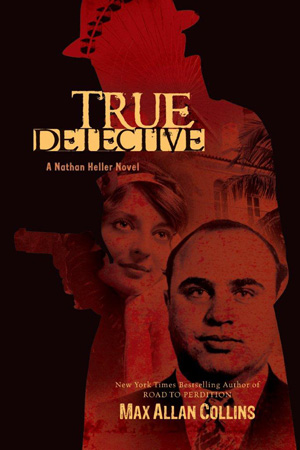
True Detective

I recently read a book by Max Allan Collins, Quarry, and although it wasn't my favorite book of all time, I was sufficiently intrigued to order the DVD of the TV series that was made from that book and this first book in Collins' "Nate Heller" series, which won a Shamus award. See more info about Collins on his blog and in my post for Quarry.
Set in 1933 Chicago, just a year before the opening of the World Fair, Nathan Heller is a detective for the Chicago Police Department, thanks to his uncle Louis putting in a good word to get him on the force in the first place, and also due to his being willing to lie about who killed a journalist/ gangster. But Nate does have standards and when he gets unwillingly dragged into yet another dirty trick on the part of the Chicago PD and the mayor, he decides to quit and go private. Two detectives who are in the pocket of Mayor Cermak drag him along to roust a bookie joint run by Frank Nitti and in the process Heller kills a young man in self-defense. One of the detectives shoots Nitti and then wounds himself claiming that he shot Nitti in self-defense. Nate knows otherwise and the pressure is on for him to lie again in the upcoming investigations. If he agrees, the mayor will let him get his PI license; if Heller insists on telling the truth, he won't be able to work. In this novel, fictional protagonist Heller is friends with a number of real people including Eliot Ness of FBI fame and Barney Ross, the lightweight boxing champion. He meets FDR, George Raft, and Al Capone. There are a lot of colorful characters in the book because there were a lot of big personalities fighting for control in Depression- and Prohibition-era Chicago. It's hard to be an honest detective in a pervasively dishonest system and much of the book deals with Heller's ongoing efforts to draw a line and still stay alive. The book is typical of the hard-boiled detective genre and is very atmospheric in describing Chicago of the 1930's. I frequently read the acknowledgements and Collins lists dozens of books he consulted to get the historical details for his book. A much more detailed plot summary and a less-than-laudatory review from Kirkus is here.

Sunday, September 20, 2015

Breaking Blue

Author Timothy Egan is a Pulitzer Prize-winning journalist and has also written several prize-winning non-fiction books, as well as several works of fiction. He will be the first author to visit Bend as part of the library's "Author! Author!" series. Here he provides a narrative account of an investigation into the oldest open murder case in the state of Washington, that of Newport town marshall George Conniff, which took place in 1935. The current Sheriff of Pend Oreille county, Tony Bamonte, while writing a history of the county's law enforcement for his master's thesis, uncovers evidence about Conniff's murder by black-market butter thieves that suggests Spokane policemen were involved, and covered up for the killers.
When Bamonte sought their help with his investigation into the cold case, Spokane PD were non-responsive and uncooperative; they wanted nothing to do with a "do-gooder" cop who is willing to go against the brotherhood (even though he was investigating the death of a law enforcement officer) and bring bad publicity to the Spokane police department in the process. But Tony is dogged and tracks down the few remaining witnesses, the murderer himself, and--amazingly--the lethal weapon, which had been thrown into the Spokane River over 50 years ago. His obsession brings closure to the children of George Conniff, even though he fails to get an indictment against the murderer, former Spokane detective Clyde Ralstin. However, it costs him his marriage of 25 years, and his job.
Evocative descriptions of Depression-era Spokane and eastern Washington, and of the dying towns of more current day eastern Washington as the mining, timber, and cement industries fade away.  This is true crime clothed in a readable story that fleshes out characters, motives and settings. If you enjoy the work of Erik Larson, are a true crime aficionado and/ or are a local history buff, you will enjoy this book. Additional reviews from Kirkus, Publishers Weekly, New York Times.