Showing posts with label mythology. Show all posts

Tuesday, February 13, 2024

Lavinia


This historical novel by Ursula LeGuin was a somewhat new direction for her. In case you don't check out the website above, I offer this summary of her achievements here: 

"Ursula Kroeber Le Guin (1929-2018) was a celebrated author whose body of work includes 23 novels, 12 volumes of short stories, 11 volumes of poetry, 13 children’s books, five essay collections, and four works of translation. The breadth and imagination of her work earned her six Nebula Awards, seven Hugo Awards, and SFWA’s Grand Master, along with the PEN/Malamud and many other awards. In 2014 she was awarded the National Book Foundation Medal for Distinguished Contribution to American Letters, and in 2016 joined the short list of authors to be published in their lifetimes by the Library of America." 

Of all the reviews I read, I thought this one from Library Journal the most accurate:"She was a minor character in The Aeneid, a "silent, shrinking maiden," but in Le Guin's brilliant reimagining of the last six books of Virgil's epic poem, Lavinia, the Latin king's daughter with whom the Trojan hero Aeneas founds the Roman Empire, finds her voice and springs fully to life. Protesting the Roman poet's dull, conventional portrait of her-"He slighted my life in his poem"-Lavinia takes us back to a Bronze Age Italy inhabited by Latin-speaking tribes. Under the rule of her father, the kingdom of Latinus is at peace until Lavinia turns 18 and the suitors arrive. Her mother Amata wants her daughter to marry her handsome, ambitious nephew, Turnus, but Lavinia is reluctant. Like her father, she can commune with the sacred spirits and in a memorable dreamlike scene meets the dying Virgil, who tells her Aeneas's story and her role in his life. Thus armed, Lavania resists her mother's will and decides to make her own destiny when early one morning the Trojan black ships sail up the Tiber River. As Le Guin's afterword acknowledges, this beautiful and moving novel is a love offering to one of the world's great poets..." 

Kirkus offers high praise: "...Le Guin has researched this ancient world assiduously, and her measured, understated prose captures with equal skill the permutations of established ritual and ceremony and the sensations of the battlefield...Arguably her best novel, and an altogether worthy companion volume to one of the Western world’s greatest stories." School Library Journal adds, "This novel takes a minor character from Vergil's Aeneid and creates a thoughtful, moving tale of prophecy, myth, and self-fulfillment...Best known for her works of fantasy, Le Guin takes a more historical approach here by toning down the magical elements; gods and prophecies have a vital role in the protagonist's life, but they are presented as concepts and rituals, not as deities playing petty games with the lives of mortals. This shifts the focus of Vergil's plot from action to character, allowing Le Guin to breathe life into a character who never utters a word in the original story. Lavinia is quite compelling as she transforms from a spirited princess into a queen full of wisdom who makes a profound impact on her people." And finally, Booklist praises in this way: "Fantasist and SF writer Le Guin turns her attention and her considerable talent to fleshing out a secondary character mentioned briefly in Virgil's masterpiece, The Aeneid...Lavinia herself remains strangely mute and is given no scope in the epic poem. Here, as Le Guin reworks the story, Lavinia evolves into a true woman of destiny, eventually forging a strong partnership with the legendary founder of Rome. The compulsively readable Le Guin earns kudos for fashioning a winning combination of history and mythology featuring an unlikely heroine imaginatively plucked from literary obscurity."

I understand that LeGuin includes an essay about writing this book in her collection, 
The Wave in the Mind, and when I finally get my hands on it, I'll add anything that enlightens my understanding. I found this book initially hard to get into, but as LeGuin continues to build the character of Lavinia, I couldn't help but admire and root for her.

Wednesday, February 2, 2022

Daughter of the Moon Goddess


This debut novel by Sue Lynn Tan draws from Chinese myths of dragons, gods and immortals.  This fantasy YA book received starred reviews from Library Journal ("an exquisitely detailed fantasy") and Publishers Weekly. ("a riveting page-turner"). Kirkus call's Tan's prose "lovely and fluid, [with] lush descriptions of magic and immortal life buoying the narrative."

BookPage also gave it a starred review and provides this succinct summary: "Xingyin has never met her father, a mortal archer who saved the human world from destruction. She is also the daughter of Chang’e, the infamous moon goddess who became immortal after drinking a potion that was given to her husband in recognition of his heroic deeds. Xingyin has lived a lonely life, hidden away in her mother’s sky-bound prison. That changes when she accidentally accesses her own magical powers and is forced to flee to avoid detection by the Celestial Emperor and his court. While on the run, Xingyin is thrust into the uncomfortable role of learning companion to the Celestial Prince, the son of the very man who imprisoned her mother. As she trains and learns alongside the prince, Xingyin is torn between loyalty to her new friend and the desperate desire to free her mother from her eternal prison."  Xingyin goes from a frightened adolescent to a formidable warrior through her training with Crown Prince Liwei and then as a soldier in the Celestial army. It is an elaborate world building book with the immortals portrayed as capricious--no surprise there--and the dragons as wise and benevolent beings. There are lots of hints about where the sequel of this story will go.

Sunday, May 16, 2021

The Girl in the Tower


 This is the 2nd book of the "Winternight" trilogy, a sequel to Katherine Arden's The Bear and the Nightingale, and I feel like it would have been good to read these in order. She does a decent job of filling in enough information to make this book stand alone, but it clearly draws on events, characters, and relationships introduced earlier. The trilogy is set in the frozen wilds of 14th C Russia and then in the citadel of Moscow. I have been on a kick reading books about witches or the suspicion of witchcraft lately, and our protagonist, Vasilisa (Vasya for short), does indeed have special gifts that have caused her to be branded as a witch. Vasya has been forced to leave home after a confrontation with evil spirits results in the death of her father and step-mother. She is disguised as a boy and rides a magical stallion named Solovey. She is also aided in several desperate situations by the frost king, Morozko, although his assistance may not be totally altruistic. A series of raids that result in burned villages and kidnapped girls grabs the attention of the Grand Prince of Moscow and serves as the vehicle to reunite Vasya with her older brother Sasha--a monk and close friend and advisor of the Grand Prince--and sister Olya--living in another Moscow palace and the mother of two with another on the way. Vasya's daring rescue of three kidnapped girls endears her to the Grand Prince, especially when he learns that s/he is the younger "brother" of Sasha. Unfortunately, this deceit puts both Sasha and Olya into a precarious and dangerous situation vis a vis the Prince. But it is the arrival of an unknown prince, who initially befriends Vasya, that catalyzes the climax of the book, for he is also a magical being who wants to overthrow Moscow's Grand Prince and has been behind the village raids. Vasya is forced to make some impossibly hard choices that endanger her siblings and even the entire populace of Moscow. Fantasy fans will love the elaborate world-building and rich characters. Reminiscent of Naomi Novik's books ( see my posts on Spinning Silver and Uprooted).

Booklist gushes, "Arden's lush, lyrical writing cultivates an intoxicating, visceral atmosphere, and her marvelous sense of pacing carries the novel along at a propulsive clip. A masterfully told story of folklore, history, and magic with a spellbinding heroine at the heart of it all." Kirkus agrees that the tale is a "compelling, fast-moving story that grounds fantasy elements in a fascinating period of Russian history."  Publishers Weekly claims "Fairy tales don't get better than this."

The third book in this trilogy was published in 2019, The Winter of the Witch.

Wednesday, March 17, 2021

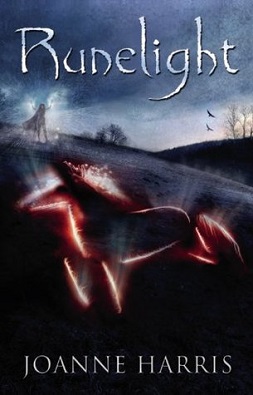
Runelight


This is the sequel to Joanne Harris' first fantasy book with a teen protagonist, Runemarks.  I liked the first one so much that I bought a used copy of this one. It helps tremendously to have read the first book before reading this one, but Harris does offer some catch up notes in her Forward, where she says, "there are just a few things you should be aware of before you begin...We're in a place called Inland, a part of one of the Nine Worlds existing in the branches of Yggdrasil, the World Tree. The Worlds have ended several times...The forces of Order and Chaos keep these Worlds in precarious balance...Gods and demons...exist here in bewildering numbers..." It's been 500 years since the Worlds ended in Ragnarok. In Runemarks, we meet Maddy, a 14-year old misfit from the village of Malbry. Turns out, she is actually the daughter of Thor. When Maddy is sent to the Underworlds on a mission for Odin, events are set in motion that cause The World to end again. The surviving gods "are obliged to take on the Aspect of the nearest appropriate living host--in this case, two humans, a goblin and a pot-bellied pig." It's 3 years later that we take up the story in this book. 

Turns out Maddy has a twin sister who was raised under the Order in the city of World's End. Neither of them know that the other one exists, and, at the beginning of the book, Maggie does not know that she is Thor's daughter and Odin's granddaughter or that she is born with god/demon blood and therefore some potent untapped powers. But the Whisperer has found her and, in the body of Maddy's old enemy Adam Scattergood (who has renamed himself Adam Goodwin), the Whisperer seeks to turn Maddy into its agent to destroy the other gods, rebuild and become the sole inhabitant of Asgard. The Seer has predicted another battle that will end Worlds and rebuild Asgard, but a lot of key pieces need to fall into place and almost none of them do. It's a big book and a sprawling story. If you love legends and fantasy, this will engage you. Fantasy Book Review says that this is a somewhat lighter tale with more character development than its predecessor.

Sunday, February 14, 2021

Lore


This fantasy novel by Alexandra Bracken was categorized by the library as a YA read, which might account for the lack of anything except a few hot kisses between the protagonists, but I still found it an enjoyable read. It is a hefty 450+ page book with a cast of characters in the back and maps of New York City of the front and end papers of the cover. I love maps and referred to these often. The story is based on Greek mythology characters although it is set in contemporary times. The premise is that nine Greek gods are forced to walk the earth as mortals for one week every seven years as punishment for some ancient rebellion. During this week, called the Agon, descendants of ancient Greek bloodlines (think Perseus, Odysseus, Achilles) seek out the gods and try to kill them and thereby gain their powers and become "false gods." This allows them to do extraordinary things and accumulate wealth and power in the years between the Agons, and, also, to build up armies of "Hunters" so that they might kill more gods in the next Agon and gain even more power, etc. Lore (short for Melora) has been hiding from the blooded families for the last seven years and wants to have nothing more to do with the Agon until Athena appears at her doorstep, severely wounded, and offers to help Lore kill the man she believes tortured and murdered her family, Aristo Kadmou, aka the false god Ares. Lore agrees and this brings her into conflict not just with Kamou, but with a childhood friend, Castor, saved from dying of leukemia after somehow killing and assuming the powers of Apollo.  Lore battles not only with herself about whether or not she wants to re-immerse herself in the endless violence on the Agons, but with those she thought were her allies. She is a well developed character and this is quite a complex plot with a large cast that will keep you guessing until the end. There is a lot of explicit violence in the story as well as some descriptions of sexual assault, so consider carefully before recommending.

Kirkus recommends it as "a gripping revenge story," and Publishers Weekly applauds the "ambitious worldbuilding and breakneck pacing."

Friday, January 22, 2021

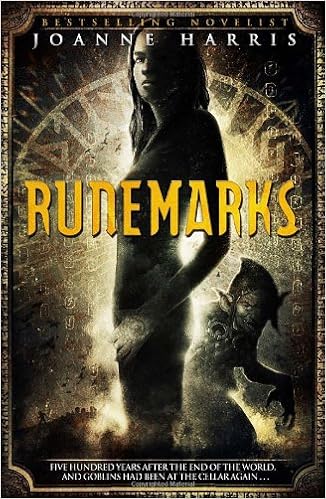
Runemarks


An Advanced Reader's Copy of Joanne Harris's first book for a tweens/YA audience has been sitting on my bookshelf for over 10 years. Harris is the bestselling author of Chocolat--the movie version of which is one of my all-time favorites (how can you go wrong with Judy Dench and Johnny Depp?).  Of course by now, there is a sequel to this book which I will have to track down, Runelight. 

Our protagonist is 14-year-old Maddy, who has always been an outcast in her small village of Malbry due to the runemark on her hand.  According to author Harris, "Runemarks is set in a universe of nine Worlds, not unlike that of Norse legend. Five hundred years have passed since Ragnarók, and the world has rebuilt itself anew. The old gods are no longer revered. Their tales have been banned. Magic has been outlawed, and a new religion – called the Order – has taken its place.

The Order is a crusading religion. It works from an ancient text – simply called The Good Book – and its ultimate mission is to bring Perfect Order to all the Worlds. This means an end to Chaos, to magic, to superstition, to false belief, to dreams, to stories (except for the stories in the Good Book) as well as to Faëries, goblins, dwarves, witches – and of course any old gods who still happen to be around." The mark on Maddy's hand make some people think she is a witch; the villagers have tolerated Maddy but she is bullied and tormented by the village children and distrusted by the adults, including her father. She feels very alone, until one day she spies a journeyman making his way along the road over Red Horse Hill and feels compelled to follow him. Eventually he acknowledges her presence and grudgingly stops to talk with her, and so begins an annual meeting between the two as he tells her tales of the before times. This traveler, One-Eye, sees Maddy's mark as a destiny rather than a cause for fear and rejection.

Expanding exuberantly on Norse mythology, Harris's heroine Maddy is called upon to play a crucial role in freeing the Seven Sleepers under the mountains (Norse gods) in an effort to stop the domination of all worlds by The Order. It's a long book but very compelling. Maddy is a well-drawn character as are the other actors in this worlds' shaking tale. It is a long book but well-told with down-to-earth dialogue that kept me engaged.

The Guardian offers a mixed review.

Monday, July 27, 2020

Certain Dark Things

In this 2nd stand-alone novel by Silvia Moreno-Garcia, near-future Mexico, like much of the rest of the world, is plagued by various tribes of vampires. Mexico City is the exception, where vampires are forbidden and cops ruthlessly seek them out for destruction. Atl, a member of an ancient Aztec- affiliated species of vampires, has nevertheless come to Mexico City for help. Atl is being pursued by the scion of a competing band of ruthless vampires who have already wiped out the rest of her family and intend the same for her. Atl lucks out, unwittingly, when she meets 17-year-old Domingo, a trash picker who lives on the streets or in the underground tunnels of the city, but can sell enough of what he finds to the recyclers to keep himself fed. He is a voracious reader of vampire stories in comic books and is totally smitten with Atl when they first meet and offers to help in any way he can, including--of course--as an occasional food source. Atl has come to Mexico City to get in touch with very old friends of her mother's who, using their networks of document forgers and human traffickers, may be able to help her get out of the country and stay alive. But her pursuers are leaving a trail of bodies across the city and drawing unwanted attention from the police, including a detective, Ana Aguirre, who has killed her fair share of vampires while working for a regional police department  outside the city. When Ana's suspicions are aroused that the deaths are vampire related, she gets no support from her misogynistic colleagues and reluctantly turns to a gang of drug dealers for help in locating the vampires.
Atl is an anti-heroine of the first order; you will come to root for her as she transitions from spoiled daughter of a wealthy family to grieving solo fugitive. She is conflicted between a tough and uncaring posture that is heredity and habit, and an inability to follow through on her overwhelming hunger in relationship with naive Domingo.
Although I gave up on another of Moreno-Garcia's books, Gods of Jade and Shadow, I really enjoyed this book. There is rich description of Mexico, some mythology, a little Aztec history, fully developed characters, and a post-text glossary of vampire species you never knew existed. Lots of rave reviews about this book including NPR, who calls it a "compelling new take on vampires;" Publishers Weekly; and The New York Journal of Books which concludes its review with this high praise:
"Filled with powerful themes of trust, corruption, vengeance, and bloodlust, this novel is by turns sensual and grim, introspective and disturbing, suspenseful and moving, and all told in the sleek and lyrical prose for which Moreno-Garcia is deservedly acclaimed. In short, Certain Dark Things is arguably the vampire novel for the 21st century."

Sunday, December 30, 2018

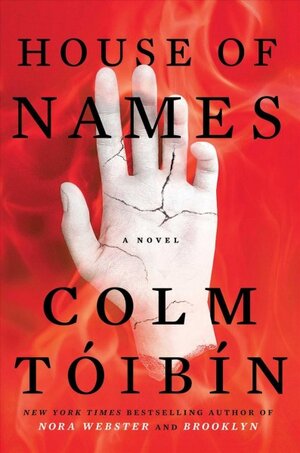
House of Names


I've never read any books by Colm Tóibín although he has had several well-known ones, including Brooklyn, which was made into a movie. Still I was intrigued by the premise of the book and by the opening line: "I have been acquainted with the smell of death." This spoken by Clytemnestra, the wife of Agammemnon, who is one of the principle narrators of this novel about the ultimate dysfunctional family. Furious that her warring husband has tricked her and their beautiful daughter, Iphigenia, into coming to his camp with a lure of marriage to the hero Achilles, Clytemnestra finds instead that Agammemnon will humiliate and sacrifice his daughter to the gods in exchange for favorable winds for his fleet. Returning home, Clytemnestra takes up with her husband's cousin, Aegisthus, both as a lover and as a co-conspirator in her plan to murder Agammemnon upon his return. Daughter Electra is put into a dungeon while the deed is done and left there to cool her heels for a time to bring her into line. Clytemnestra never tells her about her sister's murder. Orestes is sent away with the sons of many of the local powerful families--kidnapped essentially to keep everyone in line as Clytemnestra and Aegisthus take over the throne. A big chunk of the book focuses on Orestes' escape with two of the other kidnapped boys who hide out in the country far from home for several years. When he returns, vengeful Electra tells Orestes of Agammemnon's murder and convinces him to help kill Clytemnestra and avenge their father...so the cycle continues. The story is rampant with whispers and ghosts.
While Tóibín is a compelling writer, I did not find this a satisfying story; however, it is the quintessential tragedy. Lengthy and laudatory reviews from NPR, The New York Times, The New Yorker, the Washington Post, and Kirkus.

Monday, May 23, 2016

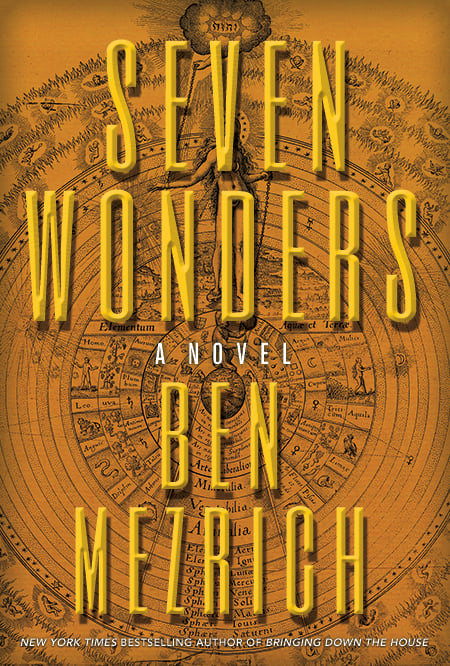
Seven Wonders

This book by Ben Mezrich revolves around a secret society of Amazons--yep those warrior women of legend. They are, apparently, fairly ruthless in keeping their existence secret, AND they seem to have endless financial resources to achieve that. The protagonists, a "field anthropologist" named Jack Grady, and a botanist, Sloane Costa, are brought together by their own individual discoveries and spurred on by the murder of Jack's brother, a reclusive computer genius who inadvertently discovered a connection between the seven ancient wonders of the world and the more modern seven wonders of the world. Jack and Sloane begin to follow the clues that lead them from Christ the Redeemer to each of the remaining architectural wonders in order to complete the puzzle--if they don't get killed first. For deadly Amazon assassins seem to always be barely one step behind them on their dizzying global itinerary.
The ending was predictable, the editing errors were annoying, and the characters were only mildly interesting, so overall this was a disappointment in spite of the intriguing premise for the plot. Kirkus gives it a less-than-flattering review, as did the Boston Globe. Mezrich has written over a dozen books that seem about equally split between SF-fantasy and "highly addictive genre of nonfiction, chronicling the amazing stories of young geniuses making tons of money on the edge of impossibility, ethics, and morality" (from the author's website), including two #1 NYT bestsellers that were made into movies (The Accidental Billionaire became The Social Network, and his Bringing Down the House became the movie 21) Several of his other books, including Seven Wonders, have been optioned for films. I may try one more book from the library...

Wednesday, April 15, 2015

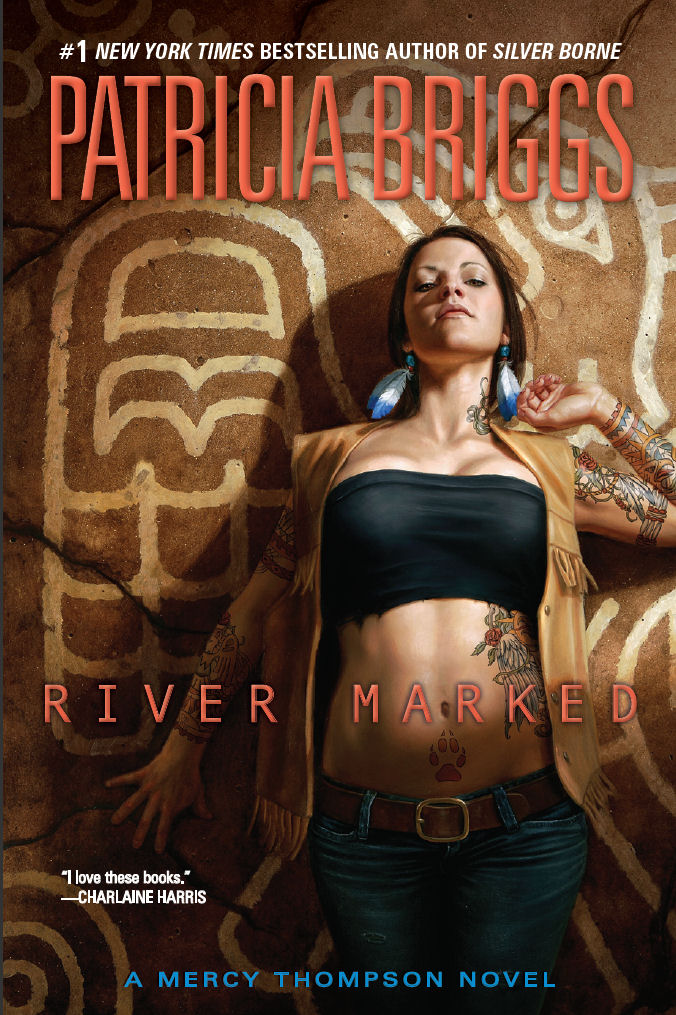
River Marked

This is the 6th in the "Mercy Thompson" series by Patricia Briggs, and I have posted on all the previous books (Moon Called, Blood Bound, Iron Kissed, Bone Crossed, and Silver Borne) if you want to get a better description of characters. The series continues to hold up. Getting cold feet about the big wedding, Mercy convinces Adam to jump the gun and have a small private wedding. However, she has underestimated the deviousness of both her mother and Adam's daughter, who plan a surprise wedding instead with everyone in attendance. Off they go on a glamping honeymoon to the Columbia River gorge towing a plush trailer loaned to them by the faeries--uh oh. Everyone knows you don't EVER want to be indebted to the fae. Turns out there is a river monster in the vicinity devouring humans and Mercy will be the only one who can possibly defeat it--or she might die. Mercy comes face to face with other Native American Walkers and possibly her father--the real Coyote. All the Native American gods (Wolf, Thunderbird, etc.) are willing to sacrifice themselves to the beast if Mercy will agree to cut out its heart while it lies in a stupor from having devoured them. It's a dicey proposition, but the only one with any chance of success. This is NOT the honeymoon Mercy and Adam had planned on.

Tuesday, April 14, 2015

Hounded

Another intriguing new series discovered...the Iron Druid Chronicles by Kevin Hearne. Atticus O'Sullivan--a take off on his original Irish name, Siodhachan  Ó Suileabháin, is the last living Druid. He lives as a 21-year-old book and tea store owner in Tempe, Arizona. And he is 21--centuries, that is. He has spent over 700 of those years perfecting a set of magic charms that allow him to do everything from breathing underwater to resisting the magic of other creatures--fae, gods, demons, etc. And he wields a magical sword, Fragarach, stolen in battle long ago, that is desperately wanted in a vicious takeover bid of the magical worlds. He has learned to communicate with his Irish Wolfhound, Oberon, who is his best friend, aside from the aged Irish woman around the block for whom he mows the lawn. All gods (from Jesus to Thor) get equal cred in this lively and entertaining tale. In this book, a particularly annoyed Celtic god has finally tracked Atticus down and is sending all manner of supernatural thugs to kill him. But Atticus has allies--werewolves, witches, vampires and even the god of the dead, Morrigan--who have all taken refuge in this part of the world that is as far as possible from the politics of Old World squabbles. Well worth the time if you are a fan of supernatural tales.

Monday, July 14, 2014

Promise of Shadows

This is a new author to me, Justina Ireland, and apparently this is only her 2nd novel. But the premise is a popular one, i.e., half gods (half humans) live among or near us and we poor mortals know nothing about it. Politics, feuds, prophecies and ancient enmities fuel this entertaining tale with a Harpy and various other beings based on Greek mythology providing the cast. When the book opens, we meet 20 something Zephyr Mourning (the aforementioned Harpy) who has been sent to Tartarus (part of the Underworld) to toil the rest of her life away, because she killed one of the  Æthereals.
Harpies are warrior women, but Zephyr has never really been any good at conjuring magic or killing people, so imagine her shock when she finds her sister murdered and she actually kills the murderer--who just happens to be a god. Harpies aren't supposed to be able to do that, and Zephyr is further surprised that the High Council (the gods) condemn her to a hellish labor camp instead of death. Someone is pulling strings. When a childhood friend, Tallon, along with his brother Blue, show up to break Zephyr and her guardian/friend Cass out of the Underworld and take them back to the Mortal Realm, things start looking up. And then Zephyr finds out that the half-gods all think she is their promised savior, the Nyx, a dark goddess who can finally help them regain power against the abusive gods. Zephyr is a coward as well as a klutz and she just doesn't see how she is going to save the world, but she is fueled by her rage against those who ordered her sister's murder, and then also killed her best friend, Cass. It looks like Hera is behind a plot to kill anyone who might have dark powers and capture their shades for a magical spell that will give her dominion over all mortals. Turns out that Hades is Zephyr's father, so she has much more power at her disposal than she ever realized and she swears she will avenge the shades of her sister, Cass, and all the other murdered victims or die trying. The powers of light are not always right, nor are the dark powers necessarily bad in this story--a welcome change. If you enjoyed the series from Rick Riordan or Michael Scott with similar mythological approaches, you will love this slightly older age outing. Review from Kirkus is here.

Thursday, May 29, 2014

The Scorpio Races

I have been on a BINGE of YA reading lately--all very good. The first was this book by Maggie Stiefvater. Set on an island off the coast of England in contemporary times, where magical, man eating horses emerge from the wild surf every fall. If you play your cards just right, you can capture and semi-tame one to enter into the Scorpio races that take place along the beach on the first of November every year. Of course you might get killed in the process, but if you don't you stand to win a lot of money. The folk on this island fish or farm and it's a poor place with few other opportunities for young people looking to make their way. So Puck (given name Kate) and Finn Connelly are not surprised, but nevertheless devastated when their older brother Gabe says he is leaving the island to find work right after the races. Since their parents were killed by the water horses--the capaill uisce--while out in their small fishing boat, the Connelly children have lived on their own, barely making ends meet. When the major land owner on the island, Malvern comes to the house and says they are months in arrears on the rent, Puck is determined to enter the races and win the money to pay back the debt and stay in their house. Only thing is, she is going to enter the race with her island pony, who normally would not stand a chance against the blindingly fast water horses. But the capaill uisce are also driven somewhat mad by the breaking waves on the beach during the race, so there is just a small chance... There is a love story here involving Puck and the 3-time winner of the races, Sean Kenrick, an orphan who works for Malvern in his renowned stables.  Sean has a magic touch with capaill uisce, which makes him invaluable, but is still just a hired hand. He is despised by Malvern's son,  Mutt, who will do anything to sabotage Sean, including trying to kill him or the water horse, Corr, that Sean will ride in the race. If Sean wins, Malvern will let him buy Corr, but if he loses, he will continue to be an indentured servant for a long time to come. So why is Sean helping Puck learn to race when so much is at stake?

Tuesday, March 25, 2014

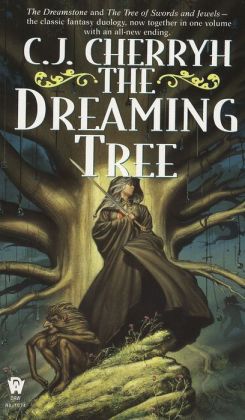
The Dreaming Tree

This is a compilation of The Dreamstone and The Tree of Swords and Jewels by C.J. Cherryh. Although the writing is lovely in places, I found it just confusing and the storyline too condensed in others. This is an astoundingly prolific author of science fiction and of high fantasies. Usually I really like this type of thing but found the heavy use of Welsh/Celtic/Old English names really tiresome at times. Maybe I was just not in the mood. This is the story of Arafel, last of the Elves left behind after the rest have departed the world of "Men." Arafel continues to stand guard over the Faery world of Eald as well as the mortal world of Man with their poisonous use of iron (roughly a Medieval time frame). She is lonely and occasionally tries to befriend a particular human but is often disappointed as humans are both in awe of and in fear of the Faery folk--not without reason. There are still plenty of other magical beings around, some mischievous, some cold and calculating, and others downright dark and evil. Generations of men pass is a blink of Faery time. The main characters in this book have elven blood in their background which allows them a somewhat increased access and affinity--or fearfulness--toward all that is Faery. One has asked Arafel's help in winning a war and she agreed and has indeed continued to exert beneficent oversight on this human, his subsequent family with two children, and the lands over which he is now lord. Farms have prospered, peace has reined. But Lord Cieran's brother, Donnchadh, as well as other lords are being advised by darker beings who foster distrust of Ciaran, particularly with the King. When things don't move fast enough, Donnchadh and the other greedy lords kill the King, and now war--not just among men, but among all things Faery--is coming and sweeping everything before it into destruction.

Tuesday, February 18, 2014

The Darkest Road

This is the final installment in Guy Gavriel Kay's Fionavar Tapestry trilogy (see blogs re Book One and Book Two). Action packed and relentlessly paced, I dove in and did not surface except for absolutely necessary chores. The big unknown remains the child born as a result of Jennifer's rape by Rakoth Maugrim, the Unraveller. Jennifer refuses to try and determine the Darien's path, although everyone else is trying to steer him toward the Light and away from the Dark. The child, now in an adolescent's body, interprets her hands off approach as rejection and so decides to go to this father and find acceptance there, taking a magic dagger crafted in ancient times by the Dwarves.
Saved by the chanting of the Paraiko when she descended into Maugrim's dark thoughts, Kim has gone to free them from their captors in the caves at Kath Maigol. She calls upon Tabor and his flying unicorn to decimate the dark hordes that imprison them. Then Kim hurries west to try and intervene with Darien and then on to Lisen's tower to warn Jennifer/Guinevere of what she has done. Everything with Darien seems to drive him further toward Rakoth. Diarmuid, Arthur, Paul, Loren, Matt, and now Lancelot are saved from a watery death when Paul once again calls on the sea god, and then they are ferried to the front lines of battle by a ghost ship captained by the original First Mage of Fionavar, Amairgen. Meanwhile, Kim has taken Matt and Loren to the realm of the Dwarves to try and reassert Matt's sovereignty as King and bring them back to the side of the Light. They succeed in the nick of time, turning potential enemies into allies. Rakoth pulls out all the stops and throws every evil being he can command at the united forces of the High Kingdom. In spite of several powerful mortal and magical interventions, it truly seems that all is lost, until Darien gains audience with his father, and uses the lore of the dagger to stop Rakoth. Loves as well as lives are lost and gained. In the end, only two of the original five will return to this world. There is a summary of books one and two at the beginning of this 3rd volume, but don't even think of not reading the first two books.

Sunday, February 16, 2014

The Wandering Fire: The Fionavar Tapestry: Book Two

So much happens that I won't even try to summarize this second installment in the The Fionavar Tapestry Trilogy by Guy Gavriel Kay (see also the blog for Book One). Let me just say I am well and truly hooked and having a hard time tearing myself out of this book to go do the mundane tasks of life--like fix dinner!
When Book One closes, Kim has used her power to pull all five of them out of Fionavar and back to present day Canada, primarily to save Jennifer, who was being raped and tortured by Rakoth Maugrim and his minion,  Blöd , one of the dwarves who betrayed Fionavar and freed Rakoth from under the mountain. Seven months later, Jennifer is carrying Rakoth's child in defiance of his last order, which was that she not be allowed to live; she believes he knew of the child and that it would be a threat to him. Kim is awaiting the Seer's dream that will take them back to Fionavar and the war between Rakoth and the rest of Fionavar. Finally it comes and she recalls The Warrior, King Arthur, from the grave. Paul and Jennifer have already returned to Fionavar because Galadan has crossed over and is hunting them. The passage brings on Jennifer's labor and the baby, Darien, is born and given up to a woman in the village whose son, Finn, has been called to the Longest Road.
Fionavar has been paralyzed and is beginning to starve under the weight of a bitter and unnatural winter, even though it is approaching Midsummer. Loren has made it his task to find out how the winter is being created, but Kevin, the member of the original group who has felt most useless in all the events up to now, beats him to the punch but pays the highest price of all. Loren, Matt, Paul and Diarmuid set out across the sea to find the treacherous former First Mage and stop his machinations. In the final battle between the two mages, Magren is killed but Loren and Matt's bond is irretrievably broken, leaving Fionavar with only a single Mage. With winter gone, Rakoth looses his dark armies and victory is barely snatched from defeat by the release of The Wild Hunt, a group of ghostly dead Kings led by Finn.

Wednesday, February 12, 2014

The Summer Tree: The Fionavar Tepestry: Book One

I am a big fan of Canadian writer Guy Gavriel Kay --see reviews for The Lions of al-Rassan and The Last Light of the Sun. I borrowed this trilogy from my even more ardent reader sister-in-law, Joan, and have finally gotten around to reading the first installment. Five Canadian university students, Kim, Jennifer, Paul, Dave and Kevin, are persuaded --with a little help from magic-- to accompany a mage and a dwarf to another world, Fionavar. Thinking they are going for a short visit to celebrate the 50th anniversary of the High King on his throne, the five have no notion of the key roles they will play in events to come--one will become the official Seer, another will be touched by the Gods and brought back from death, and a third will be kidnapped as an opening move in a challenge to war. Fionavar has been at relative peace for some decades after a pitched battle between the forces of good and evil. The evil power is Rakoth Magrim, aka the Unraveller, Sathain, or the Hooded One. Through the unified efforts of the various tribes of Fionavar, he was thrown down and imprisoned under the mountain Rangat, although he can never be killed. Touchstones are distributed to the five peoples and should any of them turn from blue to red, Fionavar is warned that Rakoth is trying to regain power. But one of the tribes has betrayed Fionavar, freeing Rakoth, who has flung down the gauntlet.  Rich development of characters, place, peoples, and history are characteristic of Kay's writing. A map and cast of characters in the front material are essential accompaniment to comprehensive reading. Although it takes a bit of time to become fully immersed in this world, it is well worth the investment.

Monday, April 4, 2011

Reading for the NYRA

Although I haven't posted much here lately, it was because I was swamped with reading books for the Nevada Young Readers Award--NYRA (we were working from the 2012 reading list). Lots of grown ups (mostly librarians) read books nominated by kids in different age categories and then have a video conference to narrow down the nominees to about 6-8 in each bracket for final voting. I read in two categories--though not all of them in any category--the final nominees haven't been posted yet. Most of them I could definitely leave rather than take, but these are my personal favorites of those I read:
Junkyard Wonders by Patricia Palacco. Young Readers level with beautiful colored drawings. Wonderful autobiographical portrayal of special needs kids and one truly inspirational teacher.
Two books by Peg Kehret, Runaway Twin and Stolen Children. Middle readers with positive girl role models. The latter was my preferred book, but there was a good dog character in the former.
The Clone Codes by the McKissacks. Also middle reader set 160 years in the future when clones are discriminated against and treated as non-human, much as slaves were in earlier times. A little heavy handed on the didactic message, but still an interesting read.
The Popularity Papers by Amy Ignatow (also the illustrator). Middle Reader. This is definitely one of the best books I  read—very funny and with a genuine sense of the voice, dialog, perspective of two 5th grade girls trying to figure out how to be popular before they move to junior high next year. Done as a collaborative journal, complete with passed notes, drawings that vary in quality depending on the artist, and unique handwriting for the two main characters. They learn a lot about friendship. I love Julie’s observation about their attempts to become popular, “Just because you are next to a tomato doesn’t make you a tomato.”
The Lost Children by Carolyn Cohagan. Middle Reader. Tend to agree with Kirkus Reviews that this is rough with missing transitions, but also has a lot of promise. The opening line is great, “ Josephine Russing owned 387 pairs of gloves.” The ending is contrived and confusing. But the heroine is brave and loyal and those are good things. 
The Immortal Fire by Anne Ursu. Middle Reader. Snarky and tongue in cheek narration make this romping adventure to save the world from mythical creatures gone bad pretty enjoyable. Similar to Percy Jackson’s books but with a MUCH more jaded view of the Greek gods who are depicted as a bunch of spoiled brats. Strong teen characters, a little confusing about who is supposed to be the lead character. Both Charlotte and cousin Zee (Zachary) –aged 13, eighth graders--at times feel they are responsible for what appears to be the impending destruction of the world or the end of humanity—or both.


Saturday, January 22, 2011

Necromancer

What's absolutely astounding about these books by Michael Scott is that nearly 400 pages covers only a couple days and you just can't believe that so much can happen in such a short time. Of course it helps that a LOT of things are going on simultaneously in other realms...This is the 4th in the series "The Secrets of the Immortal Nicholas Flamel" and the fate of the world as we know it is growing more dire by the hour. Evil forces appear to be getting the upper hand if for no other reason than Flamel has lost the diary pages that would allow him to remain immortal, and he is losing power as old age arrives at an accelerated pace--after all, he is several hundred years old. Twins Josh and Sophie try to go home again after the adventures of the first three novels, but it is not to be. Scathatch is missing as is Joan of Arc and Dr. Dee is finding a way to capitalize on Josh's mistrust of Flamel and bend Josh's growing powers to his dark ends. The action is non-stop, and the ending will leave you groaning for resolution--maybe in the next volume, The Warlock. Historical and mythological figures rub shoulders in these incredibly complicated casts of characters (think Machiavelli, Billy the Kid, the god Mars, and Prometheus just to name a few). You must read the previous books to have any idea what is going on here, but it will be an enjoyable task: The Alchemyst, The Magician, and The Sorceress.

Saturday, February 13, 2010

Monstrumologist

Monstrumology: (noun) The study of life forms generally malevolent to humans and not recognized by science as actual organisms, specificallly those considered products of myth and folklore. (verb) the act of hunting such creatures. Like his father before him, Pellinore Warthrop is a monstrumologist and Will Henry, his 12-year old ward, is his assistant apprentice. Will Henry tells the story through his diaries which come to light when he dies--apparently at the age of 131--an indigent in a small New England town. Will Henry's father had served Dr. Warthrop as assistant in his travels to far reaches and his investigations into strange creatures. So when both parents die in a fire, Will Henry is orphaned and now serves the monstrumologist in turn. Set in the late 1800's, the book is gory--there are indeed man-eating monsters and they have apparently infested the cemetery of the town in which the story is set, which in Will's diaries is known by the pseudonym of New Jerusalem. Is it just coincidence that these monsters have shown up in the same town where one of the world's eminent monstrumologists lives?? Probably not. The story is based on the first 3 folios of 7 diaries, so you can count on a sequel or two if you like this. The author, Rick Yancey, cunningly only claims editorship of the book.