Keeping track of what I read by jotting down my reactions, providing information about the author, and linking to additional reviews. And occasional notes on other book related things...
Sunday, August 31, 2025
Furever After
This is the 16th entry in the Magical Cats mystery series by Sofie Kelly. I read the first two books, Curiosity Thrilled the Cat and Sleight of Paw and enjoy both the plots and the characters. These are cozy mysteries with the added element of two cats who are anything but ordinary house pets. Owen can disappear at will and Hercules can walk through walls, doors, etc. Of course they are very smart and often have to help their owner, librarian Kathleen Paulsen, solve mysteries by providing clues. In this book she is getting ready to marry Detective Marcus Gordon and the story focuses a lot on the strong network of friends that Kathleen has formed in her small town of Mayfield. When she finds a dead body in the library, she feels compelled to try and figure out why the victim, ne'er do well Will Redfern, was trying to steal a painting from the library. It turns out the painting was part of a high profile theft some years ago and was never recovered. How did it end up in the library and why would someone kill Will Redfern? Our protagonists are put in mortal danger before the wedding and their union surprisingly comes with a bonus.
Saturday, May 31, 2025
The Mystery of the Crooked Man
This mystery by Tom Spencer (pseudonym for Tom Perrin) starts out slow but eventually pulls you into the twisty plot. The main character is a bit of an anti-hero and the ending is a surprise. Here is Publishers Weekly's review in full:
"Spencer... serves up an affectionate homage to Agatha Christie that seamlessly blends satire and fair-play mystery. Crotchety archivist Agatha Dorn is an expert on Gladden Green, author of a bestselling mystery series featuring the Poirot-like Père Flambeau. After she's passed over for a promotion, Dorn discovers the manuscript of an unpublished Flambeau novella by Green. She convinces Green's publisher to let her write an introduction to the text, which she insists she's vetted, and quickly becomes a literary sensation. Her achievement is marred, however, when her best friend and ex-lover, Amy Murgatroyd, dies--ostensibly by suicide, but Dorn suspects foul play. Then the novella turns out to be a fake, and a disgraced Dorn starts catching glimpses of a shadowy figure who resembles a villain from another Green novel. Bruised and grieving, she sets out to solve the mystery of Murgatroyd's death. Dorn is a refreshingly acerbic and misanthropic lead, and Spencer ushers the plot through a series of wild swings without sacrificing plausibility. This witty whodunit will delight fans of Anthony Horowitz. "
And here are excerpts from the New York Times short review: "Sometimes you know immediately that a book is going to get under your skin and stay there...Spencer’s tart debut... vaults the reader into the world of Agatha Dorn, an irritable archivist and passionate devotee of mystery fiction — particularly the work of Gladden Green (think Agatha Christie through a fun-house mirror.) ...Is Agatha 'a crazy woman, haphazardly but unmistakably drifting down and out, sick, unemployed, drunk, obsessed with solving a murder that had never occurred?' Or 'a maverick, pursuing truth and justice … even at the cost of [her] own well-being?' Maybe she’s both."
Sunday, March 27, 2022
The Department of Rare Books and Special Collections
Okay, maybe only a book nerd would find this mystery engaging, and I am and I did; although, I never really came to like the protagonist, Assistant Director of the Department of Rare Books and Special Collections, Liesl Weiss. Author Eva Jurczyk has herself been a librarian and this is her debut novel; she has written for several publications, however, and the writing, plotting, and characterization is certainly competent.
Liesl is suddenly called back from her sabbatical, happily writing a book on gardening, to fill in for her boss, Christopher Wolfe, who has been hospitalized with a stroke that's left him unconscious. Things immediately go awry for a number of reasons. First of all, Liesl doesn't really like the limelight and has been happy all these years doing everything to make Christopher look good to university administration and the collection's wealthy donors. Secondly, a few members of her staff are miffed about her being made acting director and aren't particularly supportive. Thirdly, she can't find the combination to the safe in Christopher's office, in which, supposedly, the department's newest acquisition, a Plantin Polyglot Bible is being kept safe until it can be evaluated for insurance purposes. And finally, when Christopher's wife shows up with the safe's combination, the Bible isn't there and the big reveal party for the main donors is just a day away. As time goes on, it's found that another of the collections prize possessions is missing, and eventually a third item is found to be a forgery. Liesl must eventually conclude that the nearly priceless items have been stolen, and that it's an inside job. When her protege, quiet and trustworthy Miriam Peters, goes missing shortly after the discoveries, suspicions immediately fall on her. Liesl is being pressured by the university president--and some of her colleagues-- to hide the fact that valuable items and a member of her staff is missing. Liesl wants to notify the police...what should she do?
Kirkus calls the book "a valentine to librarians that doesn’t shy away from their dark sides." Publishers Weekly, somewhat more subdued in their response, concludes "Mystery readers are likely to be disappointed by the crimes and their solutions, and bibliophiles may feel that the rare books themselves are given short shrift, despite the author’s obvious research. This works best as an unflinching appraisal of the personal and professional effects of a woman’s aging into invisibility."
Tuesday, December 28, 2021
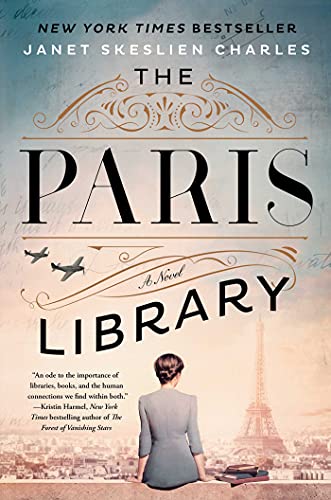
The Paris Library
The author, Janet Skeslien Charles, uses the American Library in Paris (ALP) as the centerpiece of this historical novel, where Charles actually worked as a programs manager for a time. Based largely on actual people and events, the book introduces us to the dedicated staff and loyal subscribers (patrons) of the ALP during the Nazi occupation of Paris. Told mainly from the POV of Odile, a young woman who has to fight her father to take a job at the ALP in 1939, and of Lily, a teenager in rural Froid, Montana in the 1980's. The book is about friendship, human failings, and the role that libraries and books played in sustaining the morale of war prisoners and hospital patients as well as those living under German occupation. When Odile gets the job at the ALP, it is a dream come true for her. Her aunt had been bringing her to the library since she was a child and that was where she learned to speak English. Her twin, Remy, is a law student who falls in love with one of Odile's colleagues, the children's libarian, Bitsi. When the Germans draw closer to Paris, Remy enlists, with Bitsi's support, which, for a time, strains the relationship between Odile and Bitsi. Eventually they come to be like sisters, bonded by their mutual love for Remy, who is wounded and imprisoned by the Germans. Odile also befriends the American wife of a British diplomat, who feels lost in a country where she has no friends and does not speak the language. Margaret becomes an indispensable volunteer at the ALP. Odile is in love with, and eventually engaged to, a police officer, Paul; one of the main secrets that is not revealed until the very end is why Odile is now living in Montana, the widow of American husband. Odile has kept to herself since her husband's death, but befriends Lily, whose mother has died, and tries to help Lily not make some of the same mistakes that Odile feels she has made. "The answers unspool in this well-plotted and richly populated novel" according to the New York Journal of Books.
Kirkus calls the book "an intelligent and sensuously rich novel of a young woman's coming-of-age." Publishers Weekly says it's "a delightful chronicle of a woman’s life in WWII-era Paris and rural 1980s Montana."
An absolutely must-read is the Author's Note which details what happened to several of the main characters after the war. The author's website also provides some wonderful archival materials to learn more about the actual people who staffed and supported the ALP.
Tuesday, February 11, 2020
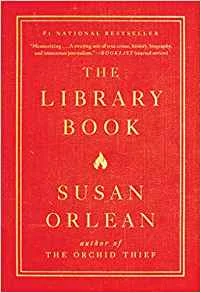
The Library Book
"On April 29, 1986, the Central Library in downtown Los Angeles caught fire and burned. Nobody died, though 50 firefighters were injured and more than a million books were damaged" (New York Times). No one ever really proved that the library fire was set, although a man, wannabe actor Harry Peak, was accused. But at the time (1986) the place was a firetrap, with poor wiring and books stacked everywhere, including in the stairwells. The NYT review goes on to say, "At any rate, the 1986 fire inside the Central Library, and the subsequent, inconclusive investigation of it, turn out to be a MacGuffin, a trick for luring the reader into a subject into which the reader never imagined he’d be lured: the history and present life of the Los Angeles Central Library. Much of the book consists of its author wandering around a library building, watching and listening to the people inside it." So not only is this a history of the library but also of the people who made it what it is today. It was often chauvinistic--women were not originally allowed in the reading room (it opened in 1873), but by 1885, it was run by women. But then the library board fired a perfectly competent woman director and hired Charles Lummis, a flamboyant journalist, adventurer, and self-promoter, who knew nothing of libraries, to be its director. Orlean offers a larger context to her story as well, providing a historical overview of book and library burning over the centuries. "The Nazis alone destroyed an estimated hundred million books during their twelve years in power."
Some of my favorite passages from the book have more to do with the importance of books in our lives. She notes that "in Senegal, the polite expression for saying someone dies is to say his or her library has burned....Our minds and souls contain volumes inscribed by our experiences and emotions; each individual's consciousness is a collection of memories we've cataloged and stored inside us, a private library of a life lived. It is something that no one else can entirely share, one that burns down and disappears when we die." She reminds us that some cultures, such as Judaism ("the people of the book") consider books sacred. "Destroying a culture's books is sentencing it to something worse than death: It is sentencing it to seem as if it never lived."
If you care about libraries, you'll find this a rewarding read.
Review from The New York Times is very detailed. Additional glowing reviews from The National Book Review, The Guardian, The Washington Post, and Kirkus.
Sunday, December 15, 2019
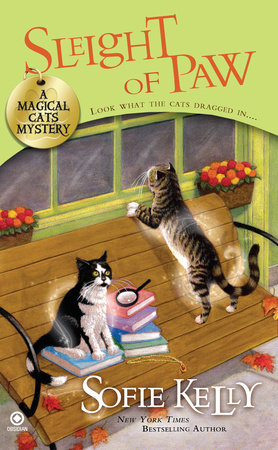
Sleight of Paw
Saturday, August 31, 2019
Sorcery of Thorns
Elizabeth, Nathaniel, and Nathaniel's dedicated demon, Silas, are all fully drawn characters and the plot is intricate and well executed. This was an engaging and enjoyable read. Favorable review from Kirkus,
Saturday, February 2, 2019
File M for Murder
Monday, January 14, 2019
Classified as Murder
Monday, December 17, 2018
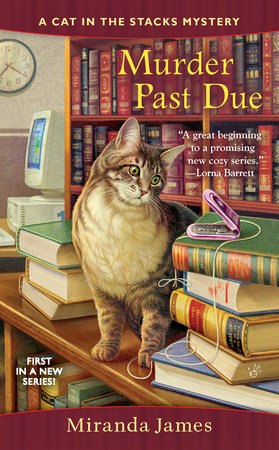
Murder Past Due
Thursday, December 8, 2016
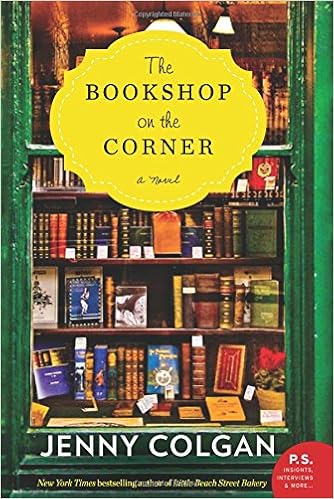
The Bookshop on the Corner
Nina has never been particularly good at matchmaking for herself and engages in yet another dead-end attachment, this time with a refugee train engineer, who leaves books and poems for her at the railroad crossing near her village. Eventually she learns he already has a son and long-time girlfriend back home, so Nina subsequenly--and predictably-- gets involved with her rude landlord. This is the least interesting part of the book, but Nina's explorations of Scotland, her growing involvement with her tiny village community, and her finding her own life and ways to express it are really enjoyable.
Wednesday, February 24, 2016
Killer Librarian
On her first night, her B & B owner, Caldwell, takes her to the local Indian restaurant for a curry and follows that up with a visit to his favorite pub. Becoming a bit tipsy due to the rather strong British brew that Caldwell and his friends keep putting in front of her, she confides in the man standing next to her at the bar about the wretched way Dave has treated her and her fantasies of killing him.
Next morning, Karen discovers one of the B & B's elderly guests dead in a sitting room chair. She's not so sure it was just an accidental heart attack and everyone, including Caldwell, the dead man's younger wife, and the dotty sisters who come every year for the Chelsea flower show are suspects in Karen's mind.
Meanwhile, Karen is loving London, but also hearing that the confidante of her drunken ramblings may have connections to the criminal elements, and she is alarmed when she sees him talking to Dave's new girlfriend outside the National Gallery. What has she set in motion? This is an engaging character, a fond portrait of London, and an entertaining cosy for book lovers. I will definitely keep my eye out for the next book, Death Overdue.
Thursday, September 25, 2014
A Fool and His Honey
Monday, July 16, 2012
The Borrower
Wednesday, May 2, 2012
Real Murders
Monday, August 27, 2007
Somewhat complicated and pretty entertaining
I'm a sucker for Nancy Perl's book talks and this is one I heard her do on NPR--in fact, while at the annual library conference in DC this June, I was on a tour of NPR and actually got to watch the beginning of the interview she did with Steve Inskeep in which she reviewed this book. You can read her well wrought and much more plot-informative preview here. The Grand Complication by Alan Kurzweil was well worth the read and the most succinct description I can provide is that it's very clever. Not only does this story about a watch end exactly on page 360 (as in degrees!) but its protagonist is an obsessive compulsive reference librarian. Not that this would recommend it to everyone, and sometimes it's not even enough for me; however, this novel offered stories within stories (one character's family crest includes a book within a book), and deceit upon deceit. The cleverness ranges from the bawdy to the sublime, or to put it another way, from humor that will be apparent to all--to insider librarian humor (no that is not an oxymoron). On one end we have the crucial clue ostensibly tattooed on someone's butt and the dialogue goes like this, "So all this time Kucko's been sitting on the evidence? Cheeky bastard." At the other end, when Zander (our librarian protagonist) "borrows" a book from the conservation room of the library, he replaces it with one of equal weight so the loss won't immediately be apparent; the replacement item is a tome on bibliokleptomania. When one character tells Zander that he can't return the book because he's sent it out to have the boards repaired, our librarian whines that the conservator "keeps a detailed condition log. He's bound to notice." Anyway, if these puns are too obscure, there will still be plenty to engage and entertain you.


.jpeg?format=300w)