Showing posts with label art. Show all posts

Tuesday, May 26, 2026

My Friends


This novel by Fredrik Backman is certainly touching in some ways but none of the characters really engaged me. The Washington Post calls it "an unforgettably funny, deeply moving tale of four teenagers whose friendship creates a bond so powerful that it changes a stranger's life twenty-five years later." 

Kirkus summarizes the plot as follows: "Never in her wildest dreams would foster kid Louisa dream of meeting C. Jat, the famous painter of The One of the Sea, which depicts a group of young teens on a pier on a hot summer’s day. But in Backman’s latest, that’s just what happens—an unexpected (but not unbelievable) set of circumstances causes their paths to collide right before the dying 39-year-old artist’s departure from the world. One of his final acts is to bequeath that painting to Louisa, who has endured a string of violent foster homes since her mother abandoned her as a child. Selling the painting will change her life—but can she do it? Before deciding, she accompanies Ted, one of the artist’s close friends and one of the young teens captured in that celebrated painting, on a train journey to take the artist’s ashes to his hometown. She wants to know all about the painting, which launched Jat’s career at age 14, and the circle of beloved friends who inspired it."And they close their review with this praise: "The novel is humorous, poignant, and always life-affirming, even when describing the bleakness of the teens’ early lives. ...A tender and moving portrait about the transcendent power of art and friendship."

Publishers Weekly gushes that "The author is at the top of his game." I have to admit that I only read the first and last thirds of the book.  


Friday, January 24, 2025

The Paris Novel


This second novel from food renowned critic Ruth Reichl was strongly recommended by a good friend and I, in turn, passed on that recommendation to my book group which is now our choice for the February meeting. Library Journal offers a reasonably accurate summary of the plot line:

"Stella and her mother Celia have long been estranged. In a last, dying effort to control Stella's life, Celia wills her daughter money that can only be spent on a trip to Paris. Stella is reluctant but needs a break from her regimented New York City existence. Arriving in Paris, she lives frugally, visiting all the tourist sights until, on impulse, she stops in a vintage dress shop with a Dior creation in the window. The shop owner convinces her to buy the dress and wear it while visiting a small museum and dining in an excellent restaurant. Stella follows these instructions and meets Jules, an elderly art expert who shows her another side of Paris, opening her mind to new possibilities. She sees Manet's controversial painting Olympia and learns that the model, Victorine-Louise Meurent, was also a painter. Deep research helps Stella find and purchase a painting by Meurent, all while tracking down her own long-missing father and discovering a love of food. Reichl...creates... a search for family and self that incorporates fashion, art, and food in a setting known for all three. ...This multi-layered story will appeal to those who love food, Paris, and a happy ending."

Publishers Weekly calls it "a delectable story" and "a feast for the senses." While Kirkus offers a mixed review, which is more in line with my personal reaction to the book.

"A stiff, lonely young woman takes a life-changing trip to Paris.After suffering a miserable childhood at the hands of her narcissistic mother, Stella St. Vincent is surprised to receive an envelope labeled “For My Daughter” after Celia’s death in 1983. In it is a piece of paper that says 'Go to Paris'; the money to pay for the trip will only be released after it’s booked. This is just the beginning of a silly story with a wildly overcaffeinated plot and characters that are not even close to real people, foremost among them an annoying protagonist who can’t stop shooting herself in the foot even as she miraculously finds her tribe and discovers her extraordinary gifts for eating and cooking. Though she lacks the instincts of a fiction writer, Reichl fills her second novel with the high-flying writing about food, wine, places, and clothes that have made her nonfiction work a well-deserved success. In fact, according to an author’s note, this book grew out of her editor’s request that she expand a chapter from her memoir about trying on a little black dress in Paris. Unfortunately, a few too many ingredients have been added, including a search for a forgotten 19th-century woman painter; appearances by culinary figures like Marc Meneau and Jean Troisgros and literary figures like John Ashbery, James Baldwin, and Allen Ginsberg; a nasty Mr. Darcy–style love interest; and the search for Stella’s father, whom she either does or doesn’t want to find depending on the page. But the food writing is almost worth the price of admission, ranging from the horrific to the euphoric. ...A somewhat ridiculous novel, nicely marbled with fine food and travel writing."

Monday, April 25, 2022

The Darkest Game


Detective Tully Jarsdel is known around the homicide division of the LAPD as the "professor policeman" since he abandoned his PhD studies in ancient history to become the oldest recruit. Then he was plucked from among his more senior colleagues for a special detail after excelling at a battery of tests designed to assess flexibility of thinking, an analytical mind...to solve cold and other "unsolvable" cases. He is partnered with a detective--Morales--who finds Jarsdel's expansive knowledge of the esoteric and his pedantic "lessons" to be constant provocation to eye-rolling dismissal.

Author Joseph Schneider himself comes from an unconventional background. His former careers include acting, magic, and teaching dance. This is the 3rd installment in the "Tully Jarsdel" mystery series and is kicked off by the point blank shooting of Dean Burken, senior curator at the Huntington Library and Museum. There are lovely descriptions of both that setting and some of the inner workings of the Huntington. The investigation of the murder soon leads to the community of Avalon on Catalina island following the murder of a member of the Huntington's board of directors.  Throughout, we are offered glimpses of Tully's family life--again, very unconventional--which consists of two fathers, one of whom, Baba, is an Iranian emigre and the other, Dad, who is dying of cancer. We also get tidbits about the persecution of those who would challenge the Ayatolloah, after the Revolution in Iran, that drove Baba to leave.

Kirkus especially likes the "elaborate banter between the two detectives. The rogues’ gallery of suspects is as quirky and colorful as anything in Hammett or Chandler, and Schneider’s plot, while linear, is full of surprises...Morales’ brusque, slangy dialogue plays nicely against Tully’s stylish, erudite speech." And they conclude that this book offers "Juicy prose redolent of classic noir, with contemporary twists." Publishers Weekly is more equivocal in its review, complaining about the "lengthy if astute asides on such topics as the museum business, the city's Persian population (Jarsdel's father emigrated from Iran), L.A. history (including, notably, the genocide of the region's indigenous people), and the moral challenge of police work in general..." but concludes that "This flawed but deeply intelligent novel will reward thoughtful readers."

Saturday, March 6, 2021

Ice Cold Heart


P. J. Tracy was the pseudonym of the award-winning mother-daughter writing duo P. J. and Traci Lambrecht; P. J. died in 2016 and Traci has continued writing their "Monkeewrench" series, of which this is the 10th installment. The recent hiatus in homicides caused by an abnormally cold January in Minneapolis comes to a horrifying end when detectives Leo Magozzi and Gino Rolseth are called to the scene of a brutal staged murder. The victim is a married woman, Kelly, but was found in the apartment of her best friend and all the clues suggest she was secretly exploring some extramarital and apparently dangerous sexual liaisons. When the trail of clues leads them to a 2nd murder, this one stages to look like an accident, and then to a murder that occurred several years ago in California with all the same earmarks, they decide to enlist the help of Monkeewrench. This is a group of digital security experts, one of whom is Grace MacBride, Leo's wife. Monkeewrench helps uncover connections to a rising art star whose art mimics--or does it inspire--the ugly murders.

It's not necessary to have read previous books in the series to enjoy this one, although series fans will no doubt have a lot more info about characters' back stories. In this book, Monkeewrench team member Roadrunner gets involved with one of the potential victims and more is learned about his background.  Publishers Weekly praises "This smooth mix of police procedural and techno thriller [that] offers likable characters and a complex, well-crafted plot."

Monday, January 4, 2021

The Talented Miss Farwell


Becky Farwell is good with numbers and so, after her mom is gone, she takes over the accounting for her father's farm machinery business. And she learns how to make a profit. Then she goes to work for her hometown of Pierson, Illinois in the accounting office and works her way up to comptroller. Here, too, she finds a way to make a profit--for herself. This novel by Emily Gray Tedrowe is perhaps an homage to Highsmith's The Talented Mr. Ripley, and also a haunting examination of obsession. For Becky discovers, quite by accident, that she has an eye for art. And, after a rocky start, she uses her ill-gotten gains from embezzling town funds to start buying an art collection. She always intends to make enough money to pay back every penny--her justification for siphoning off the much needed funds for maintaining the town's infrastructure. As with many obsessions, however, nothing is ever enough. She barely manages to survive the financial recession that renders her collection worth less than she paid for it and comes roaring back, moving into the New York market and making even more money. She remodels her father's old barn into a high tech art gallery that no one ever sees, where she stores her growing and constantly evolving collection. But we all know it must come tumbling down one day. When the town finds out that the woman they had admired for years is the worst kind of betrayer, they think her best friend must have been in on the scheme all along. This book is partly inspired by the true story of a woman who stole over $50 million from her small Illinois town. Publishers' Weekly gave this a starred review, concluding that her "unusual plot and Tedrowe’s spirited execution of it make this one sing."Although I did sort of marvel at Becky's ability to keep so many balls in the air, I never really liked her and I only kept reading because I really wanted to know how it turned out.

Tuesday, May 12, 2020

Autumn

This book by Ali Smith, intended to be the first in a 4-part seasonal series, was my book group's choice for May. I read it; I did not like it, although there was one passage that I will copy below because it was very clear and spoke to me, appropo of our times. This book got absolutely glowing reviews from many sources.
NYTimes: the first great "Brexit novel"; one of their 10 best books of 2017.
The Guardian says, "Autumn is a beautiful, poignant symphony of memories, dreams and transient realities; the “endless sad fragility” of mortal lives."
NPR says Ali Smith could be "J.D. Salinger's natural heir."
The Atlantic calls her book a "post-Brexit masterpiece."

From an interview with author Jeanette Winterson, we get a short bio, to wit, "She tells me not to worry about the facts of her life – they are simple and there is no scandal. She was born in 1962, one of five children from a Scottish working-class family. She studied at Aberdeen, and then at Cambridge, for a PHD that was never finished. A stint of working as a lecturer at Strathclyde in 1990, convinced her that she could never cut it as an academic."
She writes in several genres (poetry, short stories, plays, fiction) and you can find lists of her work here.
The NYTimes also says, apparently as a compliment, "Chronology skips forward and backward and sideways, moving slowly and then quickly. 'A minute ago it was June,' the author says. 'Now the weather is September.' Smith’s writing is fearless and nonlinear, exploring the connectivity of things: between the living and the dead, the past and the present, art and life. She conveys time almost as if it is happening all at once, like Picasso trying to record an image from every angle simultaneously."
This is part of what I didn't like about the book. I often did not know who was talking, or when in the chronology of events they were speaking. I didn't know anything about some of the prominent speakers, e.g., Christine Keeler.  But I read to the end, partly because that is my commitment to the book group and partly because I figured there had to be a pony in there somewhere. Call me old fashioned, but I like well-constructed sentences and an identifiable cast of characters--especially if there are characters I can at least empathize with--, and some sense of a timeline and purpose to the writing.
But here is the passage that did grab me (spoken by the main character's mother):
"I'm tired of the news. I'm tired of the way it makes things spectacular that aren't, and deals so simplistically with what's truly appalling. I'm tired of the vitriol. I'm tired of the anger. I'm tired of the meanness. I'm tired of the selfishness I'm tired of how we're doing nothing to stop it. I'm tired of how we're encouraging it. I'm tired of the violence there is and I'm tired of the violence that's on its way, that's coming, that hasn't happened yet. I'm tired of liars. I'm tired of sanctified liars. I'm tired of how those liars have let this happen. I'm tired of having to wonder whether they did it out of stupidity or did it on purpose. I'm tired of lying governments. I'm tired of people not caring whether they're being lied to any more. I'm tired of being made to feel this fearful. I'm tired of animosity. I'm tired of pusillanimosity." (p. 56-57)  Well said and I can only respond, "me, too!"

Monday, January 20, 2014

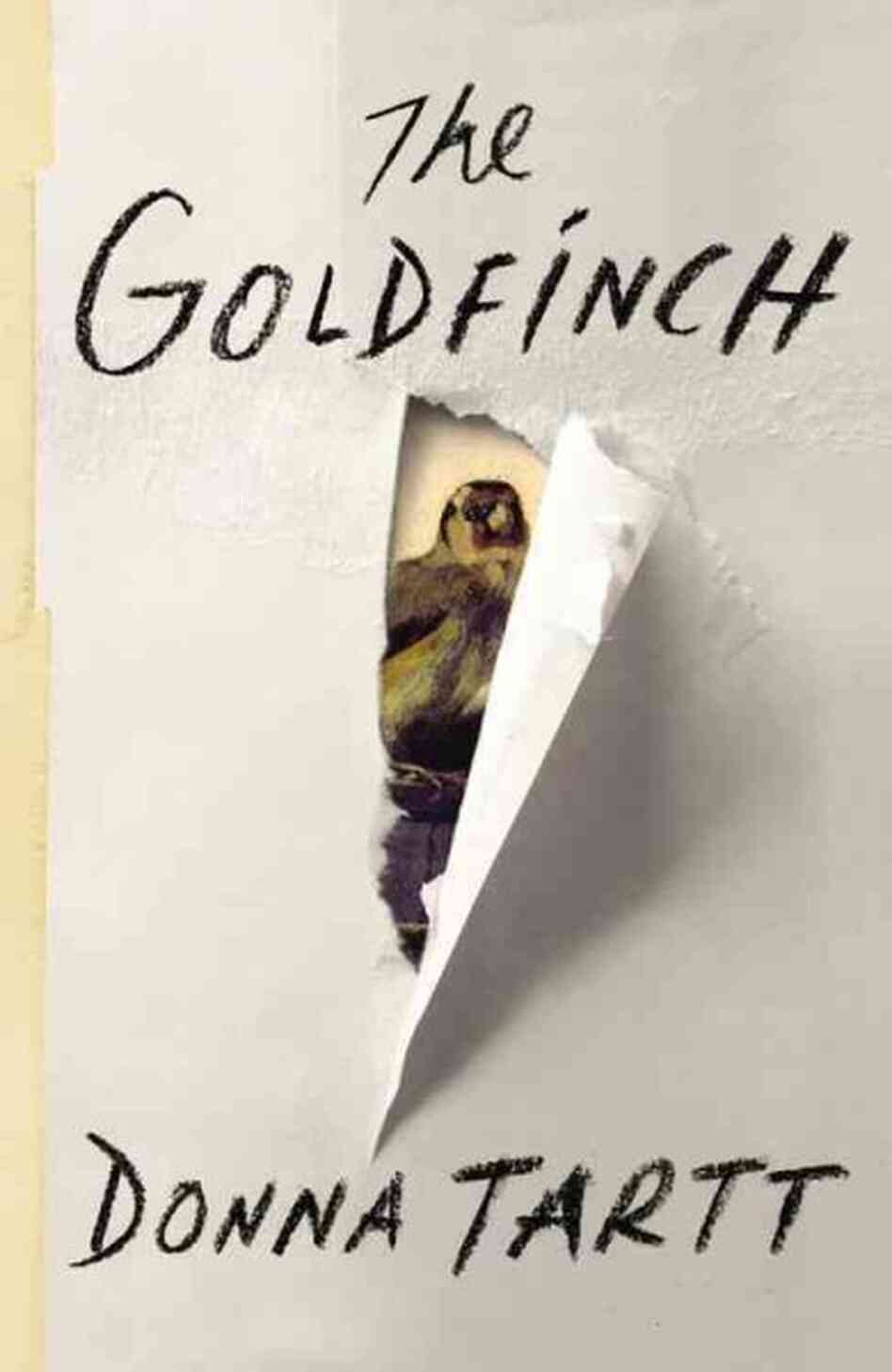
The Goldfinch

This novel by Donna Tartt has been on a lot of bestseller lists. The painting at the center of this story is a real one that was on display at the Frick last fall. In the story, 13 year old Theo Decker and his mother had taken a side trip to MOMA on their way to a meeting with Theo's teachers at school. Just after they had viewed the painting in question, Theo's mom moves away to another part of the gallery while Theo lingers to ponder an intriguing red-headed girl, who has been making eye contact throughout their somewhat parallel wanderings through the museum. Suddenly a bomb explodes and life is changed forever for Theo. Immediately after the blast, Theo crawls toward the older man who had been accompanying the red-hair girl. The dying man hands Theo a ring and gives him a somewhat garbled message. As Theo crawls through the rubble, he finds the painting lying on the floor and "rescues" it. After all his losses, though, Theo cannot bring himself to return the famous painting and he becomes a captive to it, just as the subject bird is shown chained. Theo temporarily lands at the home of a school chum, but life takes another bad turn when Theo's gambler, alcoholic father shows up to take him to Las Vegas. Theo makes his way back to Manhattan when his father dies in a drunken car wreck and hooks up with the partner of the deceased man at the museum. He continues to make bad decisions, a legacy of his father, not his mother. I admit I skipped about 150 pages and jumped to the last chapter of this 700+ page book, because it was due back at the library. Her writing is beautiful with captivating imagery and detail. The story is heartbreaking; so much damage and opportunity lost. I wouldn't seek out other books by this author, but obviously a lot of people liked this work...see the comments here.

Sunday, August 11, 2013

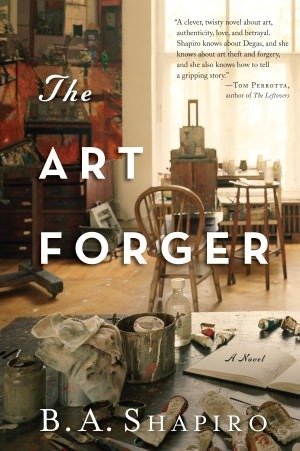
The Art Forger

Based on the actual--still unsolved-- theft of several famous paintings from the Isabella Stewart Gardner Museum in 1990, which in fact included several by Degas, this is a fictionalized and romanticized account of what happens when one of the Degas paintings (a fictitious one) resurfaces. Claire Roth is a talented painter who has made the all too common mistake of falling for her famous and married art teacher, Isaac Cullion. Three years ago, when he was having a "painter's block" she painted a picture for him to help him meet a deadline for a viewing by an agent from MoMA. The picture she painted, fortunately or unfortunately, became the keystone for their accepting his work for a special showing and was ultimately purchased by them; yet he refused to admit that he hadn't painted it. When Isaac dumped Claire, she tried to set the record straight and became persona non grata in the art world; now no one will touch her work. She has become labelled as "The Great Pretender." She works making custom reproductions for a company called Reproductions.com and is a certified Degas specialist. When the owner of a famous Boston gallery comes to her with an offer for her own show at his gallery if she will make a copy of the missing Degas from the Gardner heist, she is eventually persuaded by his claim that he will return the original to the museum itself. As she works with the painting, though, she comes to realize that it is not a real Degas but a clever forgery that had been hanging in the Gardner all these years. No one is going to want to hear that, any more than the experts at MoMA wanted to hear that they had been fooled into buying a painting by a graduate student instead of the well-know professor. We see what we want to see. Author B.A. Shapiro has done detailed research that will tell you the nitty gritty details of how to forge a painting if you have the talent, as well as the struggles facing unknown artists.

Monday, August 15, 2011

Long Gone

If any of you are James Lee Burke fans, you will recognize the author of this book--Alafair Burke--his daughter. Her first name is also the name of the young adopted child in the Dave Robicheaux series by James Lee Burke. Alafair Burke has apparently been at this a while, having written six other books with a series protagonist named Ellie Hatcher, none of which I have read.
Alice Humphrey is trying to make it on her own, without relying on the reputation or largesse of her famous movie actor father and mother. Victim of the economic downturn, she has been jobless and struggling for several months when a chance meeting at an art gallery presents her with the offer to run a small gallery--a dream come true. The owner wishes to remain anonymous and the gallery must have a showing of one artist's work--for whom the own is apparently a patron and/or lover-- for a short few weeks and then Alice is free to run the gallery as she sees fit. The artist's works, however, generate a huge controversy & protest on the part of some conservative religious fanatics, but Alice is determined to stay the course. That is until she comes to work one morning to find the gallery stripped and the intermediary of the original job offer, Drew Campbell, dead on the floor. All efforts to establish the legitimacy of the gallery seem to hit dead ends and Alice quickly becomes the main suspect for the murder. In the process of trying to find the gallery's owner, Alice uncovers some dark secrets from her family's past. Still, Alice has friends and family trying to help her get to the bottom of things--or perhaps they have an agenda of their own.