Showing posts with label domestic violence. Show all posts

Wednesday, January 22, 2025

Death at the Sanatorium


After having read one of Ragnar Jonasson's early entries in his "Dark Iceland" series (Snowblind), I decided to read his newest book, also set in Iceland but in Reykjavik rather than the far north of the country. 

Kirkus offers this review: "The retro title introduces a valentine to Golden Age whodunits relocated to Iceland. Helgi Reykdal, a graduate student in criminology at an English university, has returned to Iceland. Last summer he interned with Reykjavík’s criminal investigation department, and there’s a job waiting for him there if he wants it. But he’s torn by his conflicting desires to return to the U.K. and to appease Bergthóra, the ...live-in girlfriend who wants him to stay. An additional inducement arrives with the possibility of writing his dissertation on the deaths a generation ago of a nurse and doctor at a sanitorium in the provincial northern town of Akureyri. When both Tinna Einarsdóttir, the nurse who discovered both bodies, and Sverrir Eggertsson, the police investigator who allegedly solved the case back in 1983 by arresting what even he came to admit was the wrong suspect, summarily refuse to talk to him, his interest is naturally piqued. The circle of possible killers is tiny—Tinna herself, along with her colleague Elísabet, ambitious Dr. Thorri Thorsteinsson, and Broddi the caretaker—and in the course of Helgi’s investigation, one of them obligingly narrows it even further by killing one of the others. Inspired by his reading of classic mysteries with similar settings... Helgi digs into the archives and questions the people who are willing to talk to him. The story, which toggles back and forth between 1983 and 2012, generates considerable suspense from a remarkably limited cast of characters living and dead. Clever, absorbing, and no more uplifting than you’d expect from this master of Icelandic noir." 

Publishers Weekly opens their review with "Jónasson follows up Reykjavik with a meticulously plotted whodunit worthy of Agatha Christie..." and concludes "With scrupulously fair-play plotting, Helgi’s tumultuous relationship with his live-in girlfriend as an emotional anchor, and a worthy payoff, this is another winner from Jónasson. Readers will be rapt."

Friday, May 24, 2024

Edge of the Grave


Robbie Morrison, Scottish born and bred, wrote what was intended to be a series featuring protagonist Jimmy Dreghorn, a detective in a special squad of the Glasgow police department. To my knowledge, there is only one sequel, Cast a Cold Eye, nor could I find an author website. You can find information about him on Amazon and Wikipedia. I think the "Tartan noir" (Scottish authors) could give the "Scandi-noir" a run for its money in creating crime fiction; although, this book does, at least, offer glimpses of humor.  Set primarily in 1930's Glasgow, there are chapters that fill in Jimmy's background, both when he was a teen and when he was in WWI. His partner Archie McDaid,  is brawny and Dreghorn frequently refers to him as "Big Man," whereas Archie refers to his partner as "wee man." Jimmy is also the only police officer of Catholic upbringing in a force that is almost exclusively Protestant. It is a time when that still mattered and even the numerous and vicious gangs that rule the streets are either Catholic or Protestant. DI Dreghorn and Sgt. McDaid are part of a team specially picked by the new Chief Constable to address the rampant gang violence. When the book opens, they have been called to the scene of domestic abuse, with the wife beaten senseless and the small child murdered. The husband is loosely affiliated with one of the gangs and so Dreghorn and McDaid put pressure on the gang's leader, "King Billy," to help then find him. He agrees on the condition that Jimmy will look for Billy's sister who disappeared 20 years ago.

The pair are also the first on the scene when a body is pulled from the Clyde River near one of the shipyards that have been the foundation of Glasgow's economy; since the end of the Great War, many of the yards have been idled and many men are now out of work. The victim turns out to be the son-in-law of the owner of the largest shipyard in Glasgow and the wealthiest man in the City, Sir Iain Lockhart. Lockhart detested the man his daughter had married. "The deceased's widow, Isla, was Jimmy's doomed first love, and the investigation draws him back into his past, when he was a young boxer training under her father. Jimmy's instincts are dangerously muddied by complicated loyalties as the investigation reveals a criminal tangle of serial murder, blackmail, and child trafficking that bridges the gap between the gangland underworld and high society" (Booklist).

There is a very interesting Q & A with Robbie Morrison where he discusses the influences on his writing, and Morrison also provides a great "Author's Note" at the end of the book that indicates what is fact and what is fiction in this story.

Saturday, September 17, 2022

Hurricane Girl


This short novel by Marcy Dermansky left me asking, what's the point? Here's the book blurb:

"Allison Brody is thirty-two and newly arrived on the East Coast after just managing to flee her [abusive] movie producer boyfriend. She has some money, saved up from years of writing and waitressing, and so she spends it, buying a small house on the beach. But then a Category 3 hurricane makes landfall and scatters her home up and down the shore, leaving Allison adrift. Should she go home from the bar with the strange cameraman and stay in his guest room? Is that a glass vase he smashed on her skull? Can she wipe the blood from her eyes, get in her car, and drive to her mother's? Does she really love the brain surgeon who saved her, or is she just using him for his swimming pool? And is it possible to ever truly heal without seeking some measure of revenge?"  None of these questions really seem to matter to me.

However, several reviewers liked the book, including my go-to source, Kirkus. They offer this assessment: "Small comic gems sparkle in their deadpan settings on every page. No matter how bad things get, Alison's running joke to herself—she still has her health—never ceases to amuse her, though at a certain point, 'she did not think anyone else would think it was funny.' She’s wrong about that. The only bad thing about this book is that you will likely finish it in one sitting." Library Journal says "The ending is satisfying, if unconventional." The New York Times says the book is "hilarious. Dermansky’s offbeat humor and spare prose make Allison’s mind a thrilling and wholly unusual place to be." and they go on to conclude, "This is a wickedly entertaining read from first to last."

On the other hand, Publishers Weekly agreed with me. "In Dermansky’s lackluster latest (after Very Nice), a young woman contends with a certain well-worn millennial malaise. Allison Brody, 32 [is]'sick of everybody and everything...There’s some deliciously dry humor...but the surreal aura doesn’t really develop into anything substantial or comprehensible. Readers are left with a Moshfegh-like vibe, but without a strong character or story. This one is safe to skip."

Thursday, September 2, 2021

The Shadow Box


Hard to believe that Luanne Rice has written 35 books and I don't think I have ever read any of them. I liked this book, though, and would gladly pick up another one by her. Chapters are narrated by the two main characters:  Claire Beaudry Chase, nature lover, artist and wife of Griffin Chase, a powerful state's attorney who is running for governor of Connecticut; and Conor Reid, Connecticut State Police detective and brother-in-law of Claire's best friend, Jackie. Other chapters are narrated by Tom Reid, Conor's older brother and local Coast Guard commander, and Sally Benson, an interior decorator for the money crowd. The timeline goes back and forth between days leading up to the attack and the days following. On the day that Claire is having an exhibition of her shadow boxes at the Woodward-Lathrop Gallery in the town of Black Hall, she is attacked in her garage and left for dead. Unbeknownst to her attacker, the 100-year-old beam on which Claire had been strung up broke, and Claire did not die. She revives enough to leave the house, cover her trail, and head for a decrepit old cabin in the adjacent woods, for she is sure that her attacker was her husband. Claire had also become convinced that Griffin's college girlfriend--who supposedly slipped on the shoreline rocks and hit her head and drowned--was killed by him. Claire discovered Ellen's body in a tide pool on a late night date with Griffin, which she's sure was not a coincidence. Claire and Griffin have both previously been married and Griffin has two grown sons, Alexander and Ford. Although there had been a long-time attraction between Claire and Griffin, they were from different social sets: Griffin comes from old money and belongs to a tight-knit community living in mansions on the bluff outside town. Claire comes from much less affluent circumstances and learned from her father how to appreciate and survive in nature. She puts her father's past teaching to good use in staying out of sight until she can figure out who to trust, for Griffin has every law enforcement official in the area in his pocket. This is about the psychological and emotional as well as physical abuse of women and potential readers should be aware; although, Claire is a strong, resourceful person and conveys the message in the end that abused women can triumph. Kirkus notes, "Rice’s compelling heroine and crisp prose lift her brisk thriller above the formulaic." Publisher's Weekly suggests the book might make you pull an all-nighter.

Saturday, May 15, 2021

Hour of the Witch


This is the 2nd novel I have read by Chris Bohjalian; see also my post for The Red Lotus for a little more info on the author. This was a very well-researched historical novel, set in 1662 Boston. This was apparently a town largely comprised of immigrants from England (Puritans) who felt the English church had become too corrupt and were, therefore, seeking a more unadulterated form of worship. Quakers were routinely flogged in the public square as were drunks, adulterers, and anyone who got above themselves. Protagonist Mary Deerfield is a married 24-year old woman who came to the colonies with her parents when she was 16. Her father is a wealthy merchant trader and her older husband, Thomas Deerfield, is a successful miller. He is also physically and emotionally abusive. They have never been able to have children and, since Thomas had 3 children from his previous marriage, they both assume that it is Mary who is barren. Although Mary is a faithful church goer, she is more open minded than many of her neighbors and her actions seem to arouse a fair amount of resentment and suspicion. For example, she consulted a woman herbalist about her inability to conceive. She stopped children from throwing rocks at an elderly Quaker man who had been whipped. She offered herbs to the indentured servant of a neighbor to relieve his suffering from a fatal disease. Mary has never revealed to anyone the abuse and cruelty she endures, and the town considers Thomas an upstanding citizen and godly man. Thomas' abuse seems to be escalating and, when he stabs her hand with a fork, breaking the bones, she begins to fear for her life decides to file for divorce. Such physical abuse is illegal in Massachussetts but it's her word against his that he attacked her, and their servant Catherine swears she has never heard a cross word or seen any abuse from Thomas towards Mary. But being forced to live with Thomas may be the least of her problems as someone seems to be trying to conjure evil forces against her. It is a stark picture of sanctioned misogyny in this period of our history. I have to admit that the book was slow to start, and I was so convinced from the outset that things would turn out badly for Mary that I read the last chapter before deciding to continue. It is well written with well-developed characters and lots of historical detail. 

There are plenty of glowing reviews. The Washington Post calls it "a thriller in structure, and a real page-turner, the ending both unexpected and satisfying." While Kirkus notes the book "Illustrates how rough justice can get when religion and institutional sexism are in the mix."

Tuesday, March 13, 2018

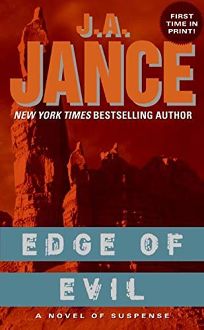
The Edge of Evil

I have recently read several of J.A. Jance's "Ali Reynolds" series (see Man Overboard and Clawback), so I decided to go back and read the 1st one. Jance is a fine writer and so I don't need to repeat that she creates believable characters, a decent sense of place, and tight story lines. Ali Reynolds is a co-anchor on the evening news (6 and 11 pm) for a TV station in Los Angeles. After her show one evening, the new guy brought in to bolster ratings tells her she is being let go, and inadvertently admits that it's because she is considered too old to appeal to a younger audience. This in spite of the fact that the male newscasters are decades older than Ali's 40+ years. Her husband, Peter, is an executive at the station, and it turns out that he and just about everybody else knew that Ali was going to be fired before she did and said nothing to her. She is determined not to take this obvious case of age discrimination lying down.
When she learns that her best friend from high school, Reenie, is missing and that she has been diagnosed with ALS. Ali decides this is a good time to go back to Sedona, Arizona, where her parents have run the Sugarloaf Cafe for years, and support Ali's family while she also gets her own life sorted out. She hires an attorney to pursue the age discrimination case and her college age son, Chris, decides to drive with her to Sedona while he is between terms at UCLA. Chris also sets up a blog for Ali called "cutlooseblog." Ali is initially surprised and then gratified to find out how many people start following her story of being let go from the TV station. As Ali investigates Reenie's disappearance, she also digs into understanding more about the disease of ALS and that becomes a thread on her blog as well. When Reenie's car and body are discovered over a cliff on a nearby mountainous road, many believe she committed suicide rather than face the slow and painful death of ALS. Ali is convinced her friend would never leave her children before she had to and determines to find out more about Reenie's last hours. In the meantime, she discovers her husband has been having affairs and now Ali's decided to end the loveless relationship. Her blog brings her to the attention of some abused women and then, unfortunately, to the attention of their abusers, who threaten Ali with physical harm. There is a lot more going on, but just go read the book and get the whole intriguing story for yourself. Publishers Weekly was not particularly impressed with the book and called it "predictable" but I still liked it.