Showing posts with label alchemy. Show all posts

Tuesday, March 6, 2018

The Strange Case of the Alchemist's Daughter

New author to me, but Dr. Theodora Goss, a professor in the Writing Program at Boston University, is apparently a prolific and award winning author of novels, essays and poetry, primarily in the myth and fantasy arena. This outing builds upon several characters from Victorian era literature: Dr. Jekyll and Mr. Hyde, Sherlock Holmes and Dr. Watson, Dr. Moreau, Dr. Frankenstein. Mary Jekyll is left penniless after her father has died (she believes) and her mother has gone mad. Looking through her father's papers and trying to sort out her mother's finances lead Mary to believe that Mr. Hyde (who she believes was a colleague of her father's) is still alive.  Years ago, there was a hefty reward for finding him in relation to a murder he committed, and that money could solve a lot of problems for Mary. Tracking down a monthly donation her mother was making for the support of the daughter of Mr. Hyde, what she finds is an unruly child, Diana, who being housed at a nunnery, but is being thrown out because she is so disruptive.  The story is told by Catherine Moreau (daughter/ creation of Dr. Moreau) with interjections from all the primary female characters (Mary, Diana, Mrs. Poole, Beatrice Rappaccini, and Justine Frankenstein), as she writes  of the mystery that brought them all together. A secret society for alchemists apparently had members who wanted to move beyond the transformation of base metals into gold and explore biological transformation--from animal to human or from dead to alive. Frankenstein, Moreau, Rappaccini, and Mary's own father, among others, all belonged to this controversial group. And it turns out they were all involved in creating monsters. Now the monsters,  most of the main women characters in the story, have found each other and are trying to create a normal life for themselves. This society may also be connected to a series of murders in Whitehall, mostly prostitutes, and it may even be that the nunnery's director is somehow complicit. There is a mystery to be solved, and it is, but the door is clearly left open for further adventures of these women with extraordinary skills. It is an interesting idea to weave all these horror tales together into an alternative narrative. And certainly the occasional direct dialogue with the characters is an unusual device. I tend to agree with Kirkus, however, which found this distracting and also felt the characters were undeveloped. Perhaps in the sequel, which is slated to be released this year? The reviewer from NPR was more positive, concluding that "At its heart, Strange Case is a lively, late-Victorian adventure that celebrates, overhauls, and pokes gentle fun at the era's weird-fiction tradition. But it's also a sparkling, insightful conversation with the canon from which it sprang." Publishers Weekly also offered a positive evaluation.

Saturday, January 3, 2015

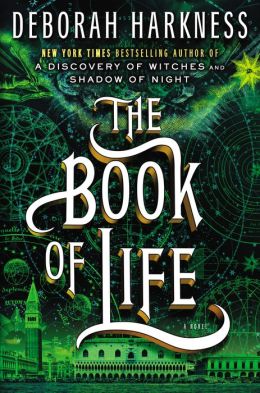
The Book of Life

This conclusion to Deborah Harkness' "All Souls Trilogy" is totally satisfying, although the complex cast of characters and plot machinations did make me want to go back and re-read the first two books, A Discovery of Witches and Shadow of Night. Now fully empowered, witch and weaver Diana Bishop and her vampire scientist husband, Matthew Clairmont, are back in the present and seeking to dodge the wrath of the Covenant for having married across species and, worse yet, conceiving twins. Vampires are not supposed to be able to conceive and Matthew's "son," Benjamin, crazy with the Blood Rage that Matthew keeps under tight control, is determined to find out why this has happened. He has been capturing, impregnating, and torturing witches in his single-minded quest, and Diana is next on his list. Add to that, the scion of the Clairmont clan, Baldwin, seems determined to put a stop to his "sire's" acknowledgement of Diana as a Clairmont. Facing opposition and outright danger on multiple fronts, Diana and Matthew head back to America, where an unlikely alliance with Diana's geneticist colleague may provide the answers they are so desperately seeking regarding the genetic inheritance of witches, vampires and daemons. Diana continues to seek the missing pages of The Book of Life, racing against those who would use it for ill, and when she finally finds it, the outcome is totally unexpected. If you love the paranormal, a bit of science, a great mystery, and historical fiction, this is the series for you.

Monday, May 13, 2013

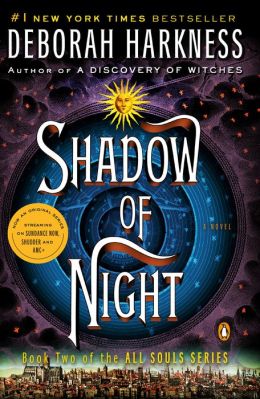
Shadow of Night

This sequel to A Discovery of Witches by Deborah Harkness was equally compelling if somewhat slower moving at times. Again, I could hardly bear to put the book down at night and was constantly trying to steal a few minutes whenever I could to read a few pages while waiting for appointments or in between tasks at home. This richness of detail obviously delights this history professor author and she describes the food, the clothing, the architecture, the bad dental hygiene and more of 16th century Europe so vividly that you can almost imagine yourself there. Diana has timewalked herself and Matthew back to 1590's England in search of the elusive manuscript, Ashmole 782, that they think might hold the secrets of the origins of current day creatures--vampires, witches, and daemons. They are also hoping to find witches who can school Diana in her newly unbound powers which contemporary witches seem to find threatening; Diana soon finds out why. She is one of a very rare breed of "weavers," witches who can create spells by weaving them from the threads of the world, not just being limited to following the spells already created. For centuries weavers have been revered, but also feared, and were eventually hounded nearly out of existence. Her father was one. In this book, both Diana and Matthew have the opportunity to reunite with their now dead fathers. Danger comes not just other creatures but from treacherous friends, relatives and political powers as Diana tries to shift from being a historian to being a participant in history. I can hardly wait for the 3rd installment in this trilogy.

Monday, May 6, 2013

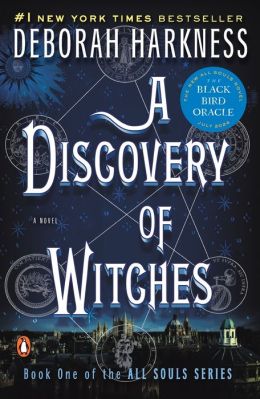
A Discovery of Witches

I have my friend Betsy Friedman to thank for beating me about the head -- uh I mean persuading me to read this book. It's the first book I've read in a long time where I had to force myself to put it down at night and turn out the lights to go to sleep. Rich, interesting settings and characters, including a house that communicates its wishes with groans and slamming doors, hides secrets until they need to be revealed, and spontaneously adds rooms when it's expecting guests. Obviously it is about witches, but also about vampires and daemons and how they have and have not gotten along--for centuries.  Author Deborah Harkness is a history professor at USC and has created two characters also steeped in history. The main witch character, Diana Bishop, is a historian of science, specifically interested in those who pursued alchemy. She has fought her witchy heritage all her life, believing both that it played a significant role in the brutal murder of her parents when she was aged seven, and that she needed to prove to herself that she could achieve academic credibility without using magic. And she largely succeeded at not using magic, until one day she calls up an old alchemical manuscript  from the stacks in Oxford's Bodleian Library and unwittingly unleashes pent-up floods of political maneuvering among the three groups of non-human creatures. An unlikely protector appears in the form of Matthew Clairmont--physician, professor, and ancient vampire, who has lived hundreds of years of history.  Their relationship may be the catalyst for an all-out creature war, or even an evolutionary tipping point. It becomes apparent to one and all that history and magical forces have been leading to this union for a very long time and yet there are those who will stop at nothing to make sure they do not survive together. I can hardly wait to read the sequel, Shadow of Night.