Showing posts with label Canada. Show all posts

Wednesday, June 21, 2023

Camp Zero


This is another science fiction book by an author I have not previously encountered, Michelle Min Sterling. Kirkus offers this summary:

"It’s 2049, and 25-year-old Rose accepts a dangerous assignment from Damien, her master-of-the-universe boss, who promises that she and her mother will be set with income and housing for life in a precarious, ever warming world if she succeeds. On her mission, she’ll continue as a sex worker alongside five other women while keeping an eye on Damien’s interests in a new, secretive project. Meanwhile, Grant Grimley just wants to escape the reach of his family’s vast wealth, a legacy created from centuries of extraction. He accepts a teaching job that guarantees to get him off the grid. Rose and Grant, both Americans, arrive at a camp in the Canadian wilderness, a frigid frontier of sorts, where a renowned architect seeks to build a refuge from climate catastrophe. Not too far off, a group of women—American soldiers and scientists—is creating a sanctuary of their own to survive an imperiled planet. It's a smart setup. The author has imagined an array of futuristic ideas stemming from our present, including a next-generation smartphone that’s implanted as a chip behind people's ears at birth and a Floating City off Boston’s shores where the elite live in bliss while the rest of the population deals with worsening hurricanes and wildfires." They are not ringingly positive about the book but do conclude by saying, "the book has a soul that generates momentum. It’s committed to the bonds of family, the ones we are born into and the ones we choose, as a way forward in an increasingly chaotic world. A love letter to what communities of women can accomplish when they work in concert."

There are several plot lines and hidden motives of the characters that are revealed as the narrative moves forward. The Toronto Star concludes their review by praising the author's "powerful storytelling, the vividness of her vision, and her creation of a world which will likely haunt your dreams."

Saturday, April 1, 2023

A World of Curiosities


The title of Louise Penny's most recent addition(the 18th) to the "Gamache" series is loosely based on an actual Flemish painting ( by Frans Francken II) from the early 17th C called "A Cabinet of Curiosities," which is supposed to represent artifacts from various cultures/ countries around the world. Only in this case, the painting also contains lots of hidden clues to the identity of a serial killer. How it came to be in a hidden room above Myrna's bookshop strains credibility. While I still love the characters of her books, who grow more richly filled out with each subsequent book, I found this book had too many moving parts and was sometimes hard to follow. What I did enjoy were the flashbacks to the original meeting of Gamache and Jean-Guy Beauvoir. The first case they worked on together involved two children who were subjected to the worst kind of sexual abuse and now those two grown up children have come back into the lives of Gamache and Beauvoir by taking up temporary residence in Three Pines. 

The Washington Post calls this "The eeriest Gamache novel yet, “A World of Curiosities” is also one of Penny’s most intricately plotted and harrowing." The Seattle Times says it is "an irresistible read." Kirkus concludes, "The plotting is complex and the characters as vivid as ever, but the opportunity to watch Gamache and Beauvoir's relationship develop is what makes this book one of Penny's best. Penny will have you turning the pages as fast as you can to see how she'll manage to tie everything together." Finally, Publishers Weekly offers these comments: "Bestseller Penny’s virtuoso 18th novel featuring Chief Insp. Armand Gamache of the Québec Sûreté ...blends nuanced characterization with nail-biting suspense....This tale of forgiveness and redemption will resonate with many." I guess you'll have to decide for yourself.

Monday, February 6, 2023

The Madness of Crowds


This is the 17th installment in Louise Penny's  "Inspector Gamache" series. The topic is extremely timely as it addresses how a charismatic speaker can interpret actual (or alternate) facts and convince millions of people to not only believe what they're told but also act on it--even when the actions are legally or morally indefensible. The rights of the most vulnerable members of society and the aftermath of the pandemic are themes that run throughout the story as well. Gamache, as further punishment from the head of homicide at the Surete, is asked to provide security for a university professor of statistics coming to a small local university to give a talk; given that it's the holidays, it seems unlikely that anyone will turn out. When Gamache researches Dr. Abigail Robinson, however, he finds her topic so repulsive that he begs the local university to cancel the event. Dr. Robinson has concluded from her data during the pandemic that we cannot survive unless we eliminate all the non-productive people in our society--the old, the sick, the disabled. Given that Gamache has a granddaughter with Down's syndrome, this is a very personal issue. Dr. Robinson's controversial conclusions have attracted millions of followers and opposition; violence has often accompanied her public appearances. Sure enough, in spite of extensive precautions, someone shoots at Robinson during he talk and she is only saved by Gamache's fast action. Now Gamache's team must investigate an attempted murder. What complicates things further is that, on New Year's Eve, when the village of Three Pines is gathered to celebrate, a successful murder spoils the festivities. However, it is not Robinson who is killed, but rather her loyal friend and assistant. Was she killed by mistake or was she actually the intended victim. As usual, past events and their effects on the human psyche, even years later, become the focus of the investigation. And everyone seems to be hiding big secrets, even people Gamache has known for years. 

Kirkus concludes their review by saying "No one balances tight plotting, compassion for her flawed characters, and a broader vision of humanity like Penny." Similarly, Publishers Weekly offers "Seamlessly integrating debates about scientific experimentation and morality into a fair-play puzzle, Penny excels at placing her characters in challenging ethical quandaries. This author just goes from strength to strength." The New York Journal of Books goes even further: "High emotion is balanced by high intellect and a high level of craft, revealing an author at the top of her game. Don’t be surprised if she receives an award for this one."

Friday, October 25, 2019

Bellewether

Recommended to me by friend Anne Zald, Susanna Kearsley is a new author to me and a prolific writer of historic novels, often with a romance plot line to them. This is her most recent book (2018) and is told in alternating chapters by a contemporary museum curator, Charley, and by two of the historic figures she is researching, Lydia Wilde, and Jean-Philippe de Sabran, The setting is the north shore of Long Island in the present day and, alternately, in 1759, during the final stretch of the Seven Years War in the theatre of eastern Canada. Kearsley provides extended notes after the story detailing the actual historical figures upon whom many of her characters were based.
Charley has come to Millbank after her brother, Niels, suddenly died of a heart attack. His daughter, Rachel, although a young adult, was left the house and Charley has come to stay with her and taken a 2-year contract with a local group that's in the process of turning the historic  house belonging to the Wilde family into a museum. That means she's left behind her boyfriend, Tyler (who everyone else thinks is a jerk), and they are trying to maintain a long-distance relationship. You pretty much know from the beginning that it's not going to work out. The love interest in Millbank is the contractor who is rehabbing the house.
Jean-Philippe is a captured French officer who has been billeted in the Wilde household, along with another French officer, while waiting exchange. Lydia runs the Wilde house after the death of her mother. Her father and two brothers as well as a young black woman, Violet, also live there. The work seems endless to maintain the farm and Jean-Philippe soon pitches in to help with the manual labor. He falls in love with Lydia, who at first despises him because of the death of her fiancé in the war. The French are, after all, the enemy.
Charley wants to make the story of a doomed love affair between Jean-Philippe and Lydia part of the narrative of the museum, although other museum board members are adamantly opposed. The house and its ghostly inhabitants have a mind of their own and secrets are gradually revealed that tell a very different story about the  Wildefamily and the events that transpired.
It took me quite a while to get into this book, but in the end, it was worth the read. I am a fan of good historical fiction and appreciate the research that goes into grounding the stories. Brief but positive review from the Historical Novel Society, and a personal piece about Kearsley's own family history  that ties into the book in Publishers Weekly.

Monday, July 8, 2019

The River

I have read both The Dog Stars and Celine by Peter Heller, the latter being one of my all-time favorites. His language is so beautiful and his characters and settings so vividly drawn that the plot is almost secondary, except it isn't. All his books have drawn me in and pulled me along, and this last one especially so. Spoiler alert, this book does not have an altogether happy ending.
Our protagonists are two college friends from Dartmouth who instantly bonded over their shared love of the outdoors, fishing, and reading. In fact, between their junior and senior year, they have worked as outdoor experience instructors and are now taking a canoe trip up the Maskwa River in the remote Canadian wilderness. They are an excellent team, each bringing their own strengths, although they are different in temperament and stature. Jack is wiry and more cynical. Wynn is a big man with a trusting nature and optimistic outlook. Although their combined experiences and knowledge prepared them well to deal with a raging forest fire they discover is headed their way, their differences contribute to fatal mis-steps when they encounter some bad people. As they are heading north, trying to keep ahead of the fire they encounter a couple of boorish older men, drinking heavily who seem uninterested in their warning about the fire. In a weird morning fog, they hear a man and woman loudly arguing on the shore but are unable to locate them to warn them. Later they encounter a man coming down river alone, saying he lost his wife--perhaps the couple they overheard. Both young men immediately retrace their steps to try and find the missing woman, but only Jack is suspicious of the circumstances. When they do find her, seriously injured, the urgency to get to a town several days away increases dramatically. Glowing reviews are provided by The New York Times, Kirkus, USA Today, Publishers Weekly, and The Guardian.

Friday, January 1, 2016

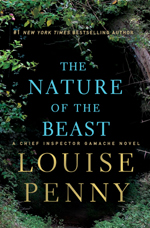
The Nature of the Beast

The latest Louise Penny--reading her is like the very best kind of meal and dessert rolled into one. She is such a fine craftswoman with her writing and the characters never cease to evolve and thus sustain my interest. Set once again in the tiny East Townships village of Three Pines, a local boy who tells too many tall tales opens a can of worms when he discovers something in the woods that someone--maybe several some ones--will kill to keep secret. The story of a missile launcher of mythical proportions being hidden in the Canadian woods seemed so far-fetched, that I was surprised to find in the Author's note that it was based on a real event.
Gamache has received numerous offers to give up his early retirement--come back to the Surete as head of the major crimes unit is just one of these. What is to be "next" in his and Reine-Marie's life? She also gave up an esteemed career. The door is left open to see what the future holds, even as we see Gamache letting go of his former role as head of homicide and allowing those he trained, Lacoste and Jean-Guy, to carry on as he taught them--with compassion for the victims, curiosity about the perpetrators, and thinking as the major tool for solving the puzzles.
Everyone has secrets it seems. We continue to learn more about the mad poet, Ruth, and the local grocer, Monsieur Beliveau, gets some development for the first time. Jean-Guy and Annie have a happy surprise that makes the moral dilemma faced by Gamache towards the end of the story all the more terrifying. I have been hooked since I read the first book in this series, Still Life, and Penny just never disappoints.

Wednesday, February 11, 2015

The Kill Artist

This is the first book in the Gabriel Allon series by Daniel Silva; having recently read one of the more recent installments, The English Girl, I wanted to backtrack and find out where Allon came from. This is very solid writing with well detailed settings, complex characters, and tight, fast-paced plots. I don't feel compelled to read all the Allon books (14 so far) but would never mind spending a few hours with another installment.
As the book opens, Allon is working as a highly in-demand art restorer, a profession in which he was originally trained through the auspices of the Israeli Secret Service to give him a valid cover for his less public activities. He is hiding from his former life, which he knows was responsible for the death of his small son and the permanent invalidism of his wife, who has been in a nursing home these last nine years. Still his former boss, Ari Shamron, once again the head of Mossad, has tracked him down and persuades Allon to assassinate the terrorist Tariq, the man who killed Allon's son. Shamron says there is proof that Tariq was behind the recent murders of the Israeli ambassador to France and his wife. He wants it done off the books and offers Allon a blank check to make it happen.
Allon recruits a part-time former agent and fading high fashion model, Jacqueline Delacroix, who also hides from her past as Sarah Halévy, daughter of Jews killed in WWII. Allon and Delacroix think they have infiltrated Tariq's organization, when in fact, they have been lured in by Tariq himself. The race is on to find and kill Tariq before he derails the Israeli-Palentinian peace process by murdering the key players, and to get Jacqueline out before her usefulness to Tariq is expended. It is only at the very end of the book that we find out how ruthlessly Shamron has manipulated Allon and Delacroix to get what he wants. Detailed plot summary available here.

Sunday, February 16, 2014

The Wandering Fire: The Fionavar Tapestry: Book Two

So much happens that I won't even try to summarize this second installment in the The Fionavar Tapestry Trilogy by Guy Gavriel Kay (see also the blog for Book One). Let me just say I am well and truly hooked and having a hard time tearing myself out of this book to go do the mundane tasks of life--like fix dinner!
When Book One closes, Kim has used her power to pull all five of them out of Fionavar and back to present day Canada, primarily to save Jennifer, who was being raped and tortured by Rakoth Maugrim and his minion,  Blöd , one of the dwarves who betrayed Fionavar and freed Rakoth from under the mountain. Seven months later, Jennifer is carrying Rakoth's child in defiance of his last order, which was that she not be allowed to live; she believes he knew of the child and that it would be a threat to him. Kim is awaiting the Seer's dream that will take them back to Fionavar and the war between Rakoth and the rest of Fionavar. Finally it comes and she recalls The Warrior, King Arthur, from the grave. Paul and Jennifer have already returned to Fionavar because Galadan has crossed over and is hunting them. The passage brings on Jennifer's labor and the baby, Darien, is born and given up to a woman in the village whose son, Finn, has been called to the Longest Road.
Fionavar has been paralyzed and is beginning to starve under the weight of a bitter and unnatural winter, even though it is approaching Midsummer. Loren has made it his task to find out how the winter is being created, but Kevin, the member of the original group who has felt most useless in all the events up to now, beats him to the punch but pays the highest price of all. Loren, Matt, Paul and Diarmuid set out across the sea to find the treacherous former First Mage and stop his machinations. In the final battle between the two mages, Magren is killed but Loren and Matt's bond is irretrievably broken, leaving Fionavar with only a single Mage. With winter gone, Rakoth looses his dark armies and victory is barely snatched from defeat by the release of The Wild Hunt, a group of ghostly dead Kings led by Finn.

Sunday, September 8, 2013

How the Light Gets In

After the ending of The Beautiful Mystery, it was ALL I could do not to turn to the last page and see how this installment of the Inspector Gamache series by Louise Penny was going to turn out. But I resisted.  And she kept me on the edge of my seat (figuratively speaking since I mostly read in bed before going to sleep) the entire time, uncertain as to whether Gamache would emerge victorious or go down in flames. The situation looks dire. Francoeur has dismantled the homicide division that Gamache worked for decades to build and has installed every ne'er do well he can round up from the Surete to undermine Gamache's credibility and effectiveness. Although there is a murder mystery that threads through the book, involving the death of the last of a world famous set of quintuplets, the real story here has to do with what evil plot Francoeur is hatching and why it involves destroying both Gamache and Jean-Guy. A former member of Gamache's team, Yvette Nichol, makes a reappearance, and Isabel Lacoste helps hold the whole thing together as Gamache pursues a deadly strategy of deception and double-cross with Francoeur and his minions.  For me, much of the tension came from the apparent contrast between Gamache's integrity and honesty, and how such a person could possibly go up against people who are incredibly dishonest and destructive.
As with previous installments, the town of Three Pines with the attendant cast of characters--including Rosa the duck--provides not only a compelling setting but its own distinctive emotional color as events unfold. There's not a wasted word, not a superfluous character, and this one kept me up nights, drawn on by the lovely prose, the characters that you want to meet on the street, and the compulsion to find out what is going on. If you haven't read the previous books in the series, do yourself a favor and start from the beginning rather than diving in with this one. When I finished, it made me want to go back and re-read the whole series!

Wednesday, September 12, 2012

The Beautiful Mystery

     I always awaits the next Louise Penny with delicious anticipation and pre-ordered The Beautiful Mystery so as not to have to wait an extra minute. Right away I was immersed in her masterful ability to make her characters come alive and create the place for the story. She has delivered another bombshell with this installment in the Inspector Gamache series, and this time it hits even closer to home than when one of our favorite innkeepers was arrested for murder. Two parallel tales unwind here, both dealing with fraternal orders, both dealing with power and how it can be used for good or ill, specifically how some will use their power to try (and sometimes fail) to protect, while others will twist the less powerless to their will. She is so effective at conveying this, that I was even led to doubt...
     The Gilbertine monks have hidden in the backwoods of Quebec for hundreds of years, first escaping the Inquisition and later just the world. They have taken a vow of silence, but ironically are known for their exquisite renditions of Gregorian chants. And now the world knows where they are, for the Prior and choirmaster persuaded them to release a recording and it has rocked the world. People have come seeking them and been repeatedly sent away from this isolated and fortress-like monastery.  But the Prior has been murdered and the Abbot is in crisis because he failed to foresee how the growing rift in his community could come to this. Gamache and Beauvoir come to stay and find out who committed this crime against God and man. The conflict among the monks centered around whether or not they should make another recording. The Abbot wants to preserve the community as it has been, while the Prior wanted to make the recording...and perhaps had another agenda as well.
     We can rely on Gamache, who is in thrall to the chants, to find the killer no matter how painful it will be to the community. But the sabot thrown into the works is when his arch enemy, Superintendent Francoeur, shows up. So begins a game of cat and mouse with the highest stakes in play. I usually don't hesitate to reveal the ending, and indeed the murderer is caught, but I can't bring myself to talk about the really important things that transpire here. If you haven't read the previous 7 books, you can still read this...it will stand on its own. But you will miss some of the nuance and gut-wrenching significance of the conclusion.

Sunday, December 26, 2010

Brutal Telling

Fifth in the Inspector Gamache series by Louis Penny, we find ourselves once again in Three Pines. This is a series that really must be taken in order to fully understand the dynamics between the characters--between husband and wife Peter and Clara Morrow for example. The Hadley house again plays a role in the murder--almost as another character--although this time brought back to life by yet another family that has fallen for the seemingly idyllic village. I have to say that the book, although still loving portrayal the characters and setting, is a bit of a disappointment and even a heartbreaker in the end. We don't really get much interaction with Armand Gamache except in his role as head of the homicide division. And a character who has been a benign and endearing presence in previous Three Pines mysteries turns out to have a dark side that even his partner and lover did not know about. So many hearts are broken--those who love this character in the story as well as those who have fallen in love as readers. We are launched into another investigation of the emotions that corrode in the dark and turn to murderous action when a body turns up in Olivier and Gabri's bistro. The new family in town--the Gilbert's--have poured money into the Hadley house in preparation for turning it into a high end  restaurant, inn and spa. Perhaps they would take customers away from the bistro and B and B run by Gabri and Olivier, and perhaps not. But the enmity between the two sets of proprietors has developed and they are currently not on speaking terms. Clara meanwhile has been "discovered" by Denis Fortin, notable art dealer, and is scheduled for her own show. But during the negotiations, Denis insults Gabri and Clara is torn about whether or not to stand up for her friend and potentially damage her relationship with Fortin in the process. Husband Peter's advice, as always, is suspect due to his fear of being eclipsed in reputation by his wife's art. Gamache listens intently and follows where the clues and his understanding of human nature take him, even though we are reluctant to follow. Worthwhile as always and I am no less keen to pursue the next in the series, but a little sadder, nevertheless. Three Pines will never be the same.

Saturday, October 23, 2010

The Cruelest Month

If you can get past the unlikelihood of three murders occurring in such a tiny Canadian village in as many years, this third Inspector Gamache installment in the Three Pines series by Louise Penny  is most satisfying. Gamache and his team are called in to solve a bizarre death --as with the two earlier mysteries, this one is connected with the old Hadley House which overlooks the village. It has fallen into disrepair after the murder of the last owner, and as Easter approaches, the villagers decide to try and exorcise the evil spirits of the place through a seance. Except that one of the seance participants is apparently frightened to death--literally . Or perhaps someone helped her along. The subplot about a colleague at the Surete maneuvering behind the scenes to fully and finally discredit Gamache is brought to a head as slanderous stories about Gamache's family appear in the press. The provocative Agent Nichol remains for almost  the entire book a question mark, although Lemieux reveals his true colors early on. The real traitor, who Gamache had called a friend all his life, realizes too late that his jealousy has destroyed one of the few things that ever brought him happiness, his friendship with Gamache.  Throughout, Gamache remains a truly human being with fears and failings, but with his integrity and compassion always intact. Would that we could all grow up to be as kind, as steady, as insightful as this man.

Sunday, September 12, 2010

A Fatal Grace

I am so well and truly hooked on this series by Louise Penny that, having finished this, the second installment of the Inspector Gamache// Three Pines mysteries, I feel like an addict in withdrawal . A little over a year has passed since Inspector Gamache came at Thanksgiving to solve a murder whose necessary ingredients had been simmering for decades. Now, at Christmastime, with the cold descending into killing sub-zero temperatures, repressed fury once again boils over in an incredibly complex and planful murder of the newest resident of Three Pines, CC de Poitiers. Everyone hated her, so the cast of initial suspects is large--her husband and daughter, her lover, the entire town. As usual, it all comes down to motive. CC is killed in plain view, at a curling match, by grabbing hold of an electrified lawn chair, sitting in a puddle of water on a frozen lake, without her gloves on--when it is freezing outside. No small feat, you will admit, to make that happen.
Intriguingly, the death of a homeless woman in Montreal may be intimately tied to this one, and serve to reveal who the murderer is. Three characters who played minimal roles in the first novel emerge as key witnesses here: Emilie, Beatrice, and Kaye. Along with the dead woman in Montreal, Elle, they all have names that can be reduced to letters: M, B, K and L. What a busy mind our author has. Like a snake curled around the base of the toilet, waiting to bite you in the butt, there is another line of trouble coiling around Gamache's life. The Arnot affair, mentioned only briefly in the previous book, is coming back to threaten him, although we do not find out exactly how that will happen in this book. We are surprised, in the end, at who is plotting against our dear Inspector. For he is irresistible, this thoughtful, compassionate, and highly ethical individual, who loves his wife and seems to consider himself a lucky and contented man. He cannot compromise for the sake of politics, however, and powerful forces hold this against him. Fortunately for me, there are more books in the series already out there, just waiting for me to get my next fix.
I don't entirely understand why, in this particular case, they needed to change the original title in England, Dead Cold, to A Fatal Grace. But under either title, you will be bound to fall in love with Three Pines, its inhabitants, and Inspector Gamache once you start reading.

Sunday, August 29, 2010

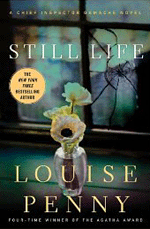
Still LIfe

Oh boy I am in love with a new writer and can hardly wait to read more in the Inspector Gamache series. Still Life is the first featuring said protagonist by Louise Penny, set in the idyllic village of Three Pines, somewhat south of Montreal and just north of the U.S.-Canadian border. Inspector Gamache, of the Surete du Quebec, is called in to investigate what appears at first to be a hunting accident, except that no one has stepped forward to admit the fatal mistake. Jane Neal, retired school teacher and perhaps unrevealed artist, was beloved by all--or was she? Inspector Gamache methodically observes, quietly directs his team to investigate, and comes to the conclusion that this was no accident. The town is lovingly portrayed--I wanted to move there right away--with a diverse and well-drawn cast of characters. Inspector Gamache is a policeman with intelligence and integrity who surrounds himself with like-minded officers when at all possible. His insistence on following his conscience has apparently landed him in hot water with his superiors at the Surete and put some significant limits on his career advancement. Nevertheless, he adores his wife, has subordinate who admire and value him, and seems a contented man overall, rather than a tortured soul like one of my other thinking woman's mystery series' protagonists (Adam Dalgliesh mysteries, by P.D.James). One of the village locals, a retired psychologist and now used-book store owner (what a dream!) is used by Penny to reveal Gamache's penchant for understanding the motivation of crime. I've already ordered the next book, A Fatal Grace/ Dead Cold.