Showing posts with label women doctors. Show all posts

Thursday, January 30, 2025

Murder by Degrees


This debut novel by Ritu Mukerji was nominated for a couple of prestigious mystery awards and I agree that it is a fine plot, setting and cast of characters. Set after the Civil War in Philadelphia as the city is becoming a powerhouse of industry, our protagonist is a woman doctor when women in medicine still faced enormous headwinds from the field. Dr. Lydia Weston is a professor and practicing clinician at the Woman's Medical College of Pennsylvania. When a young woman patient, Anna Ward goes missing and a body identified as Anna is pulled from the Schuylkill River, Lydia becomes involved in the investigation of her death. Not only must Lydia prove herself to skeptical male doctors, but also to the police who share in the sentiment that women are not fit to practice medicine, much less help solve what turns out to be a murder.

The Library Journal asserts "On the surface, this debut by Mukerji, herself a medical doctor, appears to be a mystery about the death of a working-class servant, but it's much more, as it examines women's rights, social conditions, and medicine in Philadelphia just a decade after the Civil War."  Booklist praises "Lydia assist[s] police officers Volcker and Davies with their investigation, discovering unsavory events in some of Philadelphia's wealthy families. Lydia herself is in danger as a result. This well-researched, historical-mystery debut by a practicing physician will appeal to readers who enjoy strong female characters and graphic clinical details." 

Publishers Weekly also recommends the book. "Mukerji’s taut plotting and vivid depiction of the era’s medical practices and social customs will leave readers eager for a second installment." Kirkus compares Mukerji's writing favorably to other well know writers. "Mukerji, like Patricia Cornwell and Kathy Reichs, pulls the reader into fascinating and richly detailed forensic autopsies and blesses Weston with the instincts and determination to carry out a murder investigation as effectively as—or even better than—the police. This well-constructed narrative will also be appealing to literature lovers as Lydia finds solace in reading Tennyson, Browning, and Wordsworth. Mukerji writes with the assurance of a more seasoned novelist, and armchair sleuths can hope this is the beginning of a substantive new series. Like Jacqueline Winspear’s Maisie Dobbs, Lydia is a strong and indomitable woman who transcends her circumstances to become her true self and a crusader for social justice. This atmospheric novel heralds the arrival of a talented new writer and an unforgettable heroine."

Wednesday, December 9, 2015

Working Stiff

The sub-title of this book by Dr. Judy Melinek and her husband T.J. Mitchell is "Two Years, 262 Bodies, and the Making of a Medical Examiner." I read a blurb about this book in a book catalog and, rather than buy it, I checked it out of the library and found it sufficiently engrossing to read the whole thing. Although she started a surgery residency after completing medical school, Melinek soon came to believe that the conditions of the residency threatened the health of both patients and residents and she switched to forensic pathology. She did her residency at the Office of the Chief Medical Examiner in New York City. This is considered one of the very best residency programs in the field and she felt it offered her the opportunity to continually learn more about the human body and how it functions or fails to function.
She tells a series of vignettes about the cases she work on, including discussions of various ways that the families of the deceased deal with their deaths. Homicides were not a large percentage of her cases, but she did help convict a number of killers through thorough work and documentation. On the other hand, she felt some people got away with murder because assumptions were made about the victims' life styles or because the police were unwilling to investigate.  Since her father committed suicide when she was a teen, she felt a particular empathy with the families in those cases. She even had a stalker--a mother who could not accept that her son had died of a drug overdose and wanted the death certificate change to indicate his death was due to accident or homicide.
Melinek was in the middle of her residency when 9/11 occurred and she documents in detail what the process was like to deal with the remains of nearly 3,000 victims. Within a month of that disaster, a plane crash in Queens killed almost 300 people, further straining an already overloaded system. She speaks highly of the professionalism, expertise and compassion of her co-workers.
A really interesting read, presented in a sympathetic and totally non-sensationalistic manner. Technical terminology is usually explained pretty clearly. Appeals to our morbid fascination with death. Reviews available from The Washington Post, The New York Times, and Kirkus.  

Tuesday, February 19, 2008

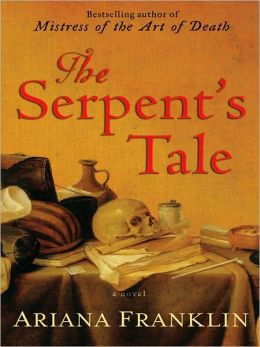
The Serpent's Tale


I had my name on the list at the public library--awaiting the sequel to Ariana Franklin's Mistress of the Art of Death (see my earlier blog post on that) and it finally came last week. I devoured it in the way that true bibliophiles do--ignoring social conventions of conversation, participation in meal preparation, etc. Well worth the wait! Our medieval forensic doctor, Adelia Aguilar, is called back into service by King Henry II from her retirement to country life in the fens of central England. Henry's favorite mistress has been poisoned; all the obvious clues lead to Henry's disgruntled Queen. If Queen Eleanor is truly guilty, civil war is seemingly inevitable and Henry doesn't want that, so Adelia must determine the true identity of mistress Rosalind's assassin. Adelia is also reunited in this book with Rowley Picot, her former lover and father of her baby daughter; he is now Bishop of St. Albans and their relationship is very complex and totally understandable given their individual dispositions. Franklin is the pen name for Diana Norman, who has written a handful of other historical novels, many of them also set in the middle ages , and she has become quite well known for the accuracy of her historical research and richness of characters. All of this plus the challenge of finding the killer(s) makes for an absolutely engrossing read. I love learning about a country, a culture, a time period-- through literature, especially when it is well researched and palatably written. These remind me of Candace Robb's mysteries with another strong woman protagonist who works as an herbalist in medieval England. Other authors using similar time period and settings are Sharon Penman and Edith Pargeter (aka Ellis Peters) of Brother Cadfael fame. Of course I loved the BBC series with Derek Jacoby playing Cadfael. Anyway, this book is an absolutely delicious diversion so hide yourself away for a weekend and dive in.

Sunday, November 4, 2007

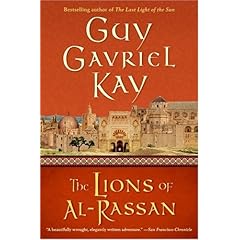
The Lions of Al-Rassan


I can't really remember where I first read about this book; it must have been a good review to prompt me to read it, however, as I was totally unfamiliar with the author, Guy Gavriel Kay. But what a really splendid novel! Although ostensibly set in a non-earthly world that has two moons (a blue and a white one) the history, place names, and geography strongly resemble those of the Iberian peninsula. This book was delightfully serendipitous in that it connected to two other recent reads, Mistress of the Art of Death and Gertrude Bell: Queen of the Desert. One of the main characters of this book, as in Mistress, is a woman physician, Jehane bet Ishak. Aside from the challenges offered by being a woman in a profession and culture dominated by men, life is made more difficult because of her faith. She is a member of the Kindath or wandering tribe; it wouldn't be too far a stretch to imagine substituting the word Jews, based on the persecution they have experienced from the other religions, the Asharites who worship the god behind the stars (read Muslims), and the Jaddites who believe the sun is god (read Christians). Early on she is befriended by and then comes to love men of these other faiths, Ammar ibn Khairan, an Asharite poet, warrior, diplomat and assassin, and Rodrigo Belmonte, captain of a Jaddite army, devoted husband and father. Like the real-life Ms. Bell, Jehane operates in a man's world, contributing unique skills and knowledge that come from a compassionate and consuming intellect. The desert born Asharites are also reflected in the dealings Ms. Bell had with the tribes of the Middle East. The body of the story takes place in less then a year; we are drawn inexorably into peoples' lives, shifting ever faster as a war of reconquest is crafted and then set in motion. A year later, decisions reached on the eve of war now reach their inevitable conclusion; but we must read the epilogue twenty years further on to really know what happened. This was one of those books that was hard to put down and that will definitely push me to seek out other works by Canadian author Kay. Kay's own sources for the historic, literary and character aspects of this book are found here.

Monday, September 24, 2007

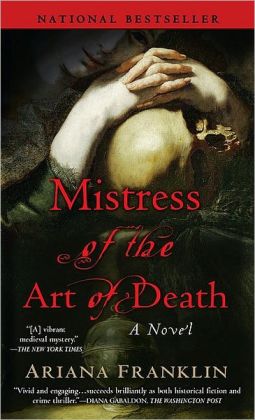
As vices go...


I suppose reading mysteries is fairly benign, but I harbor a certain shame that they aren't somehow as worthy as other reading, that is, until I know someone else is also a mystery fan, I'll talk first about the more erudite things I've read. With the occasional exceptions of really quality writers who create fine complex characters or take on weighty social issues or teach me more about a culture (P.D.James, S.Paretsky and Tony Hillerman come to mind as examples), I tend to think of them as my escapist literature--my "comfort food" reading. So recently, having had my fill of reviewing YA books, I immersed myself in a couple of mysteries, Dead Canaries Don't Sing by Cynthia Baxter and Mistress of the Art of Death by Ariana Franklin. For anyone who likes animal characters to spice up their mystery soup, Dead Canaries is good fun; the protagonist is a veterinarian and amateur sleuth who is usually escorted by her two rescued dogs, a tail-less Westie and a one-eyed, 3-legged dalmation. She also has Cat (short for Catherine the Great) and a parrot who holds a key clue in this tale. Another animal-centric series I really enjoy is that by Rita Mae Brown; these are told from the point of view of the protagonist's cats and a dog--who claim to solve the mysteries long before their sensory-challenged humans do. But the greater of the two mysteries I read, the one that really grabbed me--you know the like, can't put it down, stay up too late, everything else goes by the wayside until I'm finished--was Franklin's Mistress. I profess a certain fondness for medieval mysteries (e.g., Umberto Eco, Sharon Penman, Candace Robb, Barry Unsworth) and this one features a woman who is a pre-cursor of the forensic specialist, trained at the medical school in Salerno, and recruited to go to Cambridge to help solve the murders of several children. Not for the faint of heart since it's fairly explicit about how the children are murdered, but rich with period details, the politics and tension between the Church and Henry II, the social strictures under which women, Jews and other non-dominant groups had to maneuver. Several characters in addition to the protagonist are well-developed and an author's note on the factual basis of several aspects of the story added to my appreciation of this well-paced story. I really hope there will be a sequel...