Showing posts with label aging. Show all posts

Friday, July 31, 2026

The Borrowed Life of Frederick Fife


Publishers Weekly
offers this summary and recommendation of Anna Johnston's debut novel: "Johnston debuts with a sweet story of mistaken identity and second chances. The narrative begins with a failed rescue attempt, as impoverished widower Fred Fife tries to help a nonresponsive man, who turns out to be nursing home resident Bernard Greer, away from a river's edge. After Bernard falls into the river and is carried out of sight, a harried nursing home employee ushers Fred, who looks just like Bernard, back to the home. Because Bernard exhibited signs of dementia, nobody believes Fred's insistence that he doesn't belong there, and when Bernard's body is discovered with Fred's wallet, which fell into the river during the botched rescue attempt, he's identified by the police as Fred. After Fred's initial resistance, he settles into the relative comfort of the home, befriending fellow resident Albert, who, in his dementia, believes Fred is his brother. When Bernard's estranged daughter, Hannah, appears at the nursing home, Fred, who always longed for children and deeply misses his late wife, decides to lean into his lie to offer Hannah a happy and supportive version of the man who abandoned her. Johnston places the painful realities of grief and aging alongside Fred's puckish antics and lands a convincingly hopeful ending. The result is a triumphant last act story." Similarly, Library Journal describes the book as "a heartwarming story about growing old, grief and learning to navigate life's many challenges." And Booklist concludes their review with similar sentiments: "This touching narrative explores themes of community, family, and the redemptive power of new beginnings, illustrating the impact of past choices and the potential for personal transformation."

I found the book almost too sweet for my taste. I didn't dislike the book but it never really engaged me either.  

Wednesday, April 22, 2026

The Correspondent


This epistolary novel by Virginia Evans was a engaging read with it's slow evolution of secrets and relationships. It would be a spoiler to name all the characters with whom our 73-year-old protagonist exchanges a voluminous number of letters and emails, but they include a best friend, a neighbor, numerous famous authors, a stalker and her ex-husband. Sybil is going blind from a hereditary disease and fears losing the ability to continue her correspondence as well as the sense of permanence the letters gave her. She never knew her real mother, who put her up for adoption when Sybil was 14 months old. Her adoptive parents also adopted a boy, Felix, who Sybil considers her brother. Sybil pursued a career in law, both privately as a distinguished attorney and as a lowly clerk to her law partner when he was appointed as a federal judge, because the law was orderly, "black and white." That's also part of why she writes letters, to put her thoughts in order and be absolutely clear about what she wants to say. But it is also how she develops her relationships, finds her place in the world, comes to terms with her past, and discovers an unexpected future. 

Publishers Weekly calls the book a "charming debut" and concludes, "As the years go on, Sybil's relationships brim with tension waiting to be released, and the detailed connections between each character are brilliantly mapped through the correspondence. It adds up to an appealing family drama."

 Kirkus writes this summary and review "A lifetime’s worth of letters combine to portray a singular character. Sybil Van Antwerp, a cantankerous but exceedingly well-mannered septuagenarian, is the titular correspondent in Evans’ debut novel. Sybil has retired from a beloved job as chief clerk to a judge with whom she had previously been in private legal practice. She is the divorced mother of two living adult children and one who died when he was 8. She is a reader of novels, a gardener, and a keen observer of human nature. But the most distinguishing thing about Sybil is her lifelong practice of letter writing. As advancing vision problems threaten Sybil’s carefully constructed way of life—in which letters take the place of personal contact and engagement—she must reckon with unaddressed issues from her past that threaten the house of cards (letters, really) she has built around herself. Sybil’s relationships are gradually revealed in the series of letters ... Perhaps most affecting is the series of missives Sybil writes but never mails to a shadowy figure from her past. Thoughtful musings on the value and immortal quality of letters and the written word populate one of Sybil’s notes to a young correspondent while other messages are laugh-out-loud funny, tinged with her characteristic blunt tartness. Evans has created a brusque and quirky yet endearing main character with no shortage of opinions and advice for others but who fails to excavate the knotty difficulties of her own life. As Sybil grows into a delayed self-awareness, her letters serve as a chronicle of fitful growth. An affecting portrait of a prickly woman."

Sunday, January 11, 2026

Evensong


I have not previously read anything by Stewart O'Nan. This is a story without a plot line, rather a series of vignettes revealing the inner and outer lives of 4 aging women who are key players in an organization called the Humpty Dumpties in Pittsburgh. Publishers Weekly offers this good summary and review: O'Nan...once again finds extraordinary resonance in the lives of ordinary people. In Pittsburgh, 89-year-old Joan Hargrove, leader of the Humpty Dumpty Club, a group of elderly women who help each other out, lives the "nightmare" they all share when she falls down a flight of stairs and breaks her leg. With Joan recovering in the hospital, it's left to other club members to fill the void: Kitzi delivers prescriptions to Gene and Jean Sokolov, brother-and-sister hoarders who live with a houseful of cats, and slowly becomes enmeshed in the siblings' lives; Susie, a divorcee, takes care of Joan's cat and finds romance with a retired postal worker who plays in a bluegrass band. Meanwhile, Emily, a recurring character in O'Nan's fiction, is having trouble with her sister-in-law, who is showing the first signs of dementia. The drama here is strictly low-key (a funeral is the emotional high point), but O'Nan proves that he has no peers when it comes to evoking the quotidian challenges and routines of daily life. It's a bittersweet celebration of the twilight years. " 

Kirkus closes their review with these positive comments: "This frank depiction of people nearing the ends of their lives might sound bleak, but O’Nan’s brilliantly rendered characters refuse to be pitied, matter-of-factly accepting loss and physical decline as they go about their days quietly sustained by their faith and commitment to service. Unsentimental yet deeply moving: more wonderful work from the versatile, masterful O’Nan." There are excerpts from multiple review sources here. 

 What left me dissatisfied was the difficulty in figuring out the relationships (besides HD membership) between the primary characters and between them and many of the secondary characters as well as the lack of resolution for some of the crises facing the group.  It was also a challenge at times to know who was speaking in the dialogue exchanges. Apparently there are previous installments that deal with the Maxwell family: Henry Himself and Emily Alone. Seems like it might be advisable to read these before tackling this one. That being said, the characterizations are poignant and rich, the characters' struggles all too real and familiar. His writing merits further investigation.

Monday, July 14, 2025

Making the Best of What's Left: When We're Getting Too Old to Get the Chairs Reupholstered

You can tell from the title that 90-something Judith Viorst is not going to take aging altogether seriously, but she does delve into very serious topics and reports what she finds from interviewing dozens of he oldster cohort. Her chapter deal with leaving one's home for a "sensible safe retirement community," with the fact that we are all "losing it," our ardent wishes for a loved someone to "stop being dead," questions about an afterlife, thoughts on happiness and loneliness and the importance of community. A short and easy read that is still thought provoking and definitely worth your time.  

Friday, May 19, 2023

Remarkably Bright Creatures


This delightful and heartwarming story by Shelby Van Pelt was such a pleasure to read.  The main character at the beginning is Tova Sullivan, a woman in her 70's living in a small coastal town north of Seattle. She lost her 18-year-old son in a boating accident (although some claim it was suicide) and her husband and brother have recently died. Her only friends are a handful of women who used to gather for knitting and called themselves the Knit-Wits. But she also converses with the creatures at the local aquarium where she now works as an evening janitor; this provides some solace for her increasingly lonely existence. One creature in particular, Marcellus the Giant Pacific Octopus, is especially engaging and he gets the chance to offer his own perspective on human behavior and his own impending death in several chapters.  There are two missing persons mysteries that carry through the story. How did Tova's son actually die? And, as we are introduced to 30-year-old Cameron, whose mother left him with an aunt in a trailer park when he was 9 and never returned. When Cameron finds a picture of his mom with a man he recognizes from newspaper stories--a successful businessman by all accounts--Cameron takes off to find his father, get years of unpaid child support from the man, and start a new life. Of course Cameron tracks his father down, living in the same small town that Tova does, and their lives collide. Marcus feels that he knows something about the solution to these mysteries and desperately tries to help his friend Tova before he himself dies. People, in all their strengths and frailties, are revealed  in this touching story. And you might get a little surprise about the title at the end.

The Washington Post had this to say, "What makes the book so memorable and tender is Van Pelt’s depiction of Tova and her insistence on aging like a responsible person should....Tova won’t have anyone fussing over her — especially ... Ethan, the ... grocery store owner who’s been sweet on her for ages." NPR's Maureen Corrigan had her doubts about reading the book, but notes that "its weird premise kept calling to me." She calls the book "strange and freshly-imagined." Kirkus concludes their review as follows: "Although Tova and other characters are dealing with serious problems like loss, grief, and aging, Van Pelt maintains a light and often warmly humorous tone. Tova’s quest to figure out what happened to Erik weaves her back into other people’s lives—and occasionally into someone’s tentacles. A debut novel about a woman who befriends an octopus is a charming, warmhearted read."

An update (1/9/24) from The New York Times about this book's remarkable success and it's staying power.

Sunday, April 9, 2023

Less


This book by Andrew Sean Greer was selected for this month's book group (4/11/23), it won a Pulitzer, and I have read favorable reviews; so I was looking forward to this. But I have to say that until the very end, I did not particularly like Arthur Less. Library Journal sums up the plot line this way: "This hilarious and touching novel follows Arthur Less, a gay man, as he travels around the world in order to avoid attending the wedding of his former lover. The wedding invitation was the final realization for Arthur that he never should have broken up with Freddy, and as Arthur's 50th birthday approaches, he realizes he may be alone forever."  In addition to providing an escape hatch from his emotional distress, the trip provides "both a parade of colourful characters and a voyage of self-discovery (The Guardian). Interestingly, because Arthur's latest manuscript was turned down by his publisher, he is in the process of rewriting it as he travels. And at the end we realize that the emotional arc of the rewritten novel mirrors the emotional arc of this book. Or at least that's how I saw it because, at the very end, I did finally experience some empathy towards Arthur, just as the fool of a protagonist in his book goes from being a despised character to one towards whom the reader feels compassion.

Publishers Weekly calls the novel "wistful," while Kirkus labels it a "literary picaresque." Hmmm, perhaps. Kirkus goes on to conclude, "this is a very funny and occasionally wise book." Booklist says the novel is Greer's "his finest yet" and goes on to conclude, "Less is a wondrous achievement, deserving an even larger audience than Greer's best-selling The Confessions of Max Tivoli (2004)." And finally, The New York Times offers a glowing review, in part: "Less is the funniest, smartest and most humane novel I’ve read since Tom Rachman’s 2010 debut...Arthur’s wanderings as he makes his way from disaster to disaster are hilariously, brilliantly harrowing. But laughter is only a part of the joy of reading this book. Greer writes sentences of arresting lyricism and beauty... Delights of language abound...Even Arthur’s random observations are entertaining. Why, he bitterly wonders, do today’s young gay men insist on marrying? 'Was this why we all threw stones at the police, for weddings?' And as for quaaludes, 'is there any more perfect spelling than with that lazy superfluous vowel?'...By the time Arthur reaches Japan, the reader isn’t just rooting for him but wants to give the poor guy a hug."

Friday, October 15, 2021

The Man Who Died Twice


I loved this sequel to The Thursday Murder Club by Richard Osman. The setting and characters remain largely the same--a group of 4 septuagenarians living in a lovely retirement village in England, Coopers Chase, (see my post of the previous book for more about the characters). When Douglas, an old acquaintance (or was he something more?) of Elizabeth's comes asking for help, she feels obliged to respond, even though they didn't part on the best of terms. He is accused of stealing twenty million pounds worth of diamonds--from the wrong man. This broker for shady characters has his reputation to protect and will hunt Douglas down and kill him if the diamonds are not returned. In addition to the usual cast of characters--who all get further development-- we meet two MI 5 agents who have worked with Douglas and know Elizabeth by reputation, as well as "some new bad people: a local teenage thug; a tough-nut female drug dealer who (helpfully) goes weak at the knees around Bogdan; a high-level underworld 'middle man' from whom mafia diamonds have been stolen" (The Guardian). People get killed and Elizabeth, Ron and Joyce take the lead in setting a trap for the killer. Donna turns to Ibrahim for counseling after her set up of her boss and her mother turns out to be wildly successful, leaving Donna feeling lonelier than ever. So much heart is in these books in terms of dealing with the losses accompanying aging, and also so much spirit. You won't regret reading these and I look forward to further adventures with this group. The Guardian sums up my sentiments well, "The comedy in The Man Who Died Twice allows for all its characters to be alert to sobering realities: of time running out; of losing loved ones to death or dementia; of feeling physically unsafe in the modern world; of grown-up children finding you stupid and tiresome. It’s this self-awareness that grounds Osman’s characters, and makes us look forward to seeing them again." The Washington Post calls the cast of the Thursday Murder Club "a senior version of 'The A-Team.'” This review goes on to give brief intros to the various plots and subplots of the book. Kirkus rates this book as being even better than the first one, concluding "A clever, funny mystery peopled with captivating characters that enhance the story at every quirky turn."

Friday, August 24, 2018

Natural Causes: an epidemic of wellness, the certainty of dying, and killing ourselves to live longer

Prolific political activist and investigative journalist Barbara Ehrenreich has here taken on the--in her view misguided--culture of obsessive "fitness" and keeping people alive at all costs. She challenges some of the evidence (or lack thereof) and precepts of preventive medicine, mindfulness, and the belief we have control over our bodies. But she also ponders some interesting developments in understanding cell biology--especially those we consider dysfunctional, like cancer--such as the scientific quandary of why our immune systems sometimes turn against us. The review from the New York Times sums it up well:
"Nothing in modern life prepares us for the leaving of it. We treat aging as an outrage or, worse, as a sin. In our addiction to betterment, we’ve replaced “health” — an absence of sickness — with the amorphous “wellness” and a flurry of overtesting, fad diets and pointless “alternative” treatments."
At age 76, Ehrenreich has decided that she is "old enough to die." That means no longer subjecting herself to unnecessary exams, tests, and treatments.  “Not only do I reject the torment of a medicalized death, but I refuse to accept a medicalized life.”
With a PhD in cellular immunology, she is certainly qualified to offer an informed opinion on these matters.
Additional reviews from The Guardian, the Washington Post, The Atlantic and Kirkus.

Wednesday, February 15, 2017

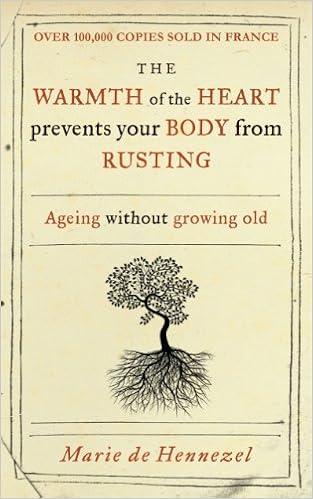
The Warmth of the Heart Prevents your Body from Rusting

French psychologist Marie de Hennezel has written several books on aging that have been translated into English.
I honestly did not much care for this book although she had a lot of good things to say, many of which are excerpted here in an article from The Mail Online (British newspaper). There is also a good interview with de Hennezel in the Huffington Post about her book The Art of Growing Old that is worth reading. There are excerpts from several reviews here, all of which are quite positive. Maybe I was just in a grumpy mood, or maybe it was her frequent reference to ugly bodies of the aged... Apparently de Hennezel has written 10 books and is a household name in France where she leads the charge on re-examining our views on aging.

At Seventy: A Journal

Born Eleanore Marie Sarton in Belgium, May Sarton (May 3, 1912 – July 16, 1995) was a prolific (over 50 books) American poet, novelist, and memoirist. She is often associated with Lesbian literature and widely read in Women's Studies, because she was one of the first women writers to focus on love between women and then to come out herself, after her parents' death, in Mrs. Stevens Hears the Mermaids Singing. She preferred to be thought of as a writer who explored the universal aspects of love and life, however. For 13 years Sarton had a partner, Judy Matlack,  and in this journal written during her 70th year, she often refers to that love. It was during the course of writing this book that Sarton learned of Judy's death, although apparently Judy had been in a home with dementia for quite some time.
What struck me most about this journal was the amazing pace of activity she sustained. Between friends and admirers coming to stay a few days or just share a meal, and her packed schedule of appearances to do readings all across the country, she struggled to find quiet time to write. She carried on a voluminous correspondence, often responding to 25 or more letters a day. She stayed in touch with distant friends by phone as well. She was a passionate gardener, and worked in the garden almost every day, weather permitting. This is even more remarkable given that  she lived in York, Maine, the last decade or so of her life. Some notable quotes follow:
"I do not feel old at all, not as much a survivor as a person still on her way. I suppose real old age begins when one looks backward rather than forward, but I look forward with joy to the years ahead and especially to the surprises that any day may bring." (p. 10)
When someone asked her at a reading why it was good to be old, she responded, "This is the best time of my life. I love being old...Because I am more myself than I have ever been."
"One thing is certain...the joys of my life have nothing to do with age...Flowers, the morning and evening light, music, poetry, silence the goldfinches darting about..." (p. 17)
"I am far better able to cope at seventy than I was at fifty. I think that is partly because I have learned to glide instead of to force myself at moments of tension...(p. 37)
"I live more completely in the moment these days, am not as anxious about the future, and am far more detached from the areas of pain, the loss of love, the struggle to get the work completed, the fear of death. I have less guilt because there is less anger." (p. 37)
"A face without lines that shows no mark of what has been lived through in a long life suggests something unlived, empty...Still one mourns one's young face sometimes...At the same time, I felt that my face is better now, and ...That is because I am a far more complete and richer person than I was at twenty-five...Now I wear the inside person outside and am more comfortable with myself...I do not have to pretend." (p. 61)
"...it is possible to keep the genius of youth into old age, the curiosity, the intense interst in everything from a bird,to a book to a dog..."(p.76)
"The autumn of life is also a matter of saying farewell, but the strange thing is that I do not feel it is autumn. Life is so rich and full these day. There is so much to look forward to, so much here and now, and also ahead..." (p. 161)
"But the discipline this time must be...to make every effort to live in eternity's light, not in time. If I begin to think of how little time we shall have...panic sets in...To live in eternity means to live in the moment, the moment unalloyed--to allow feeling to the limit of what can be felt, to hold nothing back..."(p. 190)
"These mornings when I brush my hair before going down to get breakfast I have to face wrinkles, the first sign of old age. It's not easy to accept, but I remind myself that they do not really diminish the beauty of an old face." (p. 306)
There are, of course, lots of biographies of Sarton. I found a couple of short ones online that were informative. This one from the Unitarian Universalist church, and this one from The Literary Ladies Guide to the Writing Life. 


Friday, February 10, 2017

The Last Gift of Time: Life Beyond Sixty


This memoir by Carolyn G. Heilbrun was written 20 years ago and that was when I read it for the first time. I loved it then and so, when my book group agreed to have a thematic meeting on aging gracefully, I immediately thought of re-reading this book. Strangely enough, it did not resonate with me this time around to the same extent, even though I am now the age she was when she wrote it. Still, it is a lovely book with some great insights, and she is such a good writer that it is a pleasure to read.
The passages that spoke to me were often not about aging per se, but about the world in general, and it is staggering how pertinent to our present times her observations were:
"My sixties covered a period of pronounced meanness in the United States and in the world, meanness arising from a sense of righteousness and the need to punish, preferably with violence, those who do not share one's beliefs. For the first time in my life, I became fearful of institutionalized religion...I became awakened, sadly, to policies determined to transpose the symptoms of our societal failures into its causes: the poor, that is, were to be blamed for the failures of a mean-spirited nation that condemned them to poverty...What might be called political sadness arises...as an indirect response to organized and publicly condoned selfishness and revenge..."
And this on reading:
"True sadness which is not nostalgia can...be dispelled by reading...Lifelong readers continue to read, finding in books...the means to enjoy life or to endure it."
She does indeed talk about aging and quotes (indirectly) from Montaigne on the subject:
"Above all, now that I feel my life to be brief in time, do I seek to extend it in weight. I try to delay the velocity of its flight by the velocity with which I grasp it; and to compensate for the speed of its collapse by the zest which I throw into it. The shorter my hold on life, the deeper and fuller do I seek to rend it. Others feel the sweetness of contentment and well-being; I feel it just as much as they do, but not by letting it just slip away."
She also talks about outliving our time, when there is no further point in continuing. She had given herself permission to commit suicide at the age of 70 but now says, "I find it powerfully reassuring now to think of life as borrowed time. Each day one can say to oneself: I can always die; do I choose death or life? I daily choose life the more earnesly becasue it is a choice."  She goes on to caution against "...indifference's seduction; however often apathy assaults me in these last decades, I know it to be dangerous."
She, like others I have read on the subject, encourages focus on the present, eschewing time spent on memories. "Every time those of us in our last decades allow a memory to occur, we forget to look at what is in front of us." Among other things, she writes chapters on downsizing, her love of all things English, on not wearing dresses, on sadness, on listening to the young(er), on family and husbands, on sex and romance, and on technology. Here is a review from The New York Times, and a collection of quotes from the book in GoodReads. Well worth the read.
Carolyn Gold Heilbrun, born in 1926, was an academic at Columbia University and the first woman to receive tenure there in the English department. She was a prolific author of academic and non-fiction works on topics often related to feminism. Under her pen name, Amanda Cross, she also wrote a series of mysteries with a woman professor as the protagonist. She committed suicide in 2003.  There is a fabulous obituary in the New York Times, and an interview with her in the New York Times Magazine a decade before she died. There is a list of her books and more information about her also in this article from Wikipedia.

Thursday, July 14, 2011

Portraits of Creative Aging

As I approach my 60th birthday and hopefully a not-too-distant retirement from my current job, I can't help but wonder, "What comes next?" This book by Joan Kadri Zald (the sociologist aunt of my colleague Anne Zald) is a collection of interviews with people who have retired and gone on to new careers, expanded interests and hobbies, and/or social activism. They inspire the reader with multiple examples of finding tremendous satisfaction in service to others, pursuing previously unfulfilled passions, or finding new directions altogether.  She sought to represent elders from ages 60-90's, of various cultures/ethnicities and geographic bases. A concluding chapter pulls together her observations about what characteristics these folks have in common: "passion and commitment...for the activities in which they were engaged" (p.221), meaningful and important endeavors that added "excitement and zest to their lives" (p.221). There were also some necessary preconditions: financial security, freedom from a full-time caregiving role, social connections, maintenance of cognitive and physical functioning. Their paths and undertakings are diverse and there is a lot here to chew on...I recommend it for all my fellow agers.