Showing posts with label outer space. Show all posts

Monday, April 7, 2025

Starship Troopers


In spite of the movie based loosely on this book, it is considered one of Robert Heinlein's best and a classic of science fiction. It's basically the story of a young man who defies his father's wishes and joins the army. This is the future, of course, and war is fought very differently, technologically speaking, against a race of insects with a hive mind which is trying to destroy the human race. The focus is on Juan Rico's journey from a "boot" to eventually becoming an officer. It is, in a sense, a coming-of-age story as his experience in the military shapes his character and his views on life.  It is heavy on descriptions of the tech and on the way that battles are fought. Along the way, we are offered some significant chunks of Heinlein's opinions on morality and human nature. Fore example, "The human race is too individualistic, too self-centered, to worry that much about future generations." Or this, "Citizenship is an attitude, a state of mind, an emotional conviction that the whole is greater than the part...and that the part should be humbly rpoud to scrifice itself that the whole may live." This is in reference to having the ability to vote vs. staying in the military and protecting society even though it meant that he would never get to vote. And this, "Social responsibility above the level of family, or at most of tribe, requires imagination--devotion, loyalty, all the higher virtues--which a man must develop himself; if he has them forced down him, he will vomit them out."

Thursday, July 6, 2023

A Closed and Common Orbit


This is the 2nd installment in Becky Chambers' "Wayfarer" series, which began with The Long Way to a Small, Angry Planet.  This book continues the world building and species building that Chambers seems to excel at. This time, we look into the back story of Pepper, a somewhat minor character in the first book, and the origin story of the successor to Lovey, the sentient AI who ran the Wayfarer in the previous book.When an attack on the Wayfarer ends in the destruction of Lovey, a new AI in the same series is installed but causes so much grief among the crew that she is uninstalled and another model takes her place. The new Lovey is transferred into a human body kit, which is totally illegal, and accompanies Pepper back to the port city of Coriol, where Pepper runs a technology and space gear repair shop. In alternating chapters, we learn of Pepper's childhood as a cloned child slave in a salvage factory, her escape from the factory, her rescue by another AI on a wrecked ship in the salvage yard, and her escape from the planet a decade later. Back in the present, the new Lovelace model AI has chosen the name Sidra and is trying to figure out how to fit in and not get identified as an AI. Both of the story lines present issues to think about and characters who touch the reader. 

Reviewers praised this sequel with Publishers Weekly praising "Chambers's clean, careful prose and beautiful pacing and structure [that] keep the narrative engrossing from beginning to end." Library Journal asserts that, "the power of Chamber's second space opera is in her appealing characters. ...Her protagonists might not all be human, but they possess more humanity than most." The Guardian offers this assessment: "Chambers is particularly deft when it comes to getting the reader inside Sidra’s new consciousness: from initial panicky claustrophobia through a convincing and moving process of self-discovery and awareness. The novel is compelling in its portrait of Pepper coming to terms with her past, but the real star of the show is Lovelace."

Tuesday, June 20, 2023

The Long Way to a Small, Angry Planet


This book by Becky Chambers was recommended by my friend Joan Starr Ward and is the first in the "Wayfarer" series which has 3 sequels. Chambers was turned down by every publisher she tried and so self-funded the publication of this book through a Kickstarter campaign. The book became widely popular, winning numerous awards including the Arthur C. Clarke Award in 2016. Several of her subsequent books have won writing awards including a Hugo Award for the "Wayfarer" series.

It's set in the future, after humans have made the earth uninhabitable and fled the planet to Mars and beyond. In their desperation, humans appeal to sentient beings from other planets to help and protect them. The interplanetary council agrees but with some loudly dissenting voices noting that humans cannot contribute much to the common good. 

Rosemary Harper is trying to escape the associative scandal attached to her father who was a very wealthy man on Mars. He has been tried and found guilty of selling arms to hostile species and is now in jail. She joins the crew of a somewhat ratty ship called Wayfarer which takes assignments to punch wormhole shortcuts of one area of space to another. The crew is diverse and, welcomes Rosemary--with a couple of exceptions. She is charged with all the business aspects of the ship's activities: lining up orders, keeping track of the accounts, etc. Rosemary is quickly adjusting to life in space until the captain presents them with a new job possibility. It is highly risky but will make then enough money to make the ship able to take more lucrative jobs in the future or they could choose never to work again. The vote is put to the crew and they agree. Rosemary is not so sure as danger is not what she signed up for.

Chambers is noted by reviewers as a great world builder and comprehensive character and species developer. The Guardian says, "A quietly profound, humane tour de force that tackles politics and gender issues with refreshing optimism." Other reviewers have called it "wonderfully imaginative and quirky," "brilliantly realized," "joyously written," and "perfect."

Monday, February 21, 2022

The Apollo Murders


Written by former Canadian astronaut and one-time commander of the International Space Station, Chris Hadfield, this thriller is set during the Cold War space race of the 1970's between Russia and the United States. It is full of interesting technical details about planes, rockets, space capsules and manned flight operations.  It includes lots of real people, places and events and an author's note clarifies what is fiction. Hadfield also worked as CAPCOM--capsule communicator--for 25 shuttle missions and as NASA's director of operations in Russia, so he has both front line and administrative experience with the U.S. and Russian programs. It is a wide ranging story with asides about people who salvage discarded rockets in Russia to support their families, the origins of the universe, and the horror of motion sickness induced vomiting inside an enclosed space suit. The premise is that the Russians have launched a new space station with enormously enhanced spy capabilities that would impinge on the secrecy of U.S. space efforts--i.e., creates a threat to "U.S. security." The final (fictional) Apollo 18 moonshot is re-tasked to investigate and disable the station in earth orbit before cosmonauts can be sent up to retrieve pictures. The astronauts on this mission are all former military. Additionally, the final destination on the moon is altered to land near a Russian moon rover to find out why the Russians are exploring that particular spot. The real drama arises even before blast off when the mission's commander is killed in a helicopter crash that turns out to be sabotage. I literally had a hard time putting this book down at many points. I thought the ending was a little abrupt and The New Scientist said, "the story comes across as improbable but not implausible." It still made for a compelling read. Kirkus criticizes the amount of technical detail in the early chapter but concludes, "Space nerds will geek out, and everyone else eventually gets a pretty good ride." Publishers Weekly, however, feels the details are important; "His mastery of the details enables him to generate high levels of tension from just a description of a welding error, which cascades into something significant. This is an intelligent and surprising nail-biter..."

Thursday, March 15, 2018

Six Wakes

The setting of Mur Lafferty's science fiction thriller is a space ship carrying thousands of dormant passengers to a new planet decades distant from earth. It's the 25th century and humans have pretty much ruined the earth, so those who can afford to leave do. The crew—gofer Maria Arena, Capt. Katrina de la Cruz, navigator/pilot Akihiro Sato, security chief Wolfgang, engineer Paul Seurat, and ship's physician Dr. Joanna Glass— are all former criminals who have exchanged their sentences for ferrying this ship to a new world and a new start for themselves; they will be continually re-cloned in order to survive the journey. But as the story opens, the crew's clones awake to find their former selves have been murdered and their memories of not only their deaths, but of the last 20 years of their lives have been erased from the mindmaps that are routinely inserted into new clones to provide continuity. The ship's AI,  IAN, has taken them off course and offers mixed messages with regard to sorting out what happened. As the six crew members struggle to get control of the ship and find the murderer(s?), flashbacks reveal secrets about their past that have been kept hidden or suppressed through mind manipulation. These are complex characters and as they learn about one another, never knowing who to trust, the reader is also challenged to consider what makes us uniquely human. Great futuristic "locked room" mystery.
This book has been nominated for both the Philip K. Dick and the Nebula Awards in 2018. Reviews from NPR, Kirkus, Publishers Weekly, and Booklist.

Wednesday, November 29, 2017

Artemis

I am SO far behind on posting my books that I don't know if I will ever catch up, so I am starting with the most recent and working my way backwards. Just raced through this book by Andy Weir, author of the book, The Martian, which I did not read, although I saw and enjoyed the movie. Artemis has already been optioned for a movie. This was really a great plot, supported by interesting characters and lots of well thought out details about living on the moon. Yasmine (Jazz for short) is a 20 something wise-ass who has rebelled against her father's upbringing and his Muslim faith. She has lived on the moon in the small town of Artemis (pop. 2,000) since she was 6 years old and calls this home, although she was born in Saudi Arabia. She has had the same pen pal (e-mail pal, actually) since she was 9 years old and, since he now works as a loader at the main port for freight deliveries to the moon and Jazz is a delivery porter on the moon, they have set up a nice little smuggling operation for contraband like cigars, lighters, alcohol, etc. Then one of her customers, a very rich resident of Artemis, offers Jazz an enormous amount of money to help him take over the local aluminum smelter, which also produces all the oxygen for Artemis. She agrees, but only partially completes the job before he is murdered. There have been less than a handful of murders in Artemis in the entirety of its existence, so the population is shocked. And Jazz is even more disturbed to find that the killer is now after her. It turns out that the aluminum smelting company is actually owned by a criminal cartel back on earth who will stop at nothing to maintain their exclusive contract. Jazz needs to finish taking down the smelting operation if she is to have any chance of survival. Then she uncovers a complicated plot to take over the city of Artemis, and she is not going to stand by while that happens. She formulates a plan and rounds up some friends, some not so friendly acquaintances, and her father to help her execute the idea. Nothing ever goes quite to plan, but Jazz is resourceful and committed and wins through in the end. Jazz is an engaging character and her supporting cast is terrific. You don't need to be a science fiction fan to enjoy this one.
See reviews from The Guardian, Salon, and Publishers Weekly for more details.

Saturday, February 25, 2017

Saturn Run

John Sandford, a prolific author of thrillers, here joins force with Ctein, "photographic craftsman," physicist, and science fiction thinker/writer, to create a science fiction thriller based on the device of earth's humans making first contact with alien beings. When a seemingly ne'er-do-well rich kid working at an astronomy lab notices clear evidence of a space ship landing and then departing from the rings of Saturn, the race by earth's major powers is on. China has already planned a manned launch to Mars but now is scurrying to reconfigure their ship and crew for the longer journey to Saturn. Under orders from a take-no-prisoners President, the U.S. is frantically trying to remake their space station into a ship that can travel to Saturn and get there before the Chinese. Both sides recognize that not only is there tremendous risk involved with the trip and with first contact, but also there is the potential to gain technological knowledge that is decades, if not centuries, ahead of our own. The cast of characters aboard the U.S. Richard M. Nixon will become real people and their challenges will both convince and engage the reader. There is a good chance that the failure of one of the two innovative power plants on the Nixon is the result of sabotage and that likely means a spy is on board. Recent news about the discovery of a whole system of exo-planets makes the belief that we are not alone in the universe ever more likely. What the crew finds when they arrive at Saturn's rings is unexpected.
The authors offer an Afterword that will discuss the scientific work invested in creating a realistic and believable set of technologies for the late 2060's timeframe of the novel. Well worth the read if you are a fan of sci fi.

Wednesday, February 25, 2015

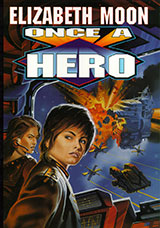
Once a Hero

I long ago read a sci-fi book by Elizabeth Moon,  Remnant Population, that I liked a lot because it had a strong female protagonist and an interesting plot. Then quite recently I read a slightly futuristic book with a male protagonist who had Autism Spectrum Disorder which was just so compelling, The Speed of Dark. This was a book I picked up at DPL Friends' shop for the trip and I thoroughly enjoyed it. Looks like this is part of her "Serrano Legacy" series which had several books that came before and several that came after. Nevertheless, it was sufficiently self-contained that it is worth while reading for it's own sake.
Esmay Suiza, as a junior officer in the Regular Space Service, has apparently not only survived a treasonous attempt by her former ship's captain to turn against the government, but then led a "mutiny" against that captain with a number of the crew. She then went on to defeat the enemy ships using only a partially disabled disabled cruiser. She had never been in combat and yet displayed uncommon abilities to strategize and lead. Where has she been hiding herself all this time? She must face a Board of Inquiry and a court martial, but is eventually cleared of all charges, promoted to Lieutenant, and reassigned to a deep space repair vehicle. First though, she is given 30 days leave and returns to her home planet of Altiplano, where she finds out that the recurring nightmares she's struggled with all her life derived from an actual rape when she was 6 years old, NOT from fever-generated dreams as her father and family asserted for all these years. She is furious and vows never to return.
How will she move forward in the RSS though now that her efforts to remain unobtrusive have been well and fully compromised by her heroic performance during the mutiny. Her commanding officers recognize that she has great potential, but Esmay cannot yet fully accept that view of herself and is terrified of getting psychological counseling that might her her reconcile these conflicting perceptions. Then Esmay uncovers a plot to hijack her ship by a terrifying enemy and again rises to the occasion. I would love to read more of these, even though I am not normally a big sci-fi fan. Moon has obviously put so much thought into these worlds she creates that every sentence conveys a picture. Brilliant really.