Showing posts with label villages.. Show all posts

Monday, November 2, 2020

The Jane Austen Society


This novel by Natalie Jenner is strongly reminiscent of the The Guernsey Literary and Potato Peel Pie Society in its gentle, bittersweet tenor describing a terrible time in the lives of those living through WWI and WWII in England.  Here our attention is focused on the small village of Chawton, outside Alton, the final home of Jane Austen and the locale for her last three novels. Every member of the village has suffered loss of some kind, the unending privations of war, the death of loved ones. And they all cope in their unique ways. The bulk of the story takes place in 1945 after the war has ended. 

Austen's brother, Edward Austen Knight, lived in the "Great House" on the Knight estate in the village. The last remaining Knight family male is on his deathbed and the vindictive old man long ago denied his daughter, Frances, a marriage to the person she loved, and now punishes her for failure to produce an heir by totally disinheriting her. The manor is due to go to any remaining male relative of the family and along with it, hundreds of years of memorabilia associated with Jane Austen and thousands of books in the manor's libraries that she had access to. An unlikely cluster of Austen fans come together to try and preserve especially the library, but also the steward's cottage on the estate, which is where Jane Austen herself lived.  The group is actually the brain child of the village handyman, Adam; no one even knew he read much, but it turns out that Austen has been a source of solace after the death of his two brothers in the war. He is joined by the widowed village physician Dr. Gray, former school teacher Adeline who lost both her husband and her baby, Frances Knight, her house maid Evie, the Knight family solicitor Andrew Forrester, Hollywood actress Mimi Harrison, and Sinclair, an expert on antiquities who works at Sotheby's and has been trying to get Frances to sell him Austen related items. 

Along the way, we discover long-suppressed loves, secret identities, and scoundrels who get their come-uppance. Somewhat of a slow start, but overall a satisfying read, even if you are not a hard core Austen fan. The book has received numerous notable mentions and laudatory reviews: The Washington Post; Kirkus; Publishers Weekly.

Thursday, December 27, 2018

Black Diamond

See the previous post, which is about Bruno, Chief of Police, the first in Martin Walker's Bruno series. This is the 3rd book in the series and some day, I will have to go back and read the 2nd, The Dark Vineyard. Bruno, who is honorifically titled Chief of Police for the French village of St. Denis, even though he is the only policeman in the village, is doing his shopping in the weekly farmers' market when several hoodlums race through on motorcycles and destroy the stall of a local Vietnamese family. Within days, an Asian restaurant in a nearby town is fire bombed. Then Bruno begins to get hints that the local truffle trade--the "black diamonds" that provide a multi-million dollar source of income for the region--is being threatened by substitutions from smuggled and inferior Chinese truffles. When his dear friend and truffle expert is brutally murdered, Bruno up to his ears in mysteries. But, as Bruno learns, his friend was also a former intelligence agent whose work may have made him a target, and there may be more important things being smuggled in from Asia than mushrooms. Once again, painful episodes from France's past, this time its colonial relationship with Vietnam, will surface and spoil the sense of a peaceful pastoral paradise. Bruno would really rather just focus on cooking, drinking wine, hunting truffles with his dog Gigi, playing and coaching rugby, and sorting out his "romances past (Isabelle of the Police Nationale), present (exotically English Pamela), and possibly future (needy single mother and research chemist Florence)."[from Publishers Weekly review]
As always, you'll want to add the Perigord region to your travel itinerary or at least go find the closest French bakery.  Additional reviews from Kirkus, The Independent, and the Washington Independent Review of Books.

Saturday, December 24, 2016

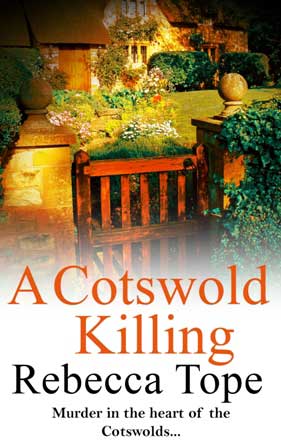
A Cotswold Killing

First of the "Cotswold Mysteries" by Rebecca Tope, the protagonist is 42-year-old and recently widowed Thea Osborne, who has decided to try out house sitting to  keep herself occupied and bring in a little extra money. Along with her spaniel, Hepzibah, she has taken a job in the village of Duntisbourne Abbots looking after not only a lovely home, but a couple of dogs, and a small herd of sheep. On her first night she awakens to a scream, but because the dogs don't bark and the security lights don't come on, she assumes it is just a fox calling and goes back to sleep. While out walking the next day, however, she finds a body in the creek and it turns out to be a neighboring farmer, Joel Jamison--one of the only village people to have stopped by and said hello when she arrived. We find out that the deceased's brother was found dead in the same field just 6 weeks earlier. Thea is curious how this could possibly happen in such a small, close-knit community. As she begins to learn more about the neighbors, however, she finds lots of history, secrets, grievances, and underlying tensions. Quite a colorful cast of characters and, since I love the Cotswolds, I enjoyed the setting as well.  Solid "English cozy" fare. I've read a couple other books of Tope's, a later book from this series, and the first in her "West Country mysteries," A Dirty Death. Tope was also the ghost writer for one of my favorite British TV mystery series, Rosemary and Thyme. 
Kirkus has written reviews of several of her books, although not this one.

Monday, May 9, 2016

A Dirty Death

Having read a much later book by Rebecca Tope (one of her "Cotswold Mysteries," A Grave in the Cotswolds), I decided to go back to the beginning and read her first book, which also inaugurated her "West Country Mysteries." Set on a dairy farm, our story opens when irascible Guy Beardon is found dead in the slurry pit--where all the cow shit is kept before being sprayed on the fields. It looks like an accident and the police treat it as such, only to find they have shit on their shoes for not treating it as a crime scene when it becomes apparent that Guy was murdered. Two more murders on this and the neighboring farm are what cinch the conclusion that someone is killing people in this lovely pastoral setting, and, although everyone would like to think it's an outsider, all evidence suggests otherwise. Our protagonist is Lilah, Guy's nearly grown daughter who has to run the farm pretty much on her own with only Sam to help (until he is murdered), who Lilah thinks is a hired hand but turns out in her father's will to have been a partner in the farm. Lilah's younger brother and mother are busy with their own dramas--real and imagined--and offer no substantive assistance. Only the local policeman, Denholm Cooper, who was a couple years ahead of Lilah at school, seems to offer a stable point of reference. The cast is filled out by neighbors, previously unknown family, friends, and town characters (notably the uncharitable vicar), who are all keeping secrets of one kind or another. It is one of these secrets that holds the key to solving the murders, and it won't be apparent whose guilty until the very end.  I would give this about a 7 on a 10 point scale. Written with a good eye for detail by an author who grew up on a farm, the writing also well conveys what life is like in a small village where everybody knows everybody else's business.