Showing posts with label Victorian. Show all posts

Tuesday, January 2, 2024

A Curious Beginning


This book by Deanna Raybourn is the first in her "Veronica Speedwell" series; she has written nine of these so far. She is also the author of the "Lady Julia Gray" series as well as some stand-alone novels, one of which is Killers of a Certain Age, which I read and really liked.  Set in 1887, we meet our protagonist, 20-something-years-old Veronica, an orphan raised by two "aunts." She is a lepidopterist and has already had several adventures in remote spots of the globe seeking rare specimens; she earns her own money by selling these on to wealthy collectors. When the last of the two aunts dies, she decides to leave the most recent small village they lived in and head for London. Her departure is interrupted by coming home to find someone has broken into the house, and who then also tries to kidnap Veronica. Saved by the arrival of another stranger in an elegant coach, Baron von Stauffenbach, Veronica accepts his offer of a ride to London--saving the train fare she reasons to herself. On the long journey, the Baron tells her that he was acquainted with her mother and that she is in grave danger. Veronica has never known who her mother was, but the Baron fears this revelation could put her in even more danger and refuses to reveal the name. He wants to take her to stay with a friend he would "trust with his life" in London. This turns out to be our other protagonist, Mr. Stoker, who is definitely not  what he first appears to be--a down-on-his-luck taxidermist living in a filthy warehouse trying to preserve an elephant shot by a wealthy patron, Lord Rosemorran.  

Kirkus continues the plot, "Before the Baron can return to tell Veronica what he knows of her mother, he's found dead, and the police like Stoker for a suspect. Stoker and Veronica partner up to find the real culprit, hurtling pell-mell into a captivatingly intricate plot, including a traveling circus, the fetid Thames, and the Tower of London, as they dodge villains with murky motives and hulking henchmen. Soon, they realize that Stauffer’s [von Stauffenbach's] death may be connected to the mystery of Veronica’s birth parents, and Stoker himself has a few secrets to discover, including what really happened on his disastrous expedition to the Amazon, which left him scarred and disgraced. As Veronica and Stoker careen through dastardly plot twists, they match wits, bantering with skill worthy of Tracey and Hepburn. A thrilling—and hilarious—beginning to a promising new series."

Library Journal also approves: "Creating strong character pairings, placing the action in ... unusual but actual historical settings, and folding it all into a clever mystery are hallmarks of this author's magical, signature style. Victoria engages in boldly inappropriate activities for women of the Victorian era but remains genuinely likable, adding a pleasant zest. Stoker's backstory allows his upbringing and past experiences to aid Victoria's investigations without becoming the primary focus. Readers will discover just enough about these two and hints of curiously reticent secondary characters to make the next in this ... series eagerly anticipated. ...For ... [those] ...who like out-of-the-ordinary historical mysteries that are completely satisfying, this new series starts off with a bang."

Friday, January 7, 2022

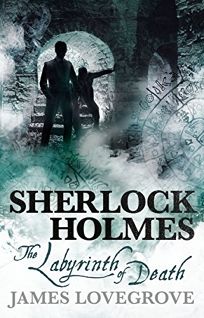
The Labyrinth of Death


I took this book from the holiday gift exchange my mystery book group had and really enjoyed it. I had never heard of author James Lovegrove, but he has written several other books (this is the 5th) featuring the Sherlock Holmes and Dr. Watson pair of protagonists. Set in 1895 (Victorian) London and in the English countryside, the characters seem believable and fairly consistent with past representations. The case here is initiated by a high court judge who comes to Sherlock, upon the recommendation of advocates and police officers he has encountered in court, to find his missing 29-year-old daughter. She is apparently quite a "free spirit," very intelligent and quite outspoken. The judge's wife died recently and he has been less than attentive to his daughter, taking solace in alcohol. It's not long before Sherlock and Watson track down the judge's daughter, but Hannah Woolfson has inserted herself into a unique organization under an assumed name in order to find a missing friend and Sherlock wants to leave her in place since they cannot get closer to the group's setting or founder as both are guarded by armed ex-soldiers referred to as the Hoplites. The term is taken from ancient Greece as is the name of the group--the Elysians. The mastermind of this community is a lauded and titled architect, Sir Philip Buchanan, who is convinced of the superiority of ancient Greek society and plans to train promising individuals and insert them back into British society at large to better it. He doesn't seem to care what the cost might be to the members of his group. When Sherlock reports back to judge Woolfson, he is of course furious, but Sherlock promises her safety. Hannah and the Holmes/Watson pair communicate via letters as to the progress of Hannah's investigations. Watson, who is widowed, is quite taken with Hannah and not at all happy with the arrangement and the potential danger to which Hannah might be exposed. After one particularly disturbing letter, Watson overrides Sherlock's admonitions to stay distant and falls into a trap set at the Elysian community by a man who Hannah had thought to be an ally. Sherlock and Watson must outwit a series of puzzles in an elaborate labyrinth in order to survive.

A middling review from Publishers Weekly.

Sunday, June 6, 2021

The House on Vesper Sands


This is the first novel of Pairaic O'Donnell's to be published in the U.S., although he one previous novel published in the U.K.; he is also a critic and poet. This is a Victorian gothic ghost tale of sorts, set in 1890's London when high society women sponsored seances and spiritualism was wildly popular fare. The protagonist is one DI Cutter of Scotland Yard and he comes to be assisted in a very circuitous fashion by a drop out from Cambridge's divinity school, Gideon Bliss. Gideon has come to London at his uncle's request, made in a letter suggesting that he and some of the poor working women he ministered to were being threatened. Coincidentally, Gideon's uncle, the Rev. Herbert Neuilly, lives in the same boarding house as DI Cutter but has not been seen for days. Moreover, the particular woman Rev. Neuilly was worried about, Angela Tatton, was someone for whom Gideon had secret loving feelings, and she has also disappeared. Gideon desperately contrives to present himself to Cutter as a police sergeant in order to try and find Angela and his uncle, although Cutter is fairly quick to see through the charade. Nevertheless, they together begin the hunt to solve not only the mystery of several women who have disappeared, captured and killed by Spiriters according to the press, but also the suicide of a seamstress who jumped to her death from the top floor of well-to-do Lord Strythe's manse. A parallel storyline and investigation are being carried out by unconventional Octavia Hillingdon, an aspiring journalist who wants to do something more than write society gossip and who is persuaded by her publisher to pursue the story of the missing women. The book is atmospheric and dark, although relieved occasionally by the interchanges between Gideon and snarky DI Cutter. Publishers Weekly asserts, "O’Donnell excels at concocting eerie scenes.Yet he’s also very funny, particularly in exchanges between the profane Cutter and the verbose but perceptive Bliss." Even though the book starts with a dramatic event, it felt slow in the beginning; however, persistence paid off as the book reaches a satisfying conclusion.

The Guardian says of this book, "O’Donnell has pulled off with brio something that might, in a lesser writer’s hands, have fallen horribly flat: he has written a coherent and satisfying novel that is both disquietingly eerie and properly funny." At the conclusion of Kirkus' amusing review they note, "Author O’Donnell carefully unspools the gothic creepiness of his story, teasing the reader with tidbits of information that raise more questions than they answer...An intriguing, unexpected gothic mashup with elements of Dorothy Sayers, Wilkie Collins, and Josephine Tey."

Saturday, November 23, 2019

Beloved Poison

This first novel by E.S. (Elaine) Thomson is an historical mystery set in 1850's London. This inaugural outing certainly conjures the horrors of those living in poverty and the crude approaches to so-called medical practices of the times. The author, after all, has a Ph.D. in the history of medicine. This is a period just subsequent to the heyday of Resurrectionists (aka body snatchers or grave robbers) who disinterred the recently dead in order to supply medical teaching facilities with corpses for anatomical study.
Our main character is Jem Flockhart, an apothecary in the crumbling hospital and infirmary of St. Saviour's, in one of the poorest parts of the city. It is slated to be torn down to make way for a new rail line and a junior architect, William Quartermain, has been sent to oversee the removal of hundreds of years of corpses from the adjacent graveyard. Jem is a woman but has been raised by her widowed father as a boy so that she might take over his apothecary practice. “Oh, yes, I was unique among women. There had been an apothecary named Flockhart at St. Saviour’s Infirmary for over one hundred years and I was set to inherit my father’s kingdom amongst the potions. But it took a man to run that apothecary, and so a man I must be.” She has lived her entire life at St. Saviour's in this role, dressing in men's clothing and even visiting houses of prostitution with her good friend, Dr. Bain, to support the charade. When Jem is showing Will around St. Saviour's, they discover a hiding place in the chapel that contains six tiny handmade coffins containing horrible small effigies. Jem shows them to Dr. Bain one evening and the action proceeds from there, because it's clear that he knows something about their origins. Dr. Bain, who had been a co-researcher Jem into the effects of various poisons, is found dead in his home the next day, apparently poisoned. When two more victims follow, Jem is determined to find out who the murderer is. There are several plot twists above and beyond the gender disguise but one can be sure from the outset, that some of the hospital's physicians are at the heart of the mystery. Although I remained engrossed in the story, I was also grossed out by the constant references to the extreme levels of filth that permeated everyday life in the hospital and surrounding slums. The descriptions were frequent and detailed. I also found the foreshadowing of events to come somewhat heavy-handed and too numerous.
Reviews available from Kirkus, Publishers Weekly, and a detailed storyline from the  NY Journal of Books.

Thursday, December 7, 2017

A Christmas Return

Apparently Anne Perry regularly writes a special mystery novella for the holidays and this is the 15th in her Victorian Christmas series. Certainly competent writing and a good plot. She is a prolific and accomplished author, but unless you are looking for something really light to read, not worth the investment of time. Apparently this is a character that has appeared in earlier novels, as has the character's granddaughter, Charlotte Pitt. Mariah Ellison is in her 80's and living with Charlotte and her husband when she receives a strange package--a Christmas pudding surrounding an antique cannon ball. She immediately recognizes it as the former property of a dear friend who died when a bookcase fell on him and the cannon ball hit his head. She hasn't had contact with his surviving wife in 20 years, but she resolves to make the trip and find out what prompted this unusual invitation. A cold case is being revived that threatens to dishonor the name of her deceased friend, and she is determined to save both his reputation and that of his wife. It is a proper detective story and enjoyable reading, but as I said, only if you have nothing better to do. 

Monday, February 6, 2017

Death at Bishop's Keep

I always learn something new when I write these posts as I try to track down author web pages, reviews, etc. This book is the 1st of the "Victorian-Edwardian Mystery" series written by married couple Susan Wittig Albert and Bill Albert, writing under the pseudonym Robin Paige. Their website,  Mystery Partners,  gives brief summaries of the books in this series. They have also written another Victorian mystery series under a different pseudonym (Emily Brightwell).
Here we first meet the two characters who become the continuing protagonists: Kate Ardleigh and Sir Charles Sheridan. At the outset, Kate lives in America, her parents are dead, and she ekes out a living writing penny dreadfuls. She is outspoken and by the manners of the times, very un-ladylike. She is shocked when she receives notification that she has an aunt Sabrina in England (her father's sister) and that she would like Kate to join her at the family home, Bishop's Keep, and become her personal assistant. Kate jumps at the chance, but does not realize she is jumping into a fire. It turns out that another widowed aunt, who goes by her married name of Jaggers, is also living at Bishop's Keep, runs the household, and was opposed to Kate being asked to come. The tension in the household could be cut with a knife and Kate soon learns that Aunt Jaggers is a cruel, arrogant, and stingy mistress. Aunt Jaggers has terrified and angered the servants, especially since she sent one of the housemaids away last year after learning that the young woman was pregnant;  the girl subsequently died.
On the train from London, Kate has met and befriended Eleanor Marsden, who lives in the neighboring manor, and, although Kate is an uncomfortable friend to maintain, Eleanor does. Through the Marsdens, Kate meets Sir Charles Sheridan, also of the landed class, but an amateur scientist and sleuth at heart. While photographing the progress of a nearby archaeological dig, Charles finds a dead body, and when Aunt Sabrina asks Kate to quietly find out what she can about the victim, Kate and Charles' paths cross--again and again. Charles is alternately admiring and dismissive of Kate for her outspoken behavior and American ways. But Kate's investigations and discoveries, and finally her trap, bring the killer and a scandal to light--unfortunately not before her two aunts are poisoned and Kate inherits Bishop's Keep. Enjoyable protagonist and would certainly read another in the series by this pair.

Friday, March 13, 2015

The Quick

A debut novel by Lauren Owen which had promise: set in turn of the century London, an element of the supernatural, good reviews in such notable sources as Publishers Weekly and The Economist. However, after reading 168 pages, I still was not captured and so departed. An aspiring Oxford-trained poet decides to escape the crumbling family estate in the countryside and seek his fortune in London. Through a mutual acquaintance, he becomes roommates with a much wealthier young man who is leading the stereotypical life of the dissolute. But then one night, their mutual intoxication leads to a tryst and they become secret lovers. And then the poet disappears. His sister heads to London to try and find him.

Tuesday, December 2, 2014

The Black Country

This is apparently the 2nd in a series by Alex Grecian written about the "murder squad" of Scotland Yard that was inaugurated in the late 19th century (i.e., Victorian era), after the Jack the Ripper cases failed to be solved. I could not find much about this unit, but in an author Q & A, Grecian claims it was and is a real unit and that his characters are based loosely on actual men in the unit. Given the unit's purview (i.e., the London metropolitan area), it's a little surprising that, in this story, they have been sent to a small village in coal mining country, Blackhampton, to find a missing family--or at least the parents and the youngest child. Inspector Walter Day and his sergeant, Nevil Hammersmith, have come on ahead of the Yard's first forensic pathologist (also based on an actual person), Dr. Bernard Kingsley. The villagers are a closed lot, highly superstitious, and seem to want to thwart efforts to find the missing family by any means, including drugging the two Yard policemen.  To complicate the picture, there is a terribly disfigured American who has come to the village on a quest for vengeance. The village itself is sinking (sometimes slowly and sometime rather abruptly) into the myriad tunnels dug underground in search of coal; it and the unseasonably cold weather both are characters in this mystery as well. It takes a while to sort out who did what. Two of the older children from the missing family are being looked after by a housekeeper and the local school teacher, and it is clear that they know something about their missing younger brother. A couple of "Interludes" set during the Civil War in the U.S. provide the motivation behind the American's quest and fill in some history on one of the people in the village who is particularly keen to find the missing child. Tied into the story is the fact, initially hidden from the police, that over half the villagers have come down with an illness which is killing them off at an alarming rate. Hammersmith may soon be among them. Day's very pregnant wife makes an appearance in the village, on her way to stay with her sister, and adds dimension to the character of Inspector Day.
Altogether this is a very atmospheric setting, with well developed characters and an engrossing plot line. Not too improbable and yet tricky to figure out. If you like historically based mysteries, this would certainly satisfy.

Friday, January 10, 2014

Etiquette and Espionage

This is the first in Gail Carriger's "Finishing School" series for young adults...like her adult "Parasol Protectorate" series for adults in that it's the same setting, only 25 years earlier, i.e., Victorian England, steampunk society where werewolves and vampires are accepted--if not universally admired--segments of high society. (See previous reviews for Soulless, Timeless, Changeless, Blameless, Heartless). Our protagonist is Sophronia Angelina Temminnick, the youngest daughter of a landed country family, who is too much of a tomboy, too curious about how things work, and, hence too troublesome for her mother's taste. At the suggestion of one of Mrs. Temminnick's close acquaintances, Mrs. Barnaclegoose (Carriger loves goofing with names), Sophronia is to be sent off to Mademoiselle Geraldine's Finishing Academy for Young Ladies of Quality. What Mrs. Temminnick does not know, and Sophronia only gradually finds out, is that this is a very different kind of finishing school--one that teaches deadly skills with a knife as well as mastering the perfect curtsy or fluttering one's eyelashes to manipulative ends. To top it off,  the finishing school floats above the moors in an elaborate contrivance of joined dirigibles. Sophronia, though not a legacy recruit, takes to her lessons with relish and manages to learn a few things that are definitely NOT part of the curriculum. Like climbing around the outside of the school (high above the ground) in order to skirt the alarmed mechanicals and get to the boiler room, where she meets the "sooties" and procurs coal supplies for her not-exactly-permitted pet mechanimal (which resembes a dachsund run by a miniatures boiler).  This is totally enjoyable for those who like this genre and not so "young" that adult won't be challenged to figure out what's going on. Highly recommended.

Sunday, March 24, 2013

Rose

An oldie (1996) but goodie by Martin Cruz Smith, author of Gorky Park, Red Square and other Arkady Renko thrillers--not sure what compelled me to choose this from my sizable collection of unread paperbacks. It's late Victorian England, 1872, and the big landowners also owned the lives of the people on the land. Set in the mining town of Wigan in the Lancashire coal district, these are hard lives for the miners and their families, crammed 10 to a room, dozens sharing a privy, compensated a few shillings for the "accidental death" of a child at the mines, relieved by even greater acts of brutality like betting on fights between the strongest men trying to kick each other to death with nail studded wooden clogs.  Whereas the moral crusaders, the Temperance workers, and the mine and mill owners cast judgement, live in relative luxury, and stand  apart...with a couple of exceptions. The protagonist Blair, has been recalled in disgrace from his duties as mining engineer (for gold) on the west coast of Africa because he used ("stole") the money from the missionaries' Bible fund to pay his porters. His boss, Lord Hannay, who has owned the Hannay mines for hundreds of years, promises to sponsor his return to Africa if he will find the missing fianc
-->é of his daughter Charlotte Hannay. He was a penniless curate named Reverend John Maypole who seemed to have a passion for the local miners, including the "Pit Girls," the women who roll up their skirts, don men's pants, and sort the coal that is brought out of the mines. One in particular, Rose Molyneux, is apparently at the heart of this mystery. This is a fascinating historical novel on so many levels. The miners are a closed community and are not about to help Blair in his investigation, even though Blair was actually born in Wigan and has worked in a coal mine before becoming an engineer working for Hannay. There are shifting identities and so many secrets people are desperate to keep. The real reason for Blair being brought in is only gradually revealed. Rose is not who she originally appears to be, but finding this out may get Blair killed. Initially, all Blair wants to do is finish the job for Hannay and get back to his beloved Africa; he hates England. But he gradually gets sucked in, wanting to figure out what has happened to the missing man who cared so deeply about these people that it may have cost him his life. Smith compellingly creates the dark, oppressive atmosphere of the mining town, and even, in very brief glimpses, the world of Africa left behind. This author is a master craftsman and you will learn a lot about coal mining and the class system surrounding it and it will keep you guessing until the very end.

Wednesday, August 17, 2011

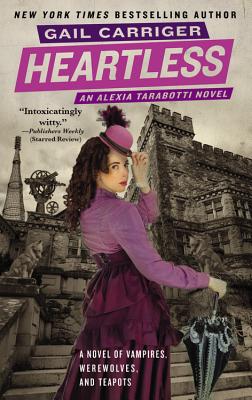
Heartless

This fourth installment in the "Parasol Protectorate" series by Gail Carriger is another romp through an alternate Victorian England, where vampires, werewolves, and ghosts are all accepted parts of society, if not always cheerfully welcomed by regular mortals. Lady Maccon, a preternatural having no soul, is wife to Lord Maccon (a werewolf) and part of Victoria's secret council. She is also 8 months pregnant, which significantly interferes with her ability to get around as nimbly as she would like. The potential capabilities of the child she is carrying to threaten werewolves and vampires alike have made Alexia Maccon the target of numerous murder attempts and she is just getting tired of it all. A truce has finally been reached wherein the child will be raised by the flamboyant vampire, Lord Akeldama. Lord and Lady Maccon move into the house next door to facilite the arrangement. But in the meantime, there appears to be a threat to the Queen and a ghost on the verge of disintegration apparently holds the key to finding out more. Alexia's tedious sister has moved in with her and Lord Maccon and taken to wearing very sensible clothing--among other strange behaviors. Madame Lafoux has come up with an even more outrageous invention and the plot line is wild and fast-paced as always. This tongue in cheek series never fails to entertain me and make me laugh out loud.

Saturday, August 21, 2010

Changeless

This second installment in the "Parasol Protectorate" by Gail Carriger finds Alexia Tarabotti now firmly ensconced as Lady Maccon and Muhjuh to Queen Victoria. Something very strange is going on because all the supernaturals in a part of London have lost their powers. Vampires and werewolves are suddenly mortal and the ghosts they rely on for information have all been exorcised. This epidemic or weapon becomes the focus of Alexia's and her husband's investigations and takes them to Scotland, his former home. We learn about his former pack and why he left them, bereft of an alpha--a seemingly unforgivable act. We meet his great great great grandaughter who desperately wants to be converted and tries to enlist Alexia's help to convince Connall to do it. We also meet a mysterious female French scientist, Madame Lefoux, commissioned by Lord Maccon to create an extraordinary parasol for Alexia, who dresses like a man and seems quite attracted to Alexia. You really need to read the first book, Soulless, to have a good handle on this one,  and you will be rewarded by greater depth of characterization and an engrossing storyline here. The wonderful cast of ancillary characters--Lord Akeldama, Miss Hisselpenny, Professor Lyall-- are all still present and accounted for. This book qualifies as steampunk with its infatuation with machanical, pseudo-scientific gizmos and machines. Alexia takes her first, and almost fatal, trip in a dirigible and learns to operate an aetherograph machine. There is a twist in the plot at the end that surprise and distress you--fortunately the sequel, Blameless, is already in the works.

Thursday, January 14, 2010

Holiday reading


Not that the reading was about holidays, mind you, just that I had a wee bit of time to do a little non-work related reading over the short break. Sue Grafton was in fine form with her newest alphabet mystery, U is for Undertow. The book segued smoothly between past and present and then all came together in a bit of a rush at the end. Kinsey seems finally to be aging a bit--some consolation to those readers who have been relentlessly getting older while she seemed not to. Kinsey gets involved in a "cold case" kidnapping of a young girl when a client comes to her believing he saw the girl's body being buried years ago. He just now recalls the memory because of a newspaper article commemorating the anniversary of her disappearance. Turns out he's not such a reliable witness, but he also turns up dead so there must be fire somewhere in all the smoke he was blowing.

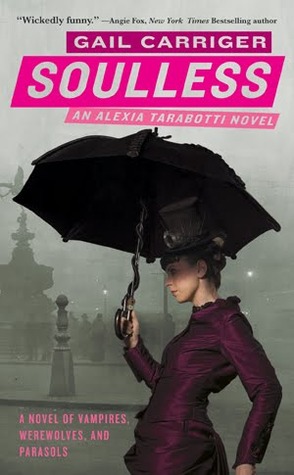
My other diversion was a totally frivolous dip into the vampirish genre with Soulless by Gail Carriger. Her protagonist, Alexia Tarabotti, is a preternatural, whose soulless state neutralizes the supernatural powers of any werewolves or vampires she encounters. Set in Victorian England, there is lots of fun here for Anglophiles and lots of bawdy romance for those who lust after that. From the back cover,
"Alexia Tarabotti is laboring under a great many social tribulations. First, she has no soul. Second, she's a spinster whose father is both Italian and dead. Third, she was rudely attacked by a vampire, breaking all standards of social etiquette."

Doesn't that just put the "pudding in the puff"?! Great supporting cast including a handsome werewolf Lord Maccon with whom she has a love/hate relationship, and her flamboyantly gay vampire best friend, Lord Akeldama. Did I mention that vampires and werewolves are part of high society in Carriger's world?? You can read the first chapter here. Carriger's homepage is here.

Sunday, February 10, 2008

Your choice of young heroines


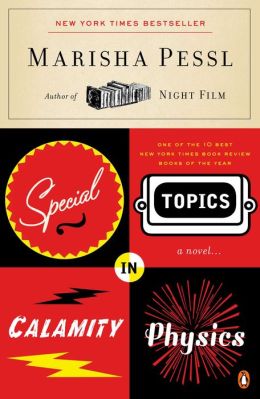
Really I am stretched to think how the books I most recently read can be compared; they probably shouldn't be. They have young adult female protagonists, but that's about the extent of shared ground. So suffice it to say that they represent some of the variety of what I consume in a any given time period. The most dazzling by far is Special Topics in Calamity Physics, told from the POV of Blue vanMeer, now a freshman at Harvard, as she briefly recounts her early years in the company of her itinerant and professorial father, and then focuses on her final year in high school. Ordinary mortals like me will occasionally find it tough going to wade through the endless footnotes and citations comparing every person, place and experience to some bug, animal, book or movie. There is a complex mystery to be explored--surrounding the death (murder or suicide?) of the film teacher, Hannah Schneider (or is she?). Blue seems a decent sort in spite of everything and especially in contrast the her school peers who epitomize everything that is wrong with "the younger generation." I would never read this book again and someone would have to really twist my arm to make me read anything else this person subsequently writes--this is Marisha Pessl's first novel. That being said, it is--on occasion--bitingly funny, and brilliantly literate. Other reviewers have been more positive in their regard, for example see the piece in Salon.com.
At the opposite end of the spectrum, there is the totally
fluffy (my word for reading that is reasonably entertaining but of little enduring literary value) first novel of Marissa Doyle, Bewitching Season. Our 17-year old protagonists, Persephone and Penelope, are twins and heir to witching talents which are being honed by their governess Melusine Allardyce. Set in early 19th century England, when Victoria is still a princess, they are about to embark on their "coming out" season in London society, which gets really complicated when Ally mysteriously disappears and Persey casts a love spell on the handsome boy next door.
And last but not least off the bookstack this week is How I Saved my Father's Life: And Ruined Everything Else by Ann Hood. The typical YA-type title should alert the reader to the pre-teen POV for the story.
Madeline Vandermeer is just barely 11 years old when she accomplishes two miracles: the first is to move a glass of water without touching it and the second is to save her father’s life when he is caught in an avalanche. But now she needs to make a third miracle happen because her father returned to his family only briefly before leaving them for a celebrity life, a new wife, and a baby on the way. Madeline is convinced her mother is to blame for the divorce, because she is so “ordinary,” whereas the new step-mother, is so glamorous. Left in the falling-apart house they can’t afford to remodel, Madeline and her younger brother are weekly subjected to their mother’s culinary experiments which provide the fodder for her food column in Family magazine. Madeline sees her mother’s work as foolish and based on lies, since they are no longer the happy family of her dreams. Worse yet, when her stressed mother takes Madeline out of ballet school in Boston, an hour away, and puts her in a local class, she sees her chances of becoming a world class ballerina slipping away. Then Family magazine offers to send the family on an all-expense-paid trip to Italy so mom can write about the joys of travelling with children. While there, Madeline, initially interested only in visiting reliquaries of various saints, has some perception altering revelations of her own. This is a great book to offer tweens and teens facing divorce and new step-families. The young protagonist exhibits all the wretched feelings and behaviors that accompany such significant losses but comes eventually to a balanced view of parents and the hard choices we all make when life isn’t perfect.