Showing posts with label climate change. Show all posts

Saturday, June 7, 2025

Wild Dark Shore


In this speculative climate fiction by Charlotte McConaghy, the story takes place on the sub-Antarctic island of Shearwater, home to the world' largest seed storage vault. Modeled on the actual island of Macquarie Island, located halfway between Tasmania and Antarctica, which does have a similar research station but no light house. The Salt family--father Dom, oldest son Raff, daughter Fen and youngest son Orly--are the caretakers of the island and have been ordered to prepare for evacuation as increasingly violent storms and rising sea levels are rapidly eroding the shoreline and taking the research facilities with them. During the worst storm they have ever experienced, they find a woman, Rowan, washed ashore and barely alive. As she is nursed back to health and becomes more integrated into the routine life of the family and the island, she forever alters the family dynamics. But everyone in this story is keeping secrets, secrets that may tear apart their newfound sense of hope. We don't get all the answers until the very end of the book. A predictable romance arises between widower Dominic and Rowan, but the ending is a surprise. The book is filled with delightful bits of obscure knowledge about plants and animals compliments of avidly curious Orly, and each member of the cast contributes their own viewpoints and experience in dedicated chapters. 

Library Journal closes their review with "As lush as it is taut with tension, this novel is filled with both the joys and ravages of nature." Publishers Weekly offers this: "McConaghy ratchets up the tension as the characters' paranoia and mutual suspicion increases and their motives are revealed,...McConaghy blends entertainment with a sobering message about conservation and the impacts of geographic isolation. Readers of climate fiction ought to check this out." The New York Times focuses on this observation: "In 'Wild Dark Shore,' we’re shown why a person might withdraw from the messiness of life after tragedy and trauma...The novel also offers its injured characters a path back to connection and community, a risk McConaghy argues must be worth taking, no matter how fraught the future, no matter how temporary the family. As Rowan reflects later in the novel: 'What is the use of safety if it deprives you of everything else?'" Kirkus opens their laudatory review with this, "The reality of climate change serves as the pervasive context for this terrific thriller..." and concludes by noting "While McConaghy keeps readers guessing which suspicions are valid, which are paranoia, and who is culpable for doing what in the face of calamity, the most critical battle turns out to be personal despair versus perseverance. McConaghy writes about both nature and human frailty with eloquent generosity. Readers won’t want to leave behind the imagined world of pain and beauty that McConaghy has conjured."

Monday, May 12, 2025

How the Penguins Saved Veronica


I've read so many good things about this 2nd novel from Hazel Prior that I was pleased when one of my book groups picked it to be on our reading list this year. Also my sisterhood fellowship decided to read it together as well. It was slow to start but then you definitely come to care for the characters and, of course, for the Adelie penguins in Antarctica. Veronica McCreedy has hardened her heart after a life full of heartbreak and loss. She is financially secure thanks to a short earlier marriage but is now alone in the world with no known living relatives. When her housekeeper, Eileen, suggests she use a service to track down possible relatives, Veronica discovers she has a here-to-fore unknown grandson, Patrick. Who turns out to be a slovenly, shiftless, drug using disappointment--or so it appears upon their initial meeting. While watching her favorite nature show on the telly one night, Veronica becomes enthralled with the threatened existence of Antarctic penguis--the Adelies. She decides she will leave her legacy of several million pounds to the research and conservation effort but first wants to see first hand what she's giving her money to. Through Eileen, she lets the small science station on Locket Island in the Antarctic Shetlands know that she is coming to visit. And she does make the long arduous trip from Scotland, in spite of the scientists attempts to discourage her. She falls in love with the penguins "joie de vivre" and then falls particularly hard for an orphaned chick which she convinces the others to take in and care for.

Booklist closes their review by saying, "A charming journey of a stubborn old lady hoping to counter her many hardships with an altruistic act...Prior's done her homework on Adélie penguins and Antarctic research conditions, immersing readers in a captivating world that's otherwise hard to reach." Kirkus offers this: "Prior...has written a story about the importance of family and love and how memories might remain long buried but, once they surface, can be just as distressing or joy-inducing as when they first occurred. The narrative, partially told by Veronica, partially by Patrick, and partially via emails, blog posts, and diary entries, explores the complicated emotions that guide people’s decisions, in both good and bad ways. Drug use, addiction, and depression are touched on, but Prior ensures that readers understand the underlying goodness of her characters and their ability to survive despite loss. While some might view the story’s proselytizing about climate change and the redemptive love of animals onerous, others will agree wholeheartedly. A light but enjoyable, optimistic tale." 

Definitely an encouraging story in these dismal times.

Thursday, March 21, 2024

Among the Living


This is the newest release (Feb. 2024) of horror and fantasy author Tim Lebbon, an author new to me; I am a fan of some fantasy but not so much horror.  I would also characterize this book as speculative fiction, i.e., near possible future scenarios. Set in our world, now in advancing climate change, we encounter two teams with opposite goals. One is a team of 4 rare mineral prospectors, exploring areas that were previous inaccessible before the planet warmed up, and the other team of 3 are eco-activists, trying to prevent further destruction of a dramatically changing world. On team 1 is Dean, whose growing unease about what they are doing causes him to send an email to former friend Bethan, a member of team 2;  team 2 is not on the same island by chance, but due to Dean's warning. It reminds me of "The Body Snatchers," except, instead of aliens from another world, the threat comes from within our own. I'll let Publishers Weekly offer a further summary in their review.

"Combining a plausible existential threat with vivid depictions of a forbidding landscape, Lebbon (The Last Storm) crafts an expert work of ecological horror. In the near future, catastrophic climate change has so devastated the planet that America’s drought-afflicted farming belt is now known as the Desert. The demand for new sources of rare-earth minerals leads four experts to the Arctic’s Hawkshead Island, where they’ve identified a cave system that could yield riches. But when they enter, the researchers encounter an unusual group of mummified human remains, apparently tens of thousands of years old. Despite every indication that the bodies are long dead, one of them, whose head is in “an impossible position,” appears to move, sending the expedition members fleeing for their lives. When three of the four emerge from the caves, they meet another team, this one comprising activists and ecoterrorists, who are concerned that the intrusion may have unleashed a contagious intelligent disease that could kill every human on Earth. Lebbon skillfully exploits the very real concern that melting permafrost could release deadly viruses to create a nail-biting scientific thriller worthy of Michael Crichton. Readers will be wowed."

The New York Times brief review recommends it. "This novel is wildly entertaining. The ragtag band of survivors must traverse dangerous, unpredictable terrain full of snow bears and sinkholes, all while fighting creatures that emerge from the ground. The tension and violence are as aggressive as a revving engine here, but Lebbon’s timely message — that hurting our planet is hurting ourselves — is just as loud."


Wednesday, June 21, 2023

Camp Zero


This is another science fiction book by an author I have not previously encountered, Michelle Min Sterling. Kirkus offers this summary:

"It’s 2049, and 25-year-old Rose accepts a dangerous assignment from Damien, her master-of-the-universe boss, who promises that she and her mother will be set with income and housing for life in a precarious, ever warming world if she succeeds. On her mission, she’ll continue as a sex worker alongside five other women while keeping an eye on Damien’s interests in a new, secretive project. Meanwhile, Grant Grimley just wants to escape the reach of his family’s vast wealth, a legacy created from centuries of extraction. He accepts a teaching job that guarantees to get him off the grid. Rose and Grant, both Americans, arrive at a camp in the Canadian wilderness, a frigid frontier of sorts, where a renowned architect seeks to build a refuge from climate catastrophe. Not too far off, a group of women—American soldiers and scientists—is creating a sanctuary of their own to survive an imperiled planet. It's a smart setup. The author has imagined an array of futuristic ideas stemming from our present, including a next-generation smartphone that’s implanted as a chip behind people's ears at birth and a Floating City off Boston’s shores where the elite live in bliss while the rest of the population deals with worsening hurricanes and wildfires." They are not ringingly positive about the book but do conclude by saying, "the book has a soul that generates momentum. It’s committed to the bonds of family, the ones we are born into and the ones we choose, as a way forward in an increasingly chaotic world. A love letter to what communities of women can accomplish when they work in concert."

There are several plot lines and hidden motives of the characters that are revealed as the narrative moves forward. The Toronto Star concludes their review by praising the author's "powerful storytelling, the vividness of her vision, and her creation of a world which will likely haunt your dreams."

Sunday, April 23, 2023

Wolf Trap


 I have not read anything by Connor Sullivan before and don't know if I will read his previous thriller, Sleeping Bear. In spite of very positive reviews for both of his books, I found his writing to often be clunky and he frequently used the wrong word to convey his characters' actions. The premise is that Brian Rhome, a former operative for one of the CIA's most clandestine services, has left the service and gone off the grid. Motivated by guilt because he led his team into a terrorist ambush, he is totally disillusioned with the powers that be, himself and the world in general. However he gets pulled back in by his godfather, also a member of Ground Branch, with the offer of being able to kill the man who slaughtered his team and at the same time possibly prevent an assassination attempt on the President of the United States. I will give the guy credit for creating an elaborate and eventually compelling plot and hope that his writing gaffes are just the result of bad editing. 

Publishers Weekly says of this book, "In this exhilarating thriller from Sullivan (Sleeping Bear), U.S. president Angela Buchanan is on the brink of a major political victory with the imminent signing of a sweeping international climate-change agreement....Sullivan's clever rhetorical tricks will keep even savvy readers in the dark while he ratchets the tension ever higher. By the end, readers will be exhausted, breathless, and eager for further Ground Branch adventures. Sullivan is a writer to watch." Booklist reviewer agrees that "it's a solid, well-crafted thriller that will keep readers turning the pages."

The Light Pirate


I really liked this book by Lily Brooks-Dalton, which is essentially a tale of the coming apocalype due to climate change. But "it is not so dystopian" (the New York Times) and is, in fact, "a redemptive tale" (Library Journal) and "a tender meditation on change and adaptability" (BookReporter.com). When the book opens, Florida is already suffering the consequences of gradually rising ocean levels. The family of Kirby, his new and pregnant wife Frida and Kirby's two sons from his first wife live in the small town of Rudder, which is directly in the path of the hurricane season's 3rd storm, Wanda. Kirby Lowe, an electrical line worker has his hands full trying to restore power and leaves his two sons, Flip and Lucas, in the care of their pregnant step-mother. Without telling Frida, the boys take off on an adventure before the storm arrives and one of them never makes it home. Frida goes into labor and delivers a baby girl who she names after the storm. Kirby gets home to find his wife dying on the kitchen floor and an infant girl wrapped in her arms and demanding attention. Wanda, who was “born at exactly the wrong time, under exactly the wrong circumstances, given exactly the wrong name,” becomes the victim of bullying as she grows up and her father eventually entrusts her after-school care to a neighbor, Phyllis. Phyllis is a biology teacher and a survivalist who makes frequent excursions into the woods to study the effects of the changing climate on the local flora and fauna. Wanda joins her on her excursions and picks up much of Phyllis' knowledge about both the environment and survivalism. We follow Wanda as she loses her home, her family members, and finally she also loses Phyllis. But she has learned how to survive in the new world of water where Florida once stood, and even finds a new sense of community. 

 Kirkus closes their review of the book with this: "Brooks-Dalton creates an all-too-believable picture of nature reclaiming Florida from its human inhabitants, and her complex and engaging characters make climate disaster a vividly individual experience rather than an abstract subject of debate." Similar to other reviewers, The New York Journal of Books sees both the dark and the light of this story: "But there is a luminescence here, a force that takes on a quality of the intelligence of the universe. In the glow of that light, hope and exhilaration bloom. And in these moments before the new, violent storm hits its readers, the world of this novel is unforgettable." I would agree with Marie Claire's reviewer who says the book is "Reminiscent of Delia Owens' Where the Crawdads Sing." Maybe this will also be a future movie.

Friday, September 25, 2020

Migrations


“The animals are dying. Soon we will be alone here.” So opens Charlotte McConaghy's debut adult novel, set in the near distant future. Our protagonist and narrator is a woman trying to make sense of a world gone mad and of her own self-destructive compulsion to wander. Abandoned early on by her father,  Franny Stone in turn abandons her mother when she wanders off at the age of 12. When she returns home, her mother is gone. Franny loves the wild spaces and the creatures that inhabit them, especially the birds and creatures of the sea. Over the years, as multiple species are driven to extinction by human greed, she undertakes one last migration of her own, to follow the only remaining flock of Arctic terns on their monumental annual journey from Greenland to Antarctica. She tags three birds during nesting season and then has to convince one of the disappearing number of fishing boats to take her south. She badgers Ennis Malone, captain of the Saghani, to take her onboard, against his better judgement and the opinion of his eccentric crew.  Franny promises that following the terns will lead them to the "Golden Catch" that has eluded them these last few years.

Franny's tortured history is revealed in flashback chapters and in her unsent letters to her ecology activist husband, Niall. But her obsession, now shared by Ennis, may be the undoing of them all. 

The book is rich in metaphor. For example, as The Guardian notes with regard to the terns' migration, "This journey is the longest migration undertaken by any animal – a complete crossing of the globe – and a feat that terns complete twice-yearly. The book uses this act of endurance, this instinctual movement, metaphorically: Franny too is driven to constant movement by forces she cannot control or understand, and is determined and driven even in the face of great adversity." They also comment on the thing I found most distracting,  the "book’s constant shuttling about in time, as well as the unreliability of Franny’s narration, the half-truths and silences with which she surrounds herself and everything she holds back from the other characters and the reader alike." If I were to re-read the book, I would keep a timeline of Franny's life on paper.

The New York Times chides that the novel veers into melodrama in the last half, but also concurs with my sense of how beautifully this book is written when they say, "this novel’s prose soars with its transporting descriptions of the planet’s landscapes and their dwindling inhabitants, and contains many wonderful meditations on our responsibilities to our earthly housemates."

 The Washington Post concludes, "In many ways, this is a story about grieving, an intimate tale of anguish set against the incalculable bereavements of climate change. There are many losses, but lives are also saved. Franny charts our course through a novel that is efficient and exciting, indicting but forgiving, and hard but ultimately hopeful."


Thursday, November 15, 2018

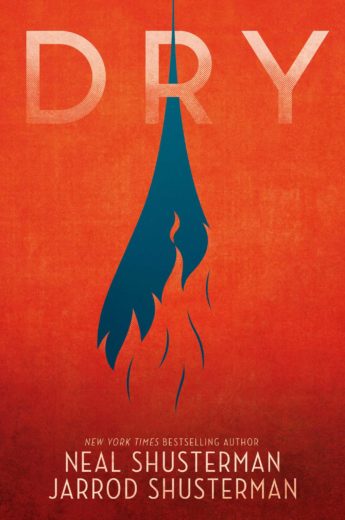
Dry

This collaboration between YA author Neal Shusterman and (son) Jarrod Shusterman has been getting rave reviews (Kirkus, Publishers Weekly). The characters are all indeed young adults, but the theme is very current and of concern to all ages. Especially with California once again consumed by deadly fires, this tale of how quickly humanity descends into dysfunctionality when Arizona and Nevada stop the flow of the Colorado River into southern California was scary reading on a very visceral level. I started the book yesterday and finished early this morning if that gives you any idea of how engrossed I was. It reminded me strongly of The Water Knife (about which I wrote some time back) but told from the perspectives of several different teenagers. Alyssa, 16, is your typical high school student who plays soccer and has an annoying 10-year old brother, Garrett. Kelton's family are survivalists living next door in this suburban neighborhood; Kelton has had a crush on Alyssa forever, but she thinks he's creepy because of his family. Jacqui, 19, has been surviving on her wits for 2 years and only hooks up with the other 3 when they go looking for Alyssa and Garrett's now missing parents who went out to look for water. Henry is an adopted 13 year old left at home by his adoptive parents in a gated community while they are on a cruise. He is a schemer and opportunist and meets the other 4 when they come looking for Alyssa and Garrett's uncle. They all quickly find out that no amount of preparation is foolproof when things start to go sideways. The government is slow to respond; FEMA is focused on a hurricane and doesn't see the emergency from a water shortage. Except that it's not a shortage--that's been going on in California for a while; it's the Great Tap-Out and people die pretty quickly from lack of water. But before they do, they turn on one another, lose hope and give up, or become heroes. The questions about under what circumstances we lose our humanity are compelling.

Thursday, May 19, 2016

The Water Knife


Expanding upon the theme and setting of a short story written in 2006, "The Tamarisk Hunter," Paolo Bacigalupi takes us into the not-so-distant future where the scarcity of water has come home to the southwestern United States, with the consequent rise of the "haves" vs. the "have nots" and the violence, greed, depredations, treachery, and hopelessness that one would expect to follow.
Having lived in the Las Vegas metro area for four years and hearing the then-director of the SNWA (Southern Nevada Water Authority) say that they had no plan for managing growth/ development, this book felt frighteningly close.
In Bacigalupi's world, the states have become armed camps with their own militias and barbed-wire fences sealing the borders. Only the very wealthy can afford to live in the self-contained high rises that recycle their water, grow their own crops, and basically insulate their tenants from the harsh world of barren land, huge tenements built of salvaged materials, and communal water pumps provided by relief organizations--if you have the money. The price is visible on the pump meter, constantly fluctuating, as politics and power shift control for water futures from one entity to another. Arizona has less senior water rights than Las Vegas and California and the woman who controls the SNWA, Catherine Case, is ruthless is enforcing her rights, never hesitating to blow up pumping stations to strand thousands without water, or murder those who get in her way. One of her main enforcement tools is a paid hit man  she plucked from the slums, Angel Velasquez, known as a "Water Knife." Sent to Arizona to sort out some anomalies in Case's enforcement strategy, he comes across an idealistic Pulitzer winning journalist, Lucy Monroe, who has taken on the devastated southwest as her cause. She is now also pursuing the killers of a friend and it is in this quest that her path crosses Angel's. A third major character is desperate and determined teenager, Maria Villarosa, a refugee from Texas, who has lost her entire family and will do just about anything to get across the border from Arizona to California.
Well crafted setting, reasonably complex characters, and a compelling narrative all made this a good read and I will seek out more of Bacigalupi's work.
Bacigalupi has written several novels, including--in the climate sci-fi, or "cli-fi" genre--including the Hugo and Nebula awards winner, The Windup Girl (2009). He has authored books for YA's (e.g., Ship Breaker) as well as over a dozen acclaimed short stories. A list of his works and awards is available here.
Good reviews here from the LA Times, NPR, The Washington Post, and the Denver Post. There
 is an interview with the author, done in 2012 before he wrote this book, on the Publishers Weekly site.

Monday, November 30, 2015

The Sixth Extinction: An Unnatural History

This review in The Guardian by Caspar Henderson does a wonderful job of contextualizing (literarily) and summarizing the Pulitzer Prize-winning (2015, General Non-fiction) piece of science writing by Elizabeth Kolbert--better than I could ever do. There have been five major extinctions in the history of planet earth and Kolbert documents the evidence that bolsters the assertion that human beings are the cause of the sixth. A major extinction is an "an event in which a significant proportion of life is eliminated in a geologically insignificant amount of time" (see The Guardian) whether the cause is a catastrophic event like the asteroid which wiped out 75% of the planet's life forms in a matter of weeks or the human-caused acidification of the oceans, deforestation, and warming of the atmosphere in the last few decades.
Kolbert travels to numerous places around the world to observe and question those scientists doing work in the study of various animal and plant extinctions today, thus offering the reader a rigorous and first hand look at the extent of damage caused and the irreversible effects of our rapidly burgeoning, increasingly mobile population. She provides an overview of history in the big sense--beyond human habitation--to put this in perspective. Which makes the rapid rate of extinctions occurring today, at one and the same time just another cycle in the big picture, and also a tragic tale of loss and destruction that will inevitably lead to a very different world in the near future.
She reports; she does not lecture or advise for she does not see that as her role. Often compelling, sometimes an effort, it is a sobering read but well worth the effort. Several online interviews with Kolbert are available including this one in the NYTimes.