Wednesday, May 31, 2017

A Simple Favor

This debut novel by Darcey Bell opens with an aside from one of the 3 main characters. "My mother used to say: Everyone has secrets. That's why you can never really know anyone else. Or trust anyone. It's why you can never know yourself. Sometimes we even keep secrets from ourselves. Growing up, I thought that was good advice...Later I discovered that Mom was speaking from personal experience. And I wonder if she was not just preparing me but programming me for secrecy and mistrust. Did she sense that I would grow up to have darker and more shameful secrets than anyone else's? Secrets I mostly manage to keep--even from myself?"
Stephanie, widowed for 2 years and living with her young son Miles, finds herself feeling lonely and so begins writing a blog for "Moms." What goes into the blog is a slightly altered version of the real Stepanie's life; her blog offers emotional honesty, unequivocal support for the challenges of being a mother, and a mostly sunny take on the world. When she is befriended by glamorous neighbor and mother of her son's best friend, she is thrilled at having found a kindred spirit--she thinks. Emily works as a publicist for a fashion designer in Manhattan, and is married to a handsome British financier on Wall Street. Due to their busy lives, Stephanie occasionally picks up their son, Nicky, and keeps him at her home until Emily or Sean can pick him up. On one particular occasion, when Sean is abroad on a business trip, Emily fails to show up. Stephanie thinks she must have misunderstood, but Emily is not answering her phone. After a couple of days, Stephanie is panicking and gets in touch with Sean, who doesn't initially seem too worried;  eventually, however, she and Sean go to the police, who also are not too worried. People not infrequently walk away from their families, after all. However, several weeks later, a body is discovered in a lake near Emily's old family cabin in Michigan, wearing Emily's ring, and matching Emily's DNA. It seems clear that Emily is dead. As Emily mourns her best friend, Sean mourns his wife, and Nicky struggles with the loss of his mother, the families become entangled. And then Nicky comes home from school one day, claiming to have seen his mother.
Apparently Stephanie did not take fully to heart her mother's advice and she continues to trust even after she learns of betrayal. She will do anything to get her best friend back, including betraying others in turn. You just know this is not going to end well.
A favorable review from Library Journal, and not so favorable reviews (which I share) from Publishers' Weekly and Kirkus.

Wednesday, May 10, 2017

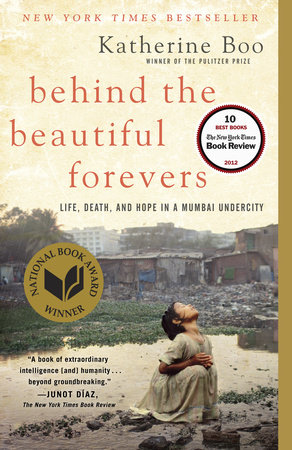
Behind the Beautiful Forevers

I went to hear Katherine Boo as part of our library's "Author! Author!" series and was just bowled over by her levels of compassion, commitment, dedication, and determination. If I had not gone to see and hear her, and if we had not selected this book for our book group read, I am not sure I could have finished this book. It was that hard. Boo had previously reported on some of the most disadvantaged communities in the U. S. winning a Pulitzer prize for her work. But after marrying an east Indian man, she felt she wanted to tell the story of the poor in that country (brief bio of Boo and her translators in the project are here). In spite of signficant health issues, she undertook this research in 2008. Boo spent 4+ years, for months at a time, in a small slum across from the Mumbai (India) airport, getting to know how the poorest people lived. Surrounded by towering luxury hotels, hidden behind billboards advertising flooring that would be "beautiful forever," the half acre of Annawadi was the center of life for over 3,000 human inhabitants, some goats, horses, pigs, and a lake of sewage. People survived by scavenging through garbage for recyclable materials, stealing, selling their bodies. Only a handful had regular jobs, and yet, according to government statistics, these people were not living in poverty. Many had no roof over their heads, never knew when they would eat next, could not rely on any government help, health care providers, or even so-called charities to offer them the most basic kinds of assistance. Not only did the rich prey on the poor, but so did the not so rich and the poor themselves. Boo was determined not to interfere in people's lives in her efforts to truthfully document was their existence was life and how they coped, but that meant she saw people (including children) beaten and sent to jail for crimes they did not commit, witnessed corruption at every level of government and in NGO's, and experienced the deaths of people she knew and had come to care about. It's not clear what separated those who chose to survive at any cost from those who gave up all hope and killed themselves by, for example, eating rat poison. Everyone should read this National Book Award winner, but be prepared for a painful journey.
Some great photos are on this website.
An interview with Boo was done on NPR.
There are numerous excellent reviews: Washington Post, The New York Times, The Guardian, and The Boston Globe, to name just a few.

Gratitude

This short little book is a collection of 4 previously published essays written in the last years of Oliver Sacks' life. Learn more about Oliver Sacks if you aren't familiar with him already. He has written some amazing books (e.g., Awakenings, The Man Who Mistook his Wife for a Hat). Born in England and originally educated at Oxford, he got his medical training at Mt. Zion in San Francisco and at UCLA before moving to New York, where he was a practicing neurologist for 5 decades. Engaged until the very end of his life, his memoir was published just a few weeks before he died in August of 2015. The first essay, "Mercury," was written on the eve of his 80th birthday; mercury is element #80 in the periodic table. He loved the periodic table and had memorability made from appropriate elements commemorating various birthdays. The last 3 essays were written after learning that a rare melanoma had metastasized and would be fatal. He examines what it means to have lived a full life and to be grateful for that life.  From the book:
“My predominant feeling is one of gratitude. I have loved and been loved. I have been given much and I have given something in return. Above all, I have been a sentient being, a thinking animal, on this beautiful planet, and that in itself has been an enormous privilege and adventure.”
A fast read that provides an interlude for thought and is well worth pondering. 

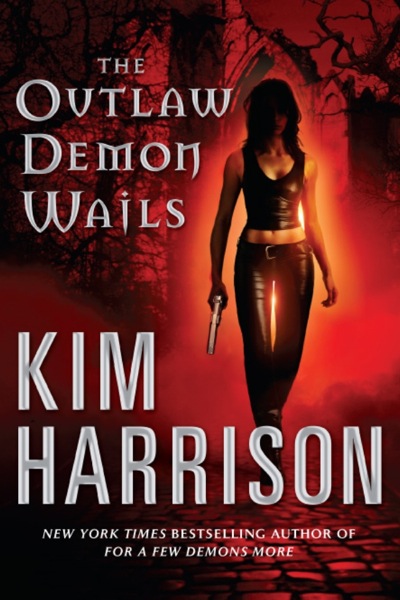
The Outlaw Demon Wails

Obviously a take-off on the title of the old Clint Eastwood movie, The Outlaw Josey Wales, although I am at a loss to explain what connection there might be. Published originally in 2008, this is about the 10th installment in "The Hollows" series (there are about 2 dozen novels and novellas). I have read a couple of Kim Harrison's other books--a prior installment in "The Hollows" series, also a take-off on a Clint Eastwood title, For a Few Demons More; and one in her YA series, Something Deadly This Way Comes-- and really enjoyed them, but was little disappointed in this one and not exactly sure why. I usually love anything with kick-ass paranormal women protagonists, but witch Rachel just did not engage me this time. I like the pixie family, Jenks and brood, that lives in her converted church and graveyard. Rachel's vampire roommate, Ivy, seemed curiously flat as a character.
Rachel and her mom are shopping for enhancements to Rachel's planned Halloween costume--like a bust-enhancing charm--when the store explodes. Having crossed paths with the demon Algaliarept--Al for short--Rachel is shocked that he has escaped demon jail and is not only ready to break his promise not to harm her but is, in fact, out to kill her. She is trying to solve the murder of former boyfriend Kisten, which still torments her, but has to stay out of Al's grasp. She learns a few secrets about her spell casting mom, has a new love interest, etc. There is a more informative plot summary at the Love Vampires web site which has a favorable take on the book, but recommends reading them in order--which I have not done.

Tuesday, May 9, 2017

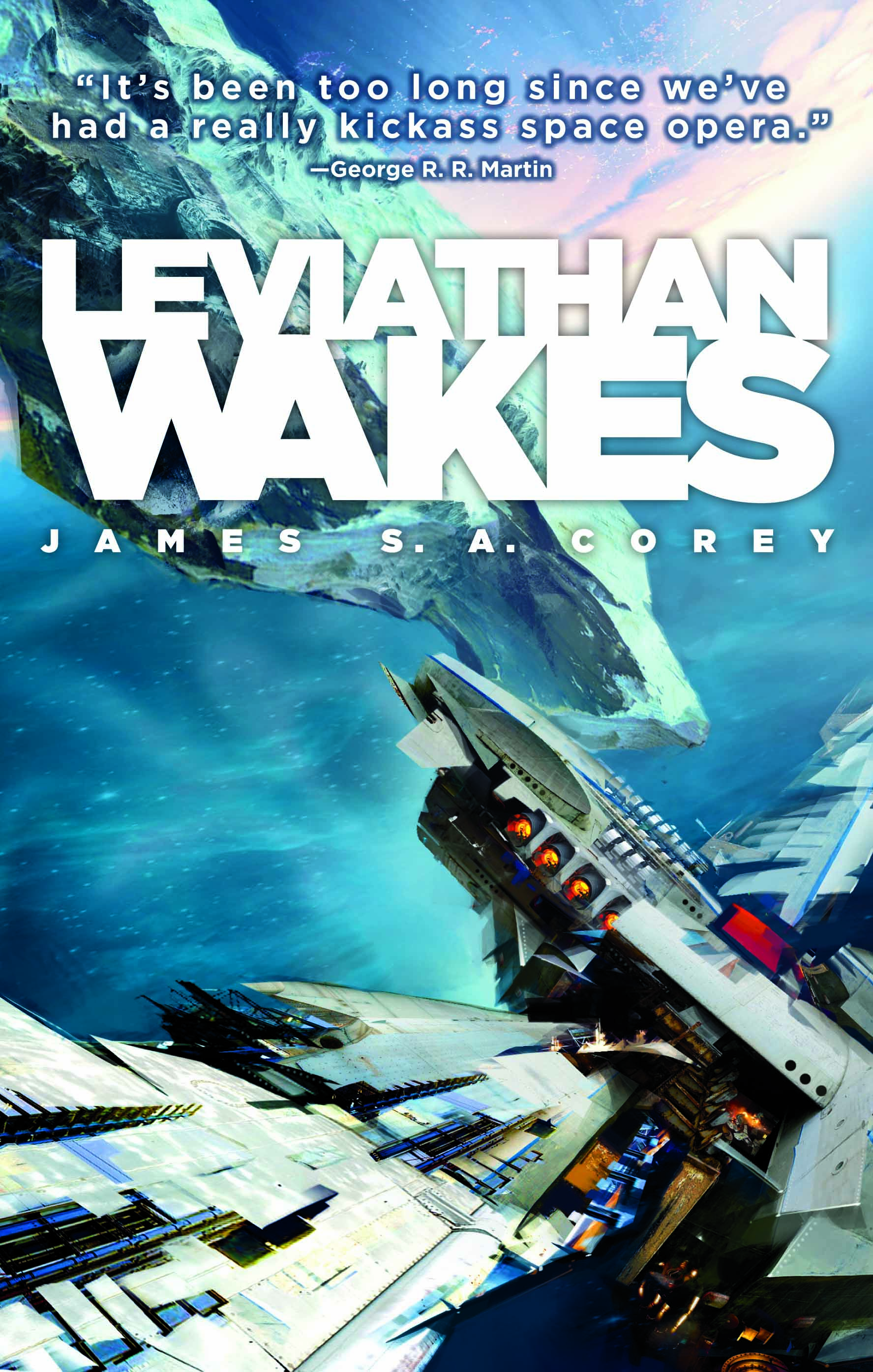
Leviathan Wakes

I'm not exactly sure what a "space opera" is supposed to be genre wise, but this is certainly good science fiction from James S. A. Corey (a pseudonym for authors Daniel Abraham and Ty Franck). Leviathan Awakes was nominated for the 2012 Hugo and Locus awards and is the first installment (a hefty one at just over 560 pages) in "The Expanse" series, which includes six novels, novellas and short stories and has been made into a TV series on SyFy. For a quick overview of the series, see the Wikipedia entry.
In this opening salvo, Humans have colonized Mars and several of the larger asteroids in our solar system, from which they mine minerals. They are also mining ice from the rings of Saturn, but as yet they have not gone further out to other star systems. When the captain of an ice freighter encounters a derelict ship, the Scopuli, the crew is thrust into a seemingly unfathomable scenario. The Scopuli's crew has vanished or been subsumed into an alien presence that will not stop with taking over one ship. In a soon-to-converge parallel storyline, Detective Miller of the Ceres police force on one of the larger asteroids, has been assigned to look for a missing woman, who could be anywhere in the solar system. But this young woman, Julie, comes from big money and the fact that money talks never seems to change. These two men will cross paths when it turns out that the missing Julie was aboard the Scopuli. As the race to find Julie and contain the alien threat go forward, there is also politics at play, with Earth, Mars, and the "Belters" vying for control and someone is using the alien being, Leviathan, to try and shift the balance of power. A civil war is almost inevitable. The characters are reasonably complex and interesting; you feel like you could meet them on the street. The particularities of this expanded human habitation seem feasible and well thought-out. I would definitely read more and will try and track down the TV series, as well. Kirkus and Publishers' Weekly offer fairly positive reviews, and I really thought the Wall Street Journal captured the flavor and grit of the book, so have attached it below (since it is subscription and you might not otherwise get to read it!)

 WSJ In Brief: Science Fiction (review, July 2, 2011)
This is the future the way it was supposed to be. From the Moon we'd step to Mars. Mars would become an industrial center, while the asteroid belt would supply hundreds of mountain-size rocks to be tunneled for habitats and mined for construction material. The gas-giant planets would remain gravitationally impossible for human life, but not their moons.
In James Corey's "Leviathan Wakes" this bustling interplanetary civilization has created a need for tourism centers, and the giant asteroid Ceres is one of them, up to a thousand ships a day docking to use its bars and casinos. "Belters" look different from Earthmen -- tall and skinny from being brought up in low gravity. They think different, too. Monkey with safety and you're out the airlock without a suit.
Mr. Corey's model isn't the now-common cyberpunk style. It's more like "L.A. Confidential" with fusion drives. One of Mr. Corey's two central figures is the tired cop, familiar from crime-noir fiction; the other is an Earthman from Montana, skippering a water-hauler. What he finds on one run, a hijacked spaceship with no survivors, sets off the latent hostility between Earthmen and Belters. But the discovery also suggests that humanity may have come into contact with a larger biosphere, something truly from the stars, something posthuman.
The story rips along, driven by two main characters who don't like each other, each of whom has his own uncompromising morality. Even more compelling than the pace, though, is the sense of possibility. Galactic empires, "Star Trek," "Star Wars": They aren't going to happen. Those futures have faded. This one, imagined in pixel-sharp detail -- it's still there.
Credit: By Tom Shippey

Wednesday, May 3, 2017

Shadow Catcher

Author James R. Hannibal (pseudomym) is a former Stealth pilot and a graduate of the Air Force Academy where he majored in Middle Eastern studies. So his bona fides for writing military thrillers are solid. What is surprising is that, in addition to writing this "Nick Baron series," he also writes a middle school series called "Section 13" (a list of his books is at Amazon).
The Triple Seven Chase team, led by Air Force major Nick Baron, is initially tasked with destroying a B-2 stealth bomber lying at the bottom of the Persian Gulf before enemies can get their hands on the technology. But then a message  intercepted by the CIA suggests that a solder thought to be dead years ago, may still be alive in China. The team, with a new member on board, must rely on the latest flight technology to rescue him. But this may all be a trap. Solid writing and good plot line. Engrossing read.

Sunday, April 2, 2017

The Crossing

Hoo boy, I am WAY behind in posting recently-read books. I have read a lot of books by Michael Connelly, both the Harry Bosch series and the Mickey Haller (Lincoln Lawyer) series. He never seems to make a false step with his writing--at least IMHO, he is a craftsman, and I like this genre. Bosch in this book decides to take on a case for his defence attorney half-brother, Mickey, thus crossing over to the dark side. After decades of putting the bad guys away as a LAPD detective,  Bosch knows that he is going to be seen as a traitor and take a lot of heat from his former colleagues. Nevertheless, he talks to the defendant and thinks he is innocent, but gets an agreement from Mickey that he will follow where the clues lead--whether it be to innocence or guilt.
Harry is still able to get a little help from his last partner, Lucy Soto, because Bosch always treated her fairly; as a female detective Lucy experienced a lot of harassment and discrimination in the job. Unfortunately, the clues Harry starts turning up suggest that it is dirty cops that have staged not only the murder for which Mickey's client has been jailed, but other deaths as well. When Bosch gets too close, the corrupt detectives make arrangements to have Haller arrested on a trumped-up charge, and they start stalking Bosch, even threatening his daughter Maddie.
As usual, things are not easy with Maddie as she is getting ready to go off to college, where she will be roommates with Mickey's daughter, Hayley. Harry will never win "father of the year" award, but it is obvious he is trying his best and just hanging in there.
Harry comes through in the end, but not without first making some high-stakes plays to lure in the killers. As always, an engrossing read with fully developed characters and credible dialog. If you are a fan of detective novels, don't miss this series.

Tuesday, March 14, 2017

Foundation

So, having just finished Prelude to Foundation by Isaac Asimov for my bookgroup, I thought I would revisit the Foundation books that I read probably 40 years ago. I would say I was not as taken with it as I remember being when I was a young adult, but this book was certainly interesting enough to keep me engaged. In Foundation, which was originally the first of the series, Hari Seldon has caused unrest in the Empire with his predictions of imperial decline and is brought to trial and exiled to the planet Terminus, at the far end of the universe. He is allowed to take his group of experts, who are also working on psychohistory, with him and they become The Foundation, whose ostensible goal is to record all the known history of the Empire. We jump a few decades ahead and Seldon is now dead, and The Empire has indeed fallen. The universe has devolved into smaller fiefdoms that are ruled by military might. Technology has disappeared from most of the planets of the former Empire  but has been maintained on Terminus (notably atomic power), which has largely remained unaccosted due to its technological superiority. Seldon is set to reappear holographically 50 years after his death and his predictions about the future are anxiously anticipated. What everyone learns is that The Foundation's purpose is a sham but a necessary one in order to move the universe forward through chaotic times as expeditiously as possible. We are introduced to a series of storylines and characters who have been trained by or have enough knowledge of the Foundation to recognize the pivotal crises in Seldon's predictions and keep everything on track, notably Salvor Hardin, a mayor on Terminus, and Hober Mallow, a cunning trader. The ending makes it clear that it is not an ending at all, but just a pause in the progression of Seldon's predictions.

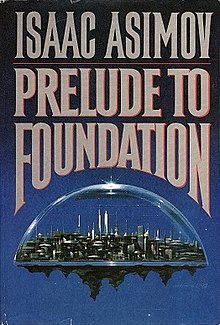
Prelude to Foundation

Although this book by Isaac Asimov was written after completion of the original "Foundation series," the chronology of the stories would put this one first. I had never read this one and do feel it provides some excellent background to the award-winning series.
We meet Hari Seldon for the first time and come to understand the evolution of his thinking as the originator of psychohistory, which can predict the future. Hari, a talented mathematician, comes from a minor planet to give a paper on the theoretical proof for psychohistory at a conference on the Empire's capital planet of Trantor. Needless to say, even though his idea is still in the theoretical stage, many people would be most interested in being able to predict the future, including the Emperor.  Seldom sincerely replies that psychohistory is not practical or do-able at this point in time and is summarily dismissed to return home. But before he can leave the Trantor, he is approached while eating lunch in a park by a friendly stranger, Chetter Hummin, who warns Hari that the Emperor will not let him go so easily. When Hari is attacked by a couple of thugs, he begins to believe the threat is real and accepts  Chetter's offer to relocate him someplace safe while he continues to work on his theory. So Hari and Dors, a female historian from the university on Trantor who has been assigned by Chetter to bodyguard Hari, get moved around several times. Hari remains convinced of the impossibility of actualizing psychohistory without written records, but Chetter is equally convincing that without it, the declining Empire will soon disintegrate into Chaos for millennia. Based on historical research, Hari then decides that, if, as certain myths contend, some nearly human robots did exist at an earlier time, and if he can find one, the robot might contain enough data about civilizations and events for Hari to implement his predictive theory. In his search for a robot, Hari is continually getting into trouble with unfamiliar cultures, species, and customs and always getting rescued by either Dors or Chetter. Eventually, Hari finds a robot, but the real solution to his dilemma is his dawning realization that the complex social diversity on Trantor is enough of a foundation for him to move ahead with making psychohistory viable.
Although this book was really great for setting the context of the Foundation series, it was not a particularly compelling novel. Nobody can fault Asimov when it comes to brilliant forward thinking ideas, but the characters are not well developed enough to really make them likeable or detestable, and there is really very little plot. There is, however, a pretty nifty surprise ending.

Saturday, February 25, 2017

Saturn Run

John Sandford, a prolific author of thrillers, here joins force with Ctein, "photographic craftsman," physicist, and science fiction thinker/writer, to create a science fiction thriller based on the device of earth's humans making first contact with alien beings. When a seemingly ne'er-do-well rich kid working at an astronomy lab notices clear evidence of a space ship landing and then departing from the rings of Saturn, the race by earth's major powers is on. China has already planned a manned launch to Mars but now is scurrying to reconfigure their ship and crew for the longer journey to Saturn. Under orders from a take-no-prisoners President, the U.S. is frantically trying to remake their space station into a ship that can travel to Saturn and get there before the Chinese. Both sides recognize that not only is there tremendous risk involved with the trip and with first contact, but also there is the potential to gain technological knowledge that is decades, if not centuries, ahead of our own. The cast of characters aboard the U.S. Richard M. Nixon will become real people and their challenges will both convince and engage the reader. There is a good chance that the failure of one of the two innovative power plants on the Nixon is the result of sabotage and that likely means a spy is on board. Recent news about the discovery of a whole system of exo-planets makes the belief that we are not alone in the universe ever more likely. What the crew finds when they arrive at Saturn's rings is unexpected.
The authors offer an Afterword that will discuss the scientific work invested in creating a realistic and believable set of technologies for the late 2060's timeframe of the novel. Well worth the read if you are a fan of sci fi.