Wednesday, September 25, 2013

We have Always Lived in the Castle

Some time back, some person put arsenic in the sugar bowl at dinner and now the whole family is dead except for Uncle Julian, an invalid, who eats very little sugar; Constance, who eats no sugar; and Mary Katherine (aka Merricat), who was sent to her room without supper for misbehaving that fateful night. Constance was the one who was tried for the multiple murders, but she was not convicted. Now the three of them continue to live in the family home, shut away from the resentful and mean-spirited villagers except for Merricat's twice weekly trip to the grocery store. The other wealthy families--for they had money and live in a mansion--occasionally come to call, but otherwise, they are totally isolated. When Cousin Charles shows up, the balance--such as it is--is upset and things begin to go quickly awry. A fire is started by someone in the house, then the fire department puts it out. But the villagers take the opportunity to rampage through the house breaking everything they find. Uncle Julian dies of a heart attack in the melee. Only Constance and Merricat are left. What are they to do?  One of the survivors is the poisoner, but the two nevertheless vow to go on. A totally strange book by Shirley Jackson, who also wrote The Haunting of Hill House. Apparently this has also been performed on stage.

Saturday, September 21, 2013

The Bookman's Tale

This novel by Charlie Lovett starts with a mystery and escalates into a thriller. Antiquarian book dealer Peter Byerly has recently lost his beloved wife Amanda to brain cancer. With her, it also feels he has lost his interest in everything else. The book alternates between three time periods and perspectives: the early history of a particular book, the Pandosto, which runs from Shakespeare's time up until present day England; the mid-1980's when Peter met Amanda at college and their subsequent five years of marriage, mostly in America; and present day (mid-1990's) in England. Peter wanders into a used book store and finds tucked into a book a watercolor painting that so eerily resembles his dead wife, he becomes obsessed with finding out who painted it and who the subject of the painting was. In the process he hooks up with Victorian art expert, Liz, and starts to uncover an elaborate plot fueled by generations of enmity between the two families, the Gardners and the Aldersons. At the heart of this story is a book, Pandosto, with margin notes that, if genuine, could settle once and for all whether or not Shakespeare was the real author of all those famous plays. Well written with a great storyline and well-developed characters. A little bit of supernatural in the form of Amanda's ghost keeping an eye on Peter. Well worth the read, especially for those interested in book collecting, Shakespeare, or English literary history in general. A good amount of research went into making this historically accurate--up to a point--which is all summarized in the "Author's Note" at the end.

Sunday, September 8, 2013

In the House upon the Dirt between the Lake and the Woods

I did not finish this book by Matt Bell. I would characterize it as magical realism, not a favorite genre of mine to start with, but again I was enticed by glowing reviews. There is too much despair, too little storyline for me here. The description is well crafted. A man and a woman marry, move away from their family and friends to an isolated plot of land. He builds a house and they try to start a family. But time after time, she miscarries. Eventually, her ability to sing things into existence is put to full use as she creates a child. But he knows of the deception--that this being is not the result of their physical union and he begins to destroy the natural world around them while she places a threatening 2nd moon in the sky above. You can read more extended reviews in the New York Times, and at NPR, among others.

How the Light Gets In

After the ending of The Beautiful Mystery, it was ALL I could do not to turn to the last page and see how this installment of the Inspector Gamache series by Louise Penny was going to turn out. But I resisted.  And she kept me on the edge of my seat (figuratively speaking since I mostly read in bed before going to sleep) the entire time, uncertain as to whether Gamache would emerge victorious or go down in flames. The situation looks dire. Francoeur has dismantled the homicide division that Gamache worked for decades to build and has installed every ne'er do well he can round up from the Surete to undermine Gamache's credibility and effectiveness. Although there is a murder mystery that threads through the book, involving the death of the last of a world famous set of quintuplets, the real story here has to do with what evil plot Francoeur is hatching and why it involves destroying both Gamache and Jean-Guy. A former member of Gamache's team, Yvette Nichol, makes a reappearance, and Isabel Lacoste helps hold the whole thing together as Gamache pursues a deadly strategy of deception and double-cross with Francoeur and his minions.  For me, much of the tension came from the apparent contrast between Gamache's integrity and honesty, and how such a person could possibly go up against people who are incredibly dishonest and destructive.
As with previous installments, the town of Three Pines with the attendant cast of characters--including Rosa the duck--provides not only a compelling setting but its own distinctive emotional color as events unfold. There's not a wasted word, not a superfluous character, and this one kept me up nights, drawn on by the lovely prose, the characters that you want to meet on the street, and the compulsion to find out what is going on. If you haven't read the previous books in the series, do yourself a favor and start from the beginning rather than diving in with this one. When I finished, it made me want to go back and re-read the whole series!

Tuesday, August 27, 2013

Blackout

This author, Connie Willis, has won several prestigious science fiction awards (Hugo, Nebula). So, her bona fides, along with a positive reviews from several sources including this lengthy one in the Washington Post, and an intriguing story line, persuaded me to dive into this incredibly overlong (500 pages) and tedious book. I have never worked so hard to get to such a disappointing ending. We begin in the year 2060, in Oxford, England, when time travel has been perfected and historians routinely travel back to various periods of time to make observations and do their research more directly than is possible through today's documentary methods. But we already have hints that things are starting to go awry as the schedules for several people are being re-arranged at the last minute, creating all sorts of problems with getting the historians properly prepared with background information, appropriate costuming, and even the relevant language skills for their assignment. Three characters, Eileen, Polly, and Mike, all end up in various parts of WWII-era Britain (London in the Blitz, the rescue of soldiers from Dunkirk, the countryside evacuation of children) unable to get back to present time. They eventually manage to track down one another in hopes that the others have an effective "drop" to return to Oxford, but there the story ends. It turns out that All Clear, the sequel, is really just the second half of the present book. Based on this review from The Guardian, I am unlikely to pursue another trudge through overly detailed and not very interesting day to day meanderings in order to find out if they make it back. While I love sci-fi and historical novels, this one left me mostly bored and tired.

Sunday, August 11, 2013

The Art Forger
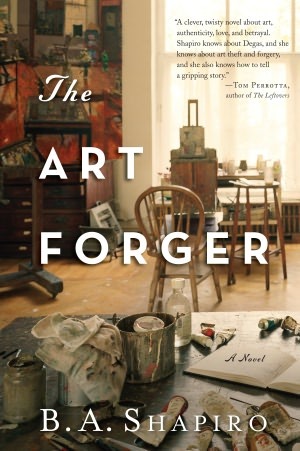
Based on the actual--still unsolved-- theft of several famous paintings from the Isabella Stewart Gardner Museum in 1990, which in fact included several by Degas, this is a fictionalized and romanticized account of what happens when one of the Degas paintings (a fictitious one) resurfaces. Claire Roth is a talented painter who has made the all too common mistake of falling for her famous and married art teacher, Isaac Cullion. Three years ago, when he was having a "painter's block" she painted a picture for him to help him meet a deadline for a viewing by an agent from MoMA. The picture she painted, fortunately or unfortunately, became the keystone for their accepting his work for a special showing and was ultimately purchased by them; yet he refused to admit that he hadn't painted it. When Isaac dumped Claire, she tried to set the record straight and became persona non grata in the art world; now no one will touch her work. She has become labelled as "The Great Pretender." She works making custom reproductions for a company called Reproductions.com and is a certified Degas specialist. When the owner of a famous Boston gallery comes to her with an offer for her own show at his gallery if she will make a copy of the missing Degas from the Gardner heist, she is eventually persuaded by his claim that he will return the original to the museum itself. As she works with the painting, though, she comes to realize that it is not a real Degas but a clever forgery that had been hanging in the Gardner all these years. No one is going to want to hear that, any more than the experts at MoMA wanted to hear that they had been fooled into buying a painting by a graduate student instead of the well-know professor. We see what we want to see. Author B.A. Shapiro has done detailed research that will tell you the nitty gritty details of how to forge a painting if you have the talent, as well as the struggles facing unknown artists.

Thursday, August 1, 2013

Crazy Enough

We went to see a Pink Martini concert here in Bend recently. There has been such a glut of tell-all memoirs about people's miserable lives in the last few years and I really have no interest in reading them; I am generally not a consumer of celebrity gossip and not interested in their private lives.  But when this woman, Storm Large, had the temerity to step into the giant shoes of China Forbes as the lead vocalist for Pink Martini and, according to bandleader Thomas Loudermilk, save their bacon by learning 10 songs in 5 languages in 6 days, AND to do a one-woman show about her life and then write a bookabout herself that won an Oregon book award, well.... I admit my curiosity was piqued. BTW, she was amazing and I was totally won over with her renditions of Pink Martini's songs and totally entertained with her sassy banter and torchy presentations of their Latin numbers.
But maybe you don't want to read this book. Sometimes you just want to maintain the illusion, and after reading this book, that just is not possible. While you have to admire the tenacity and guts and talent that it took to overcome the incredibly destructive -- both active and passive--parents she had, one sort of wishes one didn't know how she almost destroyed herself in the process. I am not sure I can ever hear her sing again without being reminded of all the pain behind it, although she absolutely soars above that when she sings. She has in every way lived up to her name, larger than life, leaving detritus in her stormy wake. She doesn't think well of us in the audience generally, and you can't really blame her, given the experiences she has had, but it does change things. That sharp edge to her banter just takes on a different significance. But do go see her sing. She is magnificent!

Friday, July 26, 2013

Alif the Unseen

G. Willow Wilson--graphic novelist and author of Seattle Times "Best Book of the Year" The Butterfly Mosque--has here turned her hand to an intriguing combination of dualing computer programmers and supernatural beings (jinn, demons, marid and others). Set in an unnamed City of an unnamed country in the Middle East, this is a world strictly structured and controlled by a royal family with powerful censors who monitor every communication. Alif, the cover name for a person who helps anyone trying to hide from the government censors--collectively known as "The Hand"--has generally been successful in keeping his clients a step ahead of trouble and out of jail. Then one day his life begins to unravel. The woman he has secretly loved, slept with and married--Intisar--has told him she is promised to another by her father, and wishes no further contact. As revenge, he develops a program so that she cannot find him online. But "The Hand" intercepts and turns the unique identifying algorithm against Alif's clients. Suddenly, Alif is on the run and everyone who knows him is in danger from the secret police as well. The wild ride that Alif and his long-time childhood friend, Dina, begin will involve seeking help from not-quite humans, imprisonment and torture, and finally full-blown revolution. This book is very timely given events in the Middle East. This book has been compared to works by Neal Stephenson (see Cryptonomicon or Snow Crash) or Philip Pullman (e.g., Golden Compass) and certainly the creation of detailed alternate worlds merits that. But it is unique in its focus on the world shaped by this particular culture and set of beliefs.

Monday, July 8, 2013

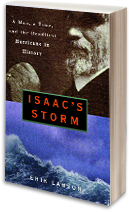
Isaac's Storm

This is one of Erik Larson's first books and when he said at his author's talk here in Bend on June 20 (2013) that it was his wife's favorites (she is is initial editor for all his work), I was even more intrigued to read it--having already bought it in preparation for his appearance here. Personally, I did not think it superseded the other two of his which I really liked, Devil in the White City or In the Garden of Beasts (see also my post on Thunderstruck ).  He does a good job of describing the hubris of men who were the initial movers and shakers of the national weather bureau and who believed, falsely as it turns out, that they already knew a lot about how hurricanes behaved. They also had political agendas which kept them from paying attention to those who did know how hurricanes behaved, the Cubans, and therefore ignored available warnings that this was a storm to be reckoned with. A lot of people died needlessly as a result. Although Isaac Cline was the chief of the Galveston station at the time the 1900 hurricane wiped out much of the city, and Larson does rely on Cline's memoirs and scientific papers, I think the reader gets a less compelling picture of Isaac than might be expected from the title of the book. As with his other books, Larson has done his research on the meteorology,  the history of the weather bureau and relevant events and personalities-- providing extensive documentation which is all relegated to notes at the end of the book;  he writes his story with the heart of a novelist so the reader is swept along with the tide of the oncoming storm.

Friday, June 28, 2013

The Book of Illusions

A very smart and well-read friend of mine, Bob Nye, said that Paul Auster was one of his favorite authors because he was able to capture dialogue so well. This came up as part of a ranging conversation about books we had been reading, favorite authors, etc. So I checked into this Auster guy and turns out he has written LOTS of books and that our local public library had lots of them on the shelf. The Book of Illusions is about the disappearance of a silent film comedian, Hector Mann, in the late 1920's and about the academic, who, in contemporary times, took on a critical review of the comedies Mann made. David had recently lost his wife and sons in an airplane crash and was pretty certain he was going to drink himself to death; then one late night, in a drunken stupor, he happened to see a snippet of one of Mann's films on TV and it made him laugh--something he had not done in months and that he thought he would never do again. Having come into insurance money from the deaths of his family members--he was already on leave from his college teaching job--he undertook to find all the silent films Hector Mann ever made and eventually wrote a book about them. Some months after the book's publication, he receives a note in the mail, ostensibly from the wife of the same Hector Mann who was presumed dead all these years. Is it a hoax? There are stories within stories throughout this novel and indeed Auster is a master craftsman at writing. You will never fault him on style or structure and his prose is very readable. But these characters didn't move me in the sense of coming alive or evoking my sympathy or walking off the page. I may give another of Auster's books a try. He is a critically acclaimed author, after all, and I certainly respect my friend's opinion, so I should give him a second chance...not sure which one it should be, though...any recommendations?