Saturday, March 27, 2010

The Ask and the Answer


Perhaps it should be called The Great Questions. This is the second installment in a planned science fiction trilogy titled "Chaos Walking" ( how could I resist?) from Patrick Ness. I ran across this one on a sale cart and, even though I hadn't read the first book in the series, picked it up just because it got so much chatter on the YA listservs. Complex characters, plots and interactions between characters are mixed in with non-stop action on this outpost of human exploration called New World. The native species, the Spackle, have apparently been defeated in a brutal war and now civil war among the settlers has broken out with one man--Mayor Prentiss-- apparently stopping at nothing to become leader. He recognizes the potential threat from the anticipated arrival of new ships with additional settlers, and so it is essential that he get information from Viola, who was the lone survivor of a scout ship that crashed. She has been befriended by Todd, and they are on the run, when Viola is shot and they desperately seek help in the town of New Haven. That's what I was able to surmise about the first installment, The Knife of Never Letting Go. This book takes up as they are captured in New Haven which has already surrendered to the invading army. Todd and Viola are separated and skillfully--and horribly--manipulated by two strong leaders, Prentiss and Mistress Coyle, a former leader of the resistance (aka the Answer)and also a healer by training. The moral issues are complex and one despairs of anything coming right as we alternately take our place in the action from first Todd's and then Viola's perspective. This is one where I would definitely recommend reading the first book before jumping into the second. Although it was a compelling read, you can't help but feel that you've missed a lot. But get busy because the next book is coming out this spring!

Thursday, March 18, 2010

Brida


I read all but the last 75 pages or so and I never really cared what happened to any of the characters, so I quit. I have liked other books by Paulo Coelho (e.g., The Alchemist) so I persisted, but something was missing. Set in relatively contemporary time, it seemed promising: a young woman is looking for a way to realize her gifts and find her soulmate; there are magi and witches; it's set in Ireland. Lots of my favorite elements, but just no spark. Ah well. I'm trying not to see my lack of enthusiasm as a character flaw...

Saturday, March 6, 2010

Two O'Clock Eastern Wartime


Another really satisfying offering from John Dunning that draws on his considerable expertise in the history of radio in America. His usual blend of detailed setting, well-developed characters and complex plotting made me feel I had indulged in a somewhat higher level of my addiction to mysteries. I love a good story that also makes me feel like I've learned something in the process and this tale set on the New Jersey coast during WWII has revealed a brief period when radio ruled and the best writers and actors wanted to be doing the shows. You get to see how things happen from the inside, the points of view of writers, actors, sound effects people and show producers. Jack Dulaney is trying to help the woman he loves, Holly, find her missing father. At the same time he is finding a new passion and talent for script writing with the support of a reclusvie station owner who dares him to push the limits of network censors who don't want to hear anything controversial or vaguely unpatriotic on the airwaves. In the context of our protagonist's zeal for telling compelling and uncomfortable stories about real people we also get bits of history about various atrocities against "the other"--Kitchener's invention of concentration camps in the Boer Wars, the inhumane treatment of blacks and other soldiers at Florence and Andersonville, the rumored Nazi camps in Europe, and of course the Americans' imprisonment of Japanese American citizens after Pearl Harbor. Murder, conspiracies, romance--it's all here. For other wonderful mysteries by Dunning, that draw on his years as a rare and antiquarian book dealer, check out Booked to Die or The Bookman's Wake.

Tuesday, February 16, 2010

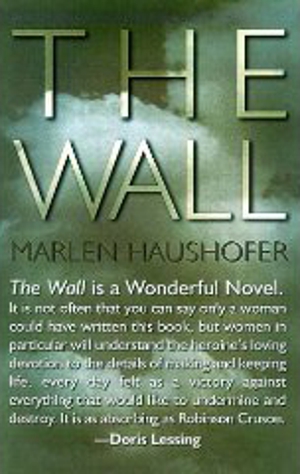
The Wall


Originally published in German, this translation of Die Wand by Shaun Whiteside is the only English language translation of any of Marlen Haushofer's novels, even though she has won several literary awards at home in Austria. Considered a "feminist novel" we are ostensibly reading a report written by the main character who remains nameless throughout. She is a wife and mother of two nearly grown daughters, and has come with her sister (Luise) and her brother-in-law (Hugo) to their hunting lodge in the mountains for the weekend. Luise and Hugo go down to the village for some socializing and never return, although their dog does. Next morning, our reporter begins to worry and as she heads down to the village, she runs into an invisible barrier, transparent and apparently stretching for miles in either direction. The first part of the book focuses on her efforts to understand what has happened and conjecturing about what will happen when the creators of this terrible weapon come to check on their work--for she figures out that whatever happened, it has killed all the fauna (human, animal, bird, insect) living on the other side. This chapterless book (which I found maddening when I needed to quit reading of an evening) shifts focus to how she makes her life alone in the mountains with only the dog, a cow and a cat for companions. It was hard to get started (it would have failed Nancy Pearl's Rule of 50 for me) but eventually I couldn't stop. She copes, although not well at times. Certainly we have to wonder what we ourselves would do in such a situation. What is the point of living, after all? She eventually realizes that no one is left alive to read her report, so why write it? Although the reader will anticipate the climax, such as it is, for most of the book, it's still profound in its implications.

Saturday, February 13, 2010

Monstrumologist

Monstrumology: (noun) The study of life forms generally malevolent to humans and not recognized by science as actual organisms, specificallly those considered products of myth and folklore. (verb) the act of hunting such creatures. Like his father before him, Pellinore Warthrop is a monstrumologist and Will Henry, his 12-year old ward, is his assistant apprentice. Will Henry tells the story through his diaries which come to light when he dies--apparently at the age of 131--an indigent in a small New England town. Will Henry's father had served Dr. Warthrop as assistant in his travels to far reaches and his investigations into strange creatures. So when both parents die in a fire, Will Henry is orphaned and now serves the monstrumologist in turn. Set in the late 1800's, the book is gory--there are indeed man-eating monsters and they have apparently infested the cemetery of the town in which the story is set, which in Will's diaries is known by the pseudonym of New Jerusalem. Is it just coincidence that these monsters have shown up in the same town where one of the world's eminent monstrumologists lives?? Probably not. The story is based on the first 3 folios of 7 diaries, so you can count on a sequel or two if you like this. The author, Rick Yancey, cunningly only claims editorship of the book.

Sunday, February 7, 2010

On Cats


Doris Lessing can always make me care about her subject and in this small volume she reveals her own intense feelings for the cats that have touched her life. I already think cats are amazing creatures so I sometimes found it hard to deal with certain of the events she describes. She was surrounded by semi-feral cats while growing up in Africa and it's wrenching to read about killing off the ones who became problematic--a painful task often delegated to her mother. As an adult however, she makes other decisions I find hard to tolerate, such as letting cats continue to have kittens (instead of neutering them) and then killing the kittens. Admittedly it was hard for her, too. She admires them, she often expends extraordinary resources to save and heal them, she admires their unique personalities. And it is her waxing eloquent about the individual personalities that drew me and kept me reading. The tale of one particular animal "Rufus the Survivor" is the most poignant; though he may not be the one she loved the most, it is in his story that she creates the most heartfelt connection.

Sunday, January 24, 2010

The Lost Conspiracy


Contrary to what you might imagine, Lost in the title of this lengthy young adult novel by Frances Hardinge refers to a special group of people who can send their senses out of their physical bodies to hear, see, and feel things at a great distance. In any world, such abilities would be valued, but in this fantasy world of Gullstruck Island, where technology is still rudimentary, they are invaluable for predicting the weather, apprehending criminals, and just general communication. The island was invaded decades ago and, as so often happens in the process of colonization, the native peoples have been persecuted and often treated as less than human. The coastal village of one such native group, the Lace, is home to a Lost, which brings them prestige, money, and protection. But is Arilou really a Lost, or just mentally deficient? The entire village, and especially her sister Hathin, are complicit in keeping the story viable until the day when all the Lost on the entire island die--except Arilou. Determining who is behind the conspiracy and the subsequent hunt for Arilou becomes the driving force of this book. Hardinge has drawn from various native lores, especially about volcano spirits, to bring life to the indigenous belief systems and the tensions between aboriginals and invaders. It's a fascinating world, compellingly drawn and you'll find it hard to put this one down.

Thursday, January 14, 2010

Holiday reading


Not that the reading was about holidays, mind you, just that I had a wee bit of time to do a little non-work related reading over the short break. Sue Grafton was in fine form with her newest alphabet mystery, U is for Undertow. The book segued smoothly between past and present and then all came together in a bit of a rush at the end. Kinsey seems finally to be aging a bit--some consolation to those readers who have been relentlessly getting older while she seemed not to. Kinsey gets involved in a "cold case" kidnapping of a young girl when a client comes to her believing he saw the girl's body being buried years ago. He just now recalls the memory because of a newspaper article commemorating the anniversary of her disappearance. Turns out he's not such a reliable witness, but he also turns up dead so there must be fire somewhere in all the smoke he was blowing.

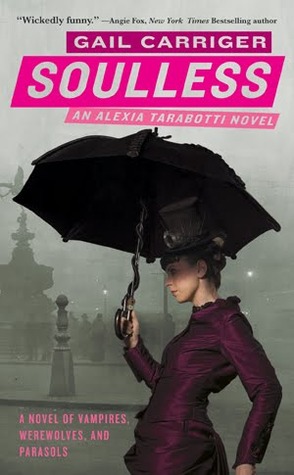
My other diversion was a totally frivolous dip into the vampirish genre with Soulless by Gail Carriger. Her protagonist, Alexia Tarabotti, is a preternatural, whose soulless state neutralizes the supernatural powers of any werewolves or vampires she encounters. Set in Victorian England, there is lots of fun here for Anglophiles and lots of bawdy romance for those who lust after that. From the back cover,
"Alexia Tarabotti is laboring under a great many social tribulations. First, she has no soul. Second, she's a spinster whose father is both Italian and dead. Third, she was rudely attacked by a vampire, breaking all standards of social etiquette."

Doesn't that just put the "pudding in the puff"?! Great supporting cast including a handsome werewolf Lord Maccon with whom she has a love/hate relationship, and her flamboyantly gay vampire best friend, Lord Akeldama. Did I mention that vampires and werewolves are part of high society in Carriger's world?? You can read the first chapter here. Carriger's homepage is here.

Thursday, October 22, 2009

A Whole New Mind


Ah, the beauty of bookgroups is that you read what you otherwise might not have. Let me admit right up front that I dipped and skimmed this book, but found it intriguing enough that I want to go back and re-read it. Daniel Pink is advocating for the development and employment of more right-brain directed types of activities in the work world, claiming that most of the left-brain directed stuff has been largely outsourced (computer programming, accounting, etc.) to developing nations where the labor is cheaper. He focuses on Empathy, Design, Symphony, Play, Story, and Meaning; he offers a bit of independent research, a lot of summarizing of other people's work, and some nice activities and resources at the end of each chapter. Some of the quote (almost all taken from other people) that I really loved are:"listening is an act of love" and "we are the authors of our own lives." He talked about labyrinths, and gratitude, and learning through stories...in short, a lot of things that resonated with me personally. I even got some good ideas to try out in classes and meetings and right now I'm needing all the help I can get with meetings. There's a 5 minute video of him talking about the book here.

Rough Weather


Oooohhh-- I sneaked a little indulgence in between all the reading I've been doing for review sources and writing projects of late. I haven't read a Robert Parker Spenser novel in ages and it was a treat. I just never get tired of Spenser's smart alecky remarks and his repartee with Hawk. Like the Evanovich novels, fairly predictable but highly enjoyable. In this book, Spenser gets hired to be a stand-in date for a seemingly wealthy woman whose daughter is getting married. His old nemesis, the Gray Man, shows up with several men toting automatic weapons and kills the security guards and the groom (right after the vows--that's significant) and then kidnaps the bride. The whole thing seems very staged and not at all consistent with the Gray Man's usual MO. Spenser thinks the mother of the bride knows way more than she's telling and he's trying to get to the bottom of things while not getting killed by the Gray Man. Hawk is enlisted as his back-up and straight man. There's more relationship between Hawk and Susan than I remember from previous books, which was also fun. It was a pleasure to get reacquainted!