Thursday, June 11, 2020

The End of October

Pulitzer Prize-winning non-fiction author Lawrence Wright has dived into speculative but well-researched fiction with what many reviewers (The New York Times,  The Guardian, Vox, Slate, The Atlantic) call an "eerily prescient" account of a global pandemic. CDC expert Henry Parsons is asked by the WHO to investigate a cluster of deaths in an Indonesian detention camp for gay men. Before Henry can even report back on the horrendous and highly contagious disease he encounters there, an infected man is on his way to pilgrimage at Mecca--the annual gathering of over 3 million faithful Muslims. Even the harshest measures are insufficient to keep people from returning to their homes after the outbreak, spreading the disease far and wide.
Henry is one of the people who needs to be working on understanding the virus in order to treat or prevent it, but is instead caught up in a worldwide travel ban, unable to return to his family in Atlanta or get access to the research and lab facilities he needs. Focusing mainly on the Middle East and the United States, Wright talks about the breakdown first of civility--neighbors don't help neighbors in a pandemic; they are afraid of them--and then of society, he paints a picture that seems all too familiar from today's headlines.
The New York Times says that what distinguishes Wright's book from a large body of pandemic based fiction is "deep, thorough research... In writing the novel, he interviewed scientists, epidemiologists, government officials and military officers. His understanding of world affairs, Middle East gossip, politics and governmental ineptitude is exceptional." And he weaves his story together with illustrative non-fiction; for example, he details "accounts of historical epidemics, descriptions of Russian cyber- and biowarfare capabilities, the story of the 1803 attempt to save the New World from smallpox..." (NYT)
NPR says of Wright's digressions into discussing pandemics throughout history that "we readers are currently in the market for exactly that: Every single fact a great reporter like Wright has learned about pandemics."
The Washington Post picks out a quote from the book that sounds like it could have come from Dr. Fauci's daily briefings: "Typically, with a pandemic, you have two or three big waves of contagion before it settles down and becomes the normal flu you get every year. That lasts till the next pandemic comes along. So if this one is like the 1918 flu, the really big wave will hit in October. But of course, we don’t know what this one will do.” Whether or not you think it is a good thing to imagine the outcome of a global pandemic while living in the middle of one is a personal decision. Even the author has mixed feelings. In an interview with The New Yorker, he says, “In some ways, I have to admit, I’m kind of proud that I imagined things that, in real life, seem to be coming into existence...On the other hand, I feel embarrassed to have written this and have it come out.”
I was engrossed and carried along by the story as well as the history and science. 

Sunday, June 7, 2020

Lock Every Door

I was a little bit leery when I started reading this thriller by Riley Sager because I am not a fan of the horror genre. But it turns out that the dark forces in this book are altogether too human, motivated by the usual vices. Jules Larsen has not only lost her job but also her abode after she caught her boyfriend/roommate cheating; so she has been camping on her friend Chloe's sofa for weeks, answering endless want ads with no success. Then she gets an interview to be an apartment sitter in one of New York City's architectural icons, the Bartholomew. It also happens to be the setting for a book that her older sister used to read to her when they were little, Heart of a Dreamer; that was before her sister disappeared, before her parents killed themselves and left her with mountains of unpaid medical bills. In fact, the author of that book is currently a resident of the Bartholomew, although not particularly friendly. The pay for 3 months of work will clear Jules' most pressing debts and give her time to hopefully find a new job; and at least she will be off her friend's couch. The apartment in question is the 12th floor penthouse, facing directly on Central Park. She nicknames one of the building's gargoyles--visible outside a corner window--George. It all seems too good to be true. And it is. The Bartholomew has a bit of a tragic reputation--more than it's share of unusual deaths. When another apartment sitter in the building, Ingrid, tells Jules that she is scared, and that the apartment sitter who preceded Jules in her current apartment disappeared without a word, and then disappears herself, Jules is determined to find Ingrid. She begins to think some shady things are going on and doesn't know who to trust.  It may be that the Bartholomew is a little like the Eagles' Hotel California...you can check in anytime you like, but you can never leave. It was a surprising twist of an ending. Not sure I would seek out any of Sager's other books, but it was an engaging tale.
Fellow book group member found this site about NYC's gargoyles, which play a role in this book:
https://convene.com/catalyst/new-york-city-office-building-gargoyles/
Kirkus was less than laudatory in its review; The New York Journal of Books offers an enthusiastically positive review and a comprehensive plot line than I have done here.

Wednesday, May 27, 2020

We Ride Upon Sticks

This is, I suppose, technically a young adult novel since all the main characters are 17-18 year old seniors at Danvers High School in the year 1989; nevertheless, I enjoyed it immensely, occasionally laughing out loud and once being moved to tears. Our protagonists are the high school field hockey team, the Danvers Falcons, composed of 10 women and 1 man:  Mel Boucher, Sue Yoon, Heather Houston, Julie Kaling, Little Smitty, Becca Bjelica, Boy Cory, Girl Cory (no relation to Boy Cory), Jen Fiorenza, AJ Johnson, and Abby Putnam. You will get to know them all as the book progresses. None of the athletic teams at Danvers HS have won much over the decades, but the field hockey team comes to believe that the dark forces possibly passed down by their witchy forebears, and currently epitomized by the smiling face of Emilio Estevez on the cover of Mel's notebook, may help them win.  After a totally demoralizing defeat at summer hockey camp, Mel is the first to scribble a dark pledge into her notebook, but when the very next day the Falcons tie with a powerhouse competitor, the rest of the team begins to fall in line. They will just need to do a few things differently than normal. The humor is, at times, adolescent, but was just what I needed at this point in time. For example, one of the "bad" things they did to placate the dark forces was to leave an open can of sardines hidden in the teachers' lounge. This is a coming of age book, a book about figuring out how to be your true self, and a paean to friendship, teamwork, and faith in one another. The culture of the 80's is richly woven throughout the story, and there is a fair amount of history about the Salem witch trials sprinkled in, which the author claims is largely accurate. Highly recommended.
Reviews from NPR, and Publishers Weekly.
Barry also gives an interview to the Paris Review about her choice of setting and subject.

Monday, May 18, 2020

Four from Lorna Barrett

I read one of the later installments in Lorna Barrett's "Booktown Mystery" series (Title Wave) and was curious to find out more of the back story. So I picked up what I could from earlier books in the series that were available online (our library has been closed for 2 months due to the pandemic shut down). They are noted here starting from the earliest publication date.
Chapter and Hearse: This is the 4th in the series, published in 2010. Tricia Miles lives in a small town that has re-invented itself as a hub of specialty bookstores. She, of course, runs the mystery bookstore. When a gas explosion at the history bookstore kills the owner and injures Angelica's (Tricia's sister) boyfriend, Bob Kelly, she can't resist doing some investigating on her own. Angelica, BTW, owns a cookbook/ food focused bookstore. You can see the relationship between the sisters develop as well as other relationships (some romantic) among acquaintances. Because Angelica is a great cook (and cookbook author), each book includes some of her recipes.

Book Clubbed: Published in 2014, this is the 8th in the series. Angelica is the newly elected President of the town's Chamber of Commerce, which is currently doing business on the 2nd floor of Angelica's bookstore--just until they find a new permanent home. Betsy Dittmeyer, the cranky CofC receptionist is killed when a toppled bookcase lands on her. Of course, the big question is, was it an accident? It turns out that Betsy had some secrets worth murdering for. Tricia, whose penchant for discovering dead bodies has resulted in her being labeled the town's "jinx," also learns some disturbing secrets about her own family. Her ex-husband has shown up in town and is competing with the chief of police for Tricia's affections.

A Just Clause: This is book #11, published in 2017, just after Title Wave. Two characters from that previous novel take on shape and character here. Tricia and Angelica's father, John, shows up in Stoneham, without their mother! When a local woman is murdered, he becomes the prime suspect due to an earlier romantic entanglement. Tricia, who has always adored her father, learns of his rather unsavory past as a con man who has actually served time in jail. An author she met on the book cruise, Steven Richardson, also comes to Tricia's bookstore for a book signing and evidences romantic interest in Tricia. The dead woman was found clutching a signed copy of Richardson's newest book--just a coincidence? Glowing review from Publishers Weekly.

Poisoned Pages: Number 12 (published in 2018) opens at a house-warming party in Tricia's newly refurbished apartment on the two floors above her bookstore. She has also learned enough about cooking from sister Angelica to do the food preparation. Which seems to have terrible consequences when one of her guests dies from an apparent allergic reaction to the hors d'oeuvres.  This time around, Tricia must find the killer in order to clear her own name. Review from Publishers Weekly.

This is not the best cozy series in the world, but it is entertaining light reading, which is often what I am in the mood for during these days of distancing, anxiety, and uncertainty.

Tuesday, May 12, 2020

Autumn

This book by Ali Smith, intended to be the first in a 4-part seasonal series, was my book group's choice for May. I read it; I did not like it, although there was one passage that I will copy below because it was very clear and spoke to me, appropo of our times. This book got absolutely glowing reviews from many sources.
NYTimes: the first great "Brexit novel"; one of their 10 best books of 2017.
The Guardian says, "Autumn is a beautiful, poignant symphony of memories, dreams and transient realities; the “endless sad fragility” of mortal lives."
NPR says Ali Smith could be "J.D. Salinger's natural heir."
The Atlantic calls her book a "post-Brexit masterpiece."

From an interview with author Jeanette Winterson, we get a short bio, to wit, "She tells me not to worry about the facts of her life – they are simple and there is no scandal. She was born in 1962, one of five children from a Scottish working-class family. She studied at Aberdeen, and then at Cambridge, for a PHD that was never finished. A stint of working as a lecturer at Strathclyde in 1990, convinced her that she could never cut it as an academic."
She writes in several genres (poetry, short stories, plays, fiction) and you can find lists of her work here.
The NYTimes also says, apparently as a compliment, "Chronology skips forward and backward and sideways, moving slowly and then quickly. 'A minute ago it was June,' the author says. 'Now the weather is September.' Smith’s writing is fearless and nonlinear, exploring the connectivity of things: between the living and the dead, the past and the present, art and life. She conveys time almost as if it is happening all at once, like Picasso trying to record an image from every angle simultaneously."
This is part of what I didn't like about the book. I often did not know who was talking, or when in the chronology of events they were speaking. I didn't know anything about some of the prominent speakers, e.g., Christine Keeler.  But I read to the end, partly because that is my commitment to the book group and partly because I figured there had to be a pony in there somewhere. Call me old fashioned, but I like well-constructed sentences and an identifiable cast of characters--especially if there are characters I can at least empathize with--, and some sense of a timeline and purpose to the writing.
But here is the passage that did grab me (spoken by the main character's mother):
"I'm tired of the news. I'm tired of the way it makes things spectacular that aren't, and deals so simplistically with what's truly appalling. I'm tired of the vitriol. I'm tired of the anger. I'm tired of the meanness. I'm tired of the selfishness I'm tired of how we're doing nothing to stop it. I'm tired of how we're encouraging it. I'm tired of the violence there is and I'm tired of the violence that's on its way, that's coming, that hasn't happened yet. I'm tired of liars. I'm tired of sanctified liars. I'm tired of how those liars have let this happen. I'm tired of having to wonder whether they did it out of stupidity or did it on purpose. I'm tired of lying governments. I'm tired of people not caring whether they're being lied to any more. I'm tired of being made to feel this fearful. I'm tired of animosity. I'm tired of pusillanimosity." (p. 56-57)  Well said and I can only respond, "me, too!"

Thursday, April 23, 2020

The Suspect

This is the 3rd mystery from Fiona Barton, an award winning English journalist. I haven't read the first 2 (The Widow and The Child) but NPR's reviewer asserts they are better constructed and more readable. I would also agree with that reviewer that there is too much extraneous stuff that does not contribute to the central mystery of the story--what actually happened to the two young women who went to Thailand for a post graduation trip and then were found dead in in a burned hostel in Bangkok? The narrative POV moves relentlessly between so many characters that, even though the chapters are clearly labeled with dates and narrator roles, it's hard to follow the storyline. Apparently reporter Kate Waters and DI Bob Sparkes, two of the main voices in this book, have appeared in previous works. Waters begins by investigating the young women's failure to get in touch with their parents at a pre-arranged time. The police are initially less interested, but as time passes with no word, they put out a missing persons alert to the Thai police and are soon notified that two bodies were found in the aftermath of a fire in a seedy part of the city.  Now the investigation is into what DI Sparks and his assistant, DS Zara Salmand, quickly determine was murder not an accidental death as the Bangkok police had claimed. When it turns out that Waters' older son, Jake, was staying at the same hostel as the young women, she is taken off the story, but of course continues to investigate on her own in order to prove that her son didn't commit the murders. Even though this book did not draw me into any of the characters, I would still be tempted to read her earlier works.
The NPR review provides much more detail on the plot;  the Washington Post has a much more positive take on this "nail-biting tale of missing teens and the parents who worry for them." Kirkus concludes, “'No one is to be believed ever,' seems to be a major takeaway. Oh, and P.S., don’t let your kids run wild in Thailand. This has the potential to be a thoughtful thriller with an interesting setting, but Barton is too willing to cater to expectations—short chapters, familiar clues, and stereotypical villains." The New York Journal of Books focuses on one of the main themes of the book, which is "a story about mothers, how fierce their love can be when their children’s lives are in jeopardy and how it surpasses right or wrong, even in death."

Tuesday, April 14, 2020

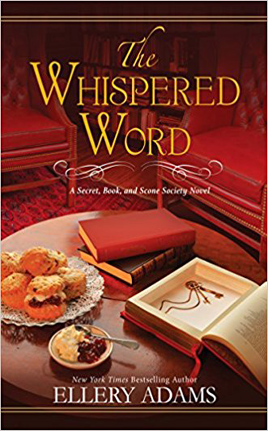
The Whispered Word

This is the 2nd installment in Ellery Adams' "Secret, Book and Scone Society" series and it was as fun as the first one, The Secret, Book and Scone Society. I have also posted about a couple of her "Book Retreat Mysteries" (Murder in the Mystery Suite and Murder in the Secret Garden). Of course one of the main reasons I love these books is that protagonist Nora Pennington, who owns the Miracle Books store in her small town of Miracle Springs, believes that books can heal--that is, she practices bibliotherapy. And since this was a passion of mine while I was working, I'm all in.
In this installment, the mysterious young woman found sleeping in Nora's bookstore--sporting a hospital ID band, clothes that clearly don't fit, and various bruises--gets taken on as a project by the Secret, Book and Scone Society's members, eventually going to work in the bakery and sharing Nora's little house. When a bookstore customer is found dead, there is a question about whether or not it was suicide, and as the friends begin to investigate, they find ties between the mysterious young bookstore refugee, who calls herself Abilene, and the victim. What or who is Abilene hiding from? Is she a murderer or the next potential victim of the killer. All turns out well, of course, as it should in any cozy mystery series. Enjoyable light read.

Monday, April 13, 2020

Title Wave

A recent installment (2016) of the "Booktown Mystery" series by Lorna Barrett, (who also writes at L.L. Bartlett  and Lorraine Bartlett), this book breaks with earlier titles, presumably, because it is set entirely on a cruise ship instead of in the small New Hampshire town of Stoneham. Protagonist Tricia Miles owns a mystery bookstore in the town, Haven't Got a Clue, and owns a cat named Miss Marple. I think I would rather have read one of the earlier books set in the village. She accurately depicts what it's like to go on a large cruise ship, in the this case the Celtic Lady. Her sister, Angelica owns a cookbook shop and is also an author. Angelica is also currently the president of the town's Chamber of Commerce and has been key in organizing a group from Stoneham to join the ship's Authors' Tour. Authors from several genres will give talks as will editors and publishers during the cruise from New York City to Bermuda and back. It's winter in New Hampshire and this is the first time the sisters have taken a vacation together, and the first time either of them has taken time off in several years. But instead of being relaxing, Tricia discovers the body of thriller author E.M. Barstow, a woman so unpleasant that nobody is really sorry she's gone. Although Tricia finds her hanging in her shower, several aspects of the situation make it clear, at least to amateur sleuth Tricia, that this was murder, not a suicide--although the cruise line's security person is bound and determined to keep anyone from thinking there's a murderer on board. What is enjoyable is that the two main female characters are both middle aged, and have been through rough periods as siblings, as daughters, as grown women. They are both successful business women, so good role models. I might check out some of her earlier books, but I wasn't overly impressed with her writing style--she used the word "grating" to describe the victim's speaking style a few too many times.
Review from Publishers Weekly.

Saturday, April 11, 2020

Paris by the Book

You might recognize Liam Callanan's name as the author of The Cloud Atlas; I neither read it nor saw the movie. But I was intrigued by the premise of this book. A sometimes happy family in Milwaukee consists of: Robert, a father who writes mostly children's stories, so isn't wildly successful and doesn't make much money; Leah, a mother who gave up dreams of being a film maker to become a speech writer for the president of a university in order to have a consistent income; and two teenage daughters Daphne and Ellie. One day Robert goes out for an early morning run and never returns. He has occasionally disappeared before to do his "write-aways" but has always left a note. So it is days before the police will take the disappearance seriously. They believe the absence of clues means he is probably dead. The rest of the family don't believe that. But at some point Leah finds a cryptic slip of paper in Robert's granola jar that turns out to be an airline reservation for 4 flights to Paris, the place he always promised Leah they would go. So Leah and the girls go, hoping Robert is waiting there for them. And then they stay. Ellie's godmother and Leah's friend, Eleanor, finds a partial manuscript of Robert's which she sends to them, describing a family that goes to Paris, buys a run down bookstore, and stays--only the mother disappears. Daphne and Ellie are convinced this is a clue and begin the search for the bookstore he described and for their father. They find one that fits the bill, and as luck would have it, the weary proprietor is happy to hire them to run it and rent them the apartment upstairs. So begins the tale of those left behind and how they cope. For most of the book, nobody knows if Robert is alive. Two classic children's stories, the Madeline series and The Red Baloon, frame the story.
Publishers Weekly calls it "sublime" and say, "Callanan has crafted a beautifully-drawn portrait of a woman interrupted set among the exquisite magic of Paris, where life frequently imitates art and the ghosts of the past linger just out of sight." Kirkus writes a more measured review.

Tuesday, April 7, 2020

The Splendid and the Vile

Erik Larson's newest non-fiction work details, at a personal and often quirky level, the first year (May 1940 - May 1941) of Winston Churchill's tenure as Britain's prime minister. ( See other posts for his books: Devil in the White City, In the Garden of Beasts, Thunderstruck, and Isaac's Storm.) All of his books are good, but they have gotten better, IMHO, over the years. This book talks about the initial choice of Churchill, even though the King (George VI) would have preferred Lord Halifax. Larson, as always, uses copious primary and secondary sources in talking about how Churchill's inspiring, pugnacious, moody, and eccentric behaviors affected those around him, from family members to secretaries, to the general populace. Accounts are taken from the collection of "Mass-Observation" (citizen) diaries. Youngest daughter Mary, who was still living at home, kept a diary and numerous excerpts are taken from this. Also, one of Churchill's primary secretaries, John Colville, kept a diary which served as the basis for subsequent books and his perspective is also heavily represented.
This was the year that Hitler turned his full fury upon Great Britain, having defeated their primary ally, France, and sued Churchill--unsuccessfully--for peace. We learn a lot about the ins and outs of Churchill's network of advisors, and about his unflagging attempts to engage the U.S. in a war that Americans vehemently wanted no part of. He felt Britain must appear as if they could win or the U.S. would never partner with them, while he was constantly trying to convince them that he desperately needed their material support. It was a delicate balance. Churchill knew that Britain's chances of survival without America's support were slim. We also learn what a very eccentric character Churchill was, but also how he was able to reassure and inspire the British public who endured months of bombings that resulted in the deaths of thousands and the destruction of, in some cases, nearly entire cities. We also hear from the Germans, especially propaganda minister Goebbels, and air marshall Göring as well as Deputy Führer Hess. We get the nitty gritty details of what it was like to endure night after night of the Blitz--the dust, the smells, the sounds. Most importantly, as the New York Times puts it, "When we look back on history, the most dramatic events — Rudolf Hess’s desperate solo flight to Scotland, the attack on Pearl Harbor — often overshadow everything else. But Larson’s deft portraits show the essential connection that words created between the powerful and the powerless, capturing the moments that defined life for millions struggling to survive the decisions of a few." Larson's great strength is to make the factual details into a compelling narrative.
Additional glowing reviews from NPR, Kirkus, and Publisher's Weekly. The reviewer in the Washington Post, on the other hand, feels Larson has succumbed to the "myth" of England as a green and pleasant land, standing alone against the invaders; whereas, "Strip away the myths of an embattled England, and a different war emerges. It’s heroic, but not in an Arthurian sense. Those dark satanic factories produced the Spitfire and the Hurricane..."