This the 2nd installment in Miranda James' "Cat in the Stacks" series starring rare book cataloger, Charlie Harris and his Maine Coon cat, Diesel (see my post on Murder Past Due, the 1st in the series). Diesel has his own Facebook page here by the way. And why not? He has been Charlie's constant companion ever since Charlie's wife and his aunt Dottie died a couple years ago and he always seems to understand what Charlie is saying. He goes with Charlie everywhere-- on a leash when they walk to work at the university library archives where they live in Athena, Mississippi, or in the car when Charlie runs errands. On one of the Friday afternoons when Charlie is volunteering at the reference desk of the public library, a frequent patron, James Delacorte, asks Charlie if he would consider doing an inventory of Delacorte's rare book collection. He is afraid one of his family members has been stealing books from his personal library. Since the university is on spring break, Charlie agrees, but first he must meet the family, who all live in the Delacorte mansion: a hypochondriac sister, Daphne; her ne'er do well son Hubert and his wife, Eloise, who spends a lot of her time in a world long past; a great niece, Cynthia, a nurse at the local hospital; a great nephew, Stewart, who is a professor at the university; and the very proper English butler, Nigel Truesdale, who has been with Mr. Delacorte for decades. Mr. Delacorte isn't sure who is stealing his priceless books, or even if they have been stolen, but before he can find out, he is murdered with cookies--he was deathly allergic to peanuts. Deputy Sheriff Kanesha Berry as well as Mr. Delacorte's attorney think Charlie should complete the inventory, and maybe also keep an eye on the rest of the family while he's at it. With the help of his son, Sean, who has unexpectedly quit his job as a corporate attorney in Houston and moved home, Charlie discovers that several valuable first editions have indeed been swapped out for inferior copies, and that Delacorte's most recent purchase, a near-priceless copy of Poe's Tamarlane, is, in fact, missing. Diesel solves the theft, but it turns out it's not the same culprit that murdered Mr. Delacorte. This series continues to hold up with interesting characters, local color, and solid plotting.
Keeping track of what I read by jotting down my reactions, providing information about the author, and linking to additional reviews. And occasional notes on other book related things...
Monday, January 14, 2019
Thursday, January 10, 2019
Homicide in Hardcover
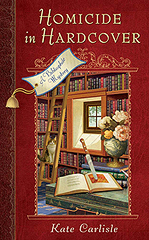
I have discovered a wealth of new mystery series recently with bookish themes. This one by Kate Carlisle is the first in her "Bibliophile Mystery" series that features rare book restorer Brooklyn Wainwright. She has opened her own business in a live-in/work-in loft in San Francisco after studying since childhood with her mentor, Abraham Karastovsky. She is delighted to receive an invitation to the opening of a fantastic new collection Abraham's been working on because they have been estranged ever since Brooklyn struck out on her own. After a cheerful reunion, he invites her to come see the rare edition of Faust that he is restoring in the basement workrooms later in the evening. But when she shows up, Brooklyn finds Abraham bleeding to death on the floor, living only long enough to whisper to her "Remember the devil." The copy of Faust he is clutching is supposed to be cursed, and when a 2nd --admittedly somewhat shady--book restorer dies, and Brooklyn herself is threatened, she begins to believe it might be true. Brooklyn decides to investigate, not only because Abraham deserves justice, but because the police, and a handsome private security consultant, think she might be involved. Brooklyn is a quirky and endearing character who will hopefully grow with future installments. There's certainly enough here to keep me going....and there are 12 more in the series!
Tuesday, January 8, 2019
White Teeth
This debut novel by Zadie Smith was also one of those chosen for PBS's Great American Read, and was my 2nd choice for this month's (January 2019) book group. Once again, I failed to complete the book I chose (see A Confederacy of Dunces) and seemed not to grasp what the critics found so gratifying in this novel; after 300 pages, I still did not care about any of the characters. Briefly stated, Kirkus says it's "An impressively witty satirical first novel, London-set, chronicling the
experiences of two eccentric multiracial families during the last half
of the 20th century." Publishers Weekly calls the book "A remarkable examination of the immigrant's experience in a postcolonial
world, Smith's novel recalls the hyper-contemporary yet history-infused
work of Rushdie, sharp-edged, fluorescent and many-faceted." While the New York Times asserts that "Zadie Smith's debut novel is, like the London it portrays, a restless
hybrid of voices, tones and textures. Hopscotching through several
continents and 150 years of history, White Teeth encompasses a
teeming family saga, a sly inquiry into race and identity and a
tender-hearted satire on religious antagonism and cultural bemusement."
A summary of numerous reviews is offered in The Guardian.
A Confederacy of Dunces
This book, written by John Kennedy Toole and published posthumously after he killed himself at age 32, was awarded the Pulitzer and received lots of rave reviews. I chose it from the PBS's "The Great American Read" list of 100 books for my book group --we all selected one book we had always wanted to read-- but after two nights of trying, I gave up. Walker Percy, who was convinced to read the manuscript by Toole's mother, read it 3 times and calls it "A great rumbling farce of Falstaffian dimension..." and the Chicago Sun-Times says of the book "What a delight, what a roaring, rollicking, footstamping wonder this book is!" It did NOT make me laugh. I did not find the characters amusing or even pitiful. They just annoyed me, so I gave up. The Indepdendent calls it "the book of a lifetime" and goes on to say, "A Confederacy of Dunces is a story of loneliness amid crowds, a comedy
that hurts. At the centre is an anti-hero named Ignatius J Reilly. If
Don Quixote had been thrust into the underbelly of modern New Orleans,
this is exactly who he would have become. Hypochondriac, melancholic, a
walking catastrophe..."It is, indeed, set in New Orleans and they have even erected a statue of the main character, Ignatius J. Reilly, on Canal Street.
This review in The Guardian tells you more about the author and the book. Other rave reviews come from Kirkus, The Wall Street Journal, and The New York Times.
Monday, December 31, 2018
The Middleman
This novel by Olen Steinhauer, author of numerous other political thrillers and the author behind the TV series "Berlin Station," presents us with a protest movement against the wealthy elite and the government (remember the Occupy movement?) called The Massive Brigade. Or are they more than that? FBI Rachel Proulx has been following terrorist groups and alarms go off for her when 400 + young adults just walk out of their lives on the same day, all over the country, leaving behind family, friends, jobs, cell phones, money and identities...and disappear without a word. Rachel has been tracking Martin Bishop, the leader of the group, for years, but can she convince her colleagues that there is a serious threat here before it's too late. Told alternately from her perspective as well as that from Kevin Moore, one of those who walked away. It gets hard to tell the good guys from the bad, probably an accurate depiction of our times. Interesting, but some of his other books have received stronger reviews and I might check them out. I'm already on the lookout for "Berlin Station."
Reviews from The New York Times, the Washington Post, Kirkus, and Publishers Weekly.
Labels:
conspiracies,
FBI,
politics,
terrorists,
thriller
The Darkest Minds
This YA novel by Alexandra Bracken was intended to be the first of a trilogy although it will possibly extend beyond that. It has been made into a movie, already. The premise is that a plague has wiped out most of America's children; the ones who survived have developed unusual powers--telekinesis, mind-reading, and other psychic abilities that scare the adults, who promptly turn their children over to authorities to be housed in "Rehabilitation Camps." Of course they are no such thing and, years after her incarceration, 16-year-old Ruby escapes with several others, all of whom are looking for a place where Psi children will be safe, the fabled East River. She hooks up with young Zu, whose touch burns, Chubb, a genius, and their leader, Liam. When they eventually find the refuge, it is led by the least likely person imaginable, the son of the President of the U.S. who created the camps. Ruby eventually begins to realize that not all is as it seems at their new home and doesn't know who to trust when everyone wants something from her. Here's the review from Publishers Weekly.
The Dry
Not to be confused with Dry, a YA novel I posted about earlier, this taut mystery--an inaugural outing by author Jane Harper--is set in the Outback of Australia, 5 hours from Melbourne where most people are sheep ranchers or farmers. Except there has been a drought for several years and what was once a deep and life-giving river through the town of Kiewarra has gone dry. Aaron Falk has returned after 20 years for the funeral of his childhood best friend, Luke Hadler, who is believed to have killed his wife and son and then himself. His baby daughter was left alive. But Luke's parents, who were more of a family to Aaron than his widowed father, just can't believe it, and they beg Aaron, a federal financial crimes investigator, to look further into the matter. The problem is, Aaron and his father were basically run out of town when Aaron and Luke's friend, Ellie, was found drowned in the river. A note was found with the word Falk written on it and people assumed either father or son had killed her. Luke provided Aaron an alibi, for which he was grateful until years later when Aaron began to realize that Luke's claim that they were together also provided an alibi for Luke. Now Aaron wonders just what Luke was capable of. He joins forces with the local police chief, who is relatively new on the job, and who doesn't quite buy the murder /suicide theory because some clues just aren't consistent with that scenario. Aaron must fight on two fronts--finding out what really happened to Luke and his family even though people in town just want to be done with it, and dealing with the ugly rumors and harassment which have been reignited by Ellie's drunken father and cousin. Are the deaths connected? And more importantly, will Aaron be able to ever find out what really happened to his friend Ellie and to Luke's family. Apparently the movie rights have already been optioned for this. There are two newer novels, Force of Nature (also featuring Aaron Falk) and The Lost Man, which will be released in the U.S. in February.
Lots of good reviews for this award-winning ( the CWA Gold Dagger for Best Crime Novel, the British Book Awards Crime and Thriller Book of the Year, the Australian Book Industry Awards Book of the Year and the Australian Indie Awards Book of the Year) book from Kirkus, Publishers Weekly, and The New York Times.
Sunday, December 30, 2018
House of Names
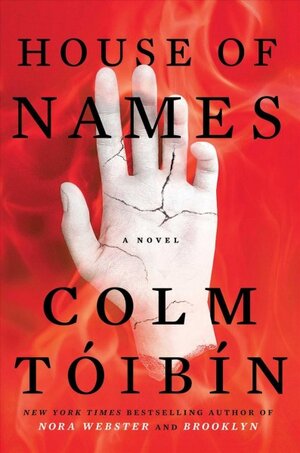
I've never read any books by Colm TóibÃn although he has had several well-known ones, including Brooklyn, which was made into a movie. Still I was intrigued by the premise of the book and by the opening line: "I have been acquainted with the smell of death." This spoken by Clytemnestra, the wife of Agammemnon, who is one of the principle narrators of this novel about the ultimate dysfunctional family. Furious that her warring husband has tricked her and their beautiful daughter, Iphigenia, into coming to his camp with a lure of marriage to the hero Achilles, Clytemnestra finds instead that Agammemnon will humiliate and sacrifice his daughter to the gods in exchange for favorable winds for his fleet. Returning home, Clytemnestra takes up with her husband's cousin, Aegisthus, both as a lover and as a co-conspirator in her plan to murder Agammemnon upon his return. Daughter Electra is put into a dungeon while the deed is done and left there to cool her heels for a time to bring her into line. Clytemnestra never tells her about her sister's murder. Orestes is sent away with the sons of many of the local powerful families--kidnapped essentially to keep everyone in line as Clytemnestra and Aegisthus take over the throne. A big chunk of the book focuses on Orestes' escape with two of the other kidnapped boys who hide out in the country far from home for several years. When he returns, vengeful Electra tells Orestes of Agammemnon's murder and convinces him to help kill Clytemnestra and avenge their father...so the cycle continues. The story is rampant with whispers and ghosts.
While TóibÃn is a compelling writer, I did not find this a satisfying story; however, it is the quintessential tragedy. Lengthy and laudatory reviews from NPR, The New York Times, The New Yorker, the Washington Post, and Kirkus.
Thursday, December 27, 2018
Black Diamond
See the previous post, which is about Bruno, Chief of Police, the first in Martin Walker's Bruno series. This is the 3rd book in the series and some day, I will have to go back and read the 2nd, The Dark Vineyard. Bruno, who is honorifically titled Chief of Police for the French village of St. Denis, even though he is the only policeman in the village, is doing his shopping in the weekly farmers' market when several hoodlums race through on motorcycles and destroy the stall of a local Vietnamese family. Within days, an Asian restaurant in a nearby town is fire bombed. Then Bruno begins to get hints that the local truffle trade--the "black diamonds" that provide a multi-million dollar source of income for the region--is being threatened by substitutions from smuggled and inferior Chinese truffles. When his dear friend and truffle expert is brutally murdered, Bruno up to his ears in mysteries. But, as Bruno learns, his friend was also a former intelligence agent whose work may have made him a target, and there may be more important things being smuggled in from Asia than mushrooms. Once again, painful episodes from France's past, this time its colonial relationship with Vietnam, will surface and spoil the sense of a peaceful pastoral paradise. Bruno would really rather just focus on cooking, drinking wine, hunting truffles with his dog Gigi, playing and coaching rugby, and sorting out his "romances past (Isabelle of the Police Nationale), present (exotically
English Pamela), and possibly future (needy single mother and research
chemist Florence)."[from Publishers Weekly review]
As always, you'll want to add the Perigord region to your travel itinerary or at least go find the closest French bakery. Additional reviews from Kirkus, The Independent, and the Washington Independent Review of Books.
Bruno, Chief of Police
I actually read this book by Martin Walker, the first of the Bruno series, some time back, but, having recently read another book in the series, I thought I should go back and fill in. Bruno Courrèges is the Chief of Police in the small town of St. Denis, in the Perigord region of France, known for foie gras and truffles. Bruno loves to cook and feed his friends. He raises animals on his little acreage and grows his own vegetables. He also plays on the local sports teams and coaches the youth soccer team. Most of the time, life is quiet in St. Denis and that's how he likes it, but he can call on a network of contacts when real trouble arises. An elderly ex-soldier who lived in the village has been found brutally tortured and murdered with a swastika carved into his chest. Because this is deemed a hate crime, competing police forces intercede and want to shut Bruno out of the investigation. Bruno however is good at skirting the national authorities and begins to think this crime has its roots in WWII and especially in a group called the Milice. According to Wikipedia, the Milice:
"was a political paramilitary organization created on 30 January 1943 by the Vichy regime (with German aid) to help fight against the French Resistance during World War II. The Milice's formal head was Prime Minister Pierre Laval, although its Chief of operations and de facto leader was Secretary General Joseph Darnand. It participated in summary executions and assassinations, helping to round up Jews and résistants in France for deportation....The Milice was the Vichy regime's most extreme manifestation of fascism....The Milice frequently used torture to extract information or confessions from those whom they interrogated. The French Resistance considered the Milice more dangerous than the Gestapo and SS because they were native Frenchmen who understood local dialects fluently, had extensive knowledge of the towns and countryside, and knew local people and informants."
Bruno also uses his local knowledge to flush out possible motives for murder. As The New York Times says in its review of Walker's 2nd installment in the series, The Dark Vineyard, Bruno works with "great discretion, circulating so quietly and tactfully among his neighbors that his interviews are more like friendly visits. It’s a wonderful detection method and an even cannier literary strategy, allowing Walker to pursue the plot of his mystery while beguiling the reader with extended scenes of village market days, old-fashioned wine harvests and some exceptionally congenial dinner parties." Of course, uncovering this information exposes some dark aspect of France's history, a marked contrast to the seemingly idyllic presentation of St. Denis. Nevertheless, you'll find yourself wanting to go there or at least enjoy some French cuisine. Read this article in the NYT for some insights on the village and cuisine which so richly embellish these books.
"was a political paramilitary organization created on 30 January 1943 by the Vichy regime (with German aid) to help fight against the French Resistance during World War II. The Milice's formal head was Prime Minister Pierre Laval, although its Chief of operations and de facto leader was Secretary General Joseph Darnand. It participated in summary executions and assassinations, helping to round up Jews and résistants in France for deportation....The Milice was the Vichy regime's most extreme manifestation of fascism....The Milice frequently used torture to extract information or confessions from those whom they interrogated. The French Resistance considered the Milice more dangerous than the Gestapo and SS because they were native Frenchmen who understood local dialects fluently, had extensive knowledge of the towns and countryside, and knew local people and informants."
Bruno also uses his local knowledge to flush out possible motives for murder. As The New York Times says in its review of Walker's 2nd installment in the series, The Dark Vineyard, Bruno works with "great discretion, circulating so quietly and tactfully among his neighbors that his interviews are more like friendly visits. It’s a wonderful detection method and an even cannier literary strategy, allowing Walker to pursue the plot of his mystery while beguiling the reader with extended scenes of village market days, old-fashioned wine harvests and some exceptionally congenial dinner parties." Of course, uncovering this information exposes some dark aspect of France's history, a marked contrast to the seemingly idyllic presentation of St. Denis. Nevertheless, you'll find yourself wanting to go there or at least enjoy some French cuisine. Read this article in the NYT for some insights on the village and cuisine which so richly embellish these books.
Subscribe to:
Posts (Atom)