Tuesday, May 15, 2018

American by Day

Can't remember where I heard about this book but I am glad I read it. This is a sequel to Derek B. Miller's Norwegian by Night, a Dagger Award winner eventually published in a dozen languages, featuring the same protagonist, Chief Inspector Sigrid Ødegård of the Oslo police. Miller is American, but married to a Norwegian woman and they live in Oslo. He has a rather impressive academic and real world resume including a PhD in international relations from the University of Geneva.
Sigrid has recently been involved in shooting a man to death and, although the shooting was ruled as justified, it has left her questioning herself. She takes leave to visit her father and finds out from him that her brother, Marcus, who has lived in the United States for 20 years, has gone missing. Moreover, Sigrid's father, has already bought her a plane ticket to go to the U. S. to find him.  So she does. But in some ways that is the least of the story, for this is a look at America from a European point of view, in particular our culture around guns and individualism and race. The characters are fascinating,  provocative, and occasionally laugh-out-loud funny. It seems like an odd combination of philosophy, humor, mystery, and literary fiction...but it works.
It's 2008 in the run-up to the Obama-McCain presidential election. Set in sultry late summer upstate New York, which as Sigrid dryly observes is still south of Venice, Sigrid has her suitcase stolen within minutes of arriving at her brother's empty house, which is now occupied by a prostitute who claims Marcus gave her the keys when he left. Sigrid teams up with local sheriff Irv Wylie, and his deputies, especially Melinda, who comes to look at Sigrid as a sort of mentor. Wylie has a master's degree in divinity so takes a somewhat different perspective on law enforcement and the world than your run-of-the-mill small-town sheriff. Marcus' disappearance coincides with the death of the woman he was dating, Lydia, an African American professor at the same small university where Marcus was working as an adjunct. Marcus made the 9-1-1 call and was there when Lydia fell to her death from the 6th floor of an office building still under construction, so he is suspect #1.  Wylie is having to tread very carefully because the Black community is up in arms about the police shooting of a 12-year-old Black boy--Lydia's nephew-- and the powers that be want this case solved quickly and seem less concerned about whether they get the right culprit. Needless to say, Sigrid feels she needs to reach Marcus before the police do if he is to have any chance of staying alive.
Not only was I impressed with the craft, the perspective, and the characters, but I also admire how Miller seemed able to cross the gender gap and authentically present a woman's point of view. I will definitely go back and read Norwegian by Night and maybe The Girl in Green as well. Reviews for this book from The Guardian, the New York Journal of Books, Kirkus, and Publishers Weekly.

Sunday, May 13, 2018

Weeping Waters: Book I of the Inspector Beeslaar Series

This crime fiction/ mystery by Karin Brynard was originally published in 2009 (in Afrikaans) but only translated recently (by Maya Fowler & Isobel Dixon) for this English edition of 2018. Really a knockout book that kept me engaged from beginning to end. I love learning about other cultures and the ins and outs of race relations in post-Apartheid South Africa were all new to me. There were times when I struggled to work through some of the unfamiliar vocabulary, but it never detracted from understanding nor slowed the plot. Brynard was previously a political and investigative journalist, and she knows how to string her words together in this compelling story.
Our main characters are, of course, Inspector Albertus Markus Beeslaar, who, we gradually learn, has left Johannesburg for a supposedly quieter life in a small town on the edge of the Kalahari Desert--it's really hot there! His reasons for leaving are partially revealed through phone conversations with a former lover, who just happened to be the wife of his ex-partner at the police department. What is clear from the beginning is that his new supervisor, in the slightly larger town of Upington, feels Beeslaar has been forced upon him--and there is racially based animosity towards this white detective as well. Beeslaar, for his part, is dealing with two very inexperienced local juniors (both black), Pyl and Ghaap, in response to a series of stock thefts from local farmers, which have recently escalated with the murders of the farmers or their hired help.
The catalyzing event of the book, however, is the brutal murder of an up-and-coming woman artist and farm owner, Frederika Swarts, and her adopted daughter. Estranged sister, Sara Swarts, arrives with a load of guilt for having abandoned her sister to care for their dying father on the family farm. Sara eventually comes to believe that Freddie's death is not, as has been characterized in the press, another in a years' long string of "farm murders," but something unique and personal to her sister. I won't try to explain the significance of "farm murders," a phenomenon that was an eye-opener for me, or to introduce the several likely suspects in the murders. I would agree with one reviewer that, if you like Stieg Larsson, you will probably like this. It is dark in nature, but also rich in character and history and culture. I can't wait for the next translation in the series to come out--hopefully later this year. A bit more detail in this review from Publishers Weekly.

Thursday, May 10, 2018

The Bellini Card: Investigator Yashim Goes to Venice

This third entry in Jason Goodwin's "Inspector Yashim" series (see my posts on The Janissary Tree and The Snake Stone), is, in fact, largely set in Venice, which was a little disappointing. It's now 1840 and the old sultan has died and been replaced by his son, Abdulmecid, who has asked Yashim to track down a portrait of his ancestor, Mehmet the Conqueror, by Italian artist Bellini, which is rumored to be on the market in Venice. However, one of the powerful pashas in the city (Istanbul) warns Yashim not to go, so Yashim is caught between two powerful men. His solution is to create a fake identity for his friend, the Polish ambassador Pawlewski, and send him instead. Pawlewski has been a man of the world but is clearly in over his head when art dealers (or dealers of forgeries) start dying and he becomes the prime suspect. Fortunately Yashim has realized, after following clues at home, that something rotten is afoot and has come to Venice in the nick of time to rescue Pawlewski, locate the painting, have a torrid affair with the Contessa d'Aspi d'Istria, and cook a wonderful Turkish meal. But there is deceit piled upon deceit, and even though the ending is revealed at the beginning of the book, you don't know that until you reach the end. We do get a behind the scenes look at Venice, which at this point in time has fallen to the Austrians, and is sliding into ever greater debt and decay. Still, I missed Istanbul.

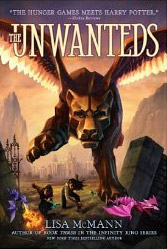
The Unwanteds

This book by Lisa McMann was her first foray into writing for young teens and the first of a series. In the town of Quill, strength and conformity are valued above all else because the world is a threat to their existence--or so they have been told by their leader, Justine. As a result, all 13-year olds are "purged" annually with the strong, smart, rule-following kids--The Wanteds-- sent to University to eventually join the Quillitary (their military), or to the Necessaries to become service people for the community. Those who have broken rules--which forbid any creative activities such as drawing or singing or telling stories--are The Unwanteds and are sent for extermination. So it is that identical twins Aaron and Alex are separated, with Aaron going to the University and Alex put on a bus for the death farm, slated to be dumped in the Great Lake of Boiling Oil. But when Alex and his fellow Unwanteds pass through the gates, what they find instead is a magical world, Artime, protected by the illusion of the death camp, run by master magician, Mr. Today. Here, the Unwanteds pursue their education and their talents and learn to use them as magical tools, including using them as weapons. But Alex cannot let go of his belief that his brother would be happier here, even though Mr. Today has warned that any knowledge of their world will be seen by the Quillian authorities as an existential threat. You can predict the rest. The war actually ends in a mutual tolerance pact for the present, but the door is clearly left open for the sequels.
This is of course a wonderful book to recommend to kids who are not part of the "in crowd" as the misfits triumph in the end. Quite suitable for middle grades, i.e., no sex and minimal/ mild descriptions of violence. Rave review from Kirkus!

Sunday, April 29, 2018

Little Fires Everywhere

This book by Celeste Ng has received so much press that I am not sure what I can add. Among other things, this is about a collision of cultures, as embodied by the two main female characters: affluent suburbanite Mrs. Elena Richardson, who has always followed the rules and believes good planning can prevent catastrophes, and unconventional artist Mia Warren, who makes up her own rules and has a child but has never had a sexual relationship. Reading the book felt like watching a train wreck in slow motion. The book starts with the culmination, i.e, the Richardsons' house in Shaker Heights burns to the ground. The rest of the book tells us how this came to happen. According to the New York Times, this is a literary device Ng employed in her first book as well. Kirkus enthuses, "This incandescent portrait of suburbia and family, creativity, and consumerism burns bright." While an advertisement for the first planned community of Shaker Heights offered "protection forever against depreciation and unwelcome change," when Mrs. Richardson rents a small duplex she inherited from her parents to artist Mia and her teenage daughter Pearl, change will overrun the rules. As Kirkus summarizes, "Mia and Pearl live a markedly different life from the Richardsons, ...making art instead of money ...; rooted in each other rather than a particular place ...; and assembling a hodgepodge home from creatively repurposed, scavenged castoffs and love rather than gathering around them the symbols of a successful life in the American suburbs..." Several reviewers have said the book's central theme is motherhood, for example, the Huffington Post asserts, "This story does a deep dive into what it means to be a mother, what qualifies as competency, who gets to decide, and raises so many more questions around the essential role of being a mother. " (see also: The Independent, The Guardian). I would disagree. Although I think the issues surrounding motherhood motivated many of the characters' actions, they are still not the core of the story. Rather it seems to be more about the relativism of right and wrong or the ambiguity of morality.
One of the aspects I found most striking about the story was the vivid visual imagery and examples of creativity Ng employed when describing Mia's work. One has to imagine Ng must be somewhat of a visual artist herself, or at least an avid afficionado, to provide such detail.
 Like the review in the Washington Post, the review from The Guardian was decidedly lukewarm. I am singling it out for a couple of reasons. It pretty much echoed my own reaction, which was, this is beautifully written, but the characters did not engage me. Also because, when the reviewer says, "After all, my experience of reading this book was perfectly pleasant. But the world in which I read it would be indistinguishable from the one in which I didn’t. This is a variety of novel that unnerves me, because it’s extremely well done and yet I didn’t warm to it. So what’s my problem?"--I was reminded of my reaction to Anthony Doerr's All the Light We Cannot See--I was the only person in my book group who did not absolutely love it. Additional reviews of Ng's book in The LA Times, The Times (UK), Publishers Weekly, The Chicago Tribune, the Denver Post, the Seattle Times.
There is an interview with Ng and some questions to consider for the book group on Ng's website.

Saturday, April 28, 2018

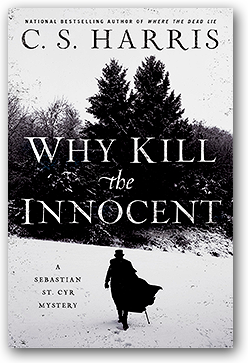
Why Kill the Innocent?

This is the 13th installment in the "Sebastian St. Cyr" series by author C.S. Harris, but she is a new author to me. Set in 1814 London, this is the Regency era (1788-1832), described by history professor Harris (19th C European history) as "The age of Napoleon and Jane Austen, of Beau Brummel and Lord Byron. Ladies wear filmy dresses and dampen their petticoats, while gentlemen duel with pistols at dawn and agonize over the cut of a coat. Fortunes are won and lost at the turn of a card, a decades-old war has turned Europe into a ravaged battlefield, and in London, a child of six can still be hanged for stealing a handkerchief." This is also the era when women were to be seen and not heard, so when talented piano virtuoso twins James and Jane Ambrose reach adulthood, he is allowed to become a concert pianist before he dies of tuberculosis. Jane is not allowed to appear in public so is married to a playwright, for whom she writes extravagently popular operas that are performed under his name. She is allowed to be a piano teacher, including among her students Princess Charlotte, the heir presumptive to the throne. When Jane's body is found in a poor part of London, lying in a snow drift with her head bashed in, the throne moves quickly to proclaim it an accident and stop any further investigation that might bring negative attention to the royal house.
However, the body was found by Hero, wife of Sebastian, Viscount Devlin, and daughter of the most powerful force behind the throne, Charles, Lord Jarvis, the Prince Regent’s cousin and fixer; although her father won't help Hero, she refuses to let Jane's murder go unchallenged. Sebastian and Hero are soon deep into the personal and political secrets surrounding the throne that involve smuggling, treachery and murder.
London is in the midst of a severe winter and an historic "Great Fog." The snow is deep, the cold is bitter, and the mighty Thames River freezes, bringing commerce to a literal standstill. The poor are freezing to death or dying of starvation while the Prince Regent, Charlotte's father, goes on spending money to eat, drink, and be merry. This was, according to Harris' extensive historical "Author's Note," the last year that London celebrated a "Frost Fair," when booths for businesses and entertainment were set up on the river itself, drawing huge crowds out on to the ice. It ended tragically when a sudden warming thaw caused the ice to break up and unknown numbers of people to die.
Obviously I have missed much of the back story to this series and will make that up in the future. Nevertheless it was an enjoyable read because I love stories with strong female protagonists, good mysteries, learning about a period in history, and almost anything set in England. Reviews provide further details: Kirkus and Publishers Weekly.

Monday, April 23, 2018

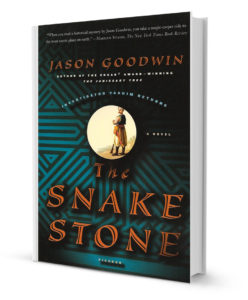
The Snake Stone: Investigator Yashim Returns

I recently posted about the first book in this series by Jason Goodwin, The Janissary Tree, which I really enjoyed. It is 2 years later, 1838, and the Sultan is dying. Yashim is hired by a wealthy banker's family to investigate a French archaeologist, Max LeFevre, who has come seeking to find and sell ancient Byzantine artifacts. When LeFevre is brutally murdered, Jashim is quickly identified as being the likely perpetrator. He must find the real killer to avoid being disgraced and possibly jailed. We are once again immersed into the history, politics, architecture, cuisine, and  religious and cultural diversity of late Ottoman-era Istanbul. It's fascinating and evocative. Once again secret societies with agendas that challenge the status quo are believed to be at the heart of a series of murders, and again we get glimpses into the secrets and power of the trade guilds, in this case, the watermen, who keep the huge city supplied with life-giving water. As in the first novel, Yashim, a eunuch and former investigator for the Palace, taps his extensive network of contacts to try and solve the mystery. When LeFevre's young wife shows up and vows to revenge her husband's death, Jashim takes her in and they have a short intimate relationship before she disappears--only to take up the search allied with not-so-trustworthy parties. But is LeFevre really dead?
Reviews and more detailed summaries are available from Kirkus, The New York Times, NPR (with a link to an audio interview with Jason Goodwin), and Publishers Weekly.   I already have the 3rd Inspector Yashim novel on hold at the library: The Bellini Card.

School for Psychics: Book One

This book by K.C. Archer (a pseudonym) is obviously intended to be a multi-installment work as indicated by the subtitle, and the open ending--loaded with numerous mysteries still unsolved--makes that obvious as well. Although the cast of characters are all supposed to be in their 20's, I would agree with Kirkus' review that this "novel reads like it's written about teens for teens." That being said, if you like YA novels, this one is fun.
Teddy Cannon, adopted by a loving couple after her parents were ostensibly killed in a car crash, has failed at just about everything--except being an outsider and gambling. Unfortunately, her family lives in Las Vegas and Teddy has managed to accumulate several hundred thousand dollars in debt to a loan shark. Moreover, because Teddy has often beat the house, she has been banned at all the casinos on the strip, leaving her no opportunity to win back the money she needs. Teddy does not cheat, but she does read people's non-verbal behaviors really well; at least that is what she thinks. She also thinks she suffers from epilepsy, although the medications prescribed for her don't seem to help much with the "episodes." When she dons a disguise and sneaks back into the Bellagio, she is nearly caught by both casino security and the loan shark, but is inexplicably rescued by someone who is obviously a cop. He offers Teddy a way out of debt and a way into being accepted for who she is, which, he claims, is an undisciplined psychic. He offers her a chance to attend the Whitfield Institute for Law Enforcement Training and Development, where psychics are trained to help law enforcement officials at all levels. Desperate to save her adoptive parents the grief of losing their savings--which she "borrowed" from in order to gamble--and seeing her in trouble again, Teddy decides to accept the offer. At Whitfield she falls in with the self-described "misfits" who are pitted against the other first year students, the "Alphas," by one of the instructors. Her colleagues include an ex-cop who can start fires, her room mate who communes with animals, someone who is telepathic, and another who can foresee people's deaths. Teddy has to train her body as well as her psychic skills;  her occasional uncontrolled bursts of astral telepathy shock both fellow students and instructors. Teddy discovers that Clint, the head of the school, is keeping information from her, and when two of the senior students disappear, Teddy begins to unravel a conspiracy to pervert the mission of the school. She will have to overcome her lifelong habit of being a loner and learn to trust her fellow misfits if she is to not only reveal the conspirators, but also survive. I stayed up late to finish this one, which I haven't done in a while and I will definitely read the sequel when it comes out. Additional review from Publishers Weekly.

Thursday, April 12, 2018

Dear Committee Members

This epistolary novel by Julie Schumacher was recommended by friend Anne Zald, who is still working in the trenches (i.e., the library) at Northwestern. Having also spent much of my life in academia, this book was bittersweet and funny because there was so much truth embedded in the sarcasm. I am reminded of another book told by a disgruntled English professor protagonist, Straight Man by Richard Russo, which also occasionally made me laugh out loud. Told through a series of letters spanning one year (2009-2010), we learn of the travails endured by creative writing professor Jason (Jay) Fitger, who is besieged by not only current but also long-ago-graduated students for letters of recommendation to every imaginable type of job. Probably believable for English majors to consider working in a store that sells nuts (the edible kind). Payne University (all puns no doubt intended) has been slashing the English department, as Fitger sees it, to enhance the the prima donnas in the Economics department, one floor up. No new faculty, no tech support, larger classes, hiring an acting dean from another department...the insults are endless. It is a wonder that Fitger ever made full professor, in spite of publishing four books, given his propensity for pissing people off. Both his ex-wife and his ex-lover still work at the university and won't even let him in their respective office doors; but he's also alienated his literary agent, the head of writing programs elsewhere, and his fellow faculty members. He does seem to be endlessly accommodating of his students (if not always flattering in his letters of recommendation) and has especially taken on the case of one Darren Browles, who has lost his fellowship and desperately needs another source of income in order to finish writing his book. Fitger beseeches everyone, but to no avail. People we come to know only as the subject of Fitger's letters either move on with their lives, or they don't, and Fitger, in the end, is elected chair of the English department--a suitable punishment. Numerous laudatory reviews: Kirkus, The New York Times, Slate, Newsweek, NPR, and so many more....
As Newsweek notes, this book is worthy of a letter of recommendation!

Sunday, April 8, 2018

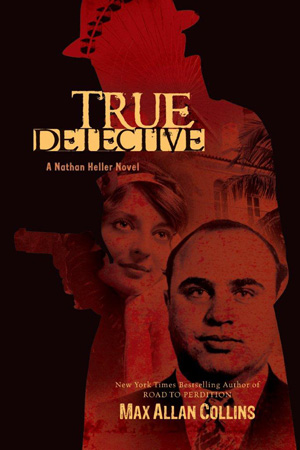
True Detective

I recently read a book by Max Allan Collins, Quarry, and although it wasn't my favorite book of all time, I was sufficiently intrigued to order the DVD of the TV series that was made from that book and this first book in Collins' "Nate Heller" series, which won a Shamus award. See more info about Collins on his blog and in my post for Quarry.
Set in 1933 Chicago, just a year before the opening of the World Fair, Nathan Heller is a detective for the Chicago Police Department, thanks to his uncle Louis putting in a good word to get him on the force in the first place, and also due to his being willing to lie about who killed a journalist/ gangster. But Nate does have standards and when he gets unwillingly dragged into yet another dirty trick on the part of the Chicago PD and the mayor, he decides to quit and go private. Two detectives who are in the pocket of Mayor Cermak drag him along to roust a bookie joint run by Frank Nitti and in the process Heller kills a young man in self-defense. One of the detectives shoots Nitti and then wounds himself claiming that he shot Nitti in self-defense. Nate knows otherwise and the pressure is on for him to lie again in the upcoming investigations. If he agrees, the mayor will let him get his PI license; if Heller insists on telling the truth, he won't be able to work. In this novel, fictional protagonist Heller is friends with a number of real people including Eliot Ness of FBI fame and Barney Ross, the lightweight boxing champion. He meets FDR, George Raft, and Al Capone. There are a lot of colorful characters in the book because there were a lot of big personalities fighting for control in Depression- and Prohibition-era Chicago. It's hard to be an honest detective in a pervasively dishonest system and much of the book deals with Heller's ongoing efforts to draw a line and still stay alive. The book is typical of the hard-boiled detective genre and is very atmospheric in describing Chicago of the 1930's. I frequently read the acknowledgements and Collins lists dozens of books he consulted to get the historical details for his book. A much more detailed plot summary and a less-than-laudatory review from Kirkus is here.