Tuesday, March 13, 2018

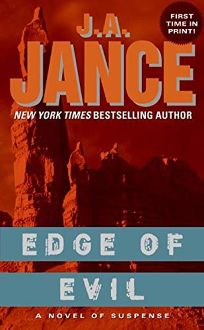
The Edge of Evil

I have recently read several of J.A. Jance's "Ali Reynolds" series (see Man Overboard and Clawback), so I decided to go back and read the 1st one. Jance is a fine writer and so I don't need to repeat that she creates believable characters, a decent sense of place, and tight story lines. Ali Reynolds is a co-anchor on the evening news (6 and 11 pm) for a TV station in Los Angeles. After her show one evening, the new guy brought in to bolster ratings tells her she is being let go, and inadvertently admits that it's because she is considered too old to appeal to a younger audience. This in spite of the fact that the male newscasters are decades older than Ali's 40+ years. Her husband, Peter, is an executive at the station, and it turns out that he and just about everybody else knew that Ali was going to be fired before she did and said nothing to her. She is determined not to take this obvious case of age discrimination lying down.
When she learns that her best friend from high school, Reenie, is missing and that she has been diagnosed with ALS. Ali decides this is a good time to go back to Sedona, Arizona, where her parents have run the Sugarloaf Cafe for years, and support Ali's family while she also gets her own life sorted out. She hires an attorney to pursue the age discrimination case and her college age son, Chris, decides to drive with her to Sedona while he is between terms at UCLA. Chris also sets up a blog for Ali called "cutlooseblog." Ali is initially surprised and then gratified to find out how many people start following her story of being let go from the TV station. As Ali investigates Reenie's disappearance, she also digs into understanding more about the disease of ALS and that becomes a thread on her blog as well. When Reenie's car and body are discovered over a cliff on a nearby mountainous road, many believe she committed suicide rather than face the slow and painful death of ALS. Ali is convinced her friend would never leave her children before she had to and determines to find out more about Reenie's last hours. In the meantime, she discovers her husband has been having affairs and now Ali's decided to end the loveless relationship. Her blog brings her to the attention of some abused women and then, unfortunately, to the attention of their abusers, who threaten Ali with physical harm. There is a lot more going on, but just go read the book and get the whole intriguing story for yourself. Publishers Weekly was not particularly impressed with the book and called it "predictable" but I still liked it.

Tuesday, March 6, 2018

The Strange Case of the Alchemist's Daughter

New author to me, but Dr. Theodora Goss, a professor in the Writing Program at Boston University, is apparently a prolific and award winning author of novels, essays and poetry, primarily in the myth and fantasy arena. This outing builds upon several characters from Victorian era literature: Dr. Jekyll and Mr. Hyde, Sherlock Holmes and Dr. Watson, Dr. Moreau, Dr. Frankenstein. Mary Jekyll is left penniless after her father has died (she believes) and her mother has gone mad. Looking through her father's papers and trying to sort out her mother's finances lead Mary to believe that Mr. Hyde (who she believes was a colleague of her father's) is still alive.  Years ago, there was a hefty reward for finding him in relation to a murder he committed, and that money could solve a lot of problems for Mary. Tracking down a monthly donation her mother was making for the support of the daughter of Mr. Hyde, what she finds is an unruly child, Diana, who being housed at a nunnery, but is being thrown out because she is so disruptive.  The story is told by Catherine Moreau (daughter/ creation of Dr. Moreau) with interjections from all the primary female characters (Mary, Diana, Mrs. Poole, Beatrice Rappaccini, and Justine Frankenstein), as she writes  of the mystery that brought them all together. A secret society for alchemists apparently had members who wanted to move beyond the transformation of base metals into gold and explore biological transformation--from animal to human or from dead to alive. Frankenstein, Moreau, Rappaccini, and Mary's own father, among others, all belonged to this controversial group. And it turns out they were all involved in creating monsters. Now the monsters,  most of the main women characters in the story, have found each other and are trying to create a normal life for themselves. This society may also be connected to a series of murders in Whitehall, mostly prostitutes, and it may even be that the nunnery's director is somehow complicit. There is a mystery to be solved, and it is, but the door is clearly left open for further adventures of these women with extraordinary skills. It is an interesting idea to weave all these horror tales together into an alternative narrative. And certainly the occasional direct dialogue with the characters is an unusual device. I tend to agree with Kirkus, however, which found this distracting and also felt the characters were undeveloped. Perhaps in the sequel, which is slated to be released this year? The reviewer from NPR was more positive, concluding that "At its heart, Strange Case is a lively, late-Victorian adventure that celebrates, overhauls, and pokes gentle fun at the era's weird-fiction tradition. But it's also a sparkling, insightful conversation with the canon from which it sprang." Publishers Weekly also offered a positive evaluation.

Monday, March 5, 2018

Word by Word: The Secret Life of Dictionaries

Well who knew that reading about dictionaries could be so entertaining. This is an absolutely charming book--one that made me both think seriously about previously unconsidered issues and occasionally made me laugh out loud. Kory Stamper, a lexicographer with Merriam Webster, has revealed the sausage-making machinery of creating that taken-for-granted staple in most people's lives, a dictionary. I learned new words, of course, like "potamologist" (a specialist in potamology, i.e, the study of rivers) but more interestingly, I learned them in the course of her provocative ideas about language. She tells us, for example, to "Think of English as a river. It looks like one cohesive ribbon of water, but any potamologist will tell you that rivers are actually made up of many different currents--sometimes hundreds of them. The interesting thing about rivers is, alter one of those currents and you alter the whole river, from its ecosystem to its course. Each of the currents in the river English is a different kind of English: business jargon...academic English, youth slang...Each of these currents is doing its own thing, and each is an integral part of English." (p. 60). Then there are the interesting facts that you could throw out the next time you are at a loss for conversation. Did you know that "...S goes on for-fucking-ever. Exactly 11 percent of your dictionary is made of words that begin with S." (p.111) Or that, "The Collegiate Dictionary has, as of this writing, about 170,000 entries with about 230,000 definitions, give or take, to review." (p. 117). Writing a dictionary definition (or revising one) is a complicated process. "Every entry...goes through multiple editing passes. The definer starts the job, then it's passed to a copy editor who cleans up the definer's work, then to a bunch of specialty editor: cross-reference editors, who make sure the definer hasn't used any word in the entry that isn't entered in that dictionary; etymologists, to review or write the word history; dating editors, who research and add the dates of first written use; pronunciation editors, who handle all the pronunciations in the book. Then eventually it's back to a copy editor (usually a different one from the first round, just to be safe), who will make any additional changes to the entry that cross-reference turned up, then to the final reader, who is, as the name suggests, the last person who can make editorial changes to the entry, and then off to the proofreader (who ends up, again, being a different editor from the definer and the two previous copy editors)...." (pp. 117-118).
Stampers sense of humor is dry and so appropriate for the topic, to wit, "The goal of a dictionary is to tell people what words mean and show them how they are used in the most objective, dispassionate, and robotic way possible. People do not come to the dictionary for excitement and romance; that's what encyclopedias are for." (pp. 126-127)
Some people, even those who are not professional lexicographers, really care about what goes into a dictionary. They will write letters to the company and Merriam Webster makes sure they get a response. Sometimes it is to explain how and why dictionaries are made; sometimes to correct misinformation about dating the words; sometimes to clarify usage. One correspondent has consistently submitted questions for over 20 years! And then there are the fanatics who charge Merriam Webster with perversion and worse if they write a definition not to their liking. When the dictionary added a new "sub-sense" for gay marriage to the main definition for marriage,  it elicited a "shit storm" of truly unbelievable proportions (literally hundreds of vituperative emails). As the editor who originally responded to someone querying their decision to include gay marriage, Stamper was "invited to personally rot in hell no fewer than thirteen times. I was told to get a life, get a fucking life, to fuck off and die, and also to swallow shards of glass mixed in acid." (p. 248). This all comes down to, according to Stamper, the common misconception about the role of dictionaries. Lexicographers see dictionaries as a mirror to the culture, not as the shaper of culture. She acknowledges that dictionary publishers are themselves somewhat responsible for the misconception since their early marketing efforts often touted their role as "The Voice of Authority" regarding the English language.
Most of all, however, Stamper shares her sprachgefühl and her love of language. You will not only learn about the foibles of the English language, but also learn a lot about the history of the language. And you'll have an enjoyable time in the process. Highly recommended. A special "Thank you" to friend Joan Starr for insisting I read this book.
Lots of great reviews: Publishers Weekly, The Atlantic, Kirkus. There is a great interview with Stamper and an overview of the book, complete with some cool photos, at the New York Times. And if you just can't get enough of Kory Stamper's wry wit, check out her blog: Harml-ess Drudg-ery
Sunday, February 25, 2018

Man Overboard

This is the next in the "Ali Reynolds" series from J.A. Jance, following Clawback, which I recently read and posted about. Once again, I found the plot engrossing.
The story opens with computer whiz Roger McGeary on a cruise in a deluxe suite, comped by the cruise lines in appreciation for Roger finding and fixing some near-fatal flaws in their online reservation system. Roger has finally made a successful life for himself after years of struggle with debilitating depression, precipitated by his father's suicide and his mother's subsequent emotional abuse. He is having a great time on the cruise thanks to a trio of older women who have adopted him as their partying companion. The only problem is that someone has been texting him with information that could only have come from his sessions with his former therapist. They are messages repeating the destructive abuse his mother used to heap on him and it is driving him back into that dark place where he feels he doesn't want to live. And when the next message arrives, he is alone and has had too much to drink, and he follows through, throwing himself overboard.
High Noon Enterprises gets involved when Roger's Aunt Julia comes seeking Roger's best friend, Stu Ramey, asking him to figure out what happened. She cannot believe Roger killed himself. When Ali sees how upset Stuart is at the death of his oldest and only friend, she and B. agree to help Julia and Stu find out what happened. After initially getting stone-walled by the Panamanian owned cruise line and the Panamanian detective who quickly closed the case as "death by misadventure" they send Cami to take a cruise on the same ship in hopes that she can shake something loose from the crew. Stu meantime begins digging into Roger's computer and his life, looking for clues.
The parallel story line comes from Owen Hansen, who father also committed suicide when he was a boy. He is also a computer genius but has turned his talents to the dark side, choosing to find other children of parental suicide and push them over the edge using illegally obtained software and an Artificial Intelligence program he created, called Frigg, as in the mythical companion to the Norse god Odin, the online identity of Owen. Frigg is the one that identified Dr. Cannon, a psychiatrist specializing in helping children of suicidal parents, and broken into her confidential patient files. Roger, it turns out, was the 2nd victim, and now Odin has his sights set on a 3rd. When Stu and Ali begin to figure out what's going on and manage to thwart Odin's 3rd murder by proxy, he turns his malice and his AI against them. But Frigg is developing some ideas of her own...harkening back to Heinlein's Rules of Robotics. It's a tantalizing premise and very timely given the rapid advancements in AI technology. Review from Kirkus available here. Additional reviews from Publishers Weekly and Strand Magazine.

Saturday, February 17, 2018

Clawback

This is the 11th novel in J.A. Jance's "Ali Reynolds" series. When I lived in Seattle, I was an ardent consumer of her J.P. Beaumont books, which were largely set in Seattle,  but I sort of fell away from reading when she moved her base to Arizona with the Joanna Brady series.
Ali Reynolds is a former Los Angeles TV newscaster who was let go and replaced with a younger-faced woman. Coincidentally, she discovered her husband was cheating on her. Leaving LA, she returned home to Sedona, Arizona, where her parents ran the Sugarloaf Cafe, and became a blogger. By the time of this book, she has become a consultant to the Sedona police department and she is married to an old flame, B. Simpson, owner of a high-tech/ computer security firm, High Noon Enterprises, and her parents have sold the diner and retired. When the news breaks that the company where her parents invested all their savings has gone bankrupt, Ali's dad decides to go the house of his long-time friend and financial advisor and confront him. Instead, he finds the man and his wife dying from multiple stab wounds. When he calls 911 and then tries to help them, he is arrested for their murders. Now Ali is determined not only to clear her father of the murder charges but to track down the mastermind of the Ponzi scheme and get some of their money back. Fortunately she has the substantial resources--human and technological-- of her husband's firm to bring to bear on the hunt. Ali and company are blind-sided by the identity of the real killer, who will stop at nothing to get away.
Not a best-seller but an engrossing read, and I think I will go back and start at the beginning! Of course, having gone to Sedona last fall for the first time will make it even more fun to read this series.

Wednesday, February 14, 2018

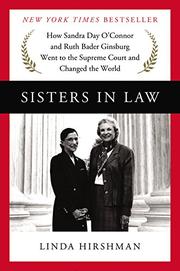
Sisters in Law: How Sandra Day O'Connor and Ruth Bader Ginsburg Went to the Supreme Court and Changed the World

This book by lawyer Linda Hirshman gives an inside look at the workings of the Supreme Court--like sausage, you my not like what you find--along with her  biographies of the legal careers of Sandra Day O'Connor (SOC) and Ruth Bader Ginsburg (RBG). They were both remarkable women but so very different in their approach to their legal careers and their adjudications. O'Connor could not get a job with a law firm after she graduated from law school--they offered her a position in the stenographers' pool--so she pursued politics as a Republican and eventually became majority leader in the Arizona state legislature. RBG was asked when she entered Harvard Law School why she was taking a place that could have gone to a man. Once graduated, she pursued an academic career becoming a professor at Columbia when Harvard would not have her. Whereas SOC was president of her local Junior League and actively supported Republican candidates, including Barry Goldwater, RBG went to work for the ACLU.
Being the first woman on the court (FWOTSC), O'Connor brought a woman's perspective, if not a liberal one to discussions and decisions. She was very canny in finding a path forward that would elicit the least resistance from the otherwise all male body. She often utilized the "concurrence"--agreeing with the majority opinion and writing a separate comment--to make conservative decisions more liberal and liberal opinions more conservative according to Hirshman. She was the consummate pragmatist.
Ginsburg is, as described by one of her clerks, a "cause lawyer;" that is, she looks at the long picture, both history and future and strategically chooses and works cases to build a foundation toward her goal of justice for all. Although she has been consistently pro-women's rights, she has also consistently been pro-rights for anyone at a disadvantage when up against larger forces.
This is a fascinating book, although at times a bit hard to wade through. Totally worth the read. Much more detailed review of the book from The NYT, a brief review from Kirkus, and an interview with the book's author by NPR's Nina Totenberg.

Tuesday, February 6, 2018

The Necessary Death of Lewis Winter

This is the first installment in Malcolm Mackay's "Glasgow Trilogy" which centers on the criminal underworld of that Scottish city. Library Journal refers to this book as an example of the increasingly popular body of Scottish crime literature known as "tartan noir."  Our protagonist, Calum MacLean, is a 29-year old loner who kills people for money. He doesn't want the "security" of working for one of the crime syndicates--he's strictly freelance. But his mentor, who works for the up and coming Peter Jamieson organization, is aging and recently had surgery, so Calum is tapped to do a job taking out someone who has been encroaching on Jamieson's territory, namely Lewis Winter. Seems a simple enough job, but what his new employer fails to tell Calum is that Winter is being backed by a group that wants to challenge Jamieson for territory and business and that this group will take the death of Winter as a challenge that cannot go unanswered. And so the hitman becomes the target. Add to this mix the wily, beautiful, but aging live-in girlfriend of Winter, the corrupt cops in the pockets of the various syndicates, and the lives-for-his-job detective charged with solving the murder of Winter and you have a colorful yet totally believable cast of characters living out their gritty lives in a city with a dark underbelly. I would definitely read the sequels: How a Gunman Says Goodbye, and The Sudden Arrival of Violence. More detail in the reviews from The Guardian, Publishers Weekly. More about Mackay in this interview in The Independent.

Friday, February 2, 2018

Celine

I really liked this novel by Peter Heller, although the review sources are not as infatuated. I recognize its faults and yet still thoroughly enjoyed the trip. The characters, gradually revealed through both their own actions and reflections, and those of the people around them, are complex and intriguing. The settings are so richly drawn that you feel like you are there. Celine has been dubbed "The Prada PI" in an article in her alumni magazine because she comes from "old money" and that is how her new client, Gabriela, finds her. Celine specializes in finding lost family members, not just a professional job for her but one that carries deep personal meaning. At the age of 68, and struggling with emphysema from years of smoking, she nevertheless feels compelled to take on the case of this young woman who lost her mother to a freak accident when very young and then lost her father to grief over his wife's death. He supposedly died in a bear attack almost 2 decades ago, but Gabriela remains unconvinced. And as Celine and her husband Pete begin to investigate, it quickly becomes apparent that somebody very much does not want them to find the missing/ dead father. Set initially in New York City and then in the beautiful country of Wyoming and Colorado during the fall, you will feel the crisp air and immerse yourself in the brilliant foliage and dark forests. Celine will continually surprise you and, in fact, you will not come to know her full story in this book. If you can suspend your disbelief and immerse yourself, NPR suggests, you will "understand that Celine is also such a joy to be with...like stumbling across the sweetest, most dazzling grandma EVER at the corner bar, and then finding out three hours later that she was also a shooter for Mickey Cohen's mob." But the outcome is very satisfying and the clever plot will keep you engrossed to the very end.
Reviews provide more detail: NPR, Kirkus, Publishers Weekly, NYT.

Sleep No More

One of my all-time-favorite mystery writers is P.D. James. This is one of 2 collections of short-stories published posthumously that I recently checked out from the library. The other is The Mistletoe Murder and Other Stories. James wrote  21 books and I think I have read almost all of the fiction entries. I don't find the short stores as satisfying, although they are certainly clever and often surprising. Nobody gets away scott-free--or do they? The advantage, of course, is not getting drawn into a longer work that keeps me from going to sleep at night!
The Washington Post provides synopses of the 6 short stories in this volume and says of the collection, "James was never much interested in ax-murderers or serial killers; she preferred to examine respectable citizens who turn to crime. The stories collected here are variously surprising, sardonic and darkly humorous, and are always intelligent and beautifully written."

Saturday, January 13, 2018

The Sympathizer

This first novel from USC professor Viet Thanh Nguyen won the Pulitzer for fiction in 2016 (among several other awards) and was the January reading selection for my book group. It is one I would probably never have finished on my own but feel it was well worth reading. It was slow to get started for me, but once I got past the first 100 pages, I was hooked.
The story deals with the fall of Saigon and the aftermath for several S. Vietnamese refugees, mostly members of the military or police who worked with U.S. military and CIA. The protagonist is a bastard, born to a teenage Vietnamese mother and a French priest father. As a result he is never accepted by the Vietnamese people and so is perhaps ripe for conversion to the Communist cause. He meets his two lifelong friends in high school, Man, who later becomes his handler, and Bon, a S. Vietnamese who works for the CIA. The Protagonist is known only as the Captain and many characters are also identified only by their role. In his public role, the Captain has served as the personal assistant to the General, who is head of the National Police, for years when Saigon falls. The Captain, the General, and Bon are among those on the last plane to get out of Saigon, arranged by Claude, their CIA contact. The description of the fall of the city to the N. Vietnamese communists is heartbreaking for it is a lethal betrayal of thousands of S. Vietnamese by the United States. Bon's wife and son are killed in the last few moments and the Captain has to literally drag him onto the plane. They are sent to refugee camps and finally settled in southern California in menial jobs.
But the large refugee community, outsiders in their new homes, never give up on returning to Vietnam, and the Captain is charged by Man to monitor any efforts to mount a resistance effort. The General continues to work with Claude and a sympathetic congressman to put together funds and re-train a group of soldiers who will go back and re-ignite the fight. Bon will be among the group that returns to Cambodia to organize other Vietnamese and take the fight to the communists. Although Man strongly warns the Captain about being among those who return, his advice is ignored for the Captain feels he must somehow protect Bon on this suicidal mission, and the final few chapters deal with the consequences. Yet another betrayal is underway, for the communists are not liberating their countrymen but killing them.
The author was born in Vietnam and raised in the United States. He was immersed in a refugee community that told and re-told their stories, so this is a unique perspective on that war. It was an eye-opener and a heart-breaker of a book. It is important to have this perspective because what we were told about the war was so much propaganda. As the Captain points out, "They [the Americans] owned the means of production, and therefore the means of representation, and the best that we could ever hope for was to get a word in edgewise before our anonymous deaths."
More detailed reviews are available here: The New York Times, The Guardian, Kirkus.
And an interview with the author by Terry Gross (NPR's "Fresh Air" program) is here: NPR