This novel in the "Jack Reacher" series by Lee Child is predictable, but also predictably satisfying as are the other Reacher books I have read. Reacher has been carrying on lengthy phone conversations with the current commander of the 110th MP, the unit he used to command. Her name is Susan Turner and, for no other reason than because he likes her voice, he has traveled back to DC to ask her to dinner. And because Reacher lives his life the way he does, with no more baggage than a folding toothbrush, he can do just that. But someone is expecting Reacher and has some surprises in store for him, including a paternity suit from a woman he claims not to know, and a wrongful death suit--validated only by affadavit--regarding a man Reacher says he never laid a hand on. To top it off, Major Turner has been incarcerated on bribery charges that very day. Reacher gets "called up" by the acting commander, essentially re-enlisted, and then arrested and imprisoned. Even before that, however, tough guys were sent to Reacher's motel room to try and scare him into leaving town. And we all know Reacher never walks away from a fight. And now he figures that all these trumped up charges have something to do with him coming back to see Turner. So he finds a way to break them both out of prison so they can figure out what the hell is going on that is so important, and who is pulling the strings at such a high level. For the pursuers seem to know their every move mere minutes after they make them in spite of their best efforts to cover their tracks. They head to California to find out if Reacher really has a daughter he didn't know about, with the DC metro police, the FBI and the secret enemies all in pursuit. Of course he will best the bad buys, solve the mystery, and walk away without the girl. That's what Reacher does, and you'll be rooting for him all the way.
Keeping track of what I read by jotting down my reactions, providing information about the author, and linking to additional reviews. And occasional notes on other book related things...
Monday, July 14, 2014
Friday, July 11, 2014
Silent Night
Apparently when he died in 2010, Robert Parker had begun the manuscript for this Spenser novel set at Christmas time. His literary agent of several decades, who also become the executor of his literary estate, undertook to finish it. The premise is that an 11 year old boy comes to Spenser's office to seek his help for the man running a home for street kids. When Spenser investigates further, he find that Jackie Alvarez has an unlicensed home, Street Business, that takes kids off the street and gets them started with minimum wage jobs. Someone has been roughing up the kids and stealing their money. Alvarez wants Spenser to help find who is responsible and put a stop to it. Perfect sort of case for our literate do-gooder private eye and gourmet cook. Christmas is coming and Spenser is trying to plan the menu in-between investigating. Turns out the problems is Jackie's older brother, Juan Alvarez, big-time Boston philanthropist and successful business man, who has also been providing the money to keep Street Business running. The tricky part is figuring out why Alvarez wants to shut down Street Business, and catch him in the act, without jeopardizing the home and the kids who have taken sanctuary there. Hawk, Susan, Pearl, and even Rita Fiori all make a showing. I don't think the dialogue between Spenser and Hawk is quite as sharp, but the element that ties this particular piece of pro-bono work to Hawk's past is somewhat intriguing. Kirkus did not give this a glowing review, nor did Publishers Weekly. Strictly for Parker/ Spenser die-hards; otherwise, you will get more joy from the earlier Spenser novels.
All the Light We Cannot See
This brand new novel by Anthony Doerr is set in the run-up to and through WWII, and told through the viewpoints of two main characters. Marie Laure went fully blind at age 6 and lives with her father, who is the key master at the Museum of Natural History in Paris. As the Germans approach Paris, Marie-Laure's father is entrusted by the museum with a rare diamond to keep it hidden; Marie-Laure and her father head east and eventually arrive to stay with her great uncle, Etienne, on the isle of Saint-Malo. Her father is not only a skilled locksmith, but also a maker of exquisite small models. He built one for Marie-Laure of their entire Paris neighborhood so she could learn her way around. He is building her one for the town of Saint-Malo when he is betrayed by a collaborator for "taking measurements" of buildings. Interned in a German prison camp, he is never seen again. Etienne has suffered what was then called "shell shock" from his experience in the Great War, and has not left his house (and often his room) for several decades. He is cared for by a housekeeper, who gets fed up and joins the resistance. She persuades Etienne to use a hidden radio transmitter in the attic of their house to transmit logistical coordinates. When the old woman dies of pneumonia, Marie-Laure and Etienne take over the task of picking up the information in a loaf of bread and transmitting the valuable data.
Our other main story teller is Werner Pfennig, who, with his younger sister Jutta, is raised by an French nun in an orphanage in a mining town in Germany. Their father was killed in the mines and Werner expects the same fate to befall him unless he can escape. He finds old radio parts in the trash and is able to receive transmissions of science talks for kids before they are cut off by the war. It turns out that the broadcasts were recordings made by Etienne's brother. Werner becomes the local radio repair wizard and at age 12 is sent to a school for German boys to be trained as an electronics engineer. He eventually helps develop equipment that can be used to locate the transmissions of resistance groups and is sent out with a small group of German soldiers to locate these radios and kill the people operating them. Near the end of the war, he gets sent to Saint-Malo and his path crosses that of Marie-Laure, but he cannot bring himself to betray her.
This is a story rich in character, setting, and emotion. It is often bleak, although not hopeless. Excellent historical fiction and a thoroughly engrossing read. Rave reviews and more detailed summaries from the NYT, The Guardian, and The Washington Post.
Sunday, June 29, 2014
The Burning
Wednesday, June 18, 2014
Iron Lake
This novel, set in the cold lake country of northern Minnesota is the first of a series by William Kent Krueger that feature ex-sheriff Corcoran ("Cork") O'Connor. Cork is part Irish and part Anishinaabe Indian, which makes residents of the small town of Aurora and the Reservation not entirely sure whose side he is on. When the extremely powerful local ex-judge and major wheeler dealer Robert Parrant apparently takes his own life, Cork is suspicious of the verdict and decides to investigate for himself. He is warned by a local medicine man that the Windigo, a powerful and malevolent spirit, has called the names of local townspeople; Cork is concerned because he is one of those whose name is on the wind. People start dying and Cork is attacked, his home invaded. He is already struggling with a load of guilt about the disintegration of his marriage and his subsequent involvement with a local woman who has an unsavory reputation, Molly Nurmi. Cork breaks it off with Molly and asks his estranged wife to work toward reconciliation but she is adamant about a divorce. Contacted by a blackmailer, Cork soon learns that his wife was already involved with the newly elected Senator, Sandy Parrant, son of the dead judge. As Cork digs deeper into the deaths, which the new sheriff is tidily explaining away as a case of corruption at the Indian casino, the number of people involved and the crimes concealed get more serious. This is a book with great local color, a bit of Native American lore, and a complex main character. Not an entirely happy ending, although the bad guys mostly get their due. Definitely worth a read and I may pursue some of the subsequent installments. Here is a review from Kirkus.
2025--10 years after the first reading, I read it again and enjoyed it as much as the first time. It held up well. This time I am committed to finding and reading some of the sequels!
Sunday, June 15, 2014
The Unlikely Pilgrimage of Harold Fry
Saturday, June 14, 2014
The Storied Life of A.J. Fikry
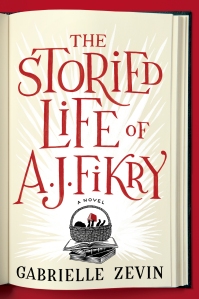
Update 1/30/2016: I re-read this book for my upcoming book group and was again just transported by the sheer tenderness of the story. This quote, something A.J. is trying to explain to Maya at the end of the book, just knocked me over. "Maya, we are what we love. We are that we love...We aren't the things we collect, acquire, read. We are, for as long as we are here, only love. The things we loved. The people we loved. And these, I think these really do live on." I loved all the characters ( does that count?)--except maybe Ismay and Daniel Parish. Daniel Parish is a shitheel and Ismay goes around hurting other people because she is so unhappy. But everyone else, I feel such an attachment to that I hated for the book to end. I wonder if there's a sequel? What surprised me on this second go around was what I had NOT remembered from my initial reading. A.J. is black and Maya is half black. In some ways this seems insignificant, but in some ways, as I re-read it, the town's behavior toward A.J. feels a bit changed by this new awareness on my part. I really must read some other books by this author.
This New York Times bestseller by Gabrielle Zevin is such a charming little novel that I would recommend it unreservedly. A.J.'s beloved wife Nicole has died in an automobile accident; he is slowly withdrawing from the world and drinking himself into a stupor at least once a week so that he can dream about her. The bookstore that he and Nic owned on Alice Island carries mostly literary fiction and caters largely to the summer crowds of tourists that come to vacation there. A.J. owns a rare collector's item--a copy of Tamerlane by Edgar Allen Poe that he found at an estate sale--which is valued at about half a million dollars. When he wakes from one of his drunken evenings, he finds the book gone. He had counted on selling the book to buy his way out if he could no longer bear to run the bookstore and now he feels trapped in this place full of painful memories. One day A.J. returns to the bookstore and discovers that someone has left a toddler in the children's section with a note asking him to care for her. Her name is Maya. Several days later, Maya's mother washes up on the shore--an apparent suicide. For some reason, although he has not the money or the temperament, A.J. cannot part with the little girl and becomes her adoptive father. Eventually A.J. remarries, to Amelia, the book rep from a small press. The chief of police, Lambiase, who met A.J. when delivering the news of Nicole's death, becomes his good friend and an avid reader. Initially Lambiase reads whatever A.J. recommends, just as a way to stay connected to A.J. and Maya, but ultimately because he comes to love reading. He even starts his own book group--Chief's Choice--which is hosted at the bookstore. A.J.'s sister-in-law, Ismay (Nicole's sister), also lives on the Island and works as an English teacher. She is married to a published author, Daniel Parish, who has been unfaithful since the day they wed. Ismay knows that Maya is Daniel's illegitimate daughter, but never told A.J. or Maya, AND Ismay is the one who stole Tamerlane. I won't say the relationships are as wonderfully rendered and rich as those in Crossing to Safety by Wallace Stegner--one of my all-time favorite books--but they are darn close. And this book is not all happiness and light, but it is touching and affirming and a most enjoyable read. There is a much better synopsis of the book on Zevin's own page. If you love books and reading as much as I do, you will fall for this book.
Thursday, June 5, 2014
Wild Inferno
Wild Penance
Tuesday, June 3, 2014
Wild Sorrow
Subscribe to:
Posts (Atom)


