Friday, July 11, 2014

All the Light We Cannot See

This brand new novel by Anthony Doerr is set in the run-up to and through WWII, and told through the viewpoints of two main characters. Marie Laure went fully blind at age 6 and lives with her father, who is the key master at the Museum of Natural History in Paris. As the Germans approach Paris, Marie-Laure's father is entrusted by the museum with a rare diamond to keep it hidden; Marie-Laure and her father head east and eventually arrive to stay with her great uncle, Etienne, on the isle of Saint-Malo. Her father is not only a skilled locksmith, but also a maker of exquisite small models. He built one for Marie-Laure of their entire Paris neighborhood so she could learn her way around. He is building her one for the town of Saint-Malo when he is betrayed by a collaborator for "taking measurements" of buildings.  Interned in a German prison camp, he is never seen again. Etienne has suffered what was then called "shell shock" from his experience in the Great War, and has not left his house (and often his room) for several decades. He is cared for by a housekeeper, who gets fed up and joins the resistance. She persuades Etienne to use a hidden radio transmitter in the attic of their house to transmit logistical coordinates. When the old woman dies of pneumonia, Marie-Laure and Etienne take over the task of picking up the information in a loaf of bread and transmitting the valuable data.
Our other main story teller is Werner Pfennig, who, with his younger sister Jutta, is raised by an French nun in an orphanage in a mining town in Germany. Their father was killed in the mines and Werner expects the same fate to befall him unless he can escape. He finds old radio parts in the trash and is able to receive transmissions of science talks for kids before they are cut off by the war. It turns out that the broadcasts were recordings made by Etienne's brother. Werner becomes the local radio repair wizard and at age 12 is sent to a school for German boys to be trained as an electronics engineer. He eventually helps develop equipment that can be used to locate the transmissions of resistance groups and is sent out with a small group of German soldiers to locate these radios and kill the people operating them. Near the end of the war, he gets sent to Saint-Malo and his path crosses that of Marie-Laure, but he cannot bring himself to betray her.
This is a story rich in character, setting, and emotion. It is often bleak, although not hopeless. Excellent historical fiction and a thoroughly engrossing read. Rave reviews and more detailed summaries from the NYT, The Guardian, and The Washington Post.

Sunday, June 29, 2014

The Burning

New author for me but this was such a good, twisty procedural that I may seek out more by Jane Casey, as this is the first in a series with DC Maeve Kerrigan of the London Police Force major crimes unit as the protagonist. Kerrigan is of Irish heritage and, as such, continually suspect among her British colleagues, to say nothing of being a woman in a highly male and sexist job environment. In this debut novel, Maeve is finding that her well-to-do boyfriend and flat mate, Ian, seems more and more like he is from a foreign planet rather than just a higher social strata. He, in turn, has run out of patience with Maeve's determined focus on her job at the expense of everything else.  The case that drags her out of bed as the story opens is a serial killer who beats his young female victims to death and then sets them on fire. This time, however, Maeve thinks there is something off about the murder, like maybe some copycat just wants the police to think it is the serial killer. Maeve has trouble convincing her immediate superior, but the head of the task force is also not so sure about this and sets Maeve the task of finding out more about the woman. Maeve digs in but does not want to lose her toe hold on the serial killer task force. She gets more than she bargained for when an undercover sting puts her directly in the path of the killer and she is almost killed. Although Maeve thinks of herself as a failure in the appearance department--hair always awry, clothes never quite right--she is beginning to notice more than professional interest from her fellow DC on the task force, Rob Langton. If you like police procedurals, this one is really well wrought with a feminist twist and the added attraction of being set in England. Reviews from Kirkus and Publishers Weekly.

Wednesday, June 18, 2014

Iron Lake

This novel, set in the cold lake country of northern Minnesota is the first of a series by William Kent Krueger that feature ex-sheriff Corcoran ("Cork") O'Connor. Cork is part Irish and part Anishinaabe Indian, which makes residents of the small town of Aurora and the Reservation not entirely sure whose side he is on. When the extremely powerful local ex-judge and major wheeler dealer Robert Parrant apparently takes his own life, Cork is suspicious of the verdict and decides to investigate for himself. He is warned by a local medicine man that the Windigo, a powerful and malevolent spirit, has called the names of local townspeople; Cork is concerned because he is one of those whose name is on the wind. People start dying and Cork is attacked, his home invaded. He is already struggling with a load of guilt about the disintegration of his marriage and his subsequent involvement with a local woman who has an unsavory reputation, Molly Nurmi. Cork breaks it off with Molly and asks his estranged wife to work toward reconciliation but she is adamant about a divorce. Contacted by a blackmailer, Cork soon learns that his wife was already involved with the  newly elected Senator, Sandy Parrant, son of the dead judge. As Cork digs deeper into the deaths, which the new sheriff is tidily explaining away as a case of corruption at the Indian casino, the number of people involved and the crimes concealed get more serious. This is a book with great local color, a bit of Native American lore, and a complex main character. Not an entirely happy ending, although the bad guys mostly get their due. Definitely worth a read and I may pursue some of the subsequent installments. Here is a review from Kirkus.
 
2025--10 years after the first reading, I read it again and enjoyed it as much as the first time. It held up well. This time I am committed to finding and reading some of the sequels! 

Sunday, June 15, 2014

The Unlikely Pilgrimage of Harold Fry

This novel by BBC playwright Rachel Joyce has certainly received a lot of positive press (The Guardian, NYT), but for me the compelling reason to read it was because my sister-in-law and I have been sharing more introspectively fueled thoughts of late and have labelled these conversations our "pilgrimage." The storyline is that one day Harold Fry receives a letter from a former co-worker, Queenie Hennessy, telling him that she is dying of cancer and wanted to say good-bye. Harold is overwhelmed, then jots a note, addresses it, and heads out the door to post it back to her. On his way to the mailbox, he starts to think about what an inadequate response this is to someone who had meant a lot to him, so he keeps walking and thinking and at some point decides he is going to walk from his home in the southwest corner of England to the hospice where Queenie currently reside in the northwest corner of the country--something over 500 miles. It is a roller coaster of a walk in so many ways. He is inspired by the stories of those he meets and alternately weighed down by them. He accumulates and then discards belongings. He is roiled with memories of the deterioration of his marriage, his failures as a husband, father and friend. People are, in turn, kind to him, inspired by him, and even dismissive of him. His walk becomes national news. He learns that his postcards to Queenie are indeed giving her a reason to hold on and continue living. Meanwhile, his estranged wife Maureen is having her own epiphanies about responsibility, blame and destroying the love of her life. Hang in there with Harold, Maureen and Queenie for a thought-provoking and ultimately rewarding journey.

Saturday, June 14, 2014

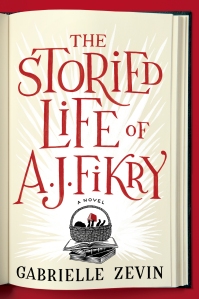
The Storied Life of A.J. Fikry

Update 1/30/2016: I re-read this book for my upcoming book group and was again just transported by the sheer tenderness of the story. This quote, something A.J. is trying to explain to Maya at the end of the book, just knocked me over. "Maya, we are what we love. We are that we love...We aren't the things we collect, acquire, read. We are, for as long as we are here, only love. The things we loved. The people we loved. And these, I think these really do live on." I loved all the characters ( does that count?)--except maybe Ismay and Daniel Parish. Daniel Parish is a shitheel and Ismay goes around hurting other people because she is so unhappy.  But everyone else, I feel such an attachment to that I hated for the book to end. I wonder if there's a sequel? What surprised me on this second go around was what I had NOT remembered from my initial reading. A.J. is black and Maya is half black. In some ways this seems insignificant, but in some ways, as I re-read it, the town's behavior toward A.J. feels a bit changed by this new awareness on my part. I really must read some other books by this author.

This New York Times bestseller by Gabrielle Zevin is such a charming little novel that I would recommend it unreservedly. A.J.'s beloved wife Nicole has died in an automobile accident; he is slowly withdrawing from the world and drinking himself into a stupor at least once a week so that he can dream about her. The bookstore that he and Nic owned on Alice Island carries mostly literary fiction and caters largely to the summer crowds of tourists that come to vacation there. A.J. owns a rare collector's item--a copy of Tamerlane by Edgar Allen Poe that he found at an estate sale--which is valued at about half a million dollars. When he wakes from one of his drunken evenings, he finds the book gone. He had counted on selling the book to buy his way out if he could no longer bear to run the bookstore and now he feels trapped in this place full of painful memories. One day A.J. returns to the bookstore and discovers that someone has left a toddler in the children's section with a note asking him to care for her. Her name is Maya. Several days later, Maya's mother washes up on the shore--an apparent suicide. For some reason, although he has not the money or the temperament, A.J. cannot part with the little girl and becomes her adoptive father. Eventually A.J. remarries, to Amelia, the book rep from a small press. The chief of police, Lambiase, who met A.J. when delivering the news of Nicole's death, becomes his good friend and an avid reader. Initially Lambiase reads whatever A.J. recommends, just as a way to stay connected to A.J. and Maya, but ultimately because he comes to love reading. He even starts his own book group--Chief's Choice--which is hosted at the bookstore. A.J.'s sister-in-law, Ismay (Nicole's sister), also lives on the Island and works as an English teacher. She is married to a published author, Daniel Parish, who has been unfaithful since the day they wed. Ismay knows that Maya is Daniel's illegitimate daughter, but never told A.J. or Maya, AND Ismay is the one who stole Tamerlane. I won't say the relationships are as wonderfully rendered and rich as those in Crossing to Safety by Wallace Stegner--one of my all-time favorite books--but they are darn close. And this book is not all happiness and light, but it is touching and affirming and a most enjoyable read. There is a much better synopsis of the book on Zevin's own page. If you love books and reading as much as I do, you will fall for this book.

Thursday, June 5, 2014

Wild Inferno

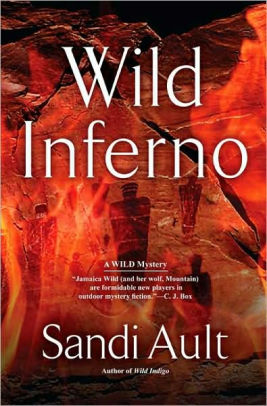
Boy am I getting absent minded--Yikes! I read this a few weeks ago and was absolutely SURE I had written a post, but apparently not. This is the 2nd in the "Jamaica Wild" series by Sandi Ault (the first being Wild Indigo) and I like them so well that I have now finished all 4 books (see also posts for Wild Sorrow and Wild Penance). Representing the BLM, Jamaica is working as liaison to the tribes who have come to Chimney rock, an ancient Native American ruin, to celebrate the astronomical event know as the "Standing Moon"--which occurs only every 18 years. Unfortunately there is a wildfire rapidly approaching the site. Challenging terrain and limited resources are hampering fire control efforts,  making it appear that the Indians may have to be evacuated over their vehement protests. Among the participants are Mama Anna, Jamaica's medicine teacher from the Tanoah Pueblo, who was looking after and has brought along Jamaica's adopted wolf, Mountain.  When Jamaica goes into the fire area to look for a missing man, she finds instead one of the "Hot Shot" firefighters who whispers with his dying breath, "Save the grandmother." The missing man is later found in the burned over area, dead not from the fire but from a blow to the head. Did the firefighter, whose compatriots were also caught in the burnover, kill him? At first, someone breaking into her tent and backpack seems like random but unusual vandalism. When the brake lines on her jeep are cut, however, it is clear that someone is out to stop her investigating further. Another action packed book, rich with detail about southwest Native Americans and the beautiful country of New Mexico and Colorado. Highly recommended.

Wild Penance

Vivid and well-develped character in protagonist Jamaica Wild, a BLM resources protection agent who would just as soon go to work on horseback as her jeep. And in this book, which is actually a prequel to the previous 3 books in author Sandi Ault's series, she gets to do just that.  She is assigned by her boss to partner with a Forest Service ranger--her future lover, Kerry Reed--to patrol an area that has been vandalized by thieves cutting wood illegally. She has to camp out and ride at night as that is obviously when the culprits cut fences and drive in to harvest. One morning, while running along the canyon rim, she sees a van on the bridge over the Rio Grande. It stops. Two persons wrestle something out of the back, carry it to the edge, and drop it several hundred feet to the river below. The object they threw off the bridge is a giant cross, and there is a man tied to it. The cross, the stripped victim wearing only a loin cloth, and the black bag over the victim's head all suggest this was done by the Penitentes, a controversial group of Catholics who believe in purification through physically damaging self-punishment. At Easter, they re-enact the Crucifixion, and one of their members takes the place of Christ on the cross. But they never throw them in the river, and this man, who turns out to be a priest who has been studying the Penitentes, was dead before he was tied to the cross. Serendipitously, Jamaica has also been studying this group as she has come across several of their sacred places in off-the-beaten-path locations on BLM land. As Jamaica pursues answers to who the victim was, and why he was killed, someone is trying to kill her. This book also introduces the curandera, Esperanza, who will figure prominently in many of the other books as a spiritual guide and healer for Jamaica. At the very end of the book, when Jamaica is on leave to recover from a wound to her shoulder, we find out how she comes to be the adoptive mother of Mountain, the wolf pup. Highly recommended series for character, plot, setting, and learning about the culture of Native Americans. See also my posts for Wild Indigo, Wild Inferno, and Wild Sorrow.

Tuesday, June 3, 2014

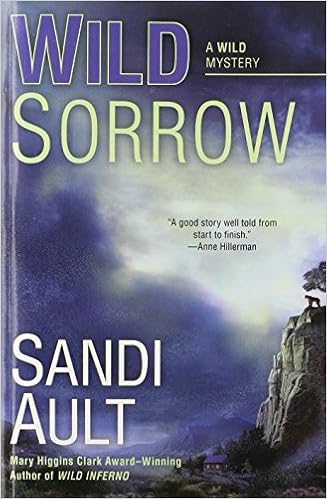
Wild Sorrow

While tracking a wounded mountain lion, a sudden snowstorm drives Jamaica Wild and her wolf, Mountain, into an abandoned ruin. There, she discovers a ritually tortured and murdered elderly woman. The blizzard forces Jamaica to spend the night in the same place; she does not get a wink of sleep, especially after the wounded cougar she had been tracking also decides to seek shelter there. Mountain drives the cat away, but Jamaica recognizes that the animal is starving, and Jamaica is also concerned about the two thin cubs left behind by the cougar in a makeshift den not far away. Now she has two serious problems on her hands--a murdered woman and a desperate mountain lion. Things go from bad to worse when there are some creative attempts on Jamaica's life. Someone starts a small rock slide intended to knock her off a ledge when she is investigating near the old ruin where the woman was found. And then she is kidnapped, beaten and nearly raped. Adding to her troubles, Jamaica learns indirectly that her lover, Kerry, has applied for a job in Washington state; he appears to be the likeliest person to get the position, and hasn't told her about it. Jamaica discovers that the dead woman was a cruel nun who routinely inflicted harsh emotional and physical punishments on the Indian children who were forced to attend the boarding school that is now the old ruin where the body was found. The suspects are many among the elders of the Tanoah Pueblo where Jamaica's medicine teacher lives, and this makes it difficult to investigate. Meanwhile, Jamaica's friend at the FBI, Diane, is having serious problems with her landlord--not repairing the broken front door, problems with the gas line to the stove--and at one point, the stove explodes with Diane and Jamaica in the kitchen, a near deadly event. But maybe the murder has nothing to do with the old boarding school at all. Diane and Jamaica team up to solve this one, but Jamaica will still have to come to terms with Kerry's departure--or accept his proposal to go with him. This is the third in the Jamaica Wild series by Sandi Ault and they are really good. I also have blog posts on the previous two books, Wild Indigo and Wild Inferno, and am deeply into the 4th, Wild Penance.

Thursday, May 29, 2014

Insurgent

I can't believe I forgot to write a blog post about this 2nd installment of Veronica Roth's Divergent trilogy. The second book holds up well and is full of shattering revelations. Four/Tobias learns that his mother is alive and leading an army of the "Factionless," who plan to take over the city in the wake of the Erudite's slaughter of the Abnegation faction. Tris is held for trial, convicted as a traitor, and scheduled for execution by the Erudite (still led by Jeanine). Her brother plays a major role in that process, as does Tris' arch-enemy, Peter.  A plot summary from Wikipedia is here. Read it and go see the movie, "Divergent."

Allegiant

This is the third, and final, installment in the Divergent trilogy from Veronica Roth. I wouldn't be surprised if the 2nd (Insurgent) and 3rd books are also made into movies as they are doing with the Hunger Games trilogy. But I can almost bet they will change the ending a bit.  When we left our heroes, Tris had revealed the video from Edith Prior telling the people of the city (a futuristic Chicago) that their society was, in fact, an experiment being run by people "out there," i.e., outside the protective fence which has been guarded for generations by the Dauntless faction. So Tris will be tried as a traitor, but able to withstand the truth serum as she has withstood the fear serum and the serum that at one point turned almost all members of Dauntless into a mindless army that nearly wiped out the Abnegation faction. A small group--from various factions-- believe the tyrannical imposition of a factionless society in the wake of the Factionless' takeover is not an improvement and plan to rebel. First and foremost, a small band will escape the city and seek to discover who is controlling the city. Tris, Four, the traitorous Caleb, and murderous Peter are among them that group. The society they discover, it turns out, has as many things wrong with it as the Faction system they just left behind, except this set of prejudices and limits is based on whether or not a person is "genetically pure" (GP) vs. "genetically damaged" (GD). A rebellion is brewing here as well, and Four is lured into helping when he finds out that he is not Divergent as he originally thought, but is GD with a few anomalous behaviors. Although it does not change Tris' view of or love for him, Four is devastated and ripe for manipulation by the disaffected GD's. When the geneticists in this compound decide that the Chicago "experiment" is teetering on the brink of self-destruction, they decide to "reset" the situation by erasing everyone's memory. Tris and her friends, many of whom have left family and friends behind in the city, can't let that happen.