
Wednesday, August 4, 2010
Undone


Two by Harlan Coben


Coben is a solid mystery writer with tricky plots and a regular cast of characters that reappear in many of his books. So it felt like a lucky find to run across one of his paperbacks in the trading library at the resort on Crete. The Woods revolves around a cold case involving 4 teenagers who disappeared into the area surrounding a co-ed summer camp and presumably all died. Except two of them were never found. One of the missing ones was the sister of our protagonist, Paul Copeland, who also happens to be the county prosecutor in Essex County, NJ . Old memories are stirred up when a murdered man with Paul's card in his pockets, is tentatively identified by Paul as the other missing teen from that night long ago. Does that mean his sister could also be alive? And did we mention that Paul had been one of the counselors in charge at the camp the night the murders and disappearances took place, and that he hasn't seen or heard from the girl he sneaked off with that night in all these years, until now?
Long Lost is one I listened to on our travels to and from Bend a couple weeks ago. Myron Bolitar, sports agent (and a regular fixture of many Coben novels) gets a 5 am wake-up call from a long-lost love, Teresa Collins, inviting him to Paris for a few fun filled days, “'Think about it,” she went on. “The City of Lights. We could make love all night long'...What’s wrong, Terese?'... 'Nothing’s wrong. I want to spend a romantic, sensual, fantasy-filled weekend with you in Paris.'Another swallow. 'I haven’t heard from you in, what, seven years?" But indeed something is very wrong. Her husband is missing and eventually turns up--dead. Events start to make it look like the daughter she thought died years ago in a car wreck might not be dead. But it's oh so much more complicated than this. It's all about a plot to grow terrorists who can go anywhere because they look just like...well, read it and find out.
”
The King Must Die

Thursday, July 22, 2010
The Skull Mantra

 My lovely sis-in-law had recommended this book and it was well worth the read. Written by Eliot Pattison, the story is set in Tibet after the Communists took over, a fairly uncommon setting for a mystery. We are introduced to the prisoners of a labor camp, mostly monks and other dissidents, but also a few Chinese communists who just didn't have the right brand of politics. Former inspector Shan Tao Yun apparently made the mistake of going after one too many corrupt officials and is now building roads under the worst physical conditions--cold, hunger, occasional torture, and ongoing physical and psychological brutality by the guards. But then the laborers discover the headless body of a well-dressed Chinese who turns out to be a high ranking official, and now the former inspector is brought out of forced retirement to unofficially investigate and write a quick report that will leave local officials in the clear. Much of the detail involves the practitioners and beliefs of Buddhism which make for fascinating reading--and apparently there are several more books in this series once you're hooked as I was.
A Venetian Reckoning/ Death and Judgement

Monday, June 7, 2010
Charlie M

Friday, June 4, 2010
The Prince of Mist
 A year or so ago, I read and wrote a post on The Shadow of the Wind by Carlos Ruiz Zafon. I just finished reading a translation of his first book, which was written specifically for young adults and I'm copying the review I wrote for Children's Literature database.
When Max and Alicia’s father decides they must move from the city to a small coastal town in England to be safer from the war (WWII), the family is less than excited. Thirteen year old Max, our narrator, is distraught at leaving behind friends and familiar places, and older sister Alicia withdraws even more into herself. The suspense begins the moment they arrive at the village train station when a large cat adopts their younger sister Irina and then seems to be keeping an eye on the family once they move into their new beach house. The house and grounds also seem to be watching and maneuvering family members in mysterious way. While exploring town, Max becomes acquainted with Roland, a young man who will be going off to war in the fall. Roland introduces Max to diving in the bay and shows him a wrecked ship, the Orpheus. Once Alicia and Roland meet, a tentative romance is begun, but events really begin to spin out of control when Irina is rushed to the hospital after an apparently accidental fall down the stairs. Alicia, Roland and Max all discover that they are being haunted by the same images of a malevolent clown—in their dreams, in a statue that seems to move in the overgrown garden, and even on some old family movies discovered in the garden shed. Roland’s adoptive grandfather, the self-appointed lighthouse keeper Victor Kray, reveals under pressure the story of his escape from the wrecked ship. Kray had been in pursuit of an evil man named Cain who was responsible for the death of a childhood friend, and originally believed Cain had died in the shipwreck, but now he’s not so sure. Cain, also known as the Prince of Mist, has come back to reclaim a promised prize, the firstborn child of the beach house’s former owner. Supposedly the child, Jacob, drowned when he was seven years old, but Max discovers from viewing the old films that Jacob is in fact Roland, who Kray has been attempting to hide and protect for over 10 years. This is a quick reading suspenseful story from beginning to end, with a believably brave young male narrator who will appeal to boy readers.
The Prince of Mist by Carlos Ruiz Zafon (Translated by Lucia Graves)
BIBLIO: 2010 (originally published in Spanish, 1992), Little. Brown and Company/Hachette Book Group. Ages 13 to18, $17.99.
Sunday, May 23, 2010
The Girl Who Played with Fire
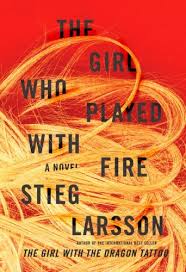
Perhaps even more compelling than the first book, or maybe more compelling because of the first book, Stieg Larsson's 2nd entry in the Millenium trilogy focuses largely on Lisbeth Salander who early on becomes the focus of a manhunt in a triple murder investigation. The complicated background that has created this socially phobic but uniquely brilliant character is revealed and boy is this a doozy of a twisty plot--imagine your most nightmarish conspiracy theory if you were the target. And then imagine you were just 12 years old when it all started. But if you liked the first book, you will love this one. Lisbeth eventually has some very powerful people on her side, which is amazing given how little she is able to offer in the way of normal personal relationships. Salander engineers several major changes in her life, and the book leaves us knowing there are more changes on the way for these characters .
Perhaps even more amazing than reading the book was finding out that the Swedish film version of Girl with the Dragon Tattoo was playing on the other side of town and we got to see it this weekend. The cast was absolutely superb and they didn't pull any punches on some of the more gut-wrenching scenes from the book. Of course no movie can ever develop the complexity of relationships and events that comprise a good novel, but they did an outstanding job of capturing the essence. They even corrected one of my minor gripes about the book--the disappearance from the storyline of the police detective originally assigned to the Harriet Vanger case. There is some foreshadowing of the 2nd novel in the movie, but you will want to see this if you possibly can no matter how many of the books in this trilogy you have or haven't read. Two members of our group knew nothing about the books and were still enthralled.
Thanks to my friend Wendy Starkweather for the lead to this lengthy article in the New York Time Magazine to a lengthy bio piece on Larsson and the controversy surrounding his literary heritage.
Sunday, April 25, 2010
Bangkok Haunts
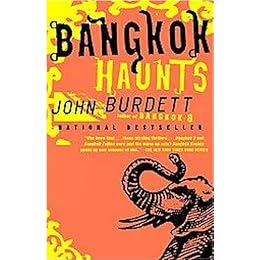
This time there is an even bigger dose of ghosts in John Burdett's 3rd Sonchai Jitpleecheep installment. One of Sonchai's former lovers has been murdered in a snuff film and someone thoughtfully sent him a copy of the film. His corrupt and greedy boss, Colonel Vikorn, can as usual only think of how to turn a profit and decides to expand his money making ventures into pornography. He instructs Sonchai to release from prison a man that Vikorn framed who is awaiting what could be a death sentence; he just happens to be a film maker and the deal offered is his freedom in exchange for making "classy" porno films. Sonchai's wife is very pregnant with the reincarnation of his former partner, and the ghost of the dead prostitute in the snuff film is regularly visiting Sonchai at night in a most physical way. Elephant games, a particularly gruesome form of murder, is planned for the masterminds behind the film by the ghost of the dead woman. As always, Burdett creates a compelling picture of Bangkok, the folly of farang tourists, the not very underworld of prostitution and corruption, all mixed with Jitplecheep's Buddhist beliefs. I can't say it makes me want to visit the country, but it certainly creates a vivid picture of life there. See earlier review of his other books: Bangkok 8, Bangkok Tattoo, and the non-series book, The Last Six Million Seconds.
Monday, April 19, 2010
Snow Crash

For starters, this is a great title for a book . I just happened upon the author, Neal Stephenson (there are links to interviews with him on his homepage), when someone left a book written by him in a hotel room. That book, Cryptonomicon, just grabbed me and didn't let go until several hundred pages later. I was gratified to learn, through an NPR piece, that it was among Nancy Pearl's favorite books in the sci-fi/fantasy genre (although clearly there are large doses of history wrapped up in there). Snow Crash is clearly set in a future world that doesn't sound all that pleasant; I'm reminded of the bleak picture of our future presented in Blade Runner (the movie based on Dick's novel: Do Androids Dream of Electric Sheep). Those who can afford it, escape to an elaborate virtual world, the Metaverse--something that wouldn't seem foreign to inhabitants of Second Life--all the more remarkable because this book was written almost 20 years ago. Hiro Protagonist (nice name :-) is a sometimes computer programmer, sometimes pizza delivery person, and sometimes information source for the CIA; he's adept with samurai swords. The US government is holed up in a compound. Megachurches and megacorporations are running the world. Hiro's sidekick is a 15-year old Kourier who delivers packages on her skateboard--don't even think you know about skateboards until you read about her model. They are trying to figure out who or what is behind the attack on one of the world's leading computer programmers, causing him become a gibbering idiot in a hospital after he watched black and white "snow" on a computer in the Metaverse. It's a wild ride in more ways than one and wildly creative, with just one serious flaw. There is a much too elaborated tie in to the ancient Sumerian language and various biblical and other mythology that just drags, sometimes for several pages. Normally, I like this kind of historical fiction reference, but I was lost and got annoyed. So you either need to really be into this particular brand of religious mythology or just skim over it like I did. It's definitely worth reading. There's a lengthy and excellent overview of the story line at the Complete Review.
Subscribe to:
Posts (Atom)