Sunday, April 25, 2010

Bangkok Haunts


This time there is an even bigger dose of ghosts in John Burdett's 3rd Sonchai Jitpleecheep installment. One of Sonchai's former lovers has been murdered in a snuff film and someone thoughtfully sent him a copy of the film. His corrupt and greedy boss, Colonel Vikorn, can as usual only think of how to turn a profit and decides to expand his money making ventures into pornography. He instructs Sonchai to release from prison a man that Vikorn framed who is awaiting what could be a death sentence; he just happens to be a film maker and the deal offered is his freedom in exchange for making "classy" porno films. Sonchai's wife is very pregnant with the reincarnation of his former partner, and the ghost of the dead prostitute in the snuff film is regularly visiting Sonchai at night in a most physical way. Elephant games, a particularly gruesome form of murder, is planned for the masterminds behind the film by the ghost of the dead woman. As always, Burdett creates a compelling picture of Bangkok, the folly of farang tourists, the not very underworld of prostitution and corruption, all mixed with Jitplecheep's Buddhist beliefs. I can't say it makes me want to visit the country, but it certainly creates a vivid picture of life there. See earlier review of his other books: Bangkok 8, Bangkok Tattoo, and the non-series book, The Last Six Million Seconds.

Monday, April 19, 2010

Snow Crash


For starters, this is a great title for a book . I just happened upon the author, Neal Stephenson (there are links to interviews with him on his homepage), when someone left a book written by him in a hotel room. That book, Cryptonomicon, just grabbed me and didn't let go until several hundred pages later. I was gratified to learn, through an NPR piece, that it was among Nancy Pearl's favorite books in the sci-fi/fantasy genre (although clearly there are large doses of history wrapped up in there). Snow Crash is clearly set in a future world that doesn't sound all that pleasant; I'm reminded of the bleak picture of our future presented in Blade Runner (the movie based on Dick's novel: Do Androids Dream of Electric Sheep). Those who can afford it, escape to an elaborate virtual world, the Metaverse--something that wouldn't seem foreign to inhabitants of Second Life--all the more remarkable because this book was written almost 20 years ago. Hiro Protagonist (nice name :-) is a sometimes computer programmer, sometimes pizza delivery person, and sometimes information source for the CIA; he's adept with samurai swords. The US government is holed up in a compound. Megachurches and megacorporations are running the world. Hiro's sidekick is a 15-year old Kourier who delivers packages on her skateboard--don't even think you know about skateboards until you read about her model. They are trying to figure out who or what is behind the attack on one of the world's leading computer programmers, causing him become a gibbering idiot in a hospital after he watched black and white "snow" on a computer in the Metaverse. It's a wild ride in more ways than one and wildly creative, with just one serious flaw. There is a much too elaborated tie in to the ancient Sumerian language and various biblical and other mythology that just drags, sometimes for several pages. Normally, I like this kind of historical fiction reference, but I was lost and got annoyed. So you either need to really be into this particular brand of religious mythology or just skim over it like I did. It's definitely worth reading. There's a lengthy and excellent overview of the story line at the Complete Review.

Tuesday, April 6, 2010

Mugwump and Bookbags


NOT a book review...
My friend Mary Caughey gave me a wonderful little purse made from the covers of an old children's book and I get compliments on it every time I carry it. It's from a company called Mugwump which recycles books, board games, old maps, etc. to make useful everyday items. Today I ran across another company, Bookbags, that also makes purses and totes using the covers of discarded books. Very fun and very ecological.

Monday, April 5, 2010

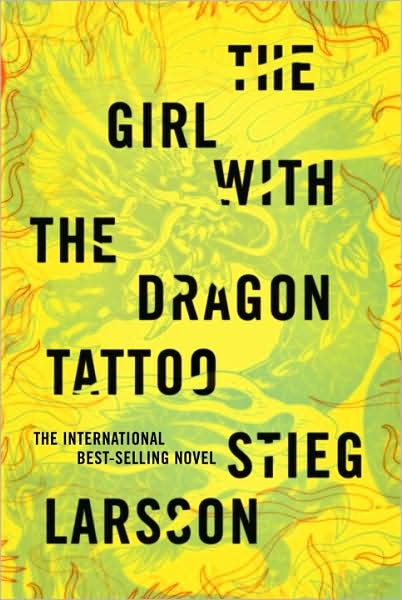
Girl with the Dragon Tattoo


It was my friend Bob Nye's recommendation that finally pushed me into reading this book by Stieg Larsson...not that it took much of a push. I tend to like Scandinavian mysteries (see my post for What Never Happens) and this was really satisfying in some ways and disappointing in others. After the 2nd chapter, I was hooked, couldn't put the book down and went on a book reading binge for about 6 hours til I finished. The characters are compelling and I'm discovering that I need to really care what happens to the characters in order to like a book these days. Through no fault of his own, investigative financial reporter and magazine publisher Mikael Blomkvist has just lost a libel case in court and decides that leaving his magazine's editorial board is the best strategy to get the target of his investigation--corporate mogul Hans-Erik Wennerstrom-- off the warpath. His co-owner, Erika Berger, feels abandoned, and Wennerstrom hasn't given up trying to destroy the magazine by a long shot. Blomkvist is at loose ends, facing a stiff fine and several months jail time, so he's ripe to be plucked by another major Swedish industrialist for a personal project. Henrik Vanger wants Mikael to write his family's history as a cover story and find out who murdered his niece four decades ago. Harriet Vanger disappeared off an isolated island during a company/family conclave and Henrik is sure one of his family members killed her. The Vanger family turns out to have a whole host of unpleasant personalities and dark secrets. The other well developed character in the mix is a computer hacking genius and social misfit named Lisbeth Solander who does investigative work for a security agency through some fairly unorthodox means. She eventually get roped into the investigation of the missing Harriet, also. Which brings up one of my bitches about the book--Solander was badly treated in the end by Larsson and it's unforgivable given the shitty life she's had. Not that she isn't perfectly capable of looking after herself, but ...well you'll see when you read the book. And you must read the book. There are some provocative issues raised about personal responsibility--and the behaviors that test this principle range from the unethical to the horrific. Another pet peeves is that a character is introduced at the beginning of the book, the police investigator of the niece's disappearance, and then himself disappears from the remainder of the story, even when he could logically have been brought back in. There are also some characters whose motivations simply go unexplained and feel incomplete, like Cecelia Vanger. Overall though, I'm hooked and will round up the remaining books published posthumously, The Girl Who Played with Fire and The Girl Who Kicked the Hornet's Nest.

Saturday, March 27, 2010

The Ask and the Answer


Perhaps it should be called The Great Questions. This is the second installment in a planned science fiction trilogy titled "Chaos Walking" ( how could I resist?) from Patrick Ness. I ran across this one on a sale cart and, even though I hadn't read the first book in the series, picked it up just because it got so much chatter on the YA listservs. Complex characters, plots and interactions between characters are mixed in with non-stop action on this outpost of human exploration called New World. The native species, the Spackle, have apparently been defeated in a brutal war and now civil war among the settlers has broken out with one man--Mayor Prentiss-- apparently stopping at nothing to become leader. He recognizes the potential threat from the anticipated arrival of new ships with additional settlers, and so it is essential that he get information from Viola, who was the lone survivor of a scout ship that crashed. She has been befriended by Todd, and they are on the run, when Viola is shot and they desperately seek help in the town of New Haven. That's what I was able to surmise about the first installment, The Knife of Never Letting Go. This book takes up as they are captured in New Haven which has already surrendered to the invading army. Todd and Viola are separated and skillfully--and horribly--manipulated by two strong leaders, Prentiss and Mistress Coyle, a former leader of the resistance (aka the Answer)and also a healer by training. The moral issues are complex and one despairs of anything coming right as we alternately take our place in the action from first Todd's and then Viola's perspective. This is one where I would definitely recommend reading the first book before jumping into the second. Although it was a compelling read, you can't help but feel that you've missed a lot. But get busy because the next book is coming out this spring!

Thursday, March 18, 2010

Brida


I read all but the last 75 pages or so and I never really cared what happened to any of the characters, so I quit. I have liked other books by Paulo Coelho (e.g., The Alchemist) so I persisted, but something was missing. Set in relatively contemporary time, it seemed promising: a young woman is looking for a way to realize her gifts and find her soulmate; there are magi and witches; it's set in Ireland. Lots of my favorite elements, but just no spark. Ah well. I'm trying not to see my lack of enthusiasm as a character flaw...

Saturday, March 6, 2010

Two O'Clock Eastern Wartime


Another really satisfying offering from John Dunning that draws on his considerable expertise in the history of radio in America. His usual blend of detailed setting, well-developed characters and complex plotting made me feel I had indulged in a somewhat higher level of my addiction to mysteries. I love a good story that also makes me feel like I've learned something in the process and this tale set on the New Jersey coast during WWII has revealed a brief period when radio ruled and the best writers and actors wanted to be doing the shows. You get to see how things happen from the inside, the points of view of writers, actors, sound effects people and show producers. Jack Dulaney is trying to help the woman he loves, Holly, find her missing father. At the same time he is finding a new passion and talent for script writing with the support of a reclusvie station owner who dares him to push the limits of network censors who don't want to hear anything controversial or vaguely unpatriotic on the airwaves. In the context of our protagonist's zeal for telling compelling and uncomfortable stories about real people we also get bits of history about various atrocities against "the other"--Kitchener's invention of concentration camps in the Boer Wars, the inhumane treatment of blacks and other soldiers at Florence and Andersonville, the rumored Nazi camps in Europe, and of course the Americans' imprisonment of Japanese American citizens after Pearl Harbor. Murder, conspiracies, romance--it's all here. For other wonderful mysteries by Dunning, that draw on his years as a rare and antiquarian book dealer, check out Booked to Die or The Bookman's Wake.

Tuesday, February 16, 2010

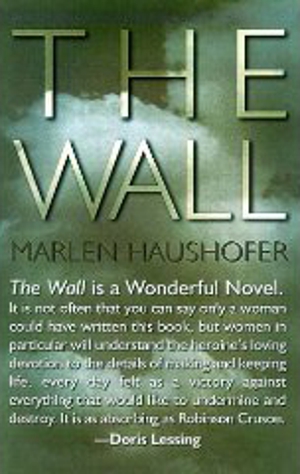
The Wall


Originally published in German, this translation of Die Wand by Shaun Whiteside is the only English language translation of any of Marlen Haushofer's novels, even though she has won several literary awards at home in Austria. Considered a "feminist novel" we are ostensibly reading a report written by the main character who remains nameless throughout. She is a wife and mother of two nearly grown daughters, and has come with her sister (Luise) and her brother-in-law (Hugo) to their hunting lodge in the mountains for the weekend. Luise and Hugo go down to the village for some socializing and never return, although their dog does. Next morning, our reporter begins to worry and as she heads down to the village, she runs into an invisible barrier, transparent and apparently stretching for miles in either direction. The first part of the book focuses on her efforts to understand what has happened and conjecturing about what will happen when the creators of this terrible weapon come to check on their work--for she figures out that whatever happened, it has killed all the fauna (human, animal, bird, insect) living on the other side. This chapterless book (which I found maddening when I needed to quit reading of an evening) shifts focus to how she makes her life alone in the mountains with only the dog, a cow and a cat for companions. It was hard to get started (it would have failed Nancy Pearl's Rule of 50 for me) but eventually I couldn't stop. She copes, although not well at times. Certainly we have to wonder what we ourselves would do in such a situation. What is the point of living, after all? She eventually realizes that no one is left alive to read her report, so why write it? Although the reader will anticipate the climax, such as it is, for most of the book, it's still profound in its implications.

Saturday, February 13, 2010

Monstrumologist

Monstrumology: (noun) The study of life forms generally malevolent to humans and not recognized by science as actual organisms, specificallly those considered products of myth and folklore. (verb) the act of hunting such creatures. Like his father before him, Pellinore Warthrop is a monstrumologist and Will Henry, his 12-year old ward, is his assistant apprentice. Will Henry tells the story through his diaries which come to light when he dies--apparently at the age of 131--an indigent in a small New England town. Will Henry's father had served Dr. Warthrop as assistant in his travels to far reaches and his investigations into strange creatures. So when both parents die in a fire, Will Henry is orphaned and now serves the monstrumologist in turn. Set in the late 1800's, the book is gory--there are indeed man-eating monsters and they have apparently infested the cemetery of the town in which the story is set, which in Will's diaries is known by the pseudonym of New Jerusalem. Is it just coincidence that these monsters have shown up in the same town where one of the world's eminent monstrumologists lives?? Probably not. The story is based on the first 3 folios of 7 diaries, so you can count on a sequel or two if you like this. The author, Rick Yancey, cunningly only claims editorship of the book.

Sunday, February 7, 2010

On Cats


Doris Lessing can always make me care about her subject and in this small volume she reveals her own intense feelings for the cats that have touched her life. I already think cats are amazing creatures so I sometimes found it hard to deal with certain of the events she describes. She was surrounded by semi-feral cats while growing up in Africa and it's wrenching to read about killing off the ones who became problematic--a painful task often delegated to her mother. As an adult however, she makes other decisions I find hard to tolerate, such as letting cats continue to have kittens (instead of neutering them) and then killing the kittens. Admittedly it was hard for her, too. She admires them, she often expends extraordinary resources to save and heal them, she admires their unique personalities. And it is her waxing eloquent about the individual personalities that drew me and kept me reading. The tale of one particular animal "Rufus the Survivor" is the most poignant; though he may not be the one she loved the most, it is in his story that she creates the most heartfelt connection.