Monday, December 29, 2008
My Cat Saved My Life
Why would you read this book? Have you ever lost a loved companion, parent, sibling, friend? Perhaps you felt that societal restrictions on how you grieved didn't really provide sufficient room for your experience. Have you ever believed that soul is not the exclusive realm of humans? Have you ever been lost in a well of depression so deep that the light cannot reach you? Do you occasionally believe that animals know more about living than we (humans) do? Then this account will resonate with you. This heartfelt little book is written by Phillip Schreibman, who lost his emotional and spiritual footing following the deaths of his father and then his mother. He describes better than anyone I've read what it is like to experience someone dying. " A miracle of experiences, hopes, stories, thoughts, a way of smiling, a voice, vanished in the smallest fraction of a second." One minute they were there and the next they were not. "Now all the parts of me where my day-to-day living had once entwined with theirs were reaching out into nothing." But then he rescued a six-week old kitten and she, in turn, rescued him.


Wednesday, December 10, 2008
Love Walked In

At first you'll think that love walked into Cornelia's life and coffee shop in the form of a Cary Grant look-alike. She really wanted to be in love with Martin Grace because there were so many things to love about him. But the real fall comes when Cornelia meets Martin's estranged daughter, Clare. I'd be surprised if you don't fall in love with Cornelia as I did, and for the same reasons she fell in love with Clare -- because she's thoughtful, emotionally courageous, ultimately stays true to herself, and is willing to risk it all for what she wants. The characters are occasionally quirky, very well drawn, enormously endearing. We are reminded that, whether in families, friendships, or love affairs, there is no happiness without some cost, but it's usually worth it. Set predominantly in Philadephia, punctuated by delightful dialog and frequent classic film references, this first novel from Maria de los Santos is a most satisfying read.
Tuesday, November 11, 2008
Evil Genes--a plunge into non-fiction
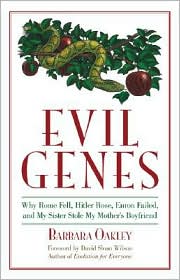
The full title of the book is Evil genes : why Rome fell, Hitler rose, Enron failed and my sister stole my mother's boyfriend by Barbara Oakley. Although she deals with some genetic research, this is primarily an overview of the research on the neurophysiology and neurochemistry of various psychiatric disorders. Personal anecdotes are sprinkled throughout as her interest in the area did come from her puzzlement over her sister's often amoral and Machiavellian behavior. She focuses initially on the development of the construct of Machiavelliamism and then moves on to its relationship to various personality disorders, e.g., narcissistic, borderline, sociopathic and psychopathic disorders. She has separate chapters on Mao Zedong, Adolf Hitler, and Slobodan Milosevic. She posits that some personality disorders may actually be adaptive, helping certain people rise to the top and gain the power and influence to expand their gene pool. She has lots of interesting side notes on things like the neurobiology of religiosity and political beliefs. Her background is as a systems engineer and she does a reasonably good job of bringing some diverse areas of research together, but it is dense and technical reading and I wouldn't recommend it unless you yourself feel compelled to learn more about someone you think might be personality disordered. Her conclusions are that people really are determined more by inheritance than nurture--undoubtedly a comfort to parents/family of those with serious personality disorders. And so I am reminded that people do not change awfully much, and that wishing they would behave differently is just that--wishing.
Back to some old favorites -- Candace Robb
 I thoroughly enjoy the Own Archer and Lucie Wilton series, partly because they are a series and the characters develop over time and you feel like you get to know them. I haven't actually read the immediate predecessor (A Gift of Sanctuary) to A Spy for the Redeemer, which apparently sets Owen off to Wales in the company of his father-in-law, Lucie's father. In this book, the impending revolt of Welsh rebels confronts Owen with his conflicting loyalties -- England vs. Wales. A mysterious suicide involves Owen directly with the various political factions and delays his return when he is ordered by the local Archdeacon to investigate. His long absence raises doubts in Lucie as well about Owen's love and commitment to her and their children, especially as rumors begin to circulate that Owen has joined the rebels. She is tempted by attentive men, some with good motives and some not. Lucie is distraught to learn her father has died on the trip and when she goes to check on his estate, run by her aunt, robbers attack, leaving Lucie unsure of what to do. What I like in general about historical mysteries--at least well-done ones like Robb's--is the opportunity to really get a feel for the events and settings and day-to-day lives of the people in a particular time and place, in this case, 14th C England (York especially) and Wales. Graduate work in medieval literature launched her interests in writing about the period and her literary career.
Monday, September 8, 2008
On Edge
This is the first crime novel that was written by Barbara Fister and I was finally able to track down a copy to buy and read, several weeks after I had read her 2nd book, In the Wind. This is also a police procedural with the protagonist a detective, Konstantin Slovo, who is currently on leave from the Chicago PD and under suspicion in the shooting death of his former partner. He is trying to restore a precarious emotional balance as well as recover from a serious gunshot wound he received in the same incident. On the flip of a coin, he heads east and stumbles into a small Maine town that is nearing mass hysteria after the kidnapping and murders of two young girls. The focus is on plot and the complex social psychology of groups getting crazy for any sort of action in the face of such horrible events that seem so out of their control. Slovo is haunted by the child abuse cases he has investigated in the past, especially the last one that he could never solve; it is therefore especially ironic that he becomes a victim of the town's vigilante group that is taking matters into their own hands. In the process of trying to help with the investigation--unofficially of course--he befriends local doctor Hari Chakravarty (the only source of any humor in the tale), the chief of police's daughter Ruth, and, it turns out, the killer.
Sunday, September 7, 2008
Murder and Mayhem in Hong Kong

I recently wrote about the forces aligning that led me to John Burdett's Bangkok 8. I investigated what else he had written and discovered that the movie rights to his series of three books set in Bangkok (also Bangkok Haunts and BangkokTattoo) had been bought and are slated to start filming soon. But I also ran across this title, The Last Six Million Seconds, and after messing around with how much time that really was (about 2 months), was curious to find out its significance. The book is set in Hong Kong prior to the handover from Great Britain to mainland China and clocks everywhere are counting out the days, hours, minutes and seconds to June 30, 1997. Our protagonist, Chief Inspector Chan Siu-kai ("Charlie"), is another character defined by others and struggling with himself due to being only half of his chosen national identity, i.e., Chinese. The other half is Irish, but all of him is vehemently anti-communist since he attributes the murder of his mother Mai-Mai, to one of their many purges. Like the detective in the Bangkok series, he is incorruptible and therefore problematic for those who consider political expediencies a higher priority than solving crimes. The grisly murders that anchor this story are dubbed by the press as the "Mincer Murders" since 3 bodies were run through commercial meat grinders while still alive. A tip leads Chan to retrieve 3 heads, sealed in a plastic bag, floating in the sea on the jurisdictional border between Hong Kong and mainland China--raising hopes that the hamburger leftovers might be identified and help solve the murders. The plot is truly labyrinthine and involves the highest levels of government interfering in Chan's investigation. Absolutely no character is all good or all bad, although you would never want to cross paths with most of them. They are driven by history and greed and hopeless passions. Like Bangkok 8, this is not for the faint of heart but an absolutely engrossing thriller, with complex characters and atmospheric settings.
Saturday, September 6, 2008
Metzger's Dog is delightful
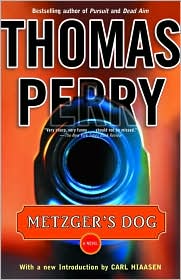
Yet another recommendation from Nancy Pearl, this book is delightfully quirky. It opens when Chinese Gordon is awakened by thieves breaking into his shop, downstairs from his living quarters. He has no weapons at hand so he takes desperate measures, although he knows there will be consequences. As the thieves move into the room and underneath the landing where he is hiding, Chinese drops his cat on the head of one of the thieves. The screams of surprise and distress-- by all parties involved-- convinces the thieves to depart in a hurry. Doctor Henry Metzger, by the way, is the cat and the dog in question is basically a junkyard brute trained to maim and kill. How he comes into Chinese's life and become the property of Doctor Henry Metzger you'll have to find out for yourself. Chinese, his woman friend Margaret and a couple of his equally unredeemed buddies stumble into the middle of a CIA plot and decide to blackmail the organization for 10 million dollars. They cleverly manage to play most of the bad guys against each other, shut down all the freeways in Los Angeles and get away with their ill-gotten gains, and you'll find yourself rooting for them the whole time. Perry, btw is the author of The Butcher's Boy, but it's been so long since I read it, I may have to add it to the pile beside my bed.
Guy Gavriel Kay still a favorite

Ever since Nancy Pearl turned me on to The Lions of Al-Rassan (see earlier post), I've had a niggling desire to read more of Kay's work and my last trip to Portland and Powell's bookstore offered an opportunity to do just that. The Last Light of the Sun is set in the same world with the same two moons but shifted considerably north and focused on relations between several groups that parallel the Norse, the Anglo-Saxons, and the Celts. Very engrossing story-telling, richly detailed creation of time and place with interesting characters and bits of magic. Faeries take on a vital role and interact with humans in surprising ways in this tale. The rise of a strong English king has put a crimp in the heretofore unimpeded raids from Vikings. Tribes within England have reached uneasy truces, which some seek to cement with politic marriages. The main characters are predominantly a new generation, the sons and daughters of the kings and leaders who waged wars. An interesting twist is offered through side tales of people whose lives intersect those of the main characters, e.g., the miller or a shepherd girl tending her goats. Althogh women are portrayed as resourceful, independent and intelligent, they do not carry the story in the same way they did in Lions. Nevertheless, an excellent read which encourages me to read more of Kay.
Friday, August 8, 2008
Bangkok 8 -- Take a walk on the wild side

This book first wandered across my field of vision at a recent library instruction conference when we created a small virtual library for an interactive experience with books. I assumed someone chose to include the book because it was obviously about the sex trade and--well--the conference was in Las Vegas. But THEN, Nancy Pearl reviewed it and that really got my attention, so I decided to see for myself (she is one of my library heroines but we don't always see eye to eye on books, see for example the blog on Dingley Falls). It's really an engrossing read, not least of all because you get the nitty gritty on how a M2F sex change operation is performed. It is, at heart, a murder mystery--but one infused with, I trust, the culture of Thailand, or, more specifically, Bangkok. What we farang westerners would call magical thinking abounds as the protagonist is able to see people's past lives as explanations for their current behaviors and relationships. Sonchai Jitpleecheep is the son of a former prostitute and an unknown American soldier, conceived during our involvement in VietNam. He lives in a self-described hovel less than 10 feet square with a hole in the floor for a toilet. He is also a detective with the Royal Thai Police Force, but has made the mistake of becoming known as an arhat, an honest cop. This is an incredibly twisty plot that starts with the gruesome and imaginative murder (by snake bites) of a Marine who was way more than he seemed. There are unfortunate consequences of the murder that make Sonchai take a very personal interest in finding the killer. Icing on the cake-- Sonchai's frequent musings on his Buddhist beliefs and his explanations of Thai cultural essence, often told with biting humor. A couple of my favorite examples: when he is trying to explain the significance of his mother cursing the man who stabbed him, Sonchai concludes, "You will not make a good death is a power curse; it makes Fuck you sound like a benediction." At another point he relays a news report on the radio that says ghouls, the spirits of the dead, are causing traffic accidents at a busy intersection. Sonchai wryly notes that his people, in death as in life, "love to party."
Monday, August 4, 2008
Mostly fluffy stuff
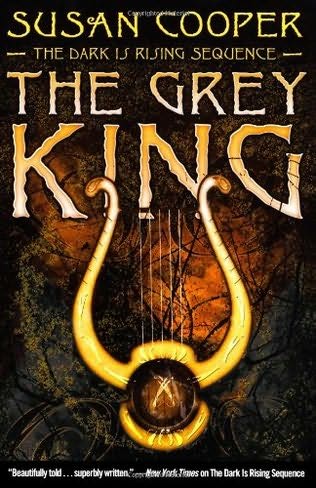

Maybe because the books I've been reading to review are SO heavy--lots of non-fiction, self-help, etc.-- I'm doing a bit more escapist reading these days. I listened to another YA fantasy book, a classic set in Wales with ties to Arthurian legend called The Grey King by Susan Cooper. A 10-year old English boy is actually the last of the "Old Ones" who has been called on for a quest to stop the dark machinations of the Grey King. The reader, Richard Mitchley, did an excellent job with the snippets of Welsh dialog and place names.
I also persisted to the end with Coyote Blue by Christopher Moore -- it was a slow starter and I didn't really like it to begin with, but I've enjoyed a couple of his other vampire books (see earlier reviews in this blog), so I kept at it and in the end it was a nice love story with the usual Moore insanity of characters, plot and the supernatural driving it all. This time the supernatural characters center around Native American lore and the tale of the Coyote trickster.
Last but not least this week was the 14th installment of the Stephanie Plum series by Janet Evanovich, Fearless Fourteen, which was a birthday gift from my friend and colleague, Dale. As always, there were laugh out-loud moments and Grandma Mazur is up to her usual tricks--this time getting immersed in online gaming, complete with black leather outfits. I don't think any cars got blown up this time around though and the interactions with Ranger were decidedly less heated, although still filled with innuendo. Not her best effort but still a fun read.
I'm on to more substantial fare, Bangkok 8, thanks to a recent set of reviews by my reading guru, Nancy Pearl.
Subscribe to:
Posts (Atom)