Thursday, March 20, 2008

Reading the YA award winners


Hard to believe it's been a month since I last posted notes on my reading. In my defense, I am in the process of moving to a new job and a new state, so I've been a little pre-occupied with trying to finish up projects at work and home. But we recently got in a batch of young adult books that have won awards so I dipped in and here's what I came up with.

The Michael Printz Award is sponsored by a publication of the American Library Association (Booklist) and intended to exemplify “literary excellence in young adult literature” (ALA YALSA website). This year’s winner is The White Darkness by Geraldine McCaughrean, the first ever 3-time winner of the Whitbread Children’s Book Award (now Costa Book Awards) and a previous Carnegie medal winner—in other words, this woman knows how to write YA books! Here’s an excerpt from page 1: “I have been in love with Titus Oates for quite a while now—which is ridiculous, since he's been dead for ninety years. But look at it this way. In ninety years I'll be dead, too, and the age difference won't matter.” And this from the book jacket will give you the basic storyline: “Sym is not your average teenage girl. She is obsessed with the Antarctic and the brave, romantic figure of Captain Oates from Scott's doomed expedition to the South Pole. In fact, Oates is the secret confidant to whom she spills all her hopes and fears. But Sym's uncle Victor is even more obsessed—and when he takes her on a dream trip into the bleak Antarctic wilderness, it turns into a nightmarish struggle for survival that will challenge everything she knows and loves.” Symone is a resourceful and tough 14-year old who will engage male as well as female readers, not least of all because she has struggled with being bullied for her hearing loss, and had to live in recent years without a dad. This is an incredibly intense survival story that so compellingly conveys the harsh reality of this frozen wilderness that you will relish anew being in a safe warm place when you read it.

Last year’s Printz winner and the first graphic novel to be a finalist for the National Book Award is American Born Chinese by former comic book creator Gene Luen Yang. I am new to graphic novels—The invention of Hugo Cabret being my first (see earlier blog). This book is largely about the impact of discrimination against ‘the other’ on the sense of self. There are 3 apparently separate story lines that all come together in the end. Each character, the monkey king of Chinese legend and two teenage boys, wants desperately to be something other than what he is—to transform himself. The moral of the story is that it’s best to accept and be who you are, and I have to say that I found it a bit simplistic and heavy handed on that score. Perhaps the format also limits how deeply one can explore the very real prejudices faced by those in non-dominant cultures.

I’d heard a lot of positive raves about The Wednesday Wars by Gary Schmidt on the YA listserv I monitor. It was an Honor book for the Newbery Award, and, of this batch, it was my favorite. Above and beyond being stuck with a name like Holling Hoodhood, our seventh grade protagonist is the only non-Jew and non-Catholic in his class. This means he is stuck with his teacher, Mrs. Baker, on Wednesday afternoons when his classmates all disappear for religious instruction at their various places of worship. Initially she tries to get him transferred back to 6th grade math class, then she consigns Holling to cleaning not only the blackboards and erasers in her room, but in every other 7th grade classroom—the story is set in 1967 so they still have chalk and blackboards. Eventually her “torture” settles on making him read Shakespeare, and Holling discovers he likes the stories so much that he takes a role in a local theatre production of “The Tempest.” Schmidt brilliantly captures the angst of being a teen, being the son of an aggressively ambitious father, being the brother of an older sister who is opposing the war in Vietnam, and being at the top of the hit list for the local school bully.

By far the winner in the “heavy book category” is Brave Story by Miyuki Miyabe, which also won the Batchelder Award (given to the publisher of a book originally published in another language and translated into English). Weighing in at 816 pages, I doubt I am the first reader to think it is too long. It’s a fantasy adventure about a 12 year boy who passes through a temporary portal into an alternative world, Vision, which is created by the cumulative imaginings of people in this one, the real world. Again this tale struck me as a bit simplistic morally; our protagonist Waturu is more considerate of others instead of being totally selfish, and so achieves the ultimate prize in the end. The fantastic creatures he encounters and befriends in Vision range from a Barney-like giant lizard to a seductive cat girl. Still it is commendable that the protagonist gradually and believably comes to act and see himself as more brave and competent than he did before his series of adventures, and so can serve as an engaging and worthy role model for young boys.

Tuesday, February 19, 2008

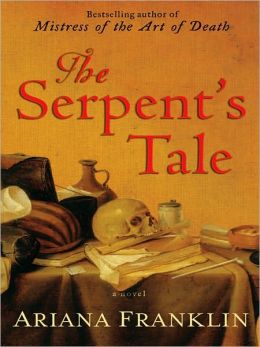
The Serpent's Tale


I had my name on the list at the public library--awaiting the sequel to Ariana Franklin's Mistress of the Art of Death (see my earlier blog post on that) and it finally came last week. I devoured it in the way that true bibliophiles do--ignoring social conventions of conversation, participation in meal preparation, etc. Well worth the wait! Our medieval forensic doctor, Adelia Aguilar, is called back into service by King Henry II from her retirement to country life in the fens of central England. Henry's favorite mistress has been poisoned; all the obvious clues lead to Henry's disgruntled Queen. If Queen Eleanor is truly guilty, civil war is seemingly inevitable and Henry doesn't want that, so Adelia must determine the true identity of mistress Rosalind's assassin. Adelia is also reunited in this book with Rowley Picot, her former lover and father of her baby daughter; he is now Bishop of St. Albans and their relationship is very complex and totally understandable given their individual dispositions. Franklin is the pen name for Diana Norman, who has written a handful of other historical novels, many of them also set in the middle ages , and she has become quite well known for the accuracy of her historical research and richness of characters. All of this plus the challenge of finding the killer(s) makes for an absolutely engrossing read. I love learning about a country, a culture, a time period-- through literature, especially when it is well researched and palatably written. These remind me of Candace Robb's mysteries with another strong woman protagonist who works as an herbalist in medieval England. Other authors using similar time period and settings are Sharon Penman and Edith Pargeter (aka Ellis Peters) of Brother Cadfael fame. Of course I loved the BBC series with Derek Jacoby playing Cadfael. Anyway, this book is an absolutely delicious diversion so hide yourself away for a weekend and dive in.

Sunday, February 10, 2008

Your choice of young heroines


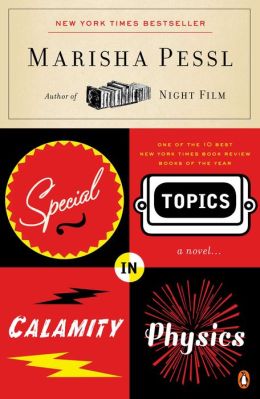
Really I am stretched to think how the books I most recently read can be compared; they probably shouldn't be. They have young adult female protagonists, but that's about the extent of shared ground. So suffice it to say that they represent some of the variety of what I consume in a any given time period. The most dazzling by far is Special Topics in Calamity Physics, told from the POV of Blue vanMeer, now a freshman at Harvard, as she briefly recounts her early years in the company of her itinerant and professorial father, and then focuses on her final year in high school. Ordinary mortals like me will occasionally find it tough going to wade through the endless footnotes and citations comparing every person, place and experience to some bug, animal, book or movie. There is a complex mystery to be explored--surrounding the death (murder or suicide?) of the film teacher, Hannah Schneider (or is she?). Blue seems a decent sort in spite of everything and especially in contrast the her school peers who epitomize everything that is wrong with "the younger generation." I would never read this book again and someone would have to really twist my arm to make me read anything else this person subsequently writes--this is Marisha Pessl's first novel. That being said, it is--on occasion--bitingly funny, and brilliantly literate. Other reviewers have been more positive in their regard, for example see the piece in Salon.com.
At the opposite end of the spectrum, there is the totally
fluffy (my word for reading that is reasonably entertaining but of little enduring literary value) first novel of Marissa Doyle, Bewitching Season. Our 17-year old protagonists, Persephone and Penelope, are twins and heir to witching talents which are being honed by their governess Melusine Allardyce. Set in early 19th century England, when Victoria is still a princess, they are about to embark on their "coming out" season in London society, which gets really complicated when Ally mysteriously disappears and Persey casts a love spell on the handsome boy next door.
And last but not least off the bookstack this week is How I Saved my Father's Life: And Ruined Everything Else by Ann Hood. The typical YA-type title should alert the reader to the pre-teen POV for the story.
Madeline Vandermeer is just barely 11 years old when she accomplishes two miracles: the first is to move a glass of water without touching it and the second is to save her father’s life when he is caught in an avalanche. But now she needs to make a third miracle happen because her father returned to his family only briefly before leaving them for a celebrity life, a new wife, and a baby on the way. Madeline is convinced her mother is to blame for the divorce, because she is so “ordinary,” whereas the new step-mother, is so glamorous. Left in the falling-apart house they can’t afford to remodel, Madeline and her younger brother are weekly subjected to their mother’s culinary experiments which provide the fodder for her food column in Family magazine. Madeline sees her mother’s work as foolish and based on lies, since they are no longer the happy family of her dreams. Worse yet, when her stressed mother takes Madeline out of ballet school in Boston, an hour away, and puts her in a local class, she sees her chances of becoming a world class ballerina slipping away. Then Family magazine offers to send the family on an all-expense-paid trip to Italy so mom can write about the joys of travelling with children. While there, Madeline, initially interested only in visiting reliquaries of various saints, has some perception altering revelations of her own. This is a great book to offer tweens and teens facing divorce and new step-families. The young protagonist exhibits all the wretched feelings and behaviors that accompany such significant losses but comes eventually to a balanced view of parents and the hard choices we all make when life isn’t perfect.

Sunday, February 3, 2008

Who Done It?


This slang reference for mysteries will take on added significance if you read this twisty tale, What Never Happens, from Scandinavian Anne Holt, set in Oslo, Norway. This is another totally new author for me--but I just got back from ALA with a box and a bag full of advanced reading copies (ARCs) and I was in the mood for a mystery, so I grabbed this one. Apparently Ms. Holt has published an earlier work (variously known as Punishment or What is Mine) starring this pair of detectives, Johanne Vik and Adam Stubo, but now they are married with a brand new baby, significantly impinging on Johanne's ability to work on the case. Johanne has been trained as a profiler by the FBI, although she seems determined to keep that chapter of her life buried; with famous people dying in bizarre and symbolic ways, however, her skills are sorely needed. Holt has come up with an unusual and yet totally logical character for her killer and the ending will just leave you creeped out. This author is compared to Henning Mankell, a Swedish author of detective procedurals, but he is also someone unfamiliar to me. Maybe I need to pursue some of these Scandinavian authors a bit more, although the ones I have read (Giants in the Earth by O.E. Rolvaag, Smilla's Sense of Snow by Peter Hoeg, some of the books by Maj Sjowall and Per Wahloo.) are very dark. Must be the climate and the long winters....maybe not the best reading for an Oregon winter, or maybe just perfect!

Monday, January 28, 2008

Go read a good children's book!


If you think you would be wasting your time reading a book written for children or young adults, you're missing some really wonderful experiences. The Golden Compass, my previous post, was written for YA's... I won't even mention "she who shall not be named" and her book/movie mania. Some of my favorite books in the world were written for YA's, like the two by Virginia Euwer Wolff, Make Lemonade and True Believer, or those by Deb Caletti, like Honey, Baby Sweetheart or The Nature of Jade. There are some absolutely brilliant picture books that stun you with their art and move you with their message. Henry's Freedom Box: A True Story from the Underground Railroad, by Ellen Levine and illustrated by Kadir Nelson just won a Caldecott Honor and When Marian Sang, by Pam Munoz Ryan, is illustrated by Brian Selznick who just garnered the Caldecott Medal for his new work, The Invention of Hugo Cabret. Written and illustrated by Selznick, Invention is clearly a labor of love. Weighing in at 530 pages and documented with source material, it can be finished in just a few hours since the creator has capitalized on the burgeoning graphic novel trend and included dozens of full page and double page illustrations. Sometimes, in true GN fashion, the story is conveyed by the B & W illustrations alone. Other times, the plot moves forward with the spare text. Illustrations vary from the vast panorama of a full moon over 1931 Paris, the setting of the story, to the detail of an anxious eye peering out from a hiding place behind the clock on the wall of the train station. You can read reviews about the book in a dozen places such as this collection by Powell's Books.
On a slightly different note, but not really, have a look at this funny/not so funny bit of invention in The Onion about some weird guy who read a whole book, under no apparent external pressure or duress, and actually enjoyed it! My friend Sara made me put this on my blog, probably because I rant so much to her and anyone who stands still long enough about how important reading is, but I must give credit to my colleague Loretta for pointing this one out to me.

Thursday, January 3, 2008

The Golden Compass


Well, what a lot of kerfuffle about a book being made into a movie. After reading this article in The Atlantic ("How Hollywood Saved God") and talking with my sis-in-law, I think the controversy about religion and anti-religion was a cover up for the real issue, sexuality. And we know that we don't talk about sexuality in this culture. So better to try and worry about whether the movie will turn people from the one true path... You DO already know I am opposed at the core of my being to organized religion so admittedly I am not a sympathetic audience to the would-be censors of movie and books. I actually went to see The Golden Compass movie and then came home and re-read the book--all in one day. Whew! I was really trying to pay attention and I just don't get why people are so upset. But anway, what I found more interesting and what also generated more conversation with S-I-L Joan was the way the characters were simplified in the translation from text to screen. Not surprising in some ways; after all, books are very hard to translate in all their subtlety. But just to take a couple of examples of relatively minor characters. In the book, it is the Master of Jordan College who tries to poison Lord Asriel, not the Magisterium. So he is a more conflicted being than we see in the movie where he is uniformly on the side of the good guys/gals. Late in the book we witness a conversation between Lee Scoresby and the witch Serafina Pekkala where he indicates, in the gentlest way, that he would really like to get paid for this work he is doing to help the good guys/gals because he is after all a businessman and is saving for retirement. Well that is not the portrayal in the movie where we are led to believe that he jumps in to help Iorek and Lyra at risk of life and limb just out of the goodness of his heart and pure friendship. So we started conjecturing about the possible relationship between these visual interpretations that presented people and issues in, shall we say, fewer shades of gray, and the propensity of our society (as witnessed by electing "you know who" twice) to view issues as black or white. Which is the chicken and which the egg? Is this part of what we lose as we move away from a culture that reads? Of course it's not that simple as my colleague Anne-Marie points out in her blog and as the recent article in the New Yorker by Caleb Crain affirms. But it sure makes you wonder.

Vacation Reading


Aahhh! My idea of vacation is reading things that aren't even vaguely work related. So my 12-day vacation to Hawaii and the following holidays allowed me to indulge. I discovered two new authors, both writing Robert Ludlum type spy novels--only with current players (terrorists instead of cold war villains). The first was Greg Rucka, whose Tara Chace works for HMG as a Minder (that's the British secret services euphemism for all-around-clean-up-person for messy situations and occasional assassin). She was apparently born in the graphic novel world in a series called Queen and Country; although I haven't seen/read these, I thoroughly enjoyed the two regular books I read, A Gentleman's Game: A Queen and Country Novel and Private Wars. He also writes a series about a professional bodyguard named Atticus Kodiak and I am just about to finish listening to the first in this series (on tape while I commute) called Keeper--also an interesting enough character that I'll look for more to while away the highway miles.
The other author I got temporarily hooked on is Vince Flynn. It was another one of those serendipitous discoveries while browsing the books on tape at Corvallis public library and I liked it well enough that when I ran across one of his paperbacks on the book exchange shelf at the condo where we were staying, I grabbed it. His professional spook and assassin is Mitch Rapp who works for the CIA. Lots of D.C. political intrigue and plenty of fodder for those who think most of our government is corrupt at so many levels. I consumed (in print or on tape) Act of Treason, Consent to Kill, and Executive Power.
Then I scarfed up an oldy by Martha Grimes, and finally read one of those I felt I needed to read in order to be considered a legimate fan of children's and young adult literature, A Wrinkle in Time by Madeleine L'Engle. I have been slowly trying to fill in what I perceive to be gaps in my childhood reading--those books that serve as the benchmarks for everything that has come later, such as Charlotte's Web. And finally I re-read The Golden Compass after going to see the movie and started a couple of other books...but I'll save those for a later post.

Sunday, December 2, 2007

Idiosyncratic reviews


I probably should have added this as part of my blog title, as in "Random Reading and Idiosyncratic Reviews" because, not only is my reading all over the place, but my reactions to books and, therefore, what I write about them are often different from the acceptable body of criticism. Take Amy Tan for example. This is an author whose books consistently get critical acclaim and yet, after this second attempt at reading one of her works, I won't give it another go because she just doesn't offer enough to make me take time away from other options. I acknowledge that she writes well and in the book I just read, Saving Fish From Drowning, she taught me things about the culture of China and Myanmar, and created quirky yet believable characters. And I even get the message about the messy consequences of well-intentioned actions (a former colleague used to say the road to hell was paved with them). But as with an earlier book I wrote about here that I didn't even finish, Dingley Falls, none of the characters so engaged me that I actually cared about what happened to them.
Then last night I finished Tracks by Louis Erdrich--again a second-time attempt to read an author who consistently gets good critical response. I love reading about other cultures but these characters were opaque, so outside my range of experience (not a bad thing necessarily) and with so little that I could connect to in terms of understanding their behavior, that I found myself merely curious but not attached.
This distresses me. I get books recommended by people whose minds I tremendously respect, and /or that are written by quality authors and then I 'm disappointed. I don't dislike them; I mildly enjoyed both Tracks and Saving Fish. BUT I'm not wild about them, and as Nancy Pearl always says, there are too many books... I should in fact follow NP's "Rule of 50" when I run into such books but I just can't let them go because of who gives them to me and who wrote them, and I keep thinking, surely this will get better.
On the bright side, I was looking over NP's fairly recent reviews of "Great Sci-Fi and Fantasy" and found a couple of pleasant surprises. She really likes Guy Gavriel Kay, the author of the book I most recently wrote about, AND she labelled Cryptonomicon by Neal Stephenson one of her "top 10 favorite books of all time"--high praise indeed! I read this book quite by accident when someone left it at a condo I was staying in on vacation last year and was totally drawn into his complex tale spanning several decades and continents. Go see NP's review for this one. This was the opposite experience. I'd never heard of Stephenson or the book and had a great read so it was a totally unanticipated delight.
Anyway, the moral of the story is, you just can't count on anyone to lead you to what may be a personally satisfying read, including me. But I love writing about what I read!

Sunday, November 4, 2007

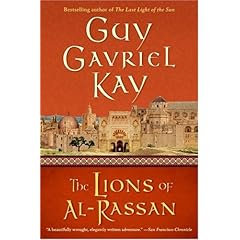
The Lions of Al-Rassan


I can't really remember where I first read about this book; it must have been a good review to prompt me to read it, however, as I was totally unfamiliar with the author, Guy Gavriel Kay. But what a really splendid novel! Although ostensibly set in a non-earthly world that has two moons (a blue and a white one) the history, place names, and geography strongly resemble those of the Iberian peninsula. This book was delightfully serendipitous in that it connected to two other recent reads, Mistress of the Art of Death and Gertrude Bell: Queen of the Desert. One of the main characters of this book, as in Mistress, is a woman physician, Jehane bet Ishak. Aside from the challenges offered by being a woman in a profession and culture dominated by men, life is made more difficult because of her faith. She is a member of the Kindath or wandering tribe; it wouldn't be too far a stretch to imagine substituting the word Jews, based on the persecution they have experienced from the other religions, the Asharites who worship the god behind the stars (read Muslims), and the Jaddites who believe the sun is god (read Christians). Early on she is befriended by and then comes to love men of these other faiths, Ammar ibn Khairan, an Asharite poet, warrior, diplomat and assassin, and Rodrigo Belmonte, captain of a Jaddite army, devoted husband and father. Like the real-life Ms. Bell, Jehane operates in a man's world, contributing unique skills and knowledge that come from a compassionate and consuming intellect. The desert born Asharites are also reflected in the dealings Ms. Bell had with the tribes of the Middle East. The body of the story takes place in less then a year; we are drawn inexorably into peoples' lives, shifting ever faster as a war of reconquest is crafted and then set in motion. A year later, decisions reached on the eve of war now reach their inevitable conclusion; but we must read the epilogue twenty years further on to really know what happened. This was one of those books that was hard to put down and that will definitely push me to seek out other works by Canadian author Kay. Kay's own sources for the historic, literary and character aspects of this book are found here.

Sunday, October 21, 2007

Who made Iraq?


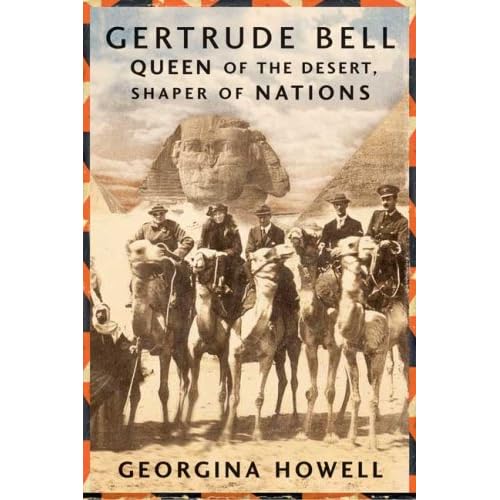
How many of you know it was Gertrude Bell? Well I know my friend Sara does, but that doesn't count because she knows lots of things ordinary people don't. I certainly didn't and I was truly awestruck by the personal and political endeavors of this Englishwoman, born in 1868, who scaled mountains, was fluent in half a dozen languages, did archaeology in her spare time, and truly was instrumental in the creation of the country today known as Iraq. The book is detailed and well written, with lots of notes on source materials, maps of her several expeditions in the mid-East, as well as a lengthy chronology, bibliography and index. Apparently vilified by some for her anti-suffragist views, she was personally one of the most intelligent, accomplished and influential women of her time. One only has to look at the cover of the book where she sites astride a camel in front of the Sphinx, flanked on one side by T.E. Lawrence (as in, Lawrence of Arabia) and on the other by Winston Churchill. Though she was passionately in love with several men during her lifetime, she never had a physical relationship with any of them and lived alone most of her adult life, much of of it in the countries of the Middle East that she loved so much. She admired and befriended Arabs of all religious sects, translated their poets, advocated for their right to self-rule, and eventually became a confidante and adviser to King Faisal. I only occasionally dip into biography and this one took me a while to finish, but it was well worth the effort, not only to learn about this amazing woman, but also to better understand the history of the area where we are making such a mess today. We are no better than the worst of the colonial powers who have played tug of war with these peoples' lands for centuries. The book is Gertrude Bell: Queen of the Desert, Shaper of Nations by Georgina Howell, published in 2006.