Friday, June 28, 2013

The Book of Illusions

A very smart and well-read friend of mine, Bob Nye, said that Paul Auster was one of his favorite authors because he was able to capture dialogue so well. This came up as part of a ranging conversation about books we had been reading, favorite authors, etc. So I checked into this Auster guy and turns out he has written LOTS of books and that our local public library had lots of them on the shelf. The Book of Illusions is about the disappearance of a silent film comedian, Hector Mann, in the late 1920's and about the academic, who, in contemporary times, took on a critical review of the comedies Mann made. David had recently lost his wife and sons in an airplane crash and was pretty certain he was going to drink himself to death; then one late night, in a drunken stupor, he happened to see a snippet of one of Mann's films on TV and it made him laugh--something he had not done in months and that he thought he would never do again. Having come into insurance money from the deaths of his family members--he was already on leave from his college teaching job--he undertook to find all the silent films Hector Mann ever made and eventually wrote a book about them. Some months after the book's publication, he receives a note in the mail, ostensibly from the wife of the same Hector Mann who was presumed dead all these years. Is it a hoax? There are stories within stories throughout this novel and indeed Auster is a master craftsman at writing. You will never fault him on style or structure and his prose is very readable. But these characters didn't move me in the sense of coming alive or evoking my sympathy or walking off the page. I may give another of Auster's books a try. He is a critically acclaimed author, after all, and I certainly respect my friend's opinion, so I should give him a second chance...not sure which one it should be, though...any recommendations?

Monday, June 24, 2013

Something Red

In spite of rave reviews in a number of sources, this novel by Douglas Nicholas never captured me in the sense of really compelling me to come back and find out what was going to happen next or wanting to know more about the characters. Set in medieval England, we join a small band of travelers, Maeve (aka Molly), her granddaughter Nemain, a adopted apprentice Hob, and Maeve's lover and ex-soldier Jack. Maeve is a healer who is always welcome along the route as her herbs and concoctions can ease pains and cure ills. Jack is strong beyond his appearance. Hob is an orphan taken in from a monastery by this small group. They travel with whatever others they encounter on the road--pilgrims, merchants, etc., but now some horrible beast seems to be dogging their path, killing indiscriminately. Maeve and Nemain also have some witch like powers to see beyond what is right in front of them and they know they are being stalked but can't tell by what. Fear has now become their constant companion. Little do they realize they have themselves already become bewitched and that what appears at first to be an impregnable shelter from the threat without has instead become a trap holding them all captive for the beast who is already within it's walls.  In spite of my lukewarm introduction, however, it was well-written prose with an abundance of historical detail, and for those who like the supernatural, a pleasant enough read.

Tuesday, June 11, 2013

Dead Ever After

This is it folks, the last of the Sookie Stackhouse series by Charlaine Harris. As I have said before, I love the characters in these books and thought the HBO TV series ("True Blood") based on them was just a terrible misrepresentation of characters--at least based on the 2 or 3 I could stand to make myself watch. I have actually "read" all 13 of these books, but mostly via audiobooks, which I highly recommend since the reader has a great southern accent! In this episode, Sookie gets unmarried from vampire lover, Eric, at the insistence of his new boss, the King of Louisiana. Eric was promised by his maker to the Queen of Oklahoma as a consort and is apparently pretty angry that Sookie did not use her magic wish, granted by her faerie kin, to release him from this contract. Rather she raised business partner, boss, and long-time friend Sam from the dead when he was killed in a big showdown between rogue werewolves and the established pack that occurred at the end Deadlocked. There seem to be several creatures out to get Sookie, and if they can't get her by framing her for murder, they may take a more direct route. But Sookie's friends turn out in force to stand up for her in court,  help find the real murderer, and protect her from dark forces. Pretty satisfying ending to the series, although I hate to see them all go, just as I hated to see the end of the Shakespeare series :-(

Thursday, May 30, 2013

City of Shadows

I picked up this book by Ariana Franklin, because I had been so taken with her medieval mysteries (see Mistress of the Art of Death and The Serpent's Tale) and was surprised to find this set in 1920's and early 30's Berlin. The "White Russians" have fled the Bolshevik revolution, the Communists and the National Socialists are in a no-holds-barred fight for the hearts and minds of the German populace that is being slammed by exponential inflation as the Weimar Republic staggers to its knees, and Jews are--as always--being blamed for everything. The criminals and thugs are prospering either through illegal activity or through gang violence, and yet people still long to believe in fairy tales, like the one about one of the Romanov children having escaped the slaughter of the czar's family. So when Esther Solomonova's boss, "Prince Nick," a corrupt nightclub owner, decides to rescue a woman from an asylum and pass her off as Anastasia, Esther is roped into the helping the young woman. Her objections to the fraud become secondary, however, when people around the fake czarina begin to die. Once again, we see how fear and complacency allow evil to blossom as Germany heads for the horrors of WWII and the purge of anyone non-Aryan, and non-conforming. Still, in spite of the grim historic situation, there is a bit of romance and a fairy tale ending to this one, so dive in and enjoy Franklin's rich attention to historic detail and character development. You'll need to suspend your disbelief a bit, but then we all do that every day, don't we?

Saturday, May 18, 2013

Death of a Kingfisher

One of the more recent installments in the Hamish Macbeth series from M.C. Beaton (2012 publication) finds Hamish still up to his usual tricks of solving the crimes while trying to stay under the radar--his goal being to avoid promotion, which might result in having to leave his cozy little town of Lochdubh. The murders seem to be a bit more bizarre (an elevator chair shot through the ceiling of an old hunting lodge) and grisly (someone's head cut off with a chain saw) than usual, but there are the more typical dirty tricks by Hamish's nemesis Blair, like hiding key pieces of evidence, and all the colorful characters we have come to know like the Currie sisters, Elspeth, and Angus Macdonald. The trouble seems to start when the town of Braikie hires an ambitious tourist director to promote a scenic plot of land called Buchan's Wood, which she promptly renames "Fairy Glen", and the tourists begin to flood in. But somebody apparently doesn't like this turn of events and hangs the iconic kingfisher bird whose image had adorned the promotional brochure, and then sabotages a bridge in the glen, causing several tourists to be injured. Hamish is torn between his attraction to the attractive tourist director, Mary, and his suspicion that she might be involved. And then there are the two strange grandchildren of the first murder victim, Charles and Olivia Palfour, who admit they wanted the old woman dead, but don't seem to have had the skills to pull off the murder. I think these books are better listened to than read because the usual reader, Graeme Malcolm, does a wonderful job with the pronunciation of local names and dialect, conveying the flavor of the place with even greater flair. These really are the perfect audiobooks for a car trip--entertaining but not so engrossing that you can't pay attention to where you're going--and we have listened to a lot of them over the years (e.g. Death of a Maid).

Monday, May 13, 2013

Wasp Factory

This first novel by Ian Banks got so many rave reviews that I put myself on the wait list at the library to get it, instead of just putting it on a list of books I would read later. BUT after 60+ pages, I am not going to finish it, even though it has been touted as "one of the top 100 novels of the century" by The Independent (result of a British poll) and "Brilliant...irresistible...compelling" by the New York Times. It is clear early on that this is a first person narrative by a pretty disturbed person and once he/she described using a home-made flame thrower to set a bunch of wild rabbits on fire, I was pretty much done. Although my curiosity was piqued about why someone turned out this way, it just wasn't worth it to me to spend the time in this twisted world. I also don't like to read/watch things like "Dexter" which is hugely popular, or "The Wire" but that's just me. The world is full of misery. Guess I have enough demons of my own that I don't need to seek out and become acquainted with anyone else's. Mr. Banks has written numerous other books, about half in the science fiction genre, perhaps they are not all so macabre. Moreover, I am a subscriber to  Nancy Pearl's "Rule of 50" which frees me of having to finish books I don't like after 50 pages (minus one page for each year my age exceeds 50). Too many books, too little time.

Shadow of Night
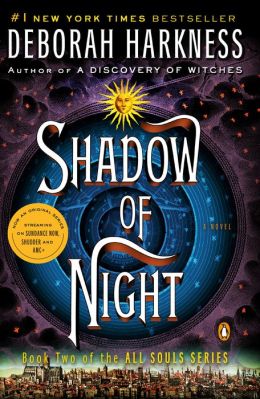
This sequel to A Discovery of Witches by Deborah Harkness was equally compelling if somewhat slower moving at times. Again, I could hardly bear to put the book down at night and was constantly trying to steal a few minutes whenever I could to read a few pages while waiting for appointments or in between tasks at home. This richness of detail obviously delights this history professor author and she describes the food, the clothing, the architecture, the bad dental hygiene and more of 16th century Europe so vividly that you can almost imagine yourself there. Diana has timewalked herself and Matthew back to 1590's England in search of the elusive manuscript, Ashmole 782, that they think might hold the secrets of the origins of current day creatures--vampires, witches, and daemons. They are also hoping to find witches who can school Diana in her newly unbound powers which contemporary witches seem to find threatening; Diana soon finds out why. She is one of a very rare breed of "weavers," witches who can create spells by weaving them from the threads of the world, not just being limited to following the spells already created. For centuries weavers have been revered, but also feared, and were eventually hounded nearly out of existence. Her father was one. In this book, both Diana and Matthew have the opportunity to reunite with their now dead fathers. Danger comes not just other creatures but from treacherous friends, relatives and political powers as Diana tries to shift from being a historian to being a participant in history. I can hardly wait for the 3rd installment in this trilogy.

Monday, May 6, 2013

A Discovery of Witches
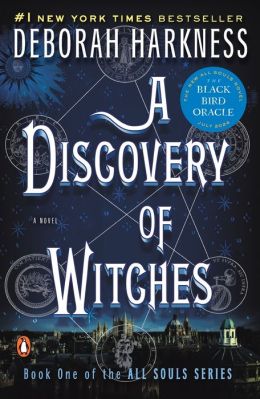
I have my friend Betsy Friedman to thank for beating me about the head -- uh I mean persuading me to read this book. It's the first book I've read in a long time where I had to force myself to put it down at night and turn out the lights to go to sleep. Rich, interesting settings and characters, including a house that communicates its wishes with groans and slamming doors, hides secrets until they need to be revealed, and spontaneously adds rooms when it's expecting guests. Obviously it is about witches, but also about vampires and daemons and how they have and have not gotten along--for centuries.  Author Deborah Harkness is a history professor at USC and has created two characters also steeped in history. The main witch character, Diana Bishop, is a historian of science, specifically interested in those who pursued alchemy. She has fought her witchy heritage all her life, believing both that it played a significant role in the brutal murder of her parents when she was aged seven, and that she needed to prove to herself that she could achieve academic credibility without using magic. And she largely succeeded at not using magic, until one day she calls up an old alchemical manuscript  from the stacks in Oxford's Bodleian Library and unwittingly unleashes pent-up floods of political maneuvering among the three groups of non-human creatures. An unlikely protector appears in the form of Matthew Clairmont--physician, professor, and ancient vampire, who has lived hundreds of years of history.  Their relationship may be the catalyst for an all-out creature war, or even an evolutionary tipping point. It becomes apparent to one and all that history and magical forces have been leading to this union for a very long time and yet there are those who will stop at nothing to make sure they do not survive together. I can hardly wait to read the sequel, Shadow of Night.

Saturday, April 27, 2013

The Gods of Gotham
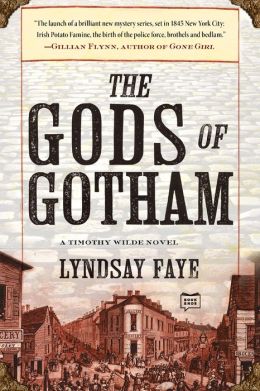
When a young boy's body is found in a waste bin with the front of his body crudely cut in a cross and several organs missing, the nascent NYPD, called "The Copper Stars" in 1845, are all hands on deck trying to find out why. This is a period of time when daily shiploads of starving Irish immigrants pour into a city that already has insufficient work and housing for them and the anti-Catholic sentiment is at burning point. Tim Wilde, younger brother of political wheeler dealer and now police captain Val Wilde, has reluctantly become one of the first crop of Copper Stars after an explosive fire burned his home, his decade-long savings, and part of his face. And it turns out he has a special talent--for observing things others miss--and that may make him especially useful at solving crimes rather than just preventing them, or so his new boss believes. On his way home from a particularly bad day, a small blood-soaked girl literally runs into Tim and instead of turning her in, he shelters her and finds that none of the blood is her own. Eventually he learns that she comes from a house that sells the services of children as well as women, and that several children have disappeared from there whenever a man in a black hooded cloak visits. With the help of unlikely allies, a mass grave of 19 children, probably all Irish, is found and it appears a serial killer is at work. A letter claiming responsibility for the murders is sent to the paper and threatens to stir the anti-immigration sentiment into a fiery riot, but the truth is much more complicated, as is the human heart. Great historical detail, vividly described and compelling characters all serve to make this an engrossing read. Several aspects of the ending definitely caught me by surprise.

Saturday, April 13, 2013

Voodoo River

With a title like Voodoo River, it's little wonder that this "Elvis Cole" installment by Robert Crais is set in the bayous of Louisiana. Normally I like to read a series in order, but I picked up a few paper backs to take to New Zealand and got hooked again on Robert Crais, so am kind of reading whatever I have on hand (see earlier reviews of Free Fall and The Last Detective). This one goes back to the time when Elvis met Lucy, then an attorney in Baton Rouge. Elvis is supposed to be tracking down the birth parents of a TV star, who it turns out, is being blackmailed about her parentage. Said star doesn't tell Elvis that and he finds out the hard way by running head on into the blackmailer and some even worse bad guys who eventually kill the blackmailer; they are also running illegal immigrants into the country. There are some pretty colorful characters here, including a centenarian snapping turtle named Luther who can bite a 2 X 4 (that's a board) into splinters and you just know he's going to be bad news. Pike comes out from LA to make sure Elvis comes out the other end of a high risk double cross designed to round up the  coyotes at the top of the food chain and get the blackmail victims off the hook. Lucy crowns Elvis with the moniker "Studly DoRight" in this book, and we meet her son Ben, so a lot of the material for subsequent books gets its genesis here...good one to read if you want to dive into these--and they are well worth reading. As I said in earlier reviews, there is a lot of actual detecting that goes on in this series.