Showing posts with label Middle East. Show all posts

Sunday, April 23, 2023

Wolf Trap


 I have not read anything by Connor Sullivan before and don't know if I will read his previous thriller, Sleeping Bear. In spite of very positive reviews for both of his books, I found his writing to often be clunky and he frequently used the wrong word to convey his characters' actions. The premise is that Brian Rhome, a former operative for one of the CIA's most clandestine services, has left the service and gone off the grid. Motivated by guilt because he led his team into a terrorist ambush, he is totally disillusioned with the powers that be, himself and the world in general. However he gets pulled back in by his godfather, also a member of Ground Branch, with the offer of being able to kill the man who slaughtered his team and at the same time possibly prevent an assassination attempt on the President of the United States. I will give the guy credit for creating an elaborate and eventually compelling plot and hope that his writing gaffes are just the result of bad editing. 

Publishers Weekly says of this book, "In this exhilarating thriller from Sullivan (Sleeping Bear), U.S. president Angela Buchanan is on the brink of a major political victory with the imminent signing of a sweeping international climate-change agreement....Sullivan's clever rhetorical tricks will keep even savvy readers in the dark while he ratchets the tension ever higher. By the end, readers will be exhausted, breathless, and eager for further Ground Branch adventures. Sullivan is a writer to watch." Booklist reviewer agrees that "it's a solid, well-crafted thriller that will keep readers turning the pages."

Wednesday, February 9, 2022

The New Girl


I always enjoy Daniel Silva's "Gabriel Allon" series books. I have dipped in at the beginning of the series (e.g., The Kill Artist), and also towards the end (The Order, The English Girl).This installment was published in 2019 so there were 20 that preceded it and 3 more since; he has another coming out this summer (2022). No matter where you start, the plots are always fast-paced and compelling and the characters well developed. As with others, this one is taken from recent headlines as a 12-year old girl at an elite private Swiss school goes missing and her father turns out to be none other than the crown prince of Saudi Arabia. Although the prince is a pariah in the media for the brutal murder of a journalist, and although he is a sworn enemy of Israel, Gabriel is convinced to take the case because he finds the crime so horrific and because, when push comes to shove, the Prince is a better alternative than the rest of the royal family. The Prince (KBM in this fictionalized account) eventually receives a demand to step down and remove himself from the next-in-line-to-the-throne spot or face the death of his daughter. Gabriel re-activates an American woman, Sarah Bancroft, a former CIA agent and now museum curator at MOMA, who is rumored to be KBM's private and secret art broker. Other characters from past books, along with their relationships to one another are important players here and one could justifiably feel one is missing background and context, but I didn't think it detracted significantly from the story.

Kirkus seems to think that Gabriel Allon is approaching the end of his literary usefulness as a protagonist. The New York Journal of Books proclaims it is "a decent spy story and little more...a story of international intrigue, fast cars, boats, planes, and high body counts." In contrast, Publishers Weekly concludes, "Silva delivers sharply drawn characters, a complex plot, and vivid backgrounds that add to the book’s realism, even if at times Allon’s own abilities seem too good to be true. Series fans will find plenty to like, and this is an excellent introduction for new readers." If you're seeking an escape from the woes of the world, read it and decide for yourself.

Monday, July 8, 2019

The Map of Salt and Stars

This novel by Jennifer Zeynab Joukhadar personalizes a years-long story we have been hearing about on the news--the Syrian civil war and the resulting refugee crisis. Her protagonists are both young teens, one the heroine of a story from the 12th century, Rawiyah, told to the other, Nour, by her father. Rawiyah disguised herself as a boy so she could apprentice herself to a famous map maker (an actual historical figure, al-Idrisi) and see the wider world. She accompanies him and his other apprentice on a journey through often-dangerously disputed territories of the Middle East as he seeks to create the first accurate area map at the behest of his patron, King Roger of Palermo. Nour's father used to tell her the story of Rawiyah in installments when they still lived in New York City--but that was before he died of cancer and her mother moved Nour and her two older sisters back to Syria to be closer to family.  However the Syria her parents knew has gone and been replaced by one experiencing escalating war and destruction. Their home in Homs is bombed and they are forced to flee with nothing but a few dollars. They end up paralleling the route of Rawiyah in their quest to find safety. Both tales are full of hardship, profound love and loss, as well as heroism and determination. The language is beautiful, the thoughts about life often profound-- and that is the one element that does not really seem to fit with the occasionally very juvenile behavior of Nour. Each section of the book that deals with the country they travel through is introduced by a poem in the shape of the country. So worth the read, however, because refugees fleeing inhumane conditions  have become such a big part of our national conversation. Reviews from The New York Times, Kirkus, and The Seattle Times.

Thursday, January 28, 2016

The Crusader

This is an historical novel by Michael Alexander Eisner (his debut as a writer of fiction) set in late 13th C eastern Spain and "The Levant," as the areas of the eastern Mediterranean were called. It is certainly a competently crafted novel in terms of character development, plot line, descriptions of setting. I have to ask myself, therefore, why it did not engage me.
Primarily, it was because I did not particularly like or empathize with any of the characters. The narration is primarily reported by a self-serving monk, Brother Lucas, at Santes Creus monastery, who has risen to the position of Prior (just below the abbot in the chain of authority). The main story line revolves around him being assigned to "exorcise" a crusader, Francisco Montcada, who has returned to Spain from The Levant after fighting and being subsequently imprisoned, and is now apparently possessed. Once Francisco begins to talk again, the bulk of the tale is his report of what happened while in Syria (Toron, Krak des Chevaliers, and Aleppo). Francisco was trained to an order of monastic Knights by a family friend, "Uncle Ramon," the leader of the Knights of Calatrava. When Ramon is betrayed by the King's son, Don Fernando, at Toron and dies, Francisco and his cousin and fellow Knight, Andres, are devastated. In a subsequent and futile  battle to save the fortress at Krak des Chevaliers, these two are also betrayed and traded to the Saracens by Don Fernando in exchange for the freedom of the remaining fighters. Andres is eventually beheaded with many of their fellow prisoners, but Francisco is finally ransomed and returns home a broken man. Brother Lucas is encouraged to bring Andres' sister, Isabel, to the monastery to tempt Francisco back to life and the light. Don Fernando, who had thought both of the knights dead, shows up and tries to murder Francisco, but is killed instead. Lucas, Isabel, and Francisco are exiled to Isabel's family home, Girona. So, in sum, we have a rather unlikable monk, a really nasty bad guy, and a guilt-ridden Crusader. Meh.
The historical events are described in rather grisly but not very enlightening detail. That is, I learned more about the cruelty of the warring parties than I did about the actual setting or events. I will often be engaged in a book if I feel I am learning new and interesting things about a period of history. I guess I have already such a jaded view of organized religion, and certainly of the Crusades, that it did not apply here.
I was curious to see how things turned out and, although the ending seemed realistic, it was not compelling. In short, I would not read this book again or recommend it unless you are particularly fond of reading about the Crusades. One reviewer summed it up by saying, "I found myself just wanting to get it over with." A somewhat more flattering review is offered by Kirkus, a source I generally find to be reliable and similar to my own.

Monday, November 18, 2013

Lawrence in Arabia: War, Deceit, Imperial Folly and the Making of the Modern Middle East


Quite unlike me to read two non-fiction books in a row, but this book by Scott Anderson received excellent reviews, including in the NYT Sunday Book Review. It is a fascinating story about four players in the Middle Eastern theatre of WWI, although mostly focused on T.E. Lawrence. The others were: the American  William Yale (yes THAT Yale family) who was manipulating events to get oil concessions for Standard Oil; Aaron Aaronsohn, a Jewish agronomist, who occasionally worked for the Turkish government, but whose driving goal was a homeland for the Jews--to which end he set up a Jewish spy ring informing the British; and Kurt Prüfer, German spymaster. Lawrence is a particularly complex character and yet seemingly the only one of the four who had any significant degree of understanding of and empathy for the native peoples of the region. The countries involved in this war, and those who made the big decisions, are shown as largely either clueless, incompetent, egomaniacal, racist, classist, self-serving or all of the above. Working for British intelligence services in Cairo, Lawrence repeatedly tried to guide war efforts to maximize on resources on the ground, and minimize losses. He was continually ignored. Gallipoli is one astounding example of total and continuing military incompetence that cost nearly half a million lives. Finally Lawrence began ignoring orders more blatantly, revealing secret information to his Arab allies about the Entente's multiple acts of deceit. He worked with the Arab approach to fighting to eventually become one of the most devastating destructive forces against the Ottoman Empire and the Central Powers in that part of the world. By many of the higher ups in the British military and government, however, Lawrence was never seen as more than an insubordinate meddler. 
I actually had to return the book or face a fine but will recheck it to finish the last few chapters I missed. Whether or not you are a history buff, this book is worth reading to increase one's understanding of how the rest of the world (Europe, England, Russia, the U.S.) has been, for the last 100 years, mucking around with the Middle East . No wonder they distrust, dislike, and even hate us; we have never acted in their interest, only for our own. I consider it a gross oversight on Anderson's part not to have had any discussion of Gertrude Bell, who was also a major player in the Middle East around this time, and had dealings with Lawrence.

Friday, July 26, 2013

Alif the Unseen

G. Willow Wilson--graphic novelist and author of Seattle Times "Best Book of the Year" The Butterfly Mosque--has here turned her hand to an intriguing combination of dualing computer programmers and supernatural beings (jinn, demons, marid and others). Set in an unnamed City of an unnamed country in the Middle East, this is a world strictly structured and controlled by a royal family with powerful censors who monitor every communication. Alif, the cover name for a person who helps anyone trying to hide from the government censors--collectively known as "The Hand"--has generally been successful in keeping his clients a step ahead of trouble and out of jail. Then one day his life begins to unravel. The woman he has secretly loved, slept with and married--Intisar--has told him she is promised to another by her father, and wishes no further contact. As revenge, he develops a program so that she cannot find him online. But "The Hand" intercepts and turns the unique identifying algorithm against Alif's clients. Suddenly, Alif is on the run and everyone who knows him is in danger from the secret police as well. The wild ride that Alif and his long-time childhood friend, Dina, begin will involve seeking help from not-quite humans, imprisonment and torture, and finally full-blown revolution. This book is very timely given events in the Middle East. This book has been compared to works by Neal Stephenson (see Cryptonomicon or Snow Crash) or Philip Pullman (e.g., Golden Compass) and certainly the creation of detailed alternate worlds merits that. But it is unique in its focus on the world shaped by this particular culture and set of beliefs.

Sunday, October 21, 2007

Who made Iraq?


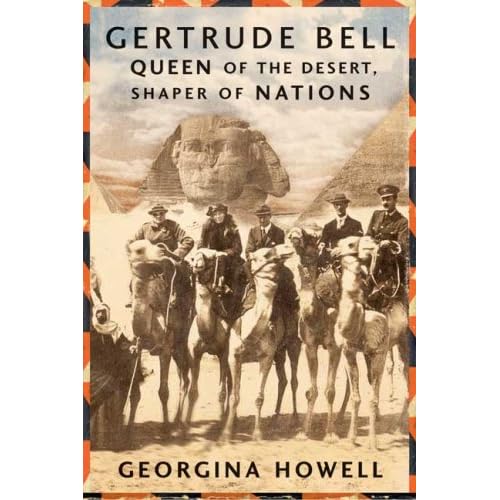
How many of you know it was Gertrude Bell? Well I know my friend Sara does, but that doesn't count because she knows lots of things ordinary people don't. I certainly didn't and I was truly awestruck by the personal and political endeavors of this Englishwoman, born in 1868, who scaled mountains, was fluent in half a dozen languages, did archaeology in her spare time, and truly was instrumental in the creation of the country today known as Iraq. The book is detailed and well written, with lots of notes on source materials, maps of her several expeditions in the mid-East, as well as a lengthy chronology, bibliography and index. Apparently vilified by some for her anti-suffragist views, she was personally one of the most intelligent, accomplished and influential women of her time. One only has to look at the cover of the book where she sites astride a camel in front of the Sphinx, flanked on one side by T.E. Lawrence (as in, Lawrence of Arabia) and on the other by Winston Churchill. Though she was passionately in love with several men during her lifetime, she never had a physical relationship with any of them and lived alone most of her adult life, much of of it in the countries of the Middle East that she loved so much. She admired and befriended Arabs of all religious sects, translated their poets, advocated for their right to self-rule, and eventually became a confidante and adviser to King Faisal. I only occasionally dip into biography and this one took me a while to finish, but it was well worth the effort, not only to learn about this amazing woman, but also to better understand the history of the area where we are making such a mess today. We are no better than the worst of the colonial powers who have played tug of war with these peoples' lands for centuries. The book is Gertrude Bell: Queen of the Desert, Shaper of Nations by Georgina Howell, published in 2006.