Showing posts with label Japanese Americans. Show all posts

Sunday, October 7, 2012

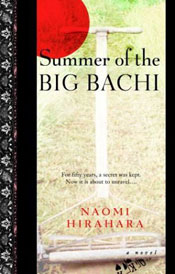
Summer of the Big Bachi

This is the first in a series of books by Naomi Hirahara that feature protagonist Mas Arai. I would almost say, the anti-hero, Mas Arai, because at least in this first book, I did not find much to like about him. He was 15 years old and living in Hiroshima the day the bomb was dropped. He survived physically but many around him did not and he lives with the images of the dead and dying and with the things the survivors did that are hard to reconcile. Some people did overtly bad things, others--like Mas--just failed to do things that in retrospect they wish they had. Bachi is a little like karma and Mas' has come back to bite him one fateful summer in his 69th year. He lives in Altadena and has made his living as a gardener, marrying Chizuko, and then sending their only daughter, Mari, to Columbia. But he is neither a very good husband or father, since he keeps secrets, hides his earnings and spends them on the races, and is generally emotionally unavailable to either spouse or child. His wife has since died of stomach cancer and he hasn't heard from his daughter in a long time. In fact, it is only through a friend, who has a daughter the same age, that he learns his daughter is married and pregnant. The big secret that Mas has kept all these years is that his pal Riki Kimura left their friend, Joji Haneda, to die and stole his papers so he could escape to the U.S. at the end of the war, and has been living under that name ever since. Now someone is looking for Joji Haneda and bad things are starting to happen. When a young Japanese man, claiming to be the grandson of Riki Kimura and Haneda's sister, Akemi, also comes to town and starts snooping around, Mas is reluctantly dragged into sorting things out to prevent an even greater miscarriage of justice. This is an intriguing glimpse into the 1st, 2nd, and 3rd generation Japanese American culture in southern California.

Thursday, September 6, 2012

Hotel on the Corner of Bitter and Sweet

     Prejudice comes in all forms and this is a book about some of the terrible consequences of the stereotypes, ignorance, cruelty and discrimination that can be engendered by such prejudices. This novel by Jamie Ford tells the story of Henry Lee from the perspective of two times in his life--one when he was 12 years old, at the beginning of WWII, and involved in a forbidden relationship with a Japanese friend, Keiko Okabe, and the second when he is a widower in 1986. In 1942, Henry is enrolled in an all-white school in Seattle because his parents want him to integrate and get ahead in a way that wouldn't happen if he stayed in the all-Chinese schools. They don't seem to understand the daily torments and bullying he must endure not only from the students but also from the teachers. And then one day, a Japanese girl also come to the school, and because she is also a "special student," she is  put to work in the cafeteria at lunch times alongside Henry and they soon become fast friends. Henry's parents, and especially his father, hate the Japanese based on the historical transgressions of the Japanese against China, so they are pleased when the entire population of Japantown, including Keiko's family, are loaded onto trains and shipped to prison camps. Henry finds a way to visit Keiko's family at Camp Minidoka but then loses touch with her until decades later when the basement of the Panama Hotel is opened by a new owner and Henry is confronted with memories of his lost love.
     I am to this day amazed that I graduated from high school in California and never read a word in any of the history books about the internment of Japanese American citizens, most of which took place on the west coast. It wasn't until I started reading children's and YA books that I learned about this shameful episode in our history. Cynthia Kadohata's Kira Kira won the Newbery in 2005 with its account of the continuing prejudices against Japanese Americans after the war and seemingly the floodgates opened for numerous other accounts targeted to children and teens: Kadohata's Weedflower, Allen Say's Home of the Brave, Virginia Euwer Wolff's Bat 6 are some of my favorites.
     This book was enjoyable to me partly because it was set in Seattle, where I lived for 18 years, so I recognized many of the landmarks. The Panama Hotel, which was bought up and renovated in the 1980's, actually existed and was really found to contain the belongings of dozen of Japanese families who had been summarily imprisoned and lost their homes and businesses.  Pioneer Square and Bud's Jazz Records are also real places. The "Author's Note" at the end details the factual elements of her story.