Tuesday, March 24, 2009

Another book I didn't finish


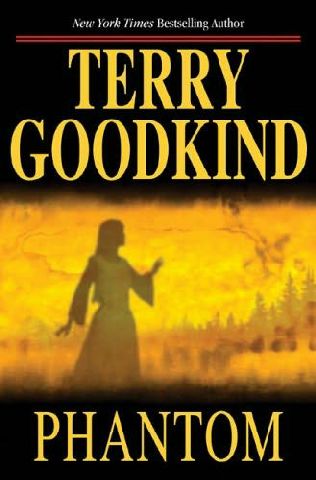
I hardly ever stop reading part-way through, so it was with heavy heart that I laid aside Phantom by Terry Goodkind, a respected fantasy author. I am a big fan of the genre that involves alternate worlds told in saga like format (think LOTR or The Golden Compass) but this one was just too ponderous. It suffered from lack of good editing in my personal opinion. Maybe if it had been told in half the number of pages I could have stayed with it, but each event seemed to be belabored endlessly, much as I am doing now with this non-recommendation. The premise is interesting enough. The phantom is a woman who has disappeared from everyone's memory as a consequence of evil machinations to control powerful tools of magic. But it's only part of a chain of events that are unwinding the power of magic throughout the world, leaving it vulnerable to a takeover by a life-negating philosophy and army. The particular religious order that fuels this destructive force rings remarkably similar to most organized religions that have been used to wreak havoc on a massive scale through the course of human history. The book is also rife with detailed explanations of magic that are too complex for someone jumping in without being grounded through prequels. The last chapter sets it up for a sequel, but don't think I'll go there.

Saturday, March 7, 2009

Bangkok Tattoo


I was so intrigued by the worlds revealed in John Burdett's other two books (see Bangkok 8 and The Last Six Million Seconds) that I came back for more. This is the sequel to Bangkok 8 and continues with protagonist detective Sonchai Jitpleecheep of the Royal Thai Police Force, who is now a partner (with his mother and his commanding officer, Commander Vikorn) in a brothel that caters to older foreigners--they can get Viagra and dope for just a small extra fee. Predictably, the book opens with a grisly murder--this time of an American CIA agent--but I won't try to convey the elaborate plot except to note that the prime suspect is one of the brothel's star employees and a soul mate of Sonchai's. He is sure they shared a former life, so he is determined to find out if she in fact committed the murder --which she neither denies nor admits--and if so, why. What keeps me engaged are the occasional insertions of a uniquely non-American (sometimes Thai/ Buddhist, or in this book occasionally Muslim) perspective on the events and characters. Some examples:
  • In speaking to Sonchai about the dead agent, a Muslim imam who knew him says, "The Western mind is wild and unpredictable, devoid of center. You Buddhists have your nirvana, we have Allah, even true Christians have a path of sorts, beset though it is by childish miracles. But what of these products of Capitalism like Mr. Turner? Human souls locked out from God forever. One hears their screams of anguish even while they drop their bombs, these young people who have no idea who they are. They think they are killing others. They are killing themsleves" (p. 53).
  • Later, through his son, the imam also says, "...without a war [speaking of the 'war on terrorism'], America would descend into total confusion and would have to turn itself into a police state to survive, because its people no longer have any internal structure. Americans can never be defeated by war. It is peace they find intolderable" (p.73).
  • In her diary, Chanya, the prostitute and suspected murderer, notes during her time in America that "Even bag people walk with purpose and energy and with total certainty about the direction they want to go in...They don't know where they're going, they just know how to look as if they do. They walk like that because they're scared. Some demon is whipping them from inside." (p.173).
  • Another CIA agent who is investigating the murder, says in a drunken entreaty to Sonchai, "Freedom? What kind of dumb all-purpose Band-Aid is that? ...what are we selling exactly? Money is the state religion of the West. We pray to it every waking minute--and we're gonna make damned sure every last human on earth gets down on their knees with us . All our wars are wars of religion" (p.202).
  • Finally, Sonchai himself, listening to one of his favorite radio talk shows, begins to rant about how far we are from enlightenment, "You see dear reader, you are a ramshackle collection of coincidences held together by a desperate and irrational clinging, there is no center at all...In a bumper sticker: The fear of letting go prevents you from letting go of the fear of letting go" (p.214).
This one took a little more determination to keep going, but it was worth the effort.

Wednesday, February 25, 2009

Gertrude Bell -- revisited


This is NOT a book review, although it is related to my earlier book review of Gertrude Bell: Queen of the Desert, Shaper of Nations. This website is a collection of primary source materials--pictures, letters, etc.--from and about Gertrude. She is definitely one of my heroines, right up there with Amelia Earhart and Eleanor Roosevelt. They were so brave in ways I wish I was. Here's the review from Choice (authored by S. Kowtko from Spokane CC) which pretty much says it all: "The Gertrude Bell Project is a representative example of the future of Internet research and primary source access. The University of Newcastle upon Tyne Robinson Library worked for four years to complete the transcription of manuscripts and recatalog and digitize photographs to make this resource available to the general public through a basic, user-friendly Web site. The goal was not to analyze and interpret the masses of documents left by Gertrude Bell, but to make a full digital collection available to those who could use these sources for their own academic pursuits. As a female traveler at the turn of the century who did not stick to standard patterns of Western travel, Gertrude Bell's life and experience offer researchers a unique look through Western eyes at the world, especially the Middle East. With over 1,600 letters to her parents, 16 diaries, 7,000 photographs, and other miscellaneous items, this archive is a rich resource quickly becoming fully digitally available. The layout of the home page consists of a short introduction to Gertrude Bell and her life, as well as links to the collection itself. At the bottom of the page, there are links to a help page, the photos, the diaries, and the letter collection. The help page is an especially useful and rather detailed introduction to the storage, layout, and presentation of the archival material. The search option is also basic, but useful if users have an idea of the subjects they are looking for in the documents..."

Wednesday, February 4, 2009

Goodies for word sluts

I'll tell you right (write!) now that this is NOT a book review, but I justify putting this here because I'm convinced that at least part of my addiction to reading is word lust.
Lake Superior State University is known for its annual List of Words to Be Banished from the Queen’s English for Mis-use, Over-use and General Uselessness. Read people's comments about why they want to send the words/phrases packing.
On the other end of the spectrum, is Wayne State University's endeavor to revitalize underused words of merit, Word Warrior. You can engage in an abecedarian activity byreading through the whole list.

Thursday, January 22, 2009

Plum Spooky


Just like all the men in her life, you have to love Stephanie Plum, Janet Evanovich's indominable protagonist because she's just so...well...spunky. She never lets her lack of skill or penchant for being in the wrong place at the wrong time get in the way of pursuing those pesky FTA's (failure to appear) that are the source of income for a bounty hunter. Something always blows up, her car always gets trashed, there are always too many gorgeous sexy men vying for her attention, Grandma Mazur and other incredibly weird and wonderful characters always make you laugh. How can you argue with a formula like that. The main hunk in this book is one I hadn't met before--Diesel (with no last name). He has an uncanny ability to open locked doors, start cars without keys and just general spooky things ordinary humans can't. But his cousin Wolf, who Diesel is hunting, and who is hunting Stephanie for not good motives, is even spookier. He can kill just by touching you, so you don't want to piss him off. Have fun--I did!

Pillars of the Earth


I haven't read Ken Follett in a very long time (think Eye of the Needle, or Key to Rebecca) but I wanted something that would last the length of time I had to spend in airports and planes while travelling in December, and this certainly met the bill. You would have to say this is a "meaty" work with substantial amounts of detail, not just about the political maneuverings during this time period (England from 1123 - 1174), but about the nitty gritty of how to build a cathedral. I certainly can't fault Follett on his research, but I did feel bogged down occasionally. You did truly come to know the characters and there is quite a cast, including some wonderful strong women who broke the mold and paid the consequences; however, I doubt that they would have chosen to try and conform if they had it to do over. Some wielded power by manipulating men, some by gaining money, and some by withdrawing from general society. Apparently there is now (18 years after Pillars) a sequel to this work called World without End.

Monday, December 29, 2008

My Cat Saved My Life

Why would you read this book? Have you ever lost a loved companion, parent, sibling, friend? Perhaps you felt that societal restrictions on how you grieved didn't really provide sufficient room for your experience. Have you ever believed that soul is not the exclusive realm of humans? Have you ever been lost in a well of depression so deep that the light cannot reach you? Do you occasionally believe that animals know more about living than we (humans) do? Then this account will resonate with you. This heartfelt little book is written by Phillip Schreibman, who lost his emotional and spiritual footing following the deaths of his father and then his mother. He describes better than anyone I've read what it is like to experience someone dying. " A miracle of experiences, hopes, stories, thoughts, a way of smiling, a voice, vanished in the smallest fraction of a second." One minute they were there and the next they were not. "Now all the parts of me where my day-to-day living had once entwined with theirs were reaching out into nothing." But then he rescued a six-week old kitten and she, in turn, rescued him.

Wednesday, December 10, 2008

Love Walked In


At first you'll think that love walked into Cornelia's life and coffee shop in the form of a Cary Grant look-alike. She really wanted to be in love with Martin Grace because there were so many things to love about him. But the real fall comes when Cornelia meets Martin's estranged daughter, Clare. I'd be surprised if you don't fall in love with Cornelia as I did, and for the same reasons she fell in love with Clare -- because she's thoughtful, emotionally courageous, ultimately stays true to herself, and is willing to risk it all for what she wants. The characters are occasionally quirky, very well drawn, enormously endearing. We are reminded that, whether in families, friendships, or love affairs, there is no happiness without some cost, but it's usually worth it. Set predominantly in Philadephia, punctuated by delightful dialog and frequent classic film references, this first novel from Maria de los Santos is a most satisfying read.

Tuesday, November 11, 2008

Evil Genes--a plunge into non-fiction


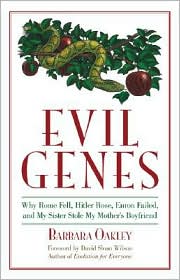
The full title of the book is Evil genes : why Rome fell, Hitler rose, Enron failed and my sister stole my mother's boyfriend by Barbara Oakley. Although she deals with some genetic research, this is primarily an overview of the research on the neurophysiology and neurochemistry of various psychiatric disorders. Personal anecdotes are sprinkled throughout as her interest in the area did come from her puzzlement over her sister's often amoral and Machiavellian behavior. She focuses initially on the development of the construct of Machiavelliamism and then moves on to its relationship to various personality disorders, e.g., narcissistic, borderline, sociopathic and psychopathic disorders. She has separate chapters on Mao Zedong, Adolf Hitler, and Slobodan Milosevic. She posits that some personality disorders may actually be adaptive, helping certain people rise to the top and gain the power and influence to expand their gene pool. She has lots of interesting side notes on things like the neurobiology of religiosity and political beliefs. Her background is as a systems engineer and she does a reasonably good job of bringing some diverse areas of research together, but it is dense and technical reading and I wouldn't recommend it unless you yourself feel compelled to learn more about someone you think might be personality disordered. Her conclusions are that people really are determined more by inheritance than nurture--undoubtedly a comfort to parents/family of those with serious personality disorders. And so I am reminded that people do not change awfully much, and that wishing they would behave differently is just that--wishing.

Back to some old favorites -- Candace Robb

I thoroughly enjoy the Own Archer and Lucie Wilton series, partly because they are a series and the characters develop over time and you feel like you get to know them. I haven't actually read the immediate predecessor (A Gift of Sanctuary) to A Spy for the Redeemer, which apparently sets Owen off to Wales in the company of his father-in-law, Lucie's father. In this book, the impending revolt of Welsh rebels confronts Owen with his conflicting loyalties -- England vs. Wales. A mysterious suicide involves Owen directly with the various political factions and delays his return when he is ordered by the local Archdeacon to investigate. His long absence raises doubts in Lucie as well about Owen's love and commitment to her and their children, especially as rumors begin to circulate that Owen has joined the rebels. She is tempted by attentive men, some with good motives and some not. Lucie is distraught to learn her father has died on the trip and when she goes to check on his estate, run by her aunt, robbers attack, leaving Lucie unsure of what to do. What I like in general about historical mysteries--at least well-done ones like Robb's--is the opportunity to really get a feel for the events and settings and day-to-day lives of the people in a particular time and place, in this case, 14th C England (York especially) and Wales. Graduate work in medieval literature launched her interests in writing about the period and her literary career.