Monday, March 21, 2022

The Christie Affair


Nina de Gramont offers a very different take on the 11 day disappearance of Agatha Christie in December of 1926. Ostensibly told from the perspective of Christie's husband's (Archie) mistress, Nancy Neele (known as Nan O'Dea in the book), we are led to believe that both women disappeared at roughly the same time, that they somehow ended up in the same small resort town (Harrogate, and that their paths crossed and they became friends -- sort of. In real life, her disappearance remains a total mystery as she never spoke of it after she was found by one of the largest manhunt's in England's history. According to the Washington Post,  the most likely explanation has been offered by Christie biographer Gillian Gill. "Christie registered at that Harrogate spa under the alias “Teresa Neele.” In so doing, Gill says, Christie cleverly found a way to publicize the last name of her husband’s mistress at a time when discretion dictated that her existence be kept private."

In this book, the mistress has become a calculating and strategic actor with one goal in mind--to displace Agatha Christie as Archie's wife. We learn why through interspersed flashbacks about Nan's early life. Archie did in fact divorce Agatha (who later remarried) and marry Nancy Neele. Whether or not the reason Nan wanted to be Mrs. Christie is true, I don't know, but certainly the situation that she describes as a young pregnant woman sent off to a Catholic home for unwed mothers has lots of historical validity.  In their review, Kirkus praises the characters created and gushingly concludes that the book is "Devilishly clever, elegantly composed and structured—simply splendid." Likewise, Publishers Weekly calls it a "superior thriller."

Sunday, March 13, 2022

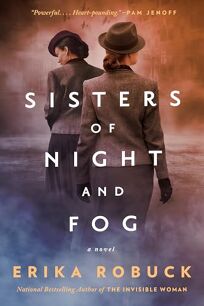
Sisters of Night and Fog


A fictionalized account of two women in the French resistance during WWII, one American and one British, written by Erika Robuck.  The author offers a note at the end telling how she came to write about Violette Bushel Szabo and Virginia d'Albert-Lake, and also details where her storytelling deviated from the actual people and events. There is also a biography which includes books written by Violette's daughter, Tania, and an edited version of Virginia's diary and memoir. It felt like a slow read at times, but was still compelling. So much of what the Nazis did during WWII are being seen again in the Russian attack on Ukraine. It's sickening at times, but one also has to admire the incredible courage of these women, both of whom ended up in Ravensbruck right after the Allies landed at Normandy. Only one of them made it out alive--barely. The Nazis were anxious to erase as much evidence as possible of what they had been doing at the concentration camps and many prisoners were summarily executed and cremated in the last days before the camp was liberated. Both men had married French men, Virginia several years prior and Violette during the war. At 19, Violette escaped France as the Nazis bombed and then invaded France, while Virginia never left. Virginia and her husband Philippe at first escaped to a small farm they owned in the country but knew they could not continue to hide; they began sheltering and escorting downed Allied pilots to various points along an escape route that would eventually get the pilots to Spain. Violette was anxious to do something useful for the war effort in spite of her father's, and later her husband's, objections and eventually was recruited to the SOE. I am reminded of other fictionalized accounts of these heroic women such as The Alice Network (Kate Quinn), The Paris Library (Janet Skeslien Charles),  and Kristin Hannah's The Nightingale. A hard but worthwhile read.

Publishers Weekly says "Fans of WWII dramas are in for a treat." BookPage praises "Violette and Virginia are two women whose stories needed to be told, particularly now that most of the people who fought in WWII are gone. Robuck has done their memory great honor."

Saturday, March 12, 2022

Peril


I hesitated to start reading this book written by Bob Woodward and Robert Costa, both of whom are familiar from the media--print journalism and print/ TV news/ analysis, respectively. This is the 3rd book in Woodward's "Trump trilogy" (preceded by Fear and Rage) and the first of the 3 with a co-author. But once I got started, I was fascinated. They interviewed over 200 people who were close to either the Trump administration or the Biden campaign--members of Congress (e.g., Nancy Pelosi), members of the military (e.g., Mark Milley), lawyers (e.g., William Barr), campaign organizers, etc. The last few months of the Trump administration were more rife with flagrant violations of norms and laws than even I imagined. The book opens with the revelation from Milley that he was in contact via back channels during the final days of the Trump administration to reassure them that the United States was not planning to attack China. This is how unbalanced and unpredictable many--in the U.S. and the world at large--had come to see Trump. It is overall a fascinating, somewhat terrifying, and very concerning read, especially as they conclude that the peril for American democracy is far from over.

NPR offers a lengthy review. In their review, The Guardian claims at one point that "In Peril, he [Trump] is indistinguishable from the Trump Baby, the diapered balloon that bobbed above Westminster during his state visit. As he suborns Pence to discount electoral results and nullify Biden’s win, his wheedling suggests dialogue overheard in a primary school playground."The LA Times calls the book "a damning--and tedious--portrait of American democracy on the brink." I still thought the book a worthwhile read.

The Tenant


This 2nd mystery in a series by Danish author Katrine Engberg fits the genre of Scandinavian noir and certainly kept my interest throughout. A young woman, 21 year old Julie Stender, is found murdered and mutilated in the ground floor flat of a house owned by a retired academic Esther de Laurenti. The elderly man who found her, the tenant on the floor above, has a heart attack after discovering her body. The owner, who lives on the top floor is trying to write a murder mystery and it appears that the murderer has somehow managed to read her manuscript and duplicated many elements of the characters and plots. 

Copenhagen police detectives Jeppe Kørner and Anette Wernerare assigned to the case and their relationship is a prominent element of the storyline. They are like "chalk and cheese" as the Brits would say, constantly rubbing each other the wrong way. Jeppe is divorced and had somewhat of a breakdown following his wife's leaving him; he still can't see a light at the end of the tunnel but is, nevertheless, back at work. Anette, on the other hand, is happily married and always jolly. Jeppe has become a scarecrow of a man, whereas Anette is always eating things that are bad for her.

Kirkus gives it a mixed but generally positive review, concluding "Overly familiar plot elements keep this from being a standout, and some twists require a significant suspension of disbelief, but Engberg’s fast-paced narrative is bolstered by an interesting and quirky cast as well as an intriguing setting. A bit over-the-top but still a lot of fun." Publishers Weekly likewise offers "The undertow from the overly ambitious plot drowns any sense of plausibility, but Engberg’s sparkling cast and palpable evocation of a society U.S. readers will find similar yet foreign keep the pages turning pleasurably."

Monday, February 21, 2022

A History of Wild Places


This is the first adult book by Shea Ernshaw, an Oregon YA author,  was a puzzler for a long time--it's almost 500 pages long--and I didn't know until near the very end if it was supposed to be about the supernatural or just humans behaving badly.  It opens as Travis Wren, a man riddled with guilt because he failed to find his younger before she committed suicide, has been asked to find a missing children's book author, Maggie St. James. She's been gone for 5 years, but Travis has a special ability to see people and events associated with objects. A silver book charm that was found near Maggie's abandoned car in northern California provides him with a trail to follow deep into the woods. When his truck gets stuck in the winter snow miles from the main road, he, too, disappears. The story then shifts to several years later and Theo and Calla are a married couple living in a run down farmhouse with Calla's younger sister, Bee, who is blind. They are part of an off-the-grid, self-sustaining community called Pastoral. The leader of the community is charismatic Levi, Bee's lover and, it turns out, the father of her as yet unborn baby. The community believes that their is a deadly disease that infects the woods that surrounds them and that, if they venture beyond the boundaries of Pastoral, they will also become infected and die. People who are caught going outside the boundaries of Pastoral are subjected to purification, being buried up to their necks, to determine if they have become infected. Bee's blindness has given her a hypersensitivity to sounds and she often attends the community's midwife at birthings because she can hear the baby's heartbeat. A baby born prematurely, who will die without medical intervention, precipitates a crisis in the community. Levi declares that one life must be sacrificed to protect the community, but the baby's father takes steps on his own to leave. Theo's job in the community is to watch the gate and make sure no one comes in and no one leaves, but he has an insatiable desire to go beyond the boundary himself. When he tells his wife that he has been going down the road beyond the gate during his night shifts, she is terrified he will die, but protects his secret. More and more secrets emerge until Calla and Theo come to realize that things in the community are not as they seem. Publishers Weekly says the plot "strains credulity, and the prose is often simplistic, but the twisty plot brims with tension." Booklist enthuses, "A richly embroidered tapestry deepens in hues as the story turns darker. Readers will sink into this one, and although they might question details of the resolution, they will be moved by the novel's power."


The Apollo Murders


Written by former Canadian astronaut and one-time commander of the International Space Station, Chris Hadfield, this thriller is set during the Cold War space race of the 1970's between Russia and the United States. It is full of interesting technical details about planes, rockets, space capsules and manned flight operations.  It includes lots of real people, places and events and an author's note clarifies what is fiction. Hadfield also worked as CAPCOM--capsule communicator--for 25 shuttle missions and as NASA's director of operations in Russia, so he has both front line and administrative experience with the U.S. and Russian programs. It is a wide ranging story with asides about people who salvage discarded rockets in Russia to support their families, the origins of the universe, and the horror of motion sickness induced vomiting inside an enclosed space suit. The premise is that the Russians have launched a new space station with enormously enhanced spy capabilities that would impinge on the secrecy of U.S. space efforts--i.e., creates a threat to "U.S. security." The final (fictional) Apollo 18 moonshot is re-tasked to investigate and disable the station in earth orbit before cosmonauts can be sent up to retrieve pictures. The astronauts on this mission are all former military. Additionally, the final destination on the moon is altered to land near a Russian moon rover to find out why the Russians are exploring that particular spot. The real drama arises even before blast off when the mission's commander is killed in a helicopter crash that turns out to be sabotage. I literally had a hard time putting this book down at many points. I thought the ending was a little abrupt and The New Scientist said, "the story comes across as improbable but not implausible." It still made for a compelling read. Kirkus criticizes the amount of technical detail in the early chapter but concludes, "Space nerds will geek out, and everyone else eventually gets a pretty good ride." Publishers Weekly, however, feels the details are important; "His mastery of the details enables him to generate high levels of tension from just a description of a welding error, which cascades into something significant. This is an intelligent and surprising nail-biter..."

Thursday, February 10, 2022

Every Dead Thing


This is the inaugural outing of Irish journalist John Connolly's "Charlie 'Bird' Parker" series of mystery/ thriller/ procedurals. The book won the LA Times "Book of the Year" (1999) and the Shamus Award for "Best First Novel" (1999) --a first for a book by a non-American author. It is long with two distinct storylines--causing Booklist to criticize it for "excess baggage." But in order to understand the rest of the series (and there are 20 books in the series), you need to know why Charlie Parker is the way he is; he is a recovering alcoholic with both a thirst for revenge--bloody if necessary--and a huge capacity for empathy. Parker is a former detective with the NYC Police Department, spending more and more of his life in a bottle, who comes home to find his wife and young daughter torturously mutiliated and very dead. The descriptions are graphic, so if grisly descriptions upset you definitely stay away from this book and this series. Two years later, he eventually sobers up and begins re-entering the stream of life as a private investigator of low-level crimes; then a former partner and NYPD asks him to help solve the case of a missing woman, which is part of a cover up for a ring of child abusers and killers. Parker never lets go of his quest for revenge even though he immerses himself in the search, and he gets aid from a strange quarter--a psychic Black woman in the swamps of Louisiana, who says the Traveling Man has come to her in her dreams and that he has already killed a young woman and left her in the swamp before killing Parker's family. Parker goes to Louisiana and hooks up with an FBI agent who is working the case. In both storylines, Parker must delve into history in order to find the perpetrators in the present, so the storylines are indeed complicated. But the characters are fascinating and Connolly kept me guessing until the very end about the identify of the killers. 

You can get more about the plot and characters from Kirkus. Publishers Weekly says Connolly's "prose rings of '40s L.A. noir, la Chandler and Hammett..." and that the "plot seldom falters and each character is memorable." I was hooked from the get-go.

Wednesday, February 9, 2022

The New Girl


I always enjoy Daniel Silva's "Gabriel Allon" series books. I have dipped in at the beginning of the series (e.g., The Kill Artist), and also towards the end (The Order, The English Girl).This installment was published in 2019 so there were 20 that preceded it and 3 more since; he has another coming out this summer (2022). No matter where you start, the plots are always fast-paced and compelling and the characters well developed. As with others, this one is taken from recent headlines as a 12-year old girl at an elite private Swiss school goes missing and her father turns out to be none other than the crown prince of Saudi Arabia. Although the prince is a pariah in the media for the brutal murder of a journalist, and although he is a sworn enemy of Israel, Gabriel is convinced to take the case because he finds the crime so horrific and because, when push comes to shove, the Prince is a better alternative than the rest of the royal family. The Prince (KBM in this fictionalized account) eventually receives a demand to step down and remove himself from the next-in-line-to-the-throne spot or face the death of his daughter. Gabriel re-activates an American woman, Sarah Bancroft, a former CIA agent and now museum curator at MOMA, who is rumored to be KBM's private and secret art broker. Other characters from past books, along with their relationships to one another are important players here and one could justifiably feel one is missing background and context, but I didn't think it detracted significantly from the story.

Kirkus seems to think that Gabriel Allon is approaching the end of his literary usefulness as a protagonist. The New York Journal of Books proclaims it is "a decent spy story and little more...a story of international intrigue, fast cars, boats, planes, and high body counts." In contrast, Publishers Weekly concludes, "Silva delivers sharply drawn characters, a complex plot, and vivid backgrounds that add to the book’s realism, even if at times Allon’s own abilities seem too good to be true. Series fans will find plenty to like, and this is an excellent introduction for new readers." If you're seeking an escape from the woes of the world, read it and decide for yourself.

Friday, February 4, 2022

The Russian Cage


Charlaine Harris' 3rd entry in the "Gunnie Rose" series, with a 4th book slated for release this coming August (2022).  The series is set in an alternate United States that has been divided and taken over by various entities, including The Holy Russian Empire (formerly California and the west coast). Bodyguard for hire Lizbeth Rose heads out from Texoma to the HRE when she learns that  her love interest, Eli Savarov, a grigori/ wizard  has been jailed under false pretenses as part of the political struggle for power between the Emperor and his half brother. While there, she reconnects with her newly discovered half-sister, Felicia Karkarov, who is also being schooled to use her magical powers...their shared father was a very powerful wizard (now deceased--killed by Gunnie Rose!). Lizbeth also gets involved with Eli's mother and two sisters and reconnects with an ambigous acquaintaince--friend or enemy--Felix, who's ability to reanimate the dead comes in handy. Felix and Lizbeth concoct a plot to get her an audience with the Emperor so she can ask for Eli's freedom. Barring that, they have to figure out a way to break him out of an impregnable prison. Strongly recommend reading these books in order--see post for An Easy Death and A Longer Fall.

Kirkus calls it "An entertaining addition to a consistently fun series."A positive review from Publishers Weekly. The Sun Sentinel calls Harris "a first-class storyteller."

Wednesday, February 2, 2022

Daughter of the Moon Goddess


This debut novel by Sue Lynn Tan draws from Chinese myths of dragons, gods and immortals.  This fantasy YA book received starred reviews from Library Journal ("an exquisitely detailed fantasy") and Publishers Weekly. ("a riveting page-turner"). Kirkus call's Tan's prose "lovely and fluid, [with] lush descriptions of magic and immortal life buoying the narrative."

BookPage also gave it a starred review and provides this succinct summary: "Xingyin has never met her father, a mortal archer who saved the human world from destruction. She is also the daughter of Chang’e, the infamous moon goddess who became immortal after drinking a potion that was given to her husband in recognition of his heroic deeds. Xingyin has lived a lonely life, hidden away in her mother’s sky-bound prison. That changes when she accidentally accesses her own magical powers and is forced to flee to avoid detection by the Celestial Emperor and his court. While on the run, Xingyin is thrust into the uncomfortable role of learning companion to the Celestial Prince, the son of the very man who imprisoned her mother. As she trains and learns alongside the prince, Xingyin is torn between loyalty to her new friend and the desperate desire to free her mother from her eternal prison."  Xingyin goes from a frightened adolescent to a formidable warrior through her training with Crown Prince Liwei and then as a soldier in the Celestial army. It is an elaborate world building book with the immortals portrayed as capricious--no surprise there--and the dragons as wise and benevolent beings. There are lots of hints about where the sequel of this story will go.