Thursday, November 18, 2010

Cat of the Century

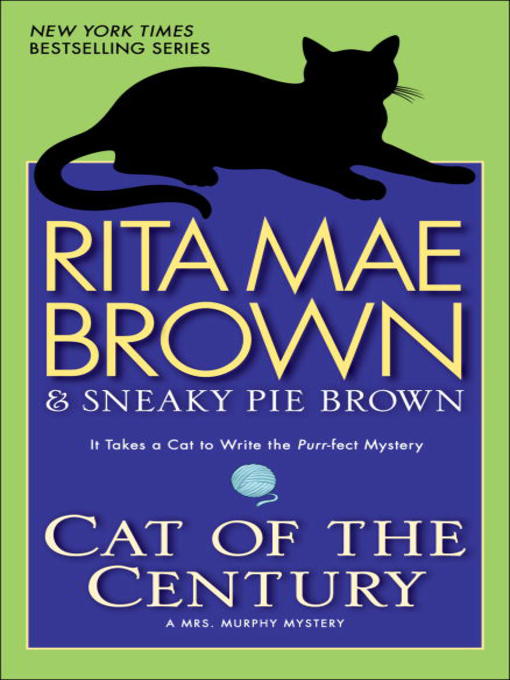
I was so infatuated with this series by Rita Mae Brown and Sneaky Pie Brown (her cat) when it first rolled out that I bought them all. I drifted away but when I saw her newest episode among the new audiobooks at the library, I grabbed it. What a disappointment. The polemics of her politics just weighed this down and overshadowed the thin thread of plot. Whether they were positions with which I agreed (humans are making a mess of the environment) or disagreed (all government and especially taxes are BAD), they were repeated so often and so pedantically--with no specific support for claims--that they just grew wearisome and eventually annoying. I am all for using literature to engage people through alternative and less threatening means in thinking deeply and sometimes differently about controversial issues. Carl Hiaasen's books for young adults that deal with ecological issues come to mind as good examples. But Brown has failed, both through her tone and her overly simplistic presentation of the issues. That being said, this book, like many of her other works, is a heartfelt and loving portrayal of her part of the country (Virginia) and offers an interesting cast of characters. Her early book, Six of One, is still in my top 10 list because it is so funny.

Saturday, October 23, 2010

The Cruelest Month

If you can get past the unlikelihood of three murders occurring in such a tiny Canadian village in as many years, this third Inspector Gamache installment in the Three Pines series by Louise Penny  is most satisfying. Gamache and his team are called in to solve a bizarre death --as with the two earlier mysteries, this one is connected with the old Hadley House which overlooks the village. It has fallen into disrepair after the murder of the last owner, and as Easter approaches, the villagers decide to try and exorcise the evil spirits of the place through a seance. Except that one of the seance participants is apparently frightened to death--literally . Or perhaps someone helped her along. The subplot about a colleague at the Surete maneuvering behind the scenes to fully and finally discredit Gamache is brought to a head as slanderous stories about Gamache's family appear in the press. The provocative Agent Nichol remains for almost  the entire book a question mark, although Lemieux reveals his true colors early on. The real traitor, who Gamache had called a friend all his life, realizes too late that his jealousy has destroyed one of the few things that ever brought him happiness, his friendship with Gamache.  Throughout, Gamache remains a truly human being with fears and failings, but with his integrity and compassion always intact. Would that we could all grow up to be as kind, as steady, as insightful as this man.

Monday, October 11, 2010

A diversion--Tell No One

Not sure who turned me on to this movie, and I don't usually talk about movies here, but this one was so good that I can't resist. I recognized Kristin Scott Thomas as a co-star, but given that it's a French film (with sub-titles) it's no surprise that my pedestrian experience does not include having seen the lead (Francois Cluzet) or knowing the director (Guillame Canet). It was suspenseful, action filled and tightly plotted. The cinematography was great. A physician whose wife was murdered 8 years ago has come under renewed suspicion from the police when two dead bodies are discovered on land near the old crime scene. Even though it seemed he couldn't and wouldn't have killed his wife, certain facts of the crime just don't add up. And now too many facts are starting to point to him as the killer of not only his wife, but the two dead bodies and a new murder where the evidence is found in his apartment. Altogether too tidy for at least one policeman's taste. The parallel story is that the doctor has received a video via e-mail showing his wife alive and well and 8 years olders accompanied by the admonistion, "tell no one, they are watching." Riveting and absolutely recommended.

Friday, September 24, 2010

The Mapping of Love and Death

This is the 7th in the Maisie Dobbs series, and I admit I have not read all the intervening ones--in fact I may have missed about 3 or 4 of them. That did not detract from my enjoyment of this audiobook, however, although I did get some surprises. In this installment, Maisie is well-established in her private investigator cum psychologist consulting practice. She is contacted by an elderly American couple who have recently learned that their son, who was MIA in The Great War, has been found, buried in a farmer's field. The remains of Michael Clifton and several of his fellow soldiers have been uncovered in a collapsed dugout. Although Michael was American by birth, his father was British and so, when the war starts, he heads for England to serve. Because he is a trained cartographer and surveyor, his skills are sorely needed and he is accepted into the British forces. His parents have also received a packet of letters that was on the body, apparently from a woman he was involved with, and they want Maisie to find her. They have come to Maisie at the recommendation of an American doctor with whom she worked during the war. Both Dr. Hayden and Maisie recognize from the post-mortem report, that something is amiss; for it appears Michael Clifton was bashed over the head--murdered--before the dugout was bombed. As with so many of her books, the plot is complicated but well-drawn, the creation of characters, place and time is faultless. It appears that someone does not want this mystery investigated, for the Cliftons are subsequently attacked in their hotel room and left for dead, and Maisie herself is attacked and her document case is stolen. Trusty associate, Billie, and Maisie both must deal with significant challenges in their personal lives as well. If you are a Maisie Dobbs fan, you won't want to miss this. If you're not a fan, get started with the first book so you'll become one.

Committed

I didn't even read Elizabeth Gilbert's book before I went to see the movie version, Eat, Pray, Love. I'm pretty sure every woman I know--at least all the ones I talked to--HAD read the book. But based on rave reviews of that book by friends, and a favorable impression of the movie, when my friend Marianne offered to loan me the follow up to that story in audiobook form, I took it. It is basically about Gilbert's year long quest to learn everything she could about marriage in order to come to terms with the situation faced by her and her partner, Felipe. For reasons unknown, Homeland Security decided at some point in their commuter relationship that Felipe could no longer come to the United States. Didn't matter that he was an Australian citizen, that he had done business in the United States for years. He simply couldn't return. And they found this out while on the way home to Philadelphia when he was detained and questioned for several hours, then imprisoned until he could be flown out of the country. The only option was for them to marry, but neither of them really wanted to, due to bad divorces from their first spouses, and it wasn't all that easy to get permission. So in the intervening months, while an immigration lawyer worked on the beaurocratic hurdles, they tried to live as cheaply as possible in southeast Asia, eventually returning to Felipe's previous home in Bali. But in the meantime, Gilbert engaged in an unrelenting research project, reading everything she could get hands on and interviewing every person she came across. And we learn what she learns. I was reminded at times of starting to read Karen Armstrong's A History of God. I realized afresh, in connection with this specific social institution, that what we know today, what people tell us has been the history of marriage, is but a small fraction of it's overall role in the course of human civilization. The reasons people marry have changed, who gets to decide who gets married has changed, even whether or not marriage is a good thing has changed. Contrary to popular religious rhetoric, the Christian churches originally sought to stop all marriage--and of course sexual behavior. The pace of the book ebbs and flows, and occasionally her dithering gets a bit tedious, but I learned so much at an intellectual level, and resonated so often at a personal level, that I wouldn't hesitate to recommend Committed. She writes wonderfully and that in and of itself is a treat.

Sunday, September 12, 2010

Blameless

This is the third installment in Gail Carriger's "Parasol Protectorate." Alexia Tarabotti, aka Lady Maccon, aka the Queen's (Victoria) muhjah, is up to her usual outrageous adventures, accompanied by a newish cast of protectors: Floote, her father's mysterious valet, and now Alexia's secretary, Madame Lefoux, the inventor cum milliner, along with assorted other members of the order of the Brass Octopus, and Major Channing Channing, in wolf form. Oh and let's not forget the "infant inconvenience" which (who?) seems, after all, to be at the very root of Alexia's problems. First of all he/she/it has precipitated Lord Maccon throwing her out of the manor and the pack, convinced of her infidelity; for no werewolf has ever sired a child. Her indiscreet sister has also made the situation the scandal of London society, resulting in the Queen's dismissal of Alexia from the Shadow Council. Secondly, this embryonic mystery seems to be the reason that the vampires have put on a full court press to kill Alexia. And then there are the Templars whose God given duty is to eliminate all supernaturals and who see Alexia as a potential weapon in their centuries-old battle--until they find out about her delicate condition. Alexia just wants to find out how this has happened, aside from the obvious "bed sports," and is determined to find some historical documentation to similar events so that she might convince her idiotic husband of just how stupid he is for believing she could be unfaithful. All sorts of steampunk inventions are used for good and evil purposes (e.g., poisonous mechanical ladybugs) and the amazingly versatile parasol created by Madame Lefoux saves their lives on more than one occasion. Lord Akeldama, usually Alexia's staunchest ally, has inexplicably fled London with his entire retinue of drones and so Alexia is forced to leave the country, in search of safety and of answers. But what she finds out may not be terribly comforting, for the unborn infant may be a rare breed of being not seen for hundreds of years. We will all have to wait to find out in the forthcoming book, Heartless.

A Fatal Grace

I am so well and truly hooked on this series by Louise Penny that, having finished this, the second installment of the Inspector Gamache// Three Pines mysteries, I feel like an addict in withdrawal . A little over a year has passed since Inspector Gamache came at Thanksgiving to solve a murder whose necessary ingredients had been simmering for decades. Now, at Christmastime, with the cold descending into killing sub-zero temperatures, repressed fury once again boils over in an incredibly complex and planful murder of the newest resident of Three Pines, CC de Poitiers. Everyone hated her, so the cast of initial suspects is large--her husband and daughter, her lover, the entire town. As usual, it all comes down to motive. CC is killed in plain view, at a curling match, by grabbing hold of an electrified lawn chair, sitting in a puddle of water on a frozen lake, without her gloves on--when it is freezing outside. No small feat, you will admit, to make that happen.
Intriguingly, the death of a homeless woman in Montreal may be intimately tied to this one, and serve to reveal who the murderer is. Three characters who played minimal roles in the first novel emerge as key witnesses here: Emilie, Beatrice, and Kaye. Along with the dead woman in Montreal, Elle, they all have names that can be reduced to letters: M, B, K and L. What a busy mind our author has. Like a snake curled around the base of the toilet, waiting to bite you in the butt, there is another line of trouble coiling around Gamache's life. The Arnot affair, mentioned only briefly in the previous book, is coming back to threaten him, although we do not find out exactly how that will happen in this book. We are surprised, in the end, at who is plotting against our dear Inspector. For he is irresistible, this thoughtful, compassionate, and highly ethical individual, who loves his wife and seems to consider himself a lucky and contented man. He cannot compromise for the sake of politics, however, and powerful forces hold this against him. Fortunately for me, there are more books in the series already out there, just waiting for me to get my next fix.
I don't entirely understand why, in this particular case, they needed to change the original title in England, Dead Cold, to A Fatal Grace. But under either title, you will be bound to fall in love with Three Pines, its inhabitants, and Inspector Gamache once you start reading.

Saturday, September 4, 2010

Patriot Acts

Not too hard to surmise from the title that this is a plot line where people who always thought they loved their country are challenged in that belief when their country appears to have turned on them. A later entry in the Atticus Kodiak series by Greg Rucka, Atticus has gone from being a reputable, competent bodyguard to being labelled as one of the ten most wanted assassins in the world, and the source of this misinformation seems to be someone very high up in the U.S. government. His partner and dear friend, Natalie Trent is killed in one of multiple attempts on his life, and so far his efforts to find out who is behind it all have fallen short. He has teamed up, romantically as well as professionally, with a former enemy, Drama, aka Alena Cizkova. They are alternately the hunted and the hunters, as they work to track down the master puppeteer, covering ground from a remote village in Russian Georgia to Portland, Oregon. In the process of their association, Alena has become more human, and Atticus has become a little more cold-blooded. Alena has taught him ballet and yoga as a way to master and control his body, and he needs every bit of this unorthodox training to survive what comes at him in this book.

Mystery Mile

Consumed a couple of audiobooks on my daily commute in the last 3 weeks. One, Death of a Celebrity, was another in M.C. Beaton's Hamish MacBeth series which I always enjoy. The other was by Marjorie Allingham, one of the British mystery dames I had heard a lot about but never actually connected with. Her protagonist, Albert Campion, is a complex and fairly bizarre character. His career is obviously one I have not been privy to follow as this book finds him well-ensconced in a flat above a police station, in the good regard of Scotland Yard, with a well-developed network of small-time and big-time criminal contacts. That all takes time to nurture. But his presentation is as a fop, for lack of a better word. He is frequently described as having a vacuous expression, engaging in the most meaningless and banal chatter, and yet underneath has a creative, calculating, and lightning fast mind that keeps him miles ahead of the really bad guys--at least most of the time. In this novel, he is hired to protect an American judge who appears to have evidence that would help identify the head of a major crime ring. Campion initially tries to hide him in the long-time home of a couple friends on a small isthmus in Suffolk, thinking that the small village is not only off the beaten path but also that villagers are likely to be acutely aware of any unwanted strangers in the vicinity. Nevertheless, it is only hours after their arrival that the first death takes place and plans must change. This is a satisfying mix: country cozy setting, a large cast of characters, some romance, and a fairly challenging plot. And of course very British. I'm not sure Allingham will replace PD James or Ngaio Marsh at the top of my list of British mystery writers, but I wouldn't mind meeting Mr. Campion again. There is a competent plot summary in Wikipedia.

Sunday, August 29, 2010

Still LIfe

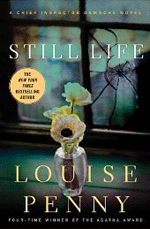
Oh boy I am in love with a new writer and can hardly wait to read more in the Inspector Gamache series. Still Life is the first featuring said protagonist by Louise Penny, set in the idyllic village of Three Pines, somewhat south of Montreal and just north of the U.S.-Canadian border. Inspector Gamache, of the Surete du Quebec, is called in to investigate what appears at first to be a hunting accident, except that no one has stepped forward to admit the fatal mistake. Jane Neal, retired school teacher and perhaps unrevealed artist, was beloved by all--or was she? Inspector Gamache methodically observes, quietly directs his team to investigate, and comes to the conclusion that this was no accident. The town is lovingly portrayed--I wanted to move there right away--with a diverse and well-drawn cast of characters. Inspector Gamache is a policeman with intelligence and integrity who surrounds himself with like-minded officers when at all possible. His insistence on following his conscience has apparently landed him in hot water with his superiors at the Surete and put some significant limits on his career advancement. Nevertheless, he adores his wife, has subordinate who admire and value him, and seems a contented man overall, rather than a tortured soul like one of my other thinking woman's mystery series' protagonists (Adam Dalgliesh mysteries, by P.D.James). One of the village locals, a retired psychologist and now used-book store owner (what a dream!) is used by Penny to reveal Gamache's penchant for understanding the motivation of crime. I've already ordered the next book, A Fatal Grace/ Dead Cold.