Thursday, October 22, 2009

A Whole New Mind


Ah, the beauty of bookgroups is that you read what you otherwise might not have. Let me admit right up front that I dipped and skimmed this book, but found it intriguing enough that I want to go back and re-read it. Daniel Pink is advocating for the development and employment of more right-brain directed types of activities in the work world, claiming that most of the left-brain directed stuff has been largely outsourced (computer programming, accounting, etc.) to developing nations where the labor is cheaper. He focuses on Empathy, Design, Symphony, Play, Story, and Meaning; he offers a bit of independent research, a lot of summarizing of other people's work, and some nice activities and resources at the end of each chapter. Some of the quote (almost all taken from other people) that I really loved are:"listening is an act of love" and "we are the authors of our own lives." He talked about labyrinths, and gratitude, and learning through stories...in short, a lot of things that resonated with me personally. I even got some good ideas to try out in classes and meetings and right now I'm needing all the help I can get with meetings. There's a 5 minute video of him talking about the book here.

Rough Weather


Oooohhh-- I sneaked a little indulgence in between all the reading I've been doing for review sources and writing projects of late. I haven't read a Robert Parker Spenser novel in ages and it was a treat. I just never get tired of Spenser's smart alecky remarks and his repartee with Hawk. Like the Evanovich novels, fairly predictable but highly enjoyable. In this book, Spenser gets hired to be a stand-in date for a seemingly wealthy woman whose daughter is getting married. His old nemesis, the Gray Man, shows up with several men toting automatic weapons and kills the security guards and the groom (right after the vows--that's significant) and then kidnaps the bride. The whole thing seems very staged and not at all consistent with the Gray Man's usual MO. Spenser thinks the mother of the bride knows way more than she's telling and he's trying to get to the bottom of things while not getting killed by the Gray Man. Hawk is enlisted as his back-up and straight man. There's more relationship between Hawk and Susan than I remember from previous books, which was also fun. It was a pleasure to get reacquainted!

Friday, September 25, 2009

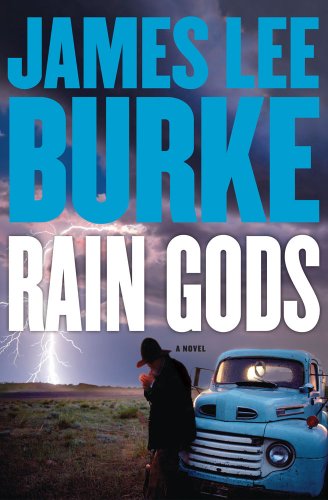
Rain Gods


I don't know why I have stayed away from James Lee Burke for so long. He is a master of character and setting and this book is no exception. Set in the Rio Grande borderlands of Texas, there are bad people out there killing Asian women behind an abandoned church and a few good ones like Sheriff Hack Holland who is bound and determined to bring them to justice. And the nature of justice is certainly a question at play here. Even the bad guy has his own "code"--somewhat reminiscent of the psychopath in No Country for Old Men-- but that doesn't mean you would want him to date your daughter. Hack is a pretty tortured soul after the death of his 2nd wife, trying to find peace in a simple existence that includes creating beautiful gardens in the inhospitable Texas hardpan. He carries a load of guilt for past transgressions both as a husband to his first wife and as a prisoner in a Chinese camp. Nevertheless, the people who work with him see his integrity and compassion and are drawn to him, in spite of his prickly stubborness. Human beings are complicated and so are their relationships; Burke's ability to draw you into knowing his characters is what sets these novels apart from lesser police/detective procedurals, much as with P.D. James' work. I was a big fan of the Dave Robichaux novels (Burke's earliest protagonist) and I think I will get to know some of his newer ones now that I've reconnected. This is a thoughtful book that takes time to read and digest, and it's worth savoring.

Finger Lickin' Fifteen


Stephanie Plum is at it again in the latest of the numbered series from Janet Evanovich. As I read in an interview with the author, she just can't decide whether Stephanie should go marry Joe Morelli and have lots of kids or live dangerously with Ranger, and that indecision is evident in this episode. True to form, Stephanie destroys cars--more than usual--and ends up in truly ridiculous and humiliating situations, like being in a hot dog costume and then falling over and not being able to get up. This time Lula is also setting things on fire in her quest to win the big barbecue contest with Grandma Mazur as her assistant chef. And as usual, the book is just laugh-out-loud funny, even if totally predictable. As long as she keeps writing them, I'll keep reading them.

Friday, August 28, 2009

Sworn to Silence


This is the first book I've read by Linda Castillo who apparently intends to write other episodes with the same protagonist, Kate Burkholder. Burkholder was raised Amish near Painters Mill, Ohio, and only left after a rape and a self-defense murder sent her off the deep end. She was shunned and ran away to the big city, but eventually found her footing, worked her way into law enforcement, and took a job back in her home town as chief of police. In this book, a serial murderer has resurfaced. She thought the person responsible for the first series of murders 16 years ago was the man she had killed as a young woman, but the MO is identical and so Kate is now uncertain--did the man she shot really die? Her siblings, who also knew of the death and were sworn to silence by Kate's parents, are dragged into Kate's conundrum about finding out if the man she shot is really dead before she brings in outside law enforcement agencies to help solve these new killings. The murders are absolutely grisly so if that isn't something you can stomach, stay away. But the character is engaging, place is well established and the plotting will keep you on the edge of your seat. And you get a little love interest, fairly predictable, in the end.

Saturday, August 1, 2009

The Sorceress

This is the third installment in The Secrets of the Immortal Nicholas Flamel series by folklorist Michael Scott (you need to read The Alchemyst and The Magician -- in that order before you read this) and I had imagined that it would be the end of a trilogy. No such luck! The Sorceress is Perenelle, Flamel's wife and she doesn't really figure any more prominently in this volume than in the previous ones. Nevertheless this is a fun read. All the action takes place in just a few short days, and nothing less than the continued existence of the humani (that's us) is at stake. The Dark Elders are bound and determined to re-assert dominance over the earth and they have summoned and collected every imaginable monster of myth and legend to move forward their plans. The first task is to get rid of Nicholas Flamel who is desperately trying to protect and train the "twins of legend", aka Josh and Sophie, who thought that they were just two ordinary teenagers living with an aunt in the bay area while their parents were on an archaeological dig. Now Sophie has mastered two of the elemental magics and Josh is learning as well. They battle the evil forces with their growing powers, with enchanted swords, and through sheer determination. Perry is trapped on Alcatraz with a whole array of creatures intent on her demise, the ghost of an old Spanish explorer who is trying to protect her, and a giant spider and a crow goddess who have become unlikely allies. Immortals in the employ of the Dark Elders have also been sent to kill her. Consequently, she is unable to assist in the action taking place in England as Flamel tries to reach the ley lines at Stonehenge that will return them to San Francisco before they are captured or murdered. William Shakespeare, Billy the Kid, and Machiavelli are just a few of the immortals who round out this colorful cast of characters.

Abide with Me


Written by Elizabeth Strout, Abide with Me tells the story of Tyler Caskey, who has come to be the minister for the small town of West Annette in upper New England. He loves God and his congregation, his wife and their daughters. But his wife does not take to small town life or to the confines of being a minister's wife. She spends more money on clothes and make-up than Tyler earns, refuses to socialize with the townsfolk, and then has the audacity to get cancer and die. Tyler goes from grief to depression, while his older daughter, Katherine, becomes mute and angry. His congregation also loses its way as his sermons become repetitions of old work rather than inspirations flowing from Tyler's former sense of grace and goodness in the world. Negative rumors about Tyler's behavior and his suitability as a father and minister are started as people imagine slights based on his unresponsiveness. People act badly and then pull themselves together. We are reminded that everyone has feet of clay and yet most of us are capable of tremendous compassion. The beautyof this book is in the small descriptive details, the pacing, and the ordinarinous of life made significant.

Dog Stories


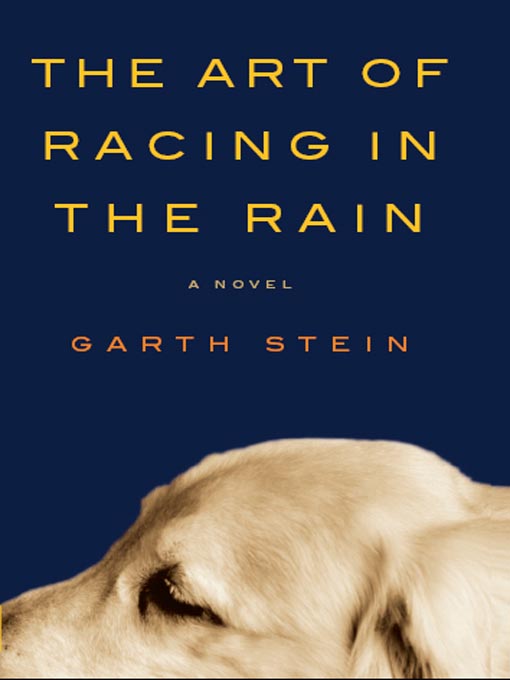
I've been on vacation and reading just for fun. My sister-in-law handed me a couple of books where dogs figure prominently: The Story of Edgar Sawtelle by David Wroblewski and The Art of Racing in the Rain by Garth Stein.
Edgar Sawtelle
introduces us to one family that for several generations has worked to selectively breed and train dogs that are highly intuitive in relation to their humans. Edgar's grandfather started out selecting promising dogs through chance encounters, based on stories (e.g., the tale of the Japanese dog who came back to meet his master at the train station for years after the man had died), and occasionally from respected kennels. The dogs were then bred and trained for an extended period of time before they were sold. They were tracked for their entire lifespan and reports of their behavior helped refine the breeding program for what became known as the Sawtelle dogs. Young Edgar, his father was also Edgar but went by Gar, is in early adolescence for most of this story; although we do hear of his early years. He was born mute, but not deaf, and has his own special dog that grew up with him, Almondine. From several perspectives--including that of the dogs--we learn of a family's devotion to creating an extraordinary group of dogs, and about the relationships between the family members, and between the dogs and the people. Edgar's father dies suddenly and his paternal uncle, Claude, who has recently re-entered the picture, begins to take over the running of the kennel and Edgar's mother's affections. Edgar is extremely intuitive in his own right and has an encounter with his father's ghost during a rainstorm; his father points Edgar to evidence that Claude killed him. Edgar's attempts to prove the murder have disastrous consequences and he runs away with several of the younger dogs; however, he can't stay away from his mother and Almondine. I couldn't stop reading the book. It is beautifully written, occasionally the phrasing and descriptions are just exquisite. But it is also the second "Oprah" recommended book I've read (She's Come Undone by Wally Lamb was the first) with such an irredeemably grim ending that I am swearing off reading anything on her list--again. One evil person is allowed to manipulate and then destroy everything good this family created. I guess that means I don't like books that offer no glimpse of hope.
Racing in the Rain, on the other hand, is infinitely hopeful, although bad things happen to one of the protagonists, and the narrator dies in the end. This is also a family story, about Denny Swift, an aspiring and gifted race car driver, his wife Eve, whose parents think she has married beneath her class, their daughter Zoe, and Enzo the narrator. Enzo happens to be Denny's dog but is at heart a philosopher who firmly believes the Mongolian legend that a dog who is ready to leave his dogness behind will be reborn as a man. He saw it once in a documentary on TV, which he watches during the day to learn how to be a person in his next life. There is a lot about car racing, but it is all tied to how one lives life with integrity and awareness. I loved this story. Don't be deterred by Enzo's death; he has learned what he needed to learn in this lifetime and he is happy to go.

Tuesday, July 14, 2009

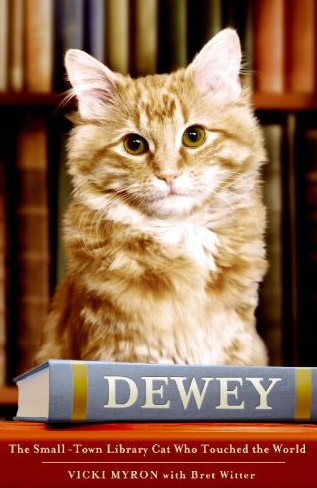
Dewey: The Small-Town Library Cat Who Touched the World


A big claim to be sure, but in fact, people did come from all over the U.S. and even from countries as far away as Japan to meet this remarkable orange cat in Spencer, Iowa. This is not only the story of a amazing cat, but also a semi-autobiography of the library's director and author of the book, Vicki Myron. Additionally, we learn about the town of Spencer, and its economic trials and tribulations, as family farms became an endangered species.
As a young kitten, Dewey Readmore Books (his full name) was found in the book drop-box one morning after a night of sub-freezing temperatures, with frost-bitten feet that required weeks of recovery. But he quickly took possession of the library, won the hearts of staff and patrons, and seemed intuitively to know who needed a cat on their lap at any given hour. He had a bad habit of eating rubber bands and so they were banned from the library. He roamed the light fixtures high overhead at will. He greeted people at the door. He excited the children of all ages and even some oldsters. This is an absolutely touching story about the amazing impact that one animal can have on individual lives and the community as a whole.

NEWS UPDATE: There's an upcoming picture book and maybe even a movie (supposedly starring Meryl Streep --man she's busy). Here's the article in Publisher's Weekly.

The Devil in the White City


Thanks to my friends Pete and Betsy (formerly of Seattle, and now in Boise), I got to read this book by Erik Larson right before going to my library conference in Chicago. It interweaves the two stories of the creation of the Columbian Exposition, aka the 1893 World's Fair, in Chicago (see photo at right) and the story of a serial killer operating in the area at the same time. The book opens with two quotes:
"Make no little plans; they have no magic to stir men's blood," spoken by Daniel Burnham, Director of Works for the Exposition.
And this from the confession of H.H.Holmes, "I was born with the devil in me. I could not help the fact that I was murderer, no more than the poet can help the inspiration to sing."

Although I expected the opposite, I found the account of building the World's Fair infinitely more interesting. Neither of these tales is fictionalized; both are based on documentary evidence and detailed research. I have to say that my visit to Chicago was enormously enriched by reading this book, which alerted me to the seminal role that Chicago played in American architecture. It was the home of the first skyscrapers--by ten years! Many of the major architectural styles, such as modernism, received critical impetus from the work of local architects. Everyone knows that Louis Sullivan and Frank Lloyd Wright also started their careers here. Chicago was celebrating the 100th anniversary of Burnham's design for the whole city while I was there and so posters of him, as well as books about him, and about the Exposition, were abundant at the Architecture Foundation's gift shop. I also found there a book of postcard with paintings and archival photographs of the "White City" and I have to say that my major criticism of the book is that more of these were not included in the book. Chicago's architecture is truly monumental and it's definitely worth taking either the land or water tour sponsored by the Architecture Foundation next time you go. Oh, and read the book, too, so you can learn about how the first Ferris Wheel almost didn't get created, or why the Exposition was called the White City, or how a serial killer almost got away unnoticed.