Monday, February 6, 2023

The Madness of Crowds


This is the 17th installment in Louise Penny's  "Inspector Gamache" series. The topic is extremely timely as it addresses how a charismatic speaker can interpret actual (or alternate) facts and convince millions of people to not only believe what they're told but also act on it--even when the actions are legally or morally indefensible. The rights of the most vulnerable members of society and the aftermath of the pandemic are themes that run throughout the story as well. Gamache, as further punishment from the head of homicide at the Surete, is asked to provide security for a university professor of statistics coming to a small local university to give a talk; given that it's the holidays, it seems unlikely that anyone will turn out. When Gamache researches Dr. Abigail Robinson, however, he finds her topic so repulsive that he begs the local university to cancel the event. Dr. Robinson has concluded from her data during the pandemic that we cannot survive unless we eliminate all the non-productive people in our society--the old, the sick, the disabled. Given that Gamache has a granddaughter with Down's syndrome, this is a very personal issue. Dr. Robinson's controversial conclusions have attracted millions of followers and opposition; violence has often accompanied her public appearances. Sure enough, in spite of extensive precautions, someone shoots at Robinson during he talk and she is only saved by Gamache's fast action. Now Gamache's team must investigate an attempted murder. What complicates things further is that, on New Year's Eve, when the village of Three Pines is gathered to celebrate, a successful murder spoils the festivities. However, it is not Robinson who is killed, but rather her loyal friend and assistant. Was she killed by mistake or was she actually the intended victim. As usual, past events and their effects on the human psyche, even years later, become the focus of the investigation. And everyone seems to be hiding big secrets, even people Gamache has known for years. 

Kirkus concludes their review by saying "No one balances tight plotting, compassion for her flawed characters, and a broader vision of humanity like Penny." Similarly, Publishers Weekly offers "Seamlessly integrating debates about scientific experimentation and morality into a fair-play puzzle, Penny excels at placing her characters in challenging ethical quandaries. This author just goes from strength to strength." The New York Journal of Books goes even further: "High emotion is balanced by high intellect and a high level of craft, revealing an author at the top of her game. Don’t be surprised if she receives an award for this one."

Wednesday, February 1, 2023

Three-Edged Sword


Jeff Lindsay, who wrote the Dexter series, has also created a series featuring Riley Wolfe, who considers himself to be the "world's best thief"--the harder the challenge, the more Riley wants to try and steal it. This is the 3rd installment in that series and, although this book can certainly stand alone, there would be some benefits to reading the 2 previous books to better understand the relationship dynamics between Riley and his partner, art forger extraordinaire Monique, who now lies in a coma. She is the only person Riley cares about besides his mother, who has been in a coma and on life support for years. Riley is rich and can afford to keep then alive and he continues his career of crime just for the fun of it. When he is kidnapped by a ruthless CIA team leader, however, he is not amused. Chase Prescott wants Riley to steal a thumb-drive containing top secret information from a Russian spy who has taken refuge in an out-of-service lighthouse off the coast of Lithuania that now houses his extensive art and documents collections. To ensure Riley's cooperation, Prescott has also kidnapped Monique and Riley's mother. Riley thrives on challenge but not on endangering his loved-ones, especially when their captor would do anything to get what he wants.

Publishers Weekly offers a lukewarm endorsement. "The efforts of FBI agent Frank Delgado and his hacker sidekick, Miranda Shaleki, to locate Wolfe's mother add to the suspense, and the tip of the cap to Edgar Allan Poe at the climax is effectively chilling, but the constant switches in point of view chop up the narrative flow, and the chapters involving Monique distract from the main plotline." Kirkus is more positive, saying: "Lindsay supplies an effortless, weightless supply of complications apparently designed to keep the overscaled enterprise, which has a lot more than three edges, from shutting down too soon. The result is a perfect beach read for anyone bound for the islands of Lithuania."

The Christmas Murder Game


In Alexandra Benedict's very tricky mystery, our protagonist, Lily Armitage, has been estranged from most of her family ever since her mother died --supposedly by suicide-- 21 years ago. She hates the stately home, Endgame House, where the aunt who raised her still lives. When her Aunt Liliana sends Lily an invitation to the annual Endgame House Christmas Game, which this year will award the winner ownership of the house itself, Lily has no interest in returning to, much less owning, Endgame House. But Liliana has also promised to reveal secrets to Lily about the house and about Lily's mother's death. When Lily arrives, she finds her aunt has died but has left their attorney specific instructions and daily clues for the Christmas game which lasts for the 12 days of Christmas. Lily will be confined with her estranged cousins and the housekeeper/cook for the duration without any outside communication. An untimely and sever snowstorm insures that no one will be leaving anytime soon. Lily has always been the cleverest one who could solve the clues in the game, but she doesn't want the house, only the clues. So she solves the riddles but gives the keys to her favorite cousin. However, one by one, her cousins or their partners begin to die and it's clear that--unless an unlikely stranger braved the storm and broke into the house--one of her family members is responsible. 

Publishers Weekly describes the book as a "fun contemporary British country house mystery..." and recommends "Puzzle-loving readers will enjoy searching for anagrams of the gifts mentioned in "The Twelve Days of Christmas" and for the titles of 12 of the author's favorite country house mysteries embedded in the text." Kirkus concludes that the puzzle-full mystery is "Super brainy in an appropriately superficial way."

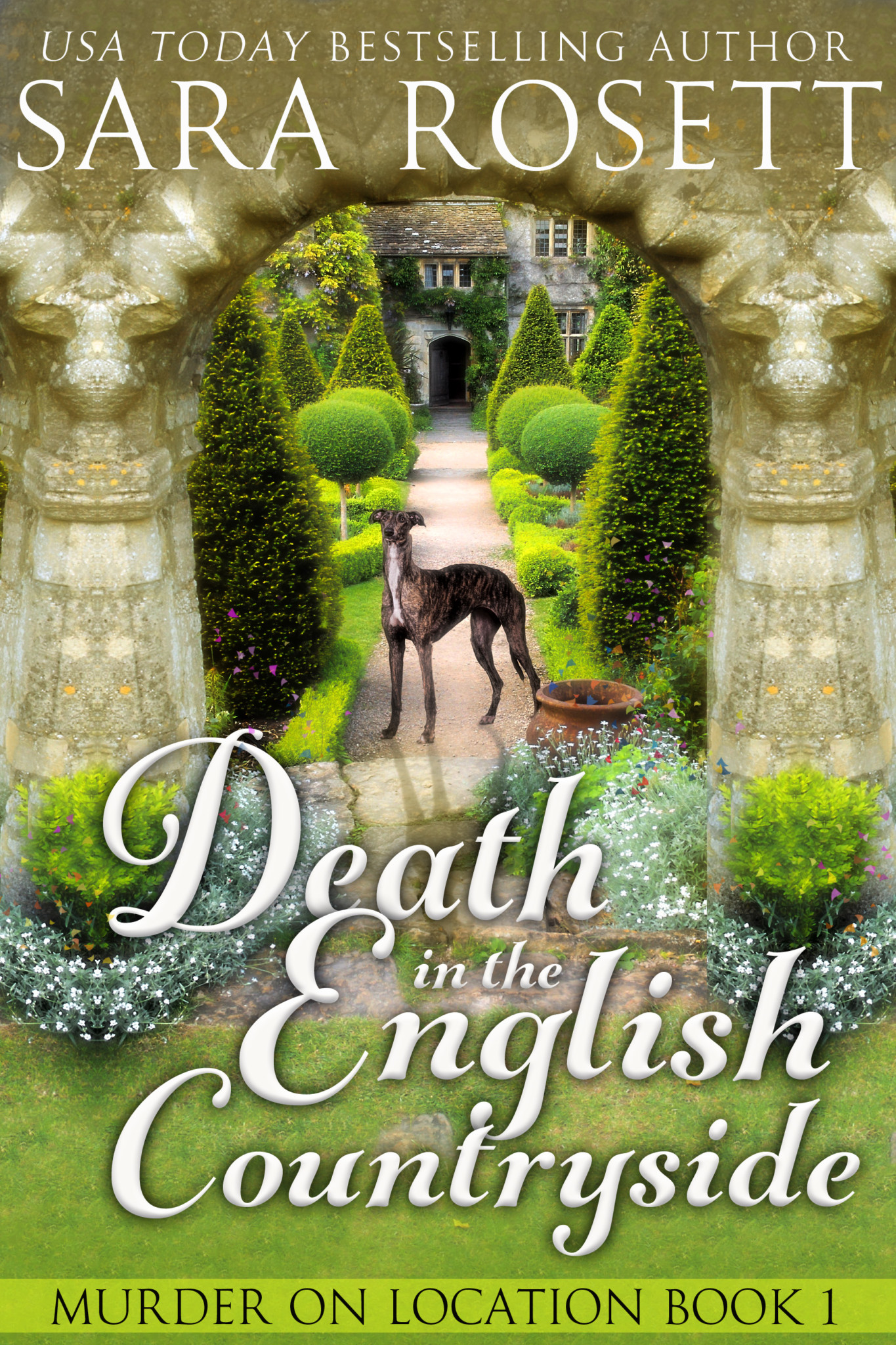
Death in the English Countryside


This is the first in the "Murder on Location" series (followed by 7 more books) by Sara Rosett, who has several other mystery series to her name. The protagonist is Kate Sharp, a Jane Austen aficionado and location scout for movie makers. Her boss in this small organization is Kevin and he has gone off to  England to scout locations for a new version of Austen's Pride and Prejudice. When he doesn't return to the office as planned and is not answering his phone, office manager Marci calls in Kate to track him down as she is the only other one at the agency who is aware of Kevin's past bouts with drinking.  With the help of Alex, the local location scout who was working with Kevin, she gathers information on the people who last saw him, but still can find no trace and begins to consider other possibilities. The small town, Nether Woodsmoor, with its golden stone cottages and scattered grand mansions, seems idyllic, but perhaps not as safe and quiet and the residents claim. This was a light and enjoyable read--a perfect cozy well suited to those who love English settings.

Wednesday, January 11, 2023

Blood Sugar


This is Sascha Rothchild's debut novel, although she is an Emmy-nominated screenwriter and a newspaper/magazine columnist. Her protagonist, Ruby Simon, is characterized as an anti-heroine or unreliable narrator by many reviewers. She is also one you may well end up rooting for --in spite of her occasional bad behavior. According to Ruby, she may be a murderer, but she is not a sociopath--that's up for debate. She loves animals and as an adult has become a successsful psychotherapist with a thriving practice. And the people she killed all deserved to die. But now she has been charged with a murder she didn't commit and all her past sins may come to light. She has lived in Miami Beach all her life and when she is brought in for questioning, word spreads quickly. Everyone believes she killed her husband, spurred on by rumors started by her manipulative mother-in-law. Her life begins to crumble and she becomes isolated and afraid because this detective is not going to let this go whether she is innocent or not. Fortunately, Ruby's former best friend, who is now a successful lawyer, owes her a very big favor and will do everything he can to keep Ruby from going to jail. This was well written and twisty mystery with an intriguing main character.

Kirkus called this "A compelling and entertaining psychological thriller." Publishers Weekly praises her "vivid prose" in this "mesmerizing thriller."

Tuesday, January 10, 2023

These Precious Days


Ann Patchett is a bestselling author and owner of Parnassus Books in Nashville. I have read a couple of her novels, Bel Canto and Dutch House, but I can't say I'm a huge fan based on those works. A friend loaned me this new (2021) book of essays and I started reading with lukewarm expectations. It is a very autobiographical collection of reflections on everything from knitting to a piece of family furniture, to what she learned from her three fathers, to a treasured friendship with a woman who was dying (the essay that gives its title to the book). As I read further, I became more engrossed and felt she offered me some inspiration for my own life. Two in particular, "My Year of No Shopping" and "How to Practice" helped me set my expectations for the New Year (2023). Reflecting on her role as a bookstore owner touched me as it would everyone who loves to read. She notes that "As every reader knows, the social contract between you and book you love is not complete until you can had that book to someone else and say, Here, you're going to love this." In her essay on How to Practice, she says that downsizing your belongings is a bit like writing vs. editing; you need to focus on one thing at a time, i.e., deciding what to get rid of before you tackle trying to figure out where it will go. Eventually as things were given away, she realized that "The point was no longer making sure that the right person got the right things. The point was that those things were gone" (p. 70).

Publishers Weekly says of the collection, "In this eloquent collection, novelist Patchett ... meditates poignantly--and often with wry humor--on 'what I needed, whom I loved, what I could let go, and how much energy the letting go would take.'" Booklist calls her writing "Mischievously funny and nimbly incisive..." The NYT praises her work, "Patchett’s heart, smarts and 40 years of craft create an economy that delivers her perfectly understated stories emotionally whole. Her writing style is most gloriously her own." And Kirkus says "An enviable life shared with candor, emotion, and knockout storytelling power. "

One Long River of Song: Notes on Wonder


I've read several of Brian Doyle's novels, one of my favorite being Martin Marten. This is a posthumous collection of Brian Doyle's essays that I keep on my bedside table to dip into when I need emotional comfort or inspiration. I'll steal a description from the book jacket that calls Doyle's writing "a balm." There is no longer an author web page for Doyle but it's easy enough to find information about him in such works as The Oregon Encyclopedia. I had the pleasure of hearing Brian Doyle speak at the bookstore in Sisters (Oregon) some years back and was just enthralled. He was clearly an extremely observant, funny, and compassionate being who could move the audience from laughter --when telling stories about growing up in a big Irish family or his twin boys for example-- to tears --when he talked about people less fortunate who need our attention and caring. The book itself is dedicated "to the overlooked and misunderstood, to compassion and grace that conquer all division." He focuses our attention on everyday events and helps us see them in new ways that evoke such emotions as joy, wonder, outrage, sadness, ferocity... He loves to play with words in a way that makes me smile--"fistcuffery" being one of my favorites. Some of my favorite essays from this book are:

The Final Frontier --about humility

Testimonio--a diatribe about pompous, preening, narcissistic arrogance (and the importance of humor)

On Not "Beating" Cancer--but instead enduring, surviving, wielding humor if possible, fearing as appropriate, dancing

An Leabharlann--about the value of libraries

The Bullet--against guns, manufacturers, gun defenders

Everyone Thinks That Awful Comes by Itself, But It Doesn't--self-explanatory

God--on finding God all around us

His Listening--among the many fine qualities his dad had, his ability to truly listen was most cherished

Read it and make your own list. Kirkus describes his writing by saying, "Doyle’s spirituality defies categorization. He was raised Catholic and does occasionally draw from that tradition, but his catechism isn’t comprised of doctrine or theology. Rather, ... Doyle employs the ordinary to catch the reflection of a world that is 'still stuffed with astonishments beyond our wildest imagining, which is humbling, and lovely, and maybe the only way we are going to survive ourselves and let everything else alive survive us too.'” Their final recommendation is "This brilliant compendium of spiritual musings will resonate with people of any faith—or of none." The NYT was effusive in their praise, for example: "Doyle was a writer 'made of love and song and amusement.' Every living thing intrigued him and was worthy of his powerful capacity for study and his equally powerful capacity for celebration."

Friday, December 30, 2022

Going Rogue: Rise and Shine Twenty-Nine


Janet Evanovich just keeps churning out new installments in the "Stephanie Plum" series. The plots are fairly predictable and the characters have become familiar to her regular readers--I think I have read every one. Still, they are an amusing light read. Stephanie and Lula are concerned when they come to the bail bonds office one Monday morning to find neither Connie nor her regular box of donuts are there. It turns out she has been kidnapped and Stephanie is determined to rescue Connie without anyone else learning that she's been kidnapped. Of course, Lula is along for the ride. When the kidnappers call and demand a coin that was provided as bail for a recently murdered man, things go from bad to worse, because the coin is nowhere to be found. A phone call to Vinnie, who is out of town is no help as he doesn't even remember taking the coin. Stephanie and Lula track down the coin's previous owner to get a description and then head off to a comic book convention to try and find a replacement. When that fails to satisfy the kidnappers, the threats to Connie's well-being escalate. Of course Ranger has to assist with some less than legal information gathering and with keeping Stephanie safe. This time around, more than a car gets destroyed. Publishers Weekly describes the book as "fast and fun," concluding "This fetchingly frivolous entry may not be Evanovich’s best, but it satisfies." Booklist is considerably more enthusiastic as they gush "Irreverent, raucous, bawdy, and always laugh-out-loud hilarious, this is Evanovich at her brilliant best."

Saturday, November 26, 2022

The Book of Lost Friends


This book by Lisa Wingate tells two intertwined stories, one set largely in the Reconstruction era South and one that is set in a small and still largely segregated town, Augustine, Louisiana in the 1980's. Hannie Gossett is a freed slave now working a sharecropping farm with an aunt and 2 brothers at the destitute Goswood Grove, the plantation where she and her family were enslaved. When she sees a girl sneaking into the plantation house after dark, she confronts her and finds out she is the illegitimate Creole daughter of Hannie's former master. She claims to be the rightful heir to Goswood Grove, but her half sister, Lavinia, denies it. Neither has the paperwork to prove their case and they decide to look for their father, who was headed to Texas two years ago and never returned. Hannie throws her lot in with them, disguised as a boy who can drive their wagon. It is a harrowing journey filled with predators of the human variety and a few surprisingly good people who want to help them.  Novice English teacher Bennedetta ("Benny") Silva has taken a job in the high school of the town that grew up around Goswood Grove. In a desperate attempt to engage her apathetic students, she borrows records from both the Goswood Grove library and the town library and asks the students to pick a real person and find out as much about them as they can. Links from the past to present day families slowly emerge. There is a minor romantic storyline that is entirely predictable and uninspiring. 

Reviews were mixed. Booklist asserts that "Wingate...makes history come alive with the dual tale of formerly enslaved Hannie Gossett in 1875 and Benedetta "Benny" Silva in 1987. Punctuating their struggles are real "Lost Friends," advertisements from a southern Methodist newspaper that featured messages from those searching for loved ones lost and separated by slavery." And they conclude, "Historical fiction fans will appreciate the authentic articles and the connection between modern times and the past, while adventure lovers will enjoy a voyage reminiscent of Huckleberry Finn." Library Journal tells us that "After the Civil War, the Southern Christian Advocate, a newspaper for the African American community distributed throughout the South, included a column called "Lost Friends" that allowed individuals to advertise for information about missing loved ones, generally sold off or stolen before or during the war. That column is the inspiration for this enthralling and ultimately heartening new novel from Wingate...Emphasizing throughout that stories matter and should never go untold, Wingate has written an absorbing historical for many readers." Publishers Weekly, however, says the book is a "disappointing outing" that is "marred by a lack of depth." Their conclusion is even more derogatory, "This underwhelming tale is sunk by its surfeit of deficiencies"

Breathless: The Scientific Race to Defeat a Deadly Virus


This non-fiction narrative about the initial reporting of and the search for origins of the SARS CoV-2 was a fascinating and enlightening read, as was David Quammen's previous book on a similar, broader topic, Spillover. During the pandemic, Quammen managed to monitor multiple virology databases and websites and interview over 95 eminent researchers and practitioners: infectious disease researchers, infectious disease ecologists, virologists, experts on the genetics and ecology of coronaviruses, evolutionary biologists, epidemiologists, public health officials, microbiologists, forensic DNA researchers, and more. He provides a brief biographical note on each person interviewed (for 1.5 - 2 hours on Zoom)  at the end of the book, along with an exhaustive bibliography of written sources consulted, and detailed notes on the text. He is truly an amazing researcher and science writer. He also clarifies some of the misinformation and out of context data that led to various conspiracy theories about the virus. Read his web page to find out why he was asked to write the book .

There are glowing reviews from multiple sources. The NYT closes with these quotes from the book: "'This virus is going to be with us forever,' Quammen warns, with a wealth of data and precedent to support him. We haven’t eradicated polio or measles. 'And those viruses have nowhere to hide except within humans.' This one could be cleared from every living human, and still exist in other animals. 'Covid-19 won’t be our last pandemic of the 21st century. It probably won’t be our worst.' In our international world, as one scientist tells Quammen, 'A disease anywhere is a disease everywhere.'” Similarly, The Guardian praises, "Few writers are able to understand the strings of amino acids that give these viruses their distinctive codes, let alone relate them to other Sars-like viruses. And even fewer possess the literary gifts necessary to make the genomics comprehensible to lay readers. Fortunately, David Quammen...is one of them." And Kirkus concurs, "An authoritative new history of Covid-19 and its predecessors...Unsettling global health news brilliantly delivered by an expert."