Thursday, May 10, 2018

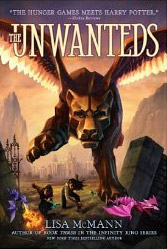
The Unwanteds

This book by Lisa McMann was her first foray into writing for young teens and the first of a series. In the town of Quill, strength and conformity are valued above all else because the world is a threat to their existence--or so they have been told by their leader, Justine. As a result, all 13-year olds are "purged" annually with the strong, smart, rule-following kids--The Wanteds-- sent to University to eventually join the Quillitary (their military), or to the Necessaries to become service people for the community. Those who have broken rules--which forbid any creative activities such as drawing or singing or telling stories--are The Unwanteds and are sent for extermination. So it is that identical twins Aaron and Alex are separated, with Aaron going to the University and Alex put on a bus for the death farm, slated to be dumped in the Great Lake of Boiling Oil. But when Alex and his fellow Unwanteds pass through the gates, what they find instead is a magical world, Artime, protected by the illusion of the death camp, run by master magician, Mr. Today. Here, the Unwanteds pursue their education and their talents and learn to use them as magical tools, including using them as weapons. But Alex cannot let go of his belief that his brother would be happier here, even though Mr. Today has warned that any knowledge of their world will be seen by the Quillian authorities as an existential threat. You can predict the rest. The war actually ends in a mutual tolerance pact for the present, but the door is clearly left open for the sequels.
This is of course a wonderful book to recommend to kids who are not part of the "in crowd" as the misfits triumph in the end. Quite suitable for middle grades, i.e., no sex and minimal/ mild descriptions of violence. Rave review from Kirkus!

Sunday, April 29, 2018

Little Fires Everywhere

This book by Celeste Ng has received so much press that I am not sure what I can add. Among other things, this is about a collision of cultures, as embodied by the two main female characters: affluent suburbanite Mrs. Elena Richardson, who has always followed the rules and believes good planning can prevent catastrophes, and unconventional artist Mia Warren, who makes up her own rules and has a child but has never had a sexual relationship. Reading the book felt like watching a train wreck in slow motion. The book starts with the culmination, i.e, the Richardsons' house in Shaker Heights burns to the ground. The rest of the book tells us how this came to happen. According to the New York Times, this is a literary device Ng employed in her first book as well. Kirkus enthuses, "This incandescent portrait of suburbia and family, creativity, and consumerism burns bright." While an advertisement for the first planned community of Shaker Heights offered "protection forever against depreciation and unwelcome change," when Mrs. Richardson rents a small duplex she inherited from her parents to artist Mia and her teenage daughter Pearl, change will overrun the rules. As Kirkus summarizes, "Mia and Pearl live a markedly different life from the Richardsons, ...making art instead of money ...; rooted in each other rather than a particular place ...; and assembling a hodgepodge home from creatively repurposed, scavenged castoffs and love rather than gathering around them the symbols of a successful life in the American suburbs..." Several reviewers have said the book's central theme is motherhood, for example, the Huffington Post asserts, "This story does a deep dive into what it means to be a mother, what qualifies as competency, who gets to decide, and raises so many more questions around the essential role of being a mother. " (see also: The Independent, The Guardian). I would disagree. Although I think the issues surrounding motherhood motivated many of the characters' actions, they are still not the core of the story. Rather it seems to be more about the relativism of right and wrong or the ambiguity of morality.
One of the aspects I found most striking about the story was the vivid visual imagery and examples of creativity Ng employed when describing Mia's work. One has to imagine Ng must be somewhat of a visual artist herself, or at least an avid afficionado, to provide such detail.
 Like the review in the Washington Post, the review from The Guardian was decidedly lukewarm. I am singling it out for a couple of reasons. It pretty much echoed my own reaction, which was, this is beautifully written, but the characters did not engage me. Also because, when the reviewer says, "After all, my experience of reading this book was perfectly pleasant. But the world in which I read it would be indistinguishable from the one in which I didn’t. This is a variety of novel that unnerves me, because it’s extremely well done and yet I didn’t warm to it. So what’s my problem?"--I was reminded of my reaction to Anthony Doerr's All the Light We Cannot See--I was the only person in my book group who did not absolutely love it. Additional reviews of Ng's book in The LA Times, The Times (UK), Publishers Weekly, The Chicago Tribune, the Denver Post, the Seattle Times.
There is an interview with Ng and some questions to consider for the book group on Ng's website.

Saturday, April 28, 2018

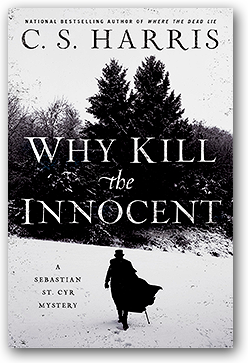
Why Kill the Innocent?

This is the 13th installment in the "Sebastian St. Cyr" series by author C.S. Harris, but she is a new author to me. Set in 1814 London, this is the Regency era (1788-1832), described by history professor Harris (19th C European history) as "The age of Napoleon and Jane Austen, of Beau Brummel and Lord Byron. Ladies wear filmy dresses and dampen their petticoats, while gentlemen duel with pistols at dawn and agonize over the cut of a coat. Fortunes are won and lost at the turn of a card, a decades-old war has turned Europe into a ravaged battlefield, and in London, a child of six can still be hanged for stealing a handkerchief." This is also the era when women were to be seen and not heard, so when talented piano virtuoso twins James and Jane Ambrose reach adulthood, he is allowed to become a concert pianist before he dies of tuberculosis. Jane is not allowed to appear in public so is married to a playwright, for whom she writes extravagently popular operas that are performed under his name. She is allowed to be a piano teacher, including among her students Princess Charlotte, the heir presumptive to the throne. When Jane's body is found in a poor part of London, lying in a snow drift with her head bashed in, the throne moves quickly to proclaim it an accident and stop any further investigation that might bring negative attention to the royal house.
However, the body was found by Hero, wife of Sebastian, Viscount Devlin, and daughter of the most powerful force behind the throne, Charles, Lord Jarvis, the Prince Regent’s cousin and fixer; although her father won't help Hero, she refuses to let Jane's murder go unchallenged. Sebastian and Hero are soon deep into the personal and political secrets surrounding the throne that involve smuggling, treachery and murder.
London is in the midst of a severe winter and an historic "Great Fog." The snow is deep, the cold is bitter, and the mighty Thames River freezes, bringing commerce to a literal standstill. The poor are freezing to death or dying of starvation while the Prince Regent, Charlotte's father, goes on spending money to eat, drink, and be merry. This was, according to Harris' extensive historical "Author's Note," the last year that London celebrated a "Frost Fair," when booths for businesses and entertainment were set up on the river itself, drawing huge crowds out on to the ice. It ended tragically when a sudden warming thaw caused the ice to break up and unknown numbers of people to die.
Obviously I have missed much of the back story to this series and will make that up in the future. Nevertheless it was an enjoyable read because I love stories with strong female protagonists, good mysteries, learning about a period in history, and almost anything set in England. Reviews provide further details: Kirkus and Publishers Weekly.
Monday, April 23, 2018

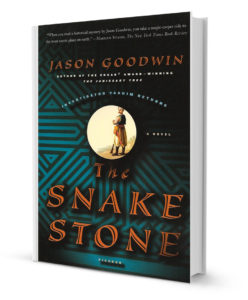
The Snake Stone: Investigator Yashim Returns

I recently posted about the first book in this series by Jason Goodwin, The Janissary Tree, which I really enjoyed. It is 2 years later, 1838, and the Sultan is dying. Yashim is hired by a wealthy banker's family to investigate a French archaeologist, Max LeFevre, who has come seeking to find and sell ancient Byzantine artifacts. When LeFevre is brutally murdered, Jashim is quickly identified as being the likely perpetrator. He must find the real killer to avoid being disgraced and possibly jailed. We are once again immersed into the history, politics, architecture, cuisine, and  religious and cultural diversity of late Ottoman-era Istanbul. It's fascinating and evocative. Once again secret societies with agendas that challenge the status quo are believed to be at the heart of a series of murders, and again we get glimpses into the secrets and power of the trade guilds, in this case, the watermen, who keep the huge city supplied with life-giving water. As in the first novel, Yashim, a eunuch and former investigator for the Palace, taps his extensive network of contacts to try and solve the mystery. When LeFevre's young wife shows up and vows to revenge her husband's death, Jashim takes her in and they have a short intimate relationship before she disappears--only to take up the search allied with not-so-trustworthy parties. But is LeFevre really dead?
Reviews and more detailed summaries are available from Kirkus, The New York Times, NPR (with a link to an audio interview with Jason Goodwin), and Publishers Weekly.   I already have the 3rd Inspector Yashim novel on hold at the library: The Bellini Card.

School for Psychics: Book One

This book by K.C. Archer (a pseudonym) is obviously intended to be a multi-installment work as indicated by the subtitle, and the open ending--loaded with numerous mysteries still unsolved--makes that obvious as well. Although the cast of characters are all supposed to be in their 20's, I would agree with Kirkus' review that this "novel reads like it's written about teens for teens." That being said, if you like YA novels, this one is fun.
Teddy Cannon, adopted by a loving couple after her parents were ostensibly killed in a car crash, has failed at just about everything--except being an outsider and gambling. Unfortunately, her family lives in Las Vegas and Teddy has managed to accumulate several hundred thousand dollars in debt to a loan shark. Moreover, because Teddy has often beat the house, she has been banned at all the casinos on the strip, leaving her no opportunity to win back the money she needs. Teddy does not cheat, but she does read people's non-verbal behaviors really well; at least that is what she thinks. She also thinks she suffers from epilepsy, although the medications prescribed for her don't seem to help much with the "episodes." When she dons a disguise and sneaks back into the Bellagio, she is nearly caught by both casino security and the loan shark, but is inexplicably rescued by someone who is obviously a cop. He offers Teddy a way out of debt and a way into being accepted for who she is, which, he claims, is an undisciplined psychic. He offers her a chance to attend the Whitfield Institute for Law Enforcement Training and Development, where psychics are trained to help law enforcement officials at all levels. Desperate to save her adoptive parents the grief of losing their savings--which she "borrowed" from in order to gamble--and seeing her in trouble again, Teddy decides to accept the offer. At Whitfield she falls in with the self-described "misfits" who are pitted against the other first year students, the "Alphas," by one of the instructors. Her colleagues include an ex-cop who can start fires, her room mate who communes with animals, someone who is telepathic, and another who can foresee people's deaths. Teddy has to train her body as well as her psychic skills;  her occasional uncontrolled bursts of astral telepathy shock both fellow students and instructors. Teddy discovers that Clint, the head of the school, is keeping information from her, and when two of the senior students disappear, Teddy begins to unravel a conspiracy to pervert the mission of the school. She will have to overcome her lifelong habit of being a loner and learn to trust her fellow misfits if she is to not only reveal the conspirators, but also survive. I stayed up late to finish this one, which I haven't done in a while and I will definitely read the sequel when it comes out. Additional review from Publishers Weekly.

Thursday, April 12, 2018

Dear Committee Members

This epistolary novel by Julie Schumacher was recommended by friend Anne Zald, who is still working in the trenches (i.e., the library) at Northwestern. Having also spent much of my life in academia, this book was bittersweet and funny because there was so much truth embedded in the sarcasm. I am reminded of another book told by a disgruntled English professor protagonist, Straight Man by Richard Russo, which also occasionally made me laugh out loud. Told through a series of letters spanning one year (2009-2010), we learn of the travails endured by creative writing professor Jason (Jay) Fitger, who is besieged by not only current but also long-ago-graduated students for letters of recommendation to every imaginable type of job. Probably believable for English majors to consider working in a store that sells nuts (the edible kind). Payne University (all puns no doubt intended) has been slashing the English department, as Fitger sees it, to enhance the the prima donnas in the Economics department, one floor up. No new faculty, no tech support, larger classes, hiring an acting dean from another department...the insults are endless. It is a wonder that Fitger ever made full professor, in spite of publishing four books, given his propensity for pissing people off. Both his ex-wife and his ex-lover still work at the university and won't even let him in their respective office doors; but he's also alienated his literary agent, the head of writing programs elsewhere, and his fellow faculty members. He does seem to be endlessly accommodating of his students (if not always flattering in his letters of recommendation) and has especially taken on the case of one Darren Browles, who has lost his fellowship and desperately needs another source of income in order to finish writing his book. Fitger beseeches everyone, but to no avail. People we come to know only as the subject of Fitger's letters either move on with their lives, or they don't, and Fitger, in the end, is elected chair of the English department--a suitable punishment. Numerous laudatory reviews: Kirkus, The New York Times, Slate, Newsweek, NPR, and so many more....
As Newsweek notes, this book is worthy of a letter of recommendation!

Sunday, April 8, 2018

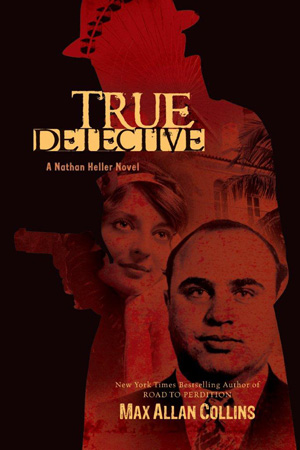
True Detective

I recently read a book by Max Allan Collins, Quarry, and although it wasn't my favorite book of all time, I was sufficiently intrigued to order the DVD of the TV series that was made from that book and this first book in Collins' "Nate Heller" series, which won a Shamus award. See more info about Collins on his blog and in my post for Quarry.
Set in 1933 Chicago, just a year before the opening of the World Fair, Nathan Heller is a detective for the Chicago Police Department, thanks to his uncle Louis putting in a good word to get him on the force in the first place, and also due to his being willing to lie about who killed a journalist/ gangster. But Nate does have standards and when he gets unwillingly dragged into yet another dirty trick on the part of the Chicago PD and the mayor, he decides to quit and go private. Two detectives who are in the pocket of Mayor Cermak drag him along to roust a bookie joint run by Frank Nitti and in the process Heller kills a young man in self-defense. One of the detectives shoots Nitti and then wounds himself claiming that he shot Nitti in self-defense. Nate knows otherwise and the pressure is on for him to lie again in the upcoming investigations. If he agrees, the mayor will let him get his PI license; if Heller insists on telling the truth, he won't be able to work. In this novel, fictional protagonist Heller is friends with a number of real people including Eliot Ness of FBI fame and Barney Ross, the lightweight boxing champion. He meets FDR, George Raft, and Al Capone. There are a lot of colorful characters in the book because there were a lot of big personalities fighting for control in Depression- and Prohibition-era Chicago. It's hard to be an honest detective in a pervasively dishonest system and much of the book deals with Heller's ongoing efforts to draw a line and still stay alive. The book is typical of the hard-boiled detective genre and is very atmospheric in describing Chicago of the 1930's. I frequently read the acknowledgements and Collins lists dozens of books he consulted to get the historical details for his book. A much more detailed plot summary and a less-than-laudatory review from Kirkus is here.

Sunday, April 1, 2018

Book Burners

This is a collaboratively written fantasy by Max Gladstone, Margaret Dunlap, Mur Lafferty, and Brian Francis Slattery. It was originally published as an online serial, sort of a version of the Charles Dickens approach; this book is the complete Season 1 and apparently there are 2 more seasons.  I was intrigued not only by the title, but also by having recently read Mur Lafferty's Six Wakes. As a collaborative effort I would say it was fairly successful, in that the tone of the writing seemed consistent, the characters developed in chunks depending on the "episode," of which there were 16, averaging 50 pages in length, and they carried ideas from one author's section to the next with little dysjunction. That being said, it was a LONG book and seemed to drag at times. It often felt like the authors were trying to each come up with the goriest situations for the protagonists to deal with rather than moving the main plot line forward. This makes sense when you think that the goal is to keep readers/ listeners coming back for a new online episode each week.
The main plot line is that NYPD detective Sal Brooks has a younger brother, Perry, who seeks out arcane materials and gets in over his head, becoming possessed by a particularly powerful demon called The Hand. When a team arrives from the Vatican's Societas Librorum Occultorum, charged with keeping the world safe from evil magic, Sal gets drafted to help them. She wants to find The Hand and retrieve her brother's soul, but the world seems to be plagued by increasingly frequent outbreaks of magic, perhaps due to the quest of Alex Norse to find and possess the "Norton Anthology of Demons" as Sal calls it, aka the Codex Umbra, a book in which the really bad demons were imprisoned centuries ago by the Knights of St. John. The other team members are a priest, Father Arturo Menchu, the Vatican's Black Archives librarian, Asanti, a formerly demon possessed computer guru, Liam, and Grace, a woman still possessed by magic who is conscious and aging only when a certain candle is burning. The relationships between team members are reasonably believable as is the political infighting among the Societas' three teams and between Team Three (Sal et al.'s team) and the Vatican hierarchy. Is there any good magic as Asanti claims, or is it all bad, as Father Menchu believes? Mixed review from me for putting this in book form.

Monday, March 26, 2018

The Painted Queen

Joan Hess (1949-2017), working with the permission of the estate of Barbara Mertz (writing under the pseudonym Elizabeth Peters), has created this novel from extensive research and notes completed by Mertz before her death in 2013. By and large she has succeeded in capturing the spirit and language of Elizabeth Peters for this final (19th) volume in the Amelia Peabody series.
Things open with a bang when, having returned to Egypt for the 1912-13 season, Amelia and husband Radcliffe Emerson immediately stumble into a case of antiquities theft and attempted murder. The first attempt at murder is towards Amelia herself when a man wearing a monocle crashes into her bath chamber at Shepheards and shouts "murder," only to fall dead with a knife in his back. With new information from Nefret, they learn that the half-brothers of her former husband, who died in a conflict with Ramses and Amelia, have vowed revenge against the two. That means there are 4 possible assassins still targeting them. In the meantime, the head of the department of antiquities has asked Emerson to check on an excavation at Amarna, originally assigned to a German archaeologist, Herr Morgenstern, who has inexplicably gone missing. Along with him, a priceless bust of Nerertiti, created by Thutmose in 1345 B.C., is also missing. When Morgenstern surfaces in Cairo, he is delirious and nearly starved; Amelia takes him in and returns with him to Amarna while Ramses and David stay in Cairo to track down the missing bust and copies (i.e., forgeries) that Morgenstern commissioned. Nobody in Amarna is who he claims to be and the adventures continue as Amelia manages to elude or be rescued from one assassination attempt after another. This book is an obvious choice for fans of the series.
More details in this review from Kirkus, this one from The New York Times, and this from Publishers Weekly.

Saturday, March 17, 2018

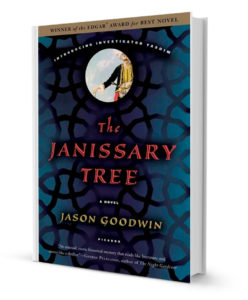
The Janissary Tree

Author Jason Goodwin has a degree in Byzantine history from Cambridge and has written a book on the history of the Ottoman Empire, so one can feel reasonably sure that much of the detail in this mystery, set in 1836 Istanbul, is probably accurate. Goodwin won an Edgar award (2007) for this book, which is the first in a series of five mysteries, and there is even a cookbook based on the series!
The Empire is in decline and the world is modernizing all around this ancient culture, so it must adapt or die. But just as the sultan is days away from announcing sweeping--and no doubt controversial--reforms, several officers from the elite New Guard are kidnapped and murdered, sending everyone's anxiety soaring. The head of the guard calls in former royal court investigator, Jashim Togalu, to solve the murders and put people's minds at rest. Maybe. And then the sultan's mother, the valide, also commands Jashim to solve the murder of one of the harem's women and the theft of the valide's jewels. Jashim lives apart because he is a eunuch, but that does not mean that passions do not still stir within him. He is observant, open minded, and uniquely capable of making himself invisible in a crowd through his stillness. As he digs deeper into the mystery, he becomes convinced that a resurrection of the disgraced and disbanded Janissaries--the former army of the Empire--is the impetus behind the murders. But can he convince the powers that be in time to stop an overthrow of the sultan? Not only the exotic locale and customs, but also the wonderful vignettes of cooking, lots of political intrigue, and a sympathetic protagonist all serve to make this an engaging read. Secondary characters, especially Jashim's friends, are also intriguing. I've already got the sequel, The Snake Stone, on hold at the library. Thanks to my friend, Joan Tyler for turning me on to this book!
I am including a glowing review from The Telegraph, and this somewhat lukewarm one from Kirkus  for the plot summaries--superior to mine!