Thursday, March 15, 2018

Six Wakes

The setting of Mur Lafferty's science fiction thriller is a space ship carrying thousands of dormant passengers to a new planet decades distant from earth. It's the 25th century and humans have pretty much ruined the earth, so those who can afford to leave do. The crew—gofer Maria Arena, Capt. Katrina de la Cruz, navigator/pilot Akihiro Sato, security chief Wolfgang, engineer Paul Seurat, and ship's physician Dr. Joanna Glass— are all former criminals who have exchanged their sentences for ferrying this ship to a new world and a new start for themselves; they will be continually re-cloned in order to survive the journey. But as the story opens, the crew's clones awake to find their former selves have been murdered and their memories of not only their deaths, but of the last 20 years of their lives have been erased from the mindmaps that are routinely inserted into new clones to provide continuity. The ship's AI,  IAN, has taken them off course and offers mixed messages with regard to sorting out what happened. As the six crew members struggle to get control of the ship and find the murderer(s?), flashbacks reveal secrets about their past that have been kept hidden or suppressed through mind manipulation. These are complex characters and as they learn about one another, never knowing who to trust, the reader is also challenged to consider what makes us uniquely human. Great futuristic "locked room" mystery.
This book has been nominated for both the Philip K. Dick and the Nebula Awards in 2018. Reviews from NPR, Kirkus, Publishers Weekly, and Booklist.

Quarry

This is a 2015 re-issue of the first in the "Quarry" series by Max Allan Collins; Hard Case publishers is re-issuing the first five books in the series. Originally titled The Broker (published 1976), it even had one season as a TV series. Collins is a prolific, award-winning, and multi-faceted writer: movies, screenplays, plays, hard boiled crime novels, historical novels, mysteries, short stories, movie and TV novelizations, and graphic novels... including the one upon which the movie "The Road to Perdition" was based. He's written several comic book series and wrote the Dick Tracy newspaper strip for over a decade. He collaborated with Mickey Spillane on several novels and on one comic book series.
Quarry is a disenchanted and disconnected Vietnam vet and former Marine sniper who has become a hit man as a means to earn a living. He has no animosity towards the people he kills, nor does he have any compassion for them. He just takes the job and gets his money. Simple. He is puzzled and more than a little unhappy when a recent job involves retrieving drugs the victim was carrying, and this initiates the unraveling of the relationship between Quarry and his contact person, known as The Broker.
Still he agrees to take a new job; he is sent to a small port city on the Mississippi River bordering Illinois and Iowa, and he is scheduled to work with his usual partner, the man who scouts the victim. What Quarry can't figure out is why anyone would want to kill the guy. He's a janitor who does not seem to interact with anyone in a significant way, a creature of small habits. But he does the job and makes it look like a burglary gone bad. However, when he returns to the observation post, he is attacked by a man with a wrench and, although he scares the man off, he finds his partner dead and their money for the job gone. He does what he can to dis-identify his partner and then calls the Broker to find out who hired them, because who else would know where they were and that they had money. When Broker refuses to provide the information, Quarry decides to find out on his own and get retribution as well as his money. It's a small town and it's not hard to quietly learn more about the dead man and his family.  Quarry also finds a woman willing to take his mind off things in the meantime. She just happens to co-own a club in town called Bunny's, and Quarry uses her business partnership with the victim's family to track down the person who hired him for the hit. It's a complicated family situation driven by greed, but maybe that isn't the source of the problem. Quarry gets his man and his money but is betrayed by Broker. Quarry is a plain-spoken anti-hero; maybe he grows on you if you read more, but I can't say this one book was enough to get me hooked, although I did order the first season of the TV series through Netflix. Collins won his two Shamus awards for books in a different series, the Nathan Heller series, and I might try one of those.

Wednesday, March 14, 2018

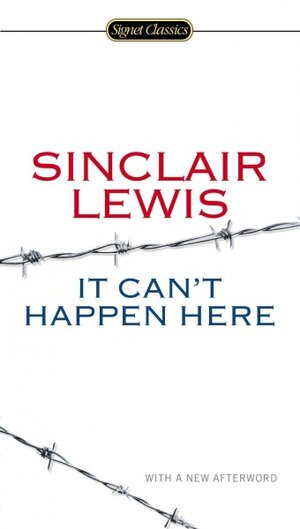
It Can't Happen Here

Sinclair Lewis (1885-1951) was the first American to win the Nobel Prize for Literature (1930) and his body of work was often satirically critical of American capitalism and materialism. He was married for a time to Dorothy Thompson, a very well known political columnist who actually interviewed Adolf Hitler. I had heard that this book, widely read when it was written in 1935, had gained a new audience with the election of Trump and so was pleased my book group selected it for March. In this dystopian alternative history, it feels like you could substitute Trump's name for that of the target character, Berzelius "Buzz" Windrip, and have it fit. Windrip runs on a populist platform, promising "every real American family" $5,000. Doesn't this sound like it could have come from Trump himself when Windrip claims to have "thoroughly tested (but unspecified) plans to make all wages very high and the prices of everything produced by these same highly paid workers very low; that he was 100 per cent for Labor, but 100 per cent against all strikes; and that he was in favor of the United States so arming itself, so preparing to produce its own coffee, sugar, perfumes, tweeds, and nickel instead of importing them, that it could defy the World ... and maybe, if that World was so impertinent as to defy America in turn ... he might have to take it over and run it properly." He will bring back the good old days when white men were supreme. He beats out two other candidates for President (including FDR) and begins to take apart the government and remake the country the way he wants it run. He disempowers Congress. He recruits loyalists to run the new jurisdictions created when he abolishes traditional states. And he enforces his suppression of dissent, especially of the press, via a group of armed thugs called Minutemen and by imprisoning anyone who disagrees with him. Windrip also disenfranchises women and minorities (notably African Americans and Jews). Another striking parallel, as noted in a review by the New York Times, is that Windrip's right hand man, Lee Sarason, "believes in propaganda, not information, openly arguing that 'it is not fair to ordinary folks — it just confuses them — to try to make them swallow all the true facts that would be suitable to a higher class of people.'” And the similarities continue: Windrip does not fulfill his promises, walking away from the "Forgotten Men," and turning on his own allies and supporters. Again from the NYT review, "As president, he insists on absolute obedience, 'louder, more convincing Yeses from everybody about him.'”
The complacent liberals also become targets of Lewis' ire. Doremus Jessup, editor of a small town newspaper in New England, eventually tries to warn people of the rising threat of a fascist type government, but ends up in prison for his trouble. Dissidents, including Trowbridge, escape to Canada and create a type of underground railroad system to help others leave. As in the book, people today will probably claim that such events couldn't happen here, but New York Times columnist David Brooks recently noted (Mar. 5, 2018, "The Chaos After Trump") that a significant percentage of young people have lost faith in the democratic form of government. "In the U.S., nearly a quarter of millennials think democracy is a bad way to run a country. Nearly half would like a strongman leader. One in six Americans of all ages supports military rule." Sobering and scary, but worth the read. Here is a link to a current re-print of Time magazine's review of the book when it was written. Additional reviews from The Guardian, and The National Book Review (via The Huffington Post).

Tuesday, March 13, 2018

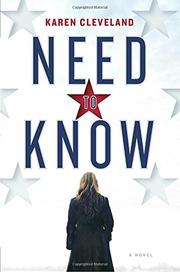
Need to Know

This modern version of a spy novel, Karen Cleveland's initial outing, has been getting a lot of attention (NYT best seller already sold for movie rights) and I was anxious to read it. Cleveland is herself a former CIA analyst and so can credibly create a female protagonist who does the same, in this case, working on the highly prestigious and pressured Russia desk. Vivian has been working on an algorithm to track down sleeper agents in the United States and has finally captured the computer of what she believes to be a mid-level handler. When she finds a file with pictures of sleeper agents, she thinks she has hit the jackpot until she realizes that one of the pictures is that of her husband Matt. When she confronts him, Matt admits he has been a sleeper for over 2 decades, recruited as an orphan when he was 15 years old. He swears he loves Viv and their 4 children and that if he could have gotten out of the situation he wold have. He says he knows she needs to turn him in. But Viv cannot face the total meltdown of her entire life. Who would help take care of the family? Matt's day job as an IT specialist gives him the flexibility to pick up kids from school, take one of their toddler twins to his appointments with the cardiologist, and generally keep the house running smoothly while Viv puts in long hours at her job. She deletes the photographs and then Matt gives her a flash drive that she can use at work to erase the activity log of the past 2 days so no one will know what Viv did. Vivian knows this will not be the end of the story and not many weeks pass before she gets a blackmail letter from Matt's handler that threatens to reveal her if she does not get information from the CIA computers. When Viv decides to fight back by finding the handler and retrieving the blackmail materials, her children and Matt become pawns in a deadly chess game.
Throughout the book, Viv revisits her entire life with Matt and wonders what was real and what was scripted. She doesn't know if she can trust Matt although she is convinced his love for their children is real. The dilemma is convincing and the story will keep you engrossed. The ending was a surprise. If you have enjoyed the TV series, "The Americans," you will like this, and stories about Russian mis-deeds are certainly big in the news these days. Reviews from Kirkus, Booklist, and Library Journal.

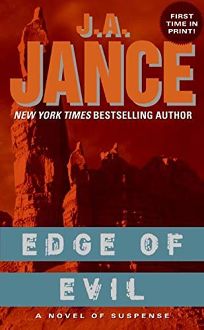
The Edge of Evil

I have recently read several of J.A. Jance's "Ali Reynolds" series (see Man Overboard and Clawback), so I decided to go back and read the 1st one. Jance is a fine writer and so I don't need to repeat that she creates believable characters, a decent sense of place, and tight story lines. Ali Reynolds is a co-anchor on the evening news (6 and 11 pm) for a TV station in Los Angeles. After her show one evening, the new guy brought in to bolster ratings tells her she is being let go, and inadvertently admits that it's because she is considered too old to appeal to a younger audience. This in spite of the fact that the male newscasters are decades older than Ali's 40+ years. Her husband, Peter, is an executive at the station, and it turns out that he and just about everybody else knew that Ali was going to be fired before she did and said nothing to her. She is determined not to take this obvious case of age discrimination lying down.
When she learns that her best friend from high school, Reenie, is missing and that she has been diagnosed with ALS. Ali decides this is a good time to go back to Sedona, Arizona, where her parents have run the Sugarloaf Cafe for years, and support Ali's family while she also gets her own life sorted out. She hires an attorney to pursue the age discrimination case and her college age son, Chris, decides to drive with her to Sedona while he is between terms at UCLA. Chris also sets up a blog for Ali called "cutlooseblog." Ali is initially surprised and then gratified to find out how many people start following her story of being let go from the TV station. As Ali investigates Reenie's disappearance, she also digs into understanding more about the disease of ALS and that becomes a thread on her blog as well. When Reenie's car and body are discovered over a cliff on a nearby mountainous road, many believe she committed suicide rather than face the slow and painful death of ALS. Ali is convinced her friend would never leave her children before she had to and determines to find out more about Reenie's last hours. In the meantime, she discovers her husband has been having affairs and now Ali's decided to end the loveless relationship. Her blog brings her to the attention of some abused women and then, unfortunately, to the attention of their abusers, who threaten Ali with physical harm. There is a lot more going on, but just go read the book and get the whole intriguing story for yourself. Publishers Weekly was not particularly impressed with the book and called it "predictable" but I still liked it.

Tuesday, March 6, 2018

The Strange Case of the Alchemist's Daughter

New author to me, but Dr. Theodora Goss, a professor in the Writing Program at Boston University, is apparently a prolific and award winning author of novels, essays and poetry, primarily in the myth and fantasy arena. This outing builds upon several characters from Victorian era literature: Dr. Jekyll and Mr. Hyde, Sherlock Holmes and Dr. Watson, Dr. Moreau, Dr. Frankenstein. Mary Jekyll is left penniless after her father has died (she believes) and her mother has gone mad. Looking through her father's papers and trying to sort out her mother's finances lead Mary to believe that Mr. Hyde (who she believes was a colleague of her father's) is still alive.  Years ago, there was a hefty reward for finding him in relation to a murder he committed, and that money could solve a lot of problems for Mary. Tracking down a monthly donation her mother was making for the support of the daughter of Mr. Hyde, what she finds is an unruly child, Diana, who being housed at a nunnery, but is being thrown out because she is so disruptive.  The story is told by Catherine Moreau (daughter/ creation of Dr. Moreau) with interjections from all the primary female characters (Mary, Diana, Mrs. Poole, Beatrice Rappaccini, and Justine Frankenstein), as she writes  of the mystery that brought them all together. A secret society for alchemists apparently had members who wanted to move beyond the transformation of base metals into gold and explore biological transformation--from animal to human or from dead to alive. Frankenstein, Moreau, Rappaccini, and Mary's own father, among others, all belonged to this controversial group. And it turns out they were all involved in creating monsters. Now the monsters,  most of the main women characters in the story, have found each other and are trying to create a normal life for themselves. This society may also be connected to a series of murders in Whitehall, mostly prostitutes, and it may even be that the nunnery's director is somehow complicit. There is a mystery to be solved, and it is, but the door is clearly left open for further adventures of these women with extraordinary skills. It is an interesting idea to weave all these horror tales together into an alternative narrative. And certainly the occasional direct dialogue with the characters is an unusual device. I tend to agree with Kirkus, however, which found this distracting and also felt the characters were undeveloped. Perhaps in the sequel, which is slated to be released this year? The reviewer from NPR was more positive, concluding that "At its heart, Strange Case is a lively, late-Victorian adventure that celebrates, overhauls, and pokes gentle fun at the era's weird-fiction tradition. But it's also a sparkling, insightful conversation with the canon from which it sprang." Publishers Weekly also offered a positive evaluation.

Monday, March 5, 2018

Word by Word: The Secret Life of Dictionaries

Well who knew that reading about dictionaries could be so entertaining. This is an absolutely charming book--one that made me both think seriously about previously unconsidered issues and occasionally made me laugh out loud. Kory Stamper, a lexicographer with Merriam Webster, has revealed the sausage-making machinery of creating that taken-for-granted staple in most people's lives, a dictionary. I learned new words, of course, like "potamologist" (a specialist in potamology, i.e, the study of rivers) but more interestingly, I learned them in the course of her provocative ideas about language. She tells us, for example, to "Think of English as a river. It looks like one cohesive ribbon of water, but any potamologist will tell you that rivers are actually made up of many different currents--sometimes hundreds of them. The interesting thing about rivers is, alter one of those currents and you alter the whole river, from its ecosystem to its course. Each of the currents in the river English is a different kind of English: business jargon...academic English, youth slang...Each of these currents is doing its own thing, and each is an integral part of English." (p. 60). Then there are the interesting facts that you could throw out the next time you are at a loss for conversation. Did you know that "...S goes on for-fucking-ever. Exactly 11 percent of your dictionary is made of words that begin with S." (p.111) Or that, "The Collegiate Dictionary has, as of this writing, about 170,000 entries with about 230,000 definitions, give or take, to review." (p. 117). Writing a dictionary definition (or revising one) is a complicated process. "Every entry...goes through multiple editing passes. The definer starts the job, then it's passed to a copy editor who cleans up the definer's work, then to a bunch of specialty editor: cross-reference editors, who make sure the definer hasn't used any word in the entry that isn't entered in that dictionary; etymologists, to review or write the word history; dating editors, who research and add the dates of first written use; pronunciation editors, who handle all the pronunciations in the book. Then eventually it's back to a copy editor (usually a different one from the first round, just to be safe), who will make any additional changes to the entry that cross-reference turned up, then to the final reader, who is, as the name suggests, the last person who can make editorial changes to the entry, and then off to the proofreader (who ends up, again, being a different editor from the definer and the two previous copy editors)...." (pp. 117-118).
Stampers sense of humor is dry and so appropriate for the topic, to wit, "The goal of a dictionary is to tell people what words mean and show them how they are used in the most objective, dispassionate, and robotic way possible. People do not come to the dictionary for excitement and romance; that's what encyclopedias are for." (pp. 126-127)
Some people, even those who are not professional lexicographers, really care about what goes into a dictionary. They will write letters to the company and Merriam Webster makes sure they get a response. Sometimes it is to explain how and why dictionaries are made; sometimes to correct misinformation about dating the words; sometimes to clarify usage. One correspondent has consistently submitted questions for over 20 years! And then there are the fanatics who charge Merriam Webster with perversion and worse if they write a definition not to their liking. When the dictionary added a new "sub-sense" for gay marriage to the main definition for marriage,  it elicited a "shit storm" of truly unbelievable proportions (literally hundreds of vituperative emails). As the editor who originally responded to someone querying their decision to include gay marriage, Stamper was "invited to personally rot in hell no fewer than thirteen times. I was told to get a life, get a fucking life, to fuck off and die, and also to swallow shards of glass mixed in acid." (p. 248). This all comes down to, according to Stamper, the common misconception about the role of dictionaries. Lexicographers see dictionaries as a mirror to the culture, not as the shaper of culture. She acknowledges that dictionary publishers are themselves somewhat responsible for the misconception since their early marketing efforts often touted their role as "The Voice of Authority" regarding the English language.
Most of all, however, Stamper shares her sprachgefühl and her love of language. You will not only learn about the foibles of the English language, but also learn a lot about the history of the language. And you'll have an enjoyable time in the process. Highly recommended. A special "Thank you" to friend Joan Starr for insisting I read this book.
Lots of great reviews: Publishers Weekly, The Atlantic, Kirkus. There is a great interview with Stamper and an overview of the book, complete with some cool photos, at the New York Times. And if you just can't get enough of Kory Stamper's wry wit, check out her blog: Harml-ess Drudg-ery

Sunday, February 25, 2018

Man Overboard

This is the next in the "Ali Reynolds" series from J.A. Jance, following Clawback, which I recently read and posted about. Once again, I found the plot engrossing.
The story opens with computer whiz Roger McGeary on a cruise in a deluxe suite, comped by the cruise lines in appreciation for Roger finding and fixing some near-fatal flaws in their online reservation system. Roger has finally made a successful life for himself after years of struggle with debilitating depression, precipitated by his father's suicide and his mother's subsequent emotional abuse. He is having a great time on the cruise thanks to a trio of older women who have adopted him as their partying companion. The only problem is that someone has been texting him with information that could only have come from his sessions with his former therapist. They are messages repeating the destructive abuse his mother used to heap on him and it is driving him back into that dark place where he feels he doesn't want to live. And when the next message arrives, he is alone and has had too much to drink, and he follows through, throwing himself overboard.
High Noon Enterprises gets involved when Roger's Aunt Julia comes seeking Roger's best friend, Stu Ramey, asking him to figure out what happened. She cannot believe Roger killed himself. When Ali sees how upset Stuart is at the death of his oldest and only friend, she and B. agree to help Julia and Stu find out what happened. After initially getting stone-walled by the Panamanian owned cruise line and the Panamanian detective who quickly closed the case as "death by misadventure" they send Cami to take a cruise on the same ship in hopes that she can shake something loose from the crew. Stu meantime begins digging into Roger's computer and his life, looking for clues.
The parallel story line comes from Owen Hansen, who father also committed suicide when he was a boy. He is also a computer genius but has turned his talents to the dark side, choosing to find other children of parental suicide and push them over the edge using illegally obtained software and an Artificial Intelligence program he created, called Frigg, as in the mythical companion to the Norse god Odin, the online identity of Owen. Frigg is the one that identified Dr. Cannon, a psychiatrist specializing in helping children of suicidal parents, and broken into her confidential patient files. Roger, it turns out, was the 2nd victim, and now Odin has his sights set on a 3rd. When Stu and Ali begin to figure out what's going on and manage to thwart Odin's 3rd murder by proxy, he turns his malice and his AI against them. But Frigg is developing some ideas of her own...harkening back to Heinlein's Rules of Robotics. It's a tantalizing premise and very timely given the rapid advancements in AI technology. Review from Kirkus available here. Additional reviews from Publishers Weekly and Strand Magazine.

Saturday, February 17, 2018

Clawback

This is the 11th novel in J.A. Jance's "Ali Reynolds" series. When I lived in Seattle, I was an ardent consumer of her J.P. Beaumont books, which were largely set in Seattle,  but I sort of fell away from reading when she moved her base to Arizona with the Joanna Brady series.
Ali Reynolds is a former Los Angeles TV newscaster who was let go and replaced with a younger-faced woman. Coincidentally, she discovered her husband was cheating on her. Leaving LA, she returned home to Sedona, Arizona, where her parents ran the Sugarloaf Cafe, and became a blogger. By the time of this book, she has become a consultant to the Sedona police department and she is married to an old flame, B. Simpson, owner of a high-tech/ computer security firm, High Noon Enterprises, and her parents have sold the diner and retired. When the news breaks that the company where her parents invested all their savings has gone bankrupt, Ali's dad decides to go the house of his long-time friend and financial advisor and confront him. Instead, he finds the man and his wife dying from multiple stab wounds. When he calls 911 and then tries to help them, he is arrested for their murders. Now Ali is determined not only to clear her father of the murder charges but to track down the mastermind of the Ponzi scheme and get some of their money back. Fortunately she has the substantial resources--human and technological-- of her husband's firm to bring to bear on the hunt. Ali and company are blind-sided by the identity of the real killer, who will stop at nothing to get away.
Not a best-seller but an engrossing read, and I think I will go back and start at the beginning! Of course, having gone to Sedona last fall for the first time will make it even more fun to read this series.

Wednesday, February 14, 2018

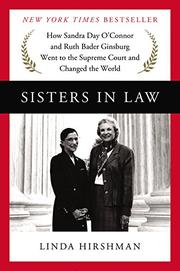
Sisters in Law: How Sandra Day O'Connor and Ruth Bader Ginsburg Went to the Supreme Court and Changed the World

This book by lawyer Linda Hirshman gives an inside look at the workings of the Supreme Court--like sausage, you my not like what you find--along with her  biographies of the legal careers of Sandra Day O'Connor (SOC) and Ruth Bader Ginsburg (RBG). They were both remarkable women but so very different in their approach to their legal careers and their adjudications. O'Connor could not get a job with a law firm after she graduated from law school--they offered her a position in the stenographers' pool--so she pursued politics as a Republican and eventually became majority leader in the Arizona state legislature. RBG was asked when she entered Harvard Law School why she was taking a place that could have gone to a man. Once graduated, she pursued an academic career becoming a professor at Columbia when Harvard would not have her. Whereas SOC was president of her local Junior League and actively supported Republican candidates, including Barry Goldwater, RBG went to work for the ACLU.
Being the first woman on the court (FWOTSC), O'Connor brought a woman's perspective, if not a liberal one to discussions and decisions. She was very canny in finding a path forward that would elicit the least resistance from the otherwise all male body. She often utilized the "concurrence"--agreeing with the majority opinion and writing a separate comment--to make conservative decisions more liberal and liberal opinions more conservative according to Hirshman. She was the consummate pragmatist.
Ginsburg is, as described by one of her clerks, a "cause lawyer;" that is, she looks at the long picture, both history and future and strategically chooses and works cases to build a foundation toward her goal of justice for all. Although she has been consistently pro-women's rights, she has also consistently been pro-rights for anyone at a disadvantage when up against larger forces.
This is a fascinating book, although at times a bit hard to wade through. Totally worth the read. Much more detailed review of the book from The NYT, a brief review from Kirkus, and an interview with the book's author by NPR's Nina Totenberg.