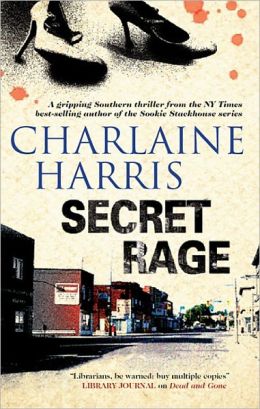
Charlaine Harris is the author of the Sookie Stackhouse (vampire) series, as well as several others--not all of which include supernatural beings (e.g., Shakespeare series, Teagarden series). In this novel, fashion model Nickie has just been told by her agent that she is past her prime at the tender age of 27. She decides to accept the invitation of BFF, Mimi, to move home and share a big rambling house left by Mimi's grandmother. Knolls, TN has a small college and Nickie is going to finish her bachelor's degree and get her novels published. A series of rapes, which include Nickie's, quickly dispel the sense of homecoming and safety. When the rapes escalate to murder, no woman in town feels safe. Nickie and one of the other rape victims, a professor at the university decide to solve this mystery on their own and have narrowed the list down to just a handful of names--none of whom seem to be the kind of person who could commit such heinous crimes. Nickie's long-standing and unrequited crush on Mimi's older brother is realized and, of course, the women triumph in the end. Good characters, well-developed southern setting (a specialty of Harris'), and fast-moving and tension filled plot all make this a very readable book.
Keeping track of what I read by jotting down my reactions, providing information about the author, and linking to additional reviews. And occasional notes on other book related things...
Monday, January 20, 2014
Friday, January 10, 2014
Etiquette and Espionage
This is the first in Gail Carriger's "Finishing School" series for young adults...like her adult "Parasol Protectorate" series for adults in that it's the same setting, only 25 years earlier, i.e., Victorian England, steampunk society where werewolves and vampires are accepted--if not universally admired--segments of high society. (See previous reviews for Soulless, Timeless, Changeless, Blameless, Heartless). Our protagonist is Sophronia Angelina Temminnick, the youngest daughter of a landed country family, who is too much of a tomboy, too curious about how things work, and, hence too troublesome for her mother's taste. At the suggestion of one of Mrs. Temminnick's close acquaintances, Mrs. Barnaclegoose (Carriger loves goofing with names), Sophronia is to be sent off to Mademoiselle Geraldine's Finishing Academy for Young Ladies of Quality. What Mrs. Temminnick does not know, and Sophronia only gradually finds out, is that this is a very different kind of finishing school--one that teaches deadly skills with a knife as well as mastering the perfect curtsy or fluttering one's eyelashes to manipulative ends. To top it off, the finishing school floats above the moors in an elaborate contrivance of joined dirigibles. Sophronia, though not a legacy recruit, takes to her lessons with relish and manages to learn a few things that are definitely NOT part of the curriculum. Like climbing around the outside of the school (high above the ground) in order to skirt the alarmed mechanicals and get to the boiler room, where she meets the "sooties" and procurs coal supplies for her not-exactly-permitted pet mechanimal (which resembes a dachsund run by a miniatures boiler). This is totally enjoyable for those who like this genre and not so "young" that adult won't be challenged to figure out what's going on. Highly recommended.
Labels:
England,
mystery,
steampunk,
supernatural,
vampires,
Victorian,
werewolves,
YA
Thursday, January 2, 2014
Scarlet
This is Book 2 in Marissa Meyer's "Lunar Chronicles" series, preceded by Cinder. I am officially hooked. I really like the cyborg heroine of the first book and, although she plays a secondary role here, she is, in fact, the driver for the whole series. Cinder, an outcast because she is cyborg in a world of humans, finds out at the end of the first book that she is also the missing Lunar princess, Selene. People have been trying to find her for years, and if Queen Levana does find her, she will finish what she started when she tried to kill her as a toddler. Selene is the rightful heir to the Lunar empire. Levana has made the moon her launching place for a planned takeover of earth and only Cinder/Selene has ANY hope of stopping her. Scarlet, the title character, gets involved because the kidnapping of her grandmother 3 weeks ago, is tied up with Levana finding Cinder. Her grandmother helped rescue the infant princess and now Levana's minions will torture her and anyone dear to her in order to find out what she knows about Princess Selene's location. There has been a little breakdown in communication, though, because Cinder inadvertently revealed herself to Levana at Emperor Kai's coronation ball. Captured, imprisoned and slated for execution, Cinder is an internationally wanted fugitive. She escaped from prison by using her newly available lunar powers of manipulating bioelectricity--she can manage people's perceptions and feelings. If you have seen any of the Star Wars movies, you are familiar with the tactic exercised by Obi-Wan Kanobi. Along the way, she hooks up with another fugitive who just happens to "own" (OK maybe he borrowed it from the U.S. military) a large star ship. Throw in some lunar super soldiers who have been hiding in plain sight--a bit like werewolves-- and you have a rousing good adventure tale. Will Emperor Kai cave in and marry Levana to stop the bloodshed, even though he knows she plans to kill him? I can hardly wait for the next in the series, Cress, due to come out this year.
Sunday, December 29, 2013
Wool Omnibus
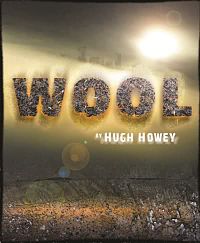
Previously self-published e-books Wool, Wool 2, Wool 3, Wool 4, and Wool 5, make up this 500+ page compilation by author Hugh Howey. It is no small undertaking to read; however, it was well worth it. After piddling slowly through the first book (originally a 40 page short story), I got a notice from the library that it was due and could not be renewed, so I read all day yesterday until 2:30 this morning to finish. In a post apocalyptic future, several thousand people are living in a cement silo that bores nearly 150 stories into the ground. Goods and information and bodies are all moved via a single spiral staircase. The various levels contain a handful of administrative offices (mayor, sheriff, deputies), a few cafeterias, clinics/nurseries, hydroponic farms, animal pens, fabrication facilities, IT, and in the lowest levels is "Mechanical" where are found the oil well, the mines, the generator, the pumps, and the people who maintain them. We open the story with a ritualized death by Cleaning. No one is allowed to say anything about the outside--wondering about it or voicing a desire to go there. The only view of the bleak and utterly desolate remains of earth (presumably) come from sensors that extend above the ground. Large screens on the top floor of the silo show this view in the cafeteria, and in the holding cell of the jail. Whenever someone is convicted of any crime, they are given wool pads, a suit to protect them from the toxic air, sent outside to clean the sensor lenses. In living memory, no one has ever returned from this task. the view of the sere brown hills, and the skeletal city remains in the distance is punctuated by the decomposing bodies of those sent out to clean. When a popular and long-standing sheriff volunteers to go "out," the Mayor and deputy sheriff seek a mechanic from the "down-deep" to replace him. Reluctant new sheriff Juliette is obsessed with finding out why Sheriff Holston voluntarily went outside to his death. Since it turns out that IT, not the popularly elected Mayor has secretly been running the whole show in the silo, they quickly determine that Juliette is a menace and must die. Before she is sentenced to clean, however, she figures out that IT has been engineering the deaths of people and through close friends in Mechanical she gets a suit that does not fail and walks out of view over the hills where she discovers another silo. This is a well-developed plot with interesting characters, and my only niggling complaint is that we are supposed to believe that it gets colder the further down you bore into the earth--probably not! Otherwise, the science seems realistic and the resolution is satisfying. Other post-apocalyptic novels I have enjoyed include The Postman (Brin), Into the Forest (Hegland), and A Gift Upon the Shore (Wren)--almost all set in the Pacific Northwest. Now there is something to ponder.
Thursday, December 26, 2013
The Circle

Monday, December 16, 2013
The Gunslinger: The Dark Tower I
Monday, December 9, 2013
Cinder

It would be bad enough losing your shoe at the ball, but to lose your whole foot!--Now that would be seriously problematic. Marissa Meyer has written a futuristic version of Cinderella with a cyborg (human being augmented by mechanical/electrical parts) as her heroine, Linh Cinder of New Beijing. Set in a future after World War IV, the world has reassembled into 6 political units, with the Eastern Commonwealth being one of them. Cinder lives here with a nasty step-mother, two step-sisters, Pearl and Peony. Only Peony and the family droid, Iko, seem to have any affection for Cinder. Step-mother Adri blames Cinder for the death of her husband, who insisted they adopt Cinder after her life-saving surgery. But cyborgs are treated as 2nd class citizens on Earth, and in spite of Cinder's uncanny skills repairing anything mechanical or electrical--skills that provide the family's only income--Adri and Pearl are embarrassed about being associated with Cinder. Plans are underway to attend the annual palace ball when Peony contracts the plague that has been devastating the earth's population in recent years. Cinder gets the blame for that as well, and Adri "volunteers" Cinder to be a subject for unfailingly fatal research on antidotes for the plague. But Cinder does NOT die, and a whole new set of problems now present themselves. Of course the parallel storyline is that the somewhat unorthodox Prince Kai has personally brought his royal droid to Cinder for repairs, claiming it is a matter of national security. The emperor has contracted the plague and if he dies, Kai will become Emperor. The Queen of Luna would very much like to get a foothold on earth through a marriage to Kai, but nobody on earth really wants that to happen. Then she offers a cure for the plague--the day after the Emperor dies. There is clearly a sequel(s) in the works, as Cinder warns Prince Kai of an imminent threat to his life, but forfeits her own freedom, and possibly her life, in the process.
Wednesday, December 4, 2013
The Paris Architect
Author Charles Belfoure is a real live architect so his perspective on German-occupied Paris during the early 1940's reflects his passion for the buildings and the structure of the city itself. Lucien, a struggling architect who sat out France's defense at the Maginot Line, which the Germans adroitly circumvented, does not consider himself to be a brave man or a fool. And only one or the other would choose to have anything to do with Jews at this point in time when the Gestapo are relentlessly hunting them down and shooting anyone who even lives in the same building as a Jew. When Manet, an aristocrat turned industrialist, comes to Lucien asking him to devise a hiding place that can't be found by the Gestapo, Lucien turns him down flat. Manet, however, promises not only a sizable sum of money, but the opportunity to build his next big factory, which at this time in the war, would be providing armaments for the Germans. Lucien is a modernist, a fan of Gropius and the Bauhaus movement, hence much reviled in a city that reveres classic architecture. He agrees more out of a desire to get his big break and do something that will demonstrate his talent, although the money does allow him to buy scarce food on the black market. Swearing each time that it will be his last, Lucien continues to build cleverly disguised hiding places, outwitting the Gestapo, and so becoming their target. With his marriage already on the rocks, Lucien's wife leaves him, accusing him of being a collaborator--an architect who has sold his soul to the devil. His denial and revelation that he has been helping hide Jews only adds to her scorn. Even Lucien's beautiful mistress, Adele, has abandoned him in favor of a powerful member of the Gestapo who can get scarce fabrics to supply her fashion design business. Because of Lucien's activities, a Catholic priest who has been aiding Jewish children, brings a boy to him, ostensibly for a short time, but the priest is captured and disappears forever into Gestapo headquarters. Lucien finds he likes being a surrogate father for Pierre. Bette, Adele's second in command, it turns out, is also hiding Jewish children, and when Lucien designs a hiding place in her apartment that saves their lives, she falls fully in love with him. As the noose draws tighter, Lucien's unlikely friendship with a German engineer buys him the resources to escape across the Swiss border with Bette and the 3 children. I thought the writing at times was a bit clunky, and the ending way too tidy, although goodness knows there was plenty of torture and violence prior to this. The book is most interesting for its portrayal of neighbor turning against neighbor when fear is expertly manipulated. There is a map in the front material so you can follow the action through the streets of Paris.
Labels:
architecture,
France,
historical novels,
Jews,
Paris,
thriller,
WWII
Friday, November 22, 2013
The Cuckoo's Calling
Robert Galbraith--apparently a pseudonym for J.K. Rowling--has written a private eye story with a somewhat curmudgeonly protagonist, Cormoran Strike. Cormoran is the illegitimate son of a famous rock star, for all the good it's done him. His mother died of a drug overdose and Cormoran isn't entirely sure it was accidental as ruled at the inquest. That might fuel his willingness to take on re-investigating the apparent suicide of mixed race beauty and super-model, Lula Landry, known as Cuckoo by one of her closest friends. Lula's brother, John Bristow (Lula was adopted into a wealthy family as a baby), hires Strike, ostensibly because he believes Lula was murdered. Strike is a veteran of the Afghan wars where he lost a leg. And now he has had a royal bust-up with on-again, off-again girlfriend, Charlotte, and is living on a camp cot in his rather dismal office. When a temporary receptionist shows up on Monday morning, Strike tries to send her away, but Robin has always secretly harbored a wish to be a PI and she won't leave, even though her
fiancé is not happy about this assignment.
Strike sets out to interview anyone who knew Lula, which is often harder than it should be as people are hard to find or reluctant to talk. When one of Lula's stranger companions, a down and out young woman Lula once met in drug rehab, is found drowned in the Thames, Strike is more convinced than ever that Lula was murdered and now he has a good idea who the killer is. But convincing the police to take action before another murder occurs, especially after they have already ruled this a suicide, is an uphill battle, and Strike finally resorts to making himself the bait in a deadly game of cat and mouse. This is a sometimes slow moving book, and if you are expecting something like Harry Potter, you will surely be disappointed. But the characters are complex and competently drawn. The writing is visual and authentic and will certainly satisfy lovers of the genre who come with no preconceptions.
Monday, November 18, 2013
Lawrence in Arabia: War, Deceit, Imperial Folly and the Making of the Modern Middle East
Quite
unlike me to read two non-fiction books in a row, but this book by
Scott Anderson received excellent reviews, including in the NYT Sunday Book Review.
It is a fascinating story about four players in the Middle Eastern
theatre of WWI, although mostly focused on T.E. Lawrence. The others
were: the American William Yale (yes THAT Yale family) who was
manipulating events to get oil concessions for Standard Oil; Aaron
Aaronsohn, a Jewish agronomist, who occasionally worked for the Turkish
government, but whose driving goal was a homeland for the Jews--to which
end he set up a Jewish spy ring informing the British; and Kurt Prüfer,
German spymaster. Lawrence is a particularly complex character and yet
seemingly the only one of the four who had any significant degree of
understanding of and empathy for the native peoples of the region. The
countries involved in this war, and those who made the big decisions,
are shown as largely either clueless, incompetent, egomaniacal, racist,
classist, self-serving or all of the above. Working for British
intelligence services in Cairo, Lawrence repeatedly tried to guide war
efforts to maximize on resources on the ground, and minimize losses. He
was continually ignored. Gallipoli is one astounding example of total
and continuing military incompetence that cost nearly half a million
lives. Finally Lawrence began ignoring orders more blatantly, revealing
secret information to his Arab allies about the Entente's multiple acts
of deceit. He worked with the Arab approach to fighting to eventually
become one of the most devastating destructive forces against the
Ottoman Empire and the Central Powers in that part of the world. By many
of the higher ups in the British military and government, however,
Lawrence was never seen as more than an insubordinate meddler.
I
actually had to return the book or face a fine but will recheck it to
finish the last few chapters I missed. Whether or not you are a history
buff, this book is worth reading to increase one's understanding of how
the rest of the world (Europe, England, Russia, the U.S.) has been, for
the last 100 years, mucking around with the Middle East . No wonder they
distrust, dislike, and even hate us; we have never acted in their
interest, only for our own. I consider it a gross oversight on
Anderson's part not to have had any discussion of Gertrude Bell, who was also a major player in the Middle East around this time, and had dealings with Lawrence.
Subscribe to:
Posts (Atom)


